
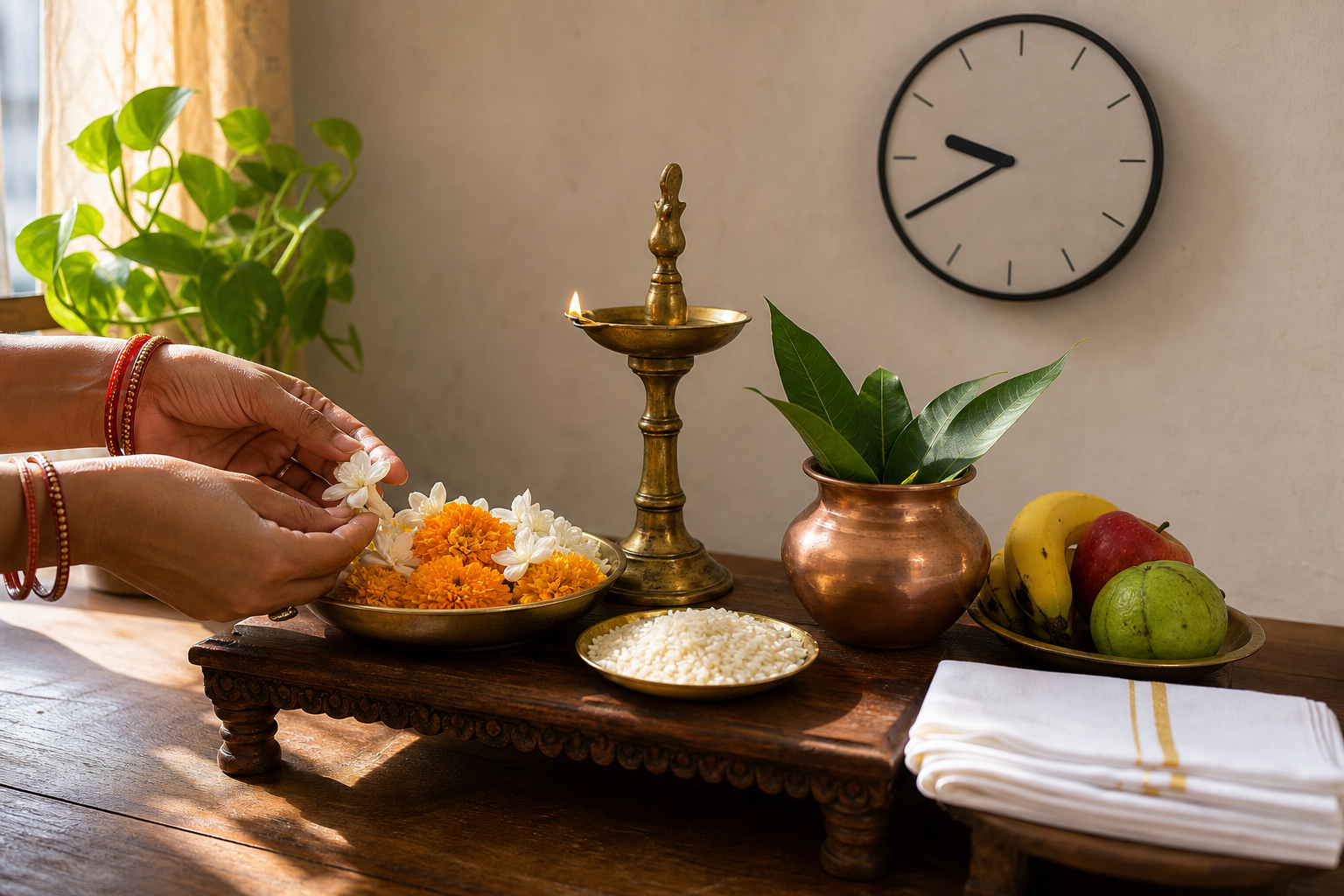
If you are deciding when to perform puja, make a sankalpa, or set aside time for seva on Monday, December 22, the date cannot be treated as one continuous tithi. The lunar day changes during the morning, so divide your plan at that boundary.
You can keep the observance simple: let Dwitiya provide a quiet reset, then let Tritiya carry the day’s deliberate work. A detailed local Panchang becomes essential only when a rite depends on an exact tithi, muhurta, Nakshatra, or other regional timing.
The day divides at the Dwitiya-Tritiya boundary
Monday, December 22, 2025, holds Shukla Paksha Dwitiya until 9:40 AM and Shukla Paksha Tritiya after that boundary. Dwitiya is the second lunar day of the waxing fortnight; Tritiya is the third. Unlike a civil date, a tithi is not compelled to begin at midnight, which is why one Monday can contain both.
| Part of the day | Prevailing tithi | Practical emphasis | One concrete action |
|---|---|---|---|
| Before the stated 9:40 AM boundary | Shukla Dwitiya | Renewal, balance, gratitude, and household harmony | Light a lamp, recite an established mantra, and express gratitude to someone in your home |
| From the stated 9:40 AM boundary onward | Shukla Tritiya | Initiative, learning, skillful effort, and community-minded action | Begin one defined task, undertake focused study, or arrange seva or daana |
Use 9:40 AM as the stated working reference, not as a universal clock time for every city. The transition is astronomical, but its wall-clock label changes with the time zone, and regional Panchang information is prepared for a locality. If the Panchang for your actual place gives a different time, follow that local calculation.
A simple observance that follows both tithis
You do not need to fill the day with ceremonies to respect its rhythm. Give each tithi one clear expression and carry the resulting disposition into ordinary work.
- Decide whether precision is necessary. A brief home prayer can follow the general two-part pattern. A formal sankalpa, prescribed vrata, temple rite, or time-sensitive daana deserves a local timing check before you begin.
- Use Dwitiya for a quiet reset. While Dwitiya prevails, light a lamp, use the mantra already established in your household or sampradaya, and sit briefly with gratitude. Make renewal tangible through one act that supports family harmony: offer thanks, speak without irritation, or resolve a small misunderstanding.
- Turn Tritiya into purposeful movement. Once your local Panchang shows Tritiya, choose one piece of learning, skillful work, or community help. Define the first action instead of holding only a broad intention: open the text and study, begin the postponed task, contact the person you can assist, or prepare the daana you intend to give.
- Close with steadiness. A short period of mindful breathing or meditation can help you notice whether the morning’s clarity actually shaped your later conduct. The measure is not how elaborate the observance looked, but whether it produced more disciplined and considerate action.
If a light vrata is already part of your tradition, the Dwitiya period can support it. The date and tithi alone do not establish the vrata’s food rules, mantra, deity, or method of completion, however. Follow the practice transmitted by your family, temple, guru, or sampradaya rather than improvising ritual requirements from a calendar entry.
Localize any timing-sensitive rite before making a sankalpa
The 9:40 AM transition is enough for a general devotional plan, but it is not enough to calculate every auspicious or inauspicious interval. If your intended act depends on exact timing, check a trusted regional almanac or temple calendar for the place where the act will occur.
- Set the correct locality and time zone. Do not reuse the clock from another city, from India while you are abroad, or from the place where a journey began.
- Confirm the local sunrise and tithi-ending time. This tells you which tithi prevails when you begin and whether the 9:40 AM reference needs adjustment for your location.
- Look up the particular intervals your tradition uses. A regional Panchang should supply Abhijit Muhurat, Amrita Kalam, Rahu Kalam, and Yamaganda when those factors matter to the planned rite.
- Verify Nakshatra and the Moon’s Rashi separately. Their calendar presentation depends on the time and place of observation. Do not copy an unverified value merely to complete a sankalpa.
- Follow the officiating tradition. If a priest or temple has prescribed a procedure, use the calendar and conventions governing that rite rather than combining details from unrelated Panchangs.
Nakshatra and Rashi can refine an observance, but they are optional for the simple practices described here. Missing those details need not stop you from lighting a lamp, reciting a familiar mantra, meditating, practicing non-harm, or serving another person. When the calendar cannot be verified, sincerity, steadiness, and ethical restraint are safer guides than invented precision.
Keep shared dharmic values without flattening traditions
Shared dharmic ground does not require identical ritual forms. Hindu, Buddhist, Jain, and Sikh paths can meet in compassion, discipline, service, and mutual respect while retaining their distinct calendars, teachings, and modes of worship.
If your household or community includes more than one dharmic tradition, make the common part ethical rather than artificially uniform. Each person can maintain the practice proper to their path while joining in daana, helping a neighbour, mindful speech, or community service. That approach honours unity without erasing difference.
Key takeaways
- December 22, 2025 is Monday and contains two waxing-fortnight tithis: Shukla Dwitiya before the stated 9:40 AM boundary and Shukla Tritiya afterward.
- Use Dwitiya for a lamp, familiar mantra, gratitude, light vrata where customary, and a concrete gesture of household harmony.
- Use Tritiya for focused learning, skillful work, a new practical step, seva, or daana.
- Treat 9:40 AM as a reference that must be localized when you are travelling, living outside India, or undertaking a timing-dependent rite.
- Check a trusted regional Panchang for sunrise, exact tithi ending, Nakshatra, Rashi, Abhijit Muhurat, Amrita Kalam, Rahu Kalam, and Yamaganda when those details are required.
- When elaborate timing is unnecessary or unavailable, preserve the day through sincere worship, non-harm, disciplined effort, and service.
For an observance on this date, write two lines in your calendar: the verified local transition time and the one purposeful action you will begin under Tritiya. That is enough structure to let the Panchang guide your conduct without allowing the clock to overwhelm devotion.
References
