
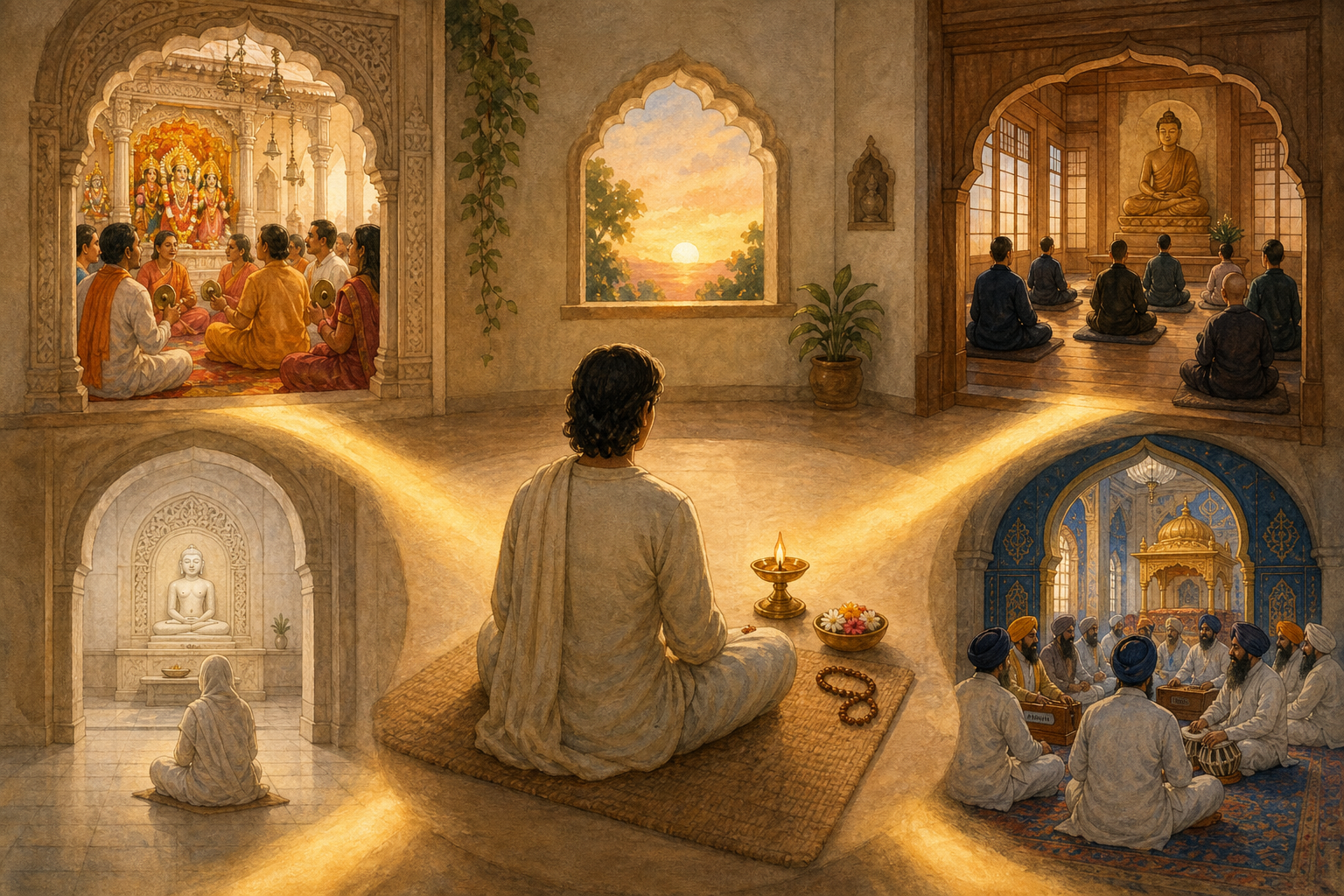
You may feel at home in Hindu kirtan, become still while hearing a Buddhist mantra, admire Jain ahiṃsā, and be moved by a Sikh shabad. Then comes the practical question: how do you honour that kinship without turning distinct traditions into a spiritual mixture?
Build your practice around one clear centre. Let neighbouring Dharmic traditions refine how you listen, serve, restrain the ego, and regard the living world. You can recognise a family resemblance without pretending that every path worships the same way or makes the same theological claims.
Begin with a centre, not a blend

A durable devotional life needs an answer to a simple question: what are you actually practising? Admiration is not yet practice. A playlist assembled from several traditions may create a mood, but it cannot supply the discipline, interpretation, or accountability that a living path provides.
Start with the tradition to which you already owe fidelity. That may be the sampradāya in which you received a mantra, the gurdwara and sangat with which you worship, the Buddhist lineage whose method you have been taught, or the Jain framework that guides your vows and reflections. If you have no settled affiliation, choose one practice to study seriously before combining elements from several.
| Tradition | A devotional emphasis | What you should preserve |
|---|---|---|
| Hindu traditions | Bhakti may be cultivated through aarti, nāma or mantra, kirtan, pūjā, and relationship with a chosen form or name of the Divine. | Keep the deity, mantra, ritual, and sampradāya context connected. Do not reduce sacred names to interchangeable sounds. |
| Sikhism | Shabad and kirtan orient the devotee toward the formless One, while remembrance is joined to sangat and sewa. | Keep the words rooted in the Guru Granth Sahib and Sikh communal life. Do not recast Nirankar as merely another personal deity. |
| Buddhist traditions | Mantra recitation can train recollection, attention, and a mindful cadence within a particular Buddhist path. | Learn what the mantra means and how its lineage uses it. Do not impose a creator-God theology that the practice does not claim. |
| Jainism | Anuprekṣā, reverence, and recollection can cultivate inner clarity, restraint, and ethical poise. | Do not assume that devotional reverence amounts to creator worship. Let ahiṃsā and disciplined conduct remain decisive. |
This distinction protects both commitment and hospitality. You do not honour Sikh kirtan by calling it Hindu bhajan under another name. You do not honour Jain devotion by treating a Jina as a boon-granting creator. You do not honour Buddhist mantra by detaching it from its method. Nor do you understand Hindu bhakti if every iṣṭa-devatā becomes a generic symbol stripped of sacred relationship.
Use this sequence to establish your centre:
- Name the path whose teachings will interpret your practice.
- Select one authorised or well-established form: a mantra, nāma, shabad, prayer, hymn, aarti, or contemplation.
- Learn its words, meaning, customary setting, and the conduct expected of someone who recites it.
- Give it a dependable cue in your day, such as waking, bathing, lighting a lamp, beginning work, or preparing to sleep.
- Stay with it long enough for repetition to expose distraction, impatience, pride, and resistance.
- Take questions to a knowledgeable teacher or community rather than solving every uncertainty through private improvisation.
The point is not to construct the most varied routine. It is to become answerable to what you repeat.
Give sacred sound a job beyond creating atmosphere

Mantra and kirtan travel easily because melody lowers the threshold for participation. That is a strength, but it also creates a temptation: sacred sound can become background music, cultural decoration, or a performance that leaves the listener unchanged.
A 2014 invitation at Antwerp’s Lotto Arena moved thousands of pop listeners from spectatorship into a Hare Krishna response. Its simplicity mattered. The audience did not need a lengthy lecture before participating, and call-and-response replaced passive consumption with shared attention.
You can use the same structural insight without confusing accessibility with equivalence. Sacred sound works through repetition, attention, meaning, and participation. The setting may change, but those functions should remain visible.
- Before recitation: recall whom or what the words address. If you do not know, find out before making the phrase part of your routine.
- During recitation: listen as closely as you vocalise. Speed, volume, and musical polish are secondary to recollection.
- After recitation: leave a brief interval without speech or another recording. Notice whether attention has gathered or merely been stimulated.
- After the practice: attach one act of conduct to the remembrance. Speak truthfully in the conversation you were avoiding, serve someone without display, or refrain from a needless injury.
When you lead chanting in a mixed or public setting, make the invitation explicit and non-coercive. Say what is being recited, identify its tradition, and allow people to listen without joining. Do not promise that participation makes someone a convert, and do not claim that every religion secretly means the same thing. Hospitality becomes more credible when consent and difference are respected.
There is also a useful test for performance. If the melody grows more elaborate while the words become less intelligible, pause and restore the text to the centre. Musical beauty can carry devotion, but it should not conceal the object of devotion.
Let cosmic worship change how you see ordinary things

Devotion does not always require adding another object, lamp, or ceremony. Sometimes it asks you to perceive what is already present more truthfully.
Guru Nanak’s Gagan Mai Thaal, preserved in the Guru Granth Sahib, presents the sky as the aarti platter and the celestial lights as lamps. The imagery directs reverence toward the formless One whose presence is not confined to a human arrangement of ritual objects. The cosmos is not scenery surrounding worship; it becomes the field in which worship is recognised.
You can contemplate this vision without pretending that Sikh teaching and Hindu temple aarti are identical. The productive question is not which ritual cancels the other. It is whether your ritual has trained you to recognise sacred significance beyond the ritual space.
Try a creation-facing examination before or after your established practice:
- Attend to one element already involved in worship: water, flame, fragrance, food, earth, air, or open sky.
- Notice the dependence hidden inside it. Water reaches you through a living world and human labour; food joins soil, weather, seed, animal life, and hands.
- Name the ethical demand that follows. Reverence for water is contradicted by careless waste. Offering food is contradicted by indifference to hunger. Praise of creation is contradicted by casual harm to living beings.
- Complete one fitting act of care while the contemplation is still fresh. Repair the waste you noticed, share the food, clean the place, or reduce the injury within your control.
This keeps cosmic language from floating above daily life. Awe becomes stewardship; gratitude becomes restraint. The practice also gives adherents of different Dharmic paths a genuine meeting point. Vedic reflections on cosmic order, Sikh praise of Nirankar, Buddhist attention to interdependence, and Jain ahiṃsā need not be declared identical before they can deepen responsibility toward life.
Test devotion where conduct and community can correct you

Private feeling is easy to misread. A moving chant can leave you convinced that you have become humble, while the people around you continue to meet your impatience. Dharmic practice therefore needs an ethical test and, where the tradition provides it, a community that can challenge self-deception.
Sikh devotional life makes the connection especially plain by joining remembrance to sewa, sangat, and fearless truth-telling. Song does not excuse withdrawal from public responsibility. Congregation is not merely an audience; it is a setting in which devotion becomes service, belonging, and moral courage.
Other Dharmic disciplines apply their own tests. Bhakti should soften possessiveness and redirect action as an offering. Buddhist recitation should support attention and compassion rather than spiritual vanity. Jain reflection should sharpen restraint and ahiṃsā. These are related ethical movements, but each remains accountable to its own teaching.
Ask these questions after practice, when your answer can still change what you do:
- Did remembrance make the next truthful action clearer, or did it help me avoid that action?
- Has devotion produced service that another person or living being can actually receive?
- Am I more restrained in speech, consumption, and anger, or only more certain of my identity?
- Do I treat fellow practitioners as a sangat, saṅgha, or community of discipline, or as an audience for my piety?
- When I borrow from a neighbouring tradition, have I listened to how its own adherents understand the practice?
- Can I explain the difference between respect for another path and claiming its practices as my own?
Do not use comparison to rank which tradition is most compassionate, musical, rational, or universal. Use comparison to find your blind spot. Hindu ritual precision may expose the casualness of your attention. Sikh sewa may expose devotion without service. Buddhist mindfulness may expose mechanical repetition. Jain ahiṃsā may expose the injuries hidden inside ordinary habits.
When visiting another community, enter as a guest. Follow the rules of the sacred space, join only where participation is invited, and ask about meaning after listening. If a practice moves you deeply, resist the urge to extract it immediately for personal use. Appreciation can mature into study; it does not need to become possession.
Key takeaways
- Choose one home discipline to supply meaning, continuity, and accountability.
- Recognise shared forms such as song, repetition, remembrance, contemplation, and service without declaring their theologies interchangeable.
- Keep sacred sound connected to its words, object, lineage, and ethical purpose.
- Let reverence for creation produce a visible act of care, restraint, or service.
- Measure devotion by truthfulness, ahiṃsā, compassion, humility, and responsibility, not by emotional intensity alone.
- Approach another Dharmic tradition as a respectful guest before adopting anything from it.
At your next regular practice, make one clean commitment. Recite or sing the form rooted in your path, listen to what it asks of you, and carry it into one concrete act before the day closes. Once that centre is steady, encounters with other Dharmic traditions can enlarge your reverence without dissolving anyone’s distinct voice.
References
- Dandavats – Electrifying Bhakti on a Pop Stage: Jayadev John Richardson’s Hare Krishna Call in Antwerp
- SikhNet – Gagan Mai Thaal: Guru Nanak’s Vision of Cosmic Worship
- SikhNet – The Sikh Spectrum Released at Khalsa College, Amritsar
