
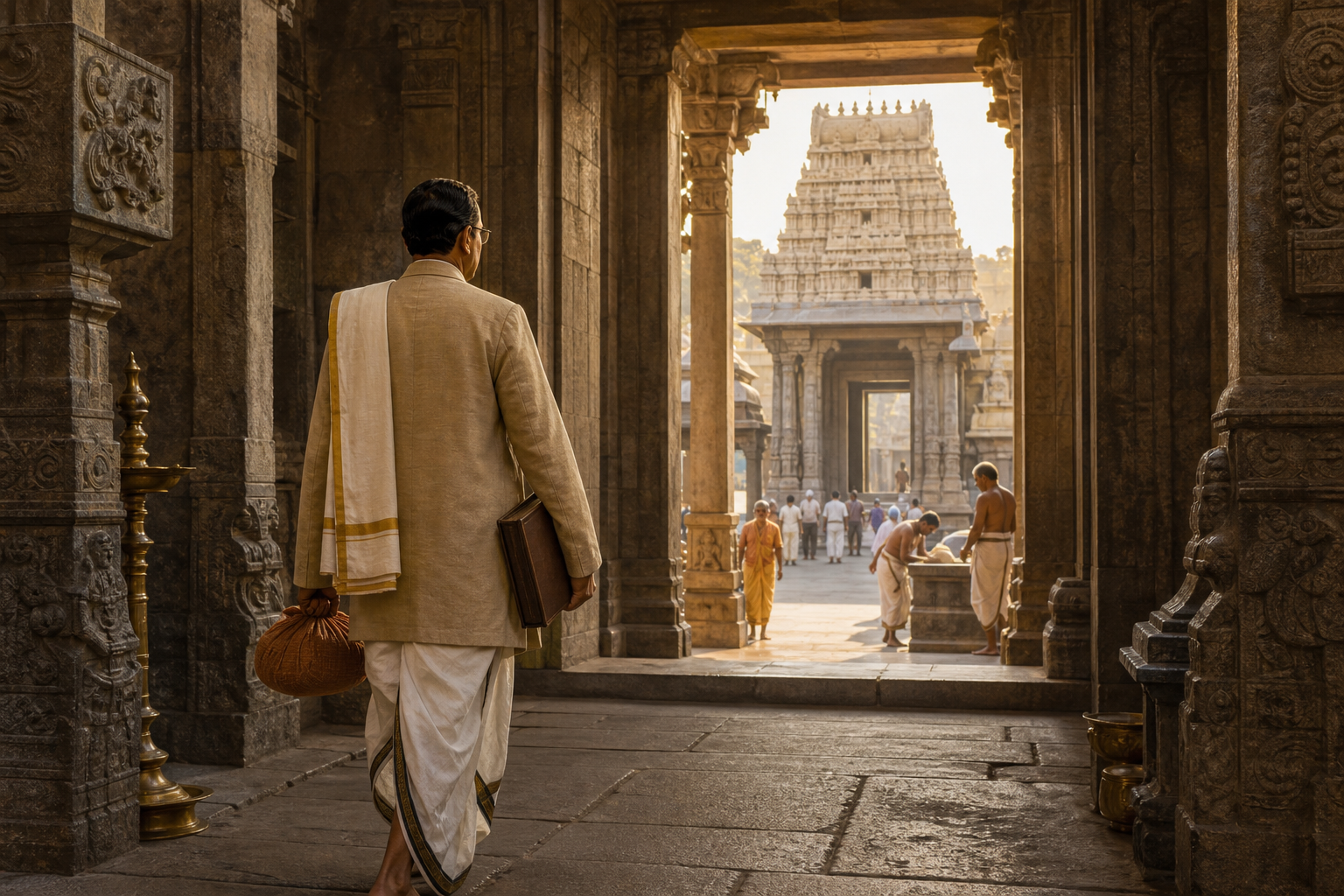
If you know Tirumala mainly through darshan, festivals, and devotional literature, Sadhu Subramanya Shastri’s name may seem like a footnote. It should instead change how you understand the temple. His life points to the disciplined work that allows a sacred institution to preserve knowledge while serving generation after generation.
Shastri served as the First Peishkar of the Tirumala temple and is remembered for important translation work. Those two facts belong together. They show that Tirumala’s continuity has depended not only on visible worship, but also on administration, language, documentation, and the patient transmission of inherited knowledge.
His legacy rests on two connected forms of seva
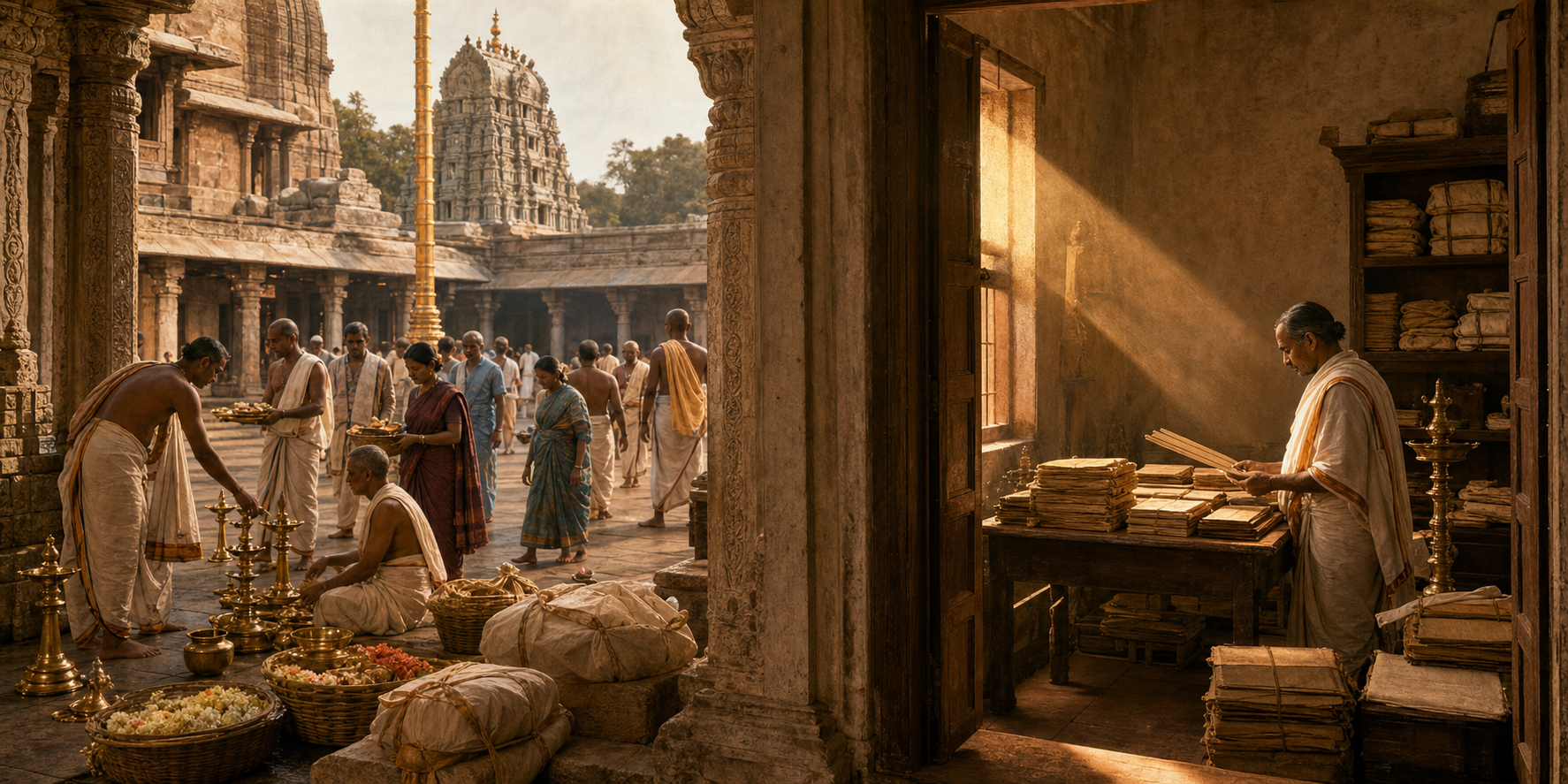
The title First Peishkar places Shastri within Tirumala’s administrative history. It marks a distinctive institutional role, but the title alone does not establish the dates of his service, his complete responsibilities, or the extent of his authority. A careful remembrance begins with what is known and does not manufacture a fuller biography merely because the surviving outline is brief.
Even that brief outline is significant. Administration in a temple is not an activity outside the sacred sphere. Worship must be supported by people who coordinate responsibilities, preserve institutional memory, communicate decisions, and maintain continuity. When that work is performed with discipline and humility, it becomes seva: ordered service directed toward a purpose larger than the officeholder.
Shastri’s translation work represents a second kind of continuity. Knowledge can survive physically and still become inaccessible when later readers cannot understand its language or context. Translation helps carry meaning across that boundary. It allows sacred or institutional learning to enter another community of readers without requiring the original material to disappear.
The administrative and scholarly duties therefore reinforce one another. Administration without intelligible knowledge can become a set of procedures whose purpose is forgotten. Translation without careful institutional custody can lose its provenance, context, or connection to a living tradition. Shastri’s Tirumala legacy lies in the meeting of these responsibilities.
This is also where accuracy matters. Do not attach particular titles, languages, manuscripts, or editions to Shastri’s name unless you can point to a catalogue, archival record, or published edition that establishes them. Saying that his translations aided preservation and access is warranted. Supplying an undocumented list of works is not. Respect for an ancestor of learning includes respect for the limits of the record.
Translation is temple seva, not merely literary work

A translation associated with a sacred institution has at least three responsibilities. It must remain answerable to the source, become intelligible to its intended readers, and preserve enough context for later generations to evaluate it. These responsibilities are not fulfilled by replacing unfamiliar words with easy ones. Dharmic terms often carry philosophical, ritual, and cultural associations that no single substitute can contain.
That gives you a practical test whenever you encounter a translated temple text. Look for the identity of the original work, the language from which it was translated, the translator’s name, and the edition or manuscript used. Check whether difficult terms are retained or explained rather than silently flattened. A translation becomes more useful when the reader can trace its relationship to the original.
Preservation and accessibility are sometimes treated as competing aims. They need not be. You can preserve the original wording, script, and provenance while also providing a translation, glossary, or explanatory note. The original protects continuity; the translation widens participation. The sound approach is to keep both within reach.
Shastri’s remembrance encourages this larger view of scholarship. A translator does not simply produce a second text. The translator serves as a custodian at a point of passage, helping knowledge cross a linguistic boundary without severing it from its origin. In a temple ecosystem, that labour supports devotees, students, administrators, and future custodians alike.
Why temple administrators belong in sacred memory
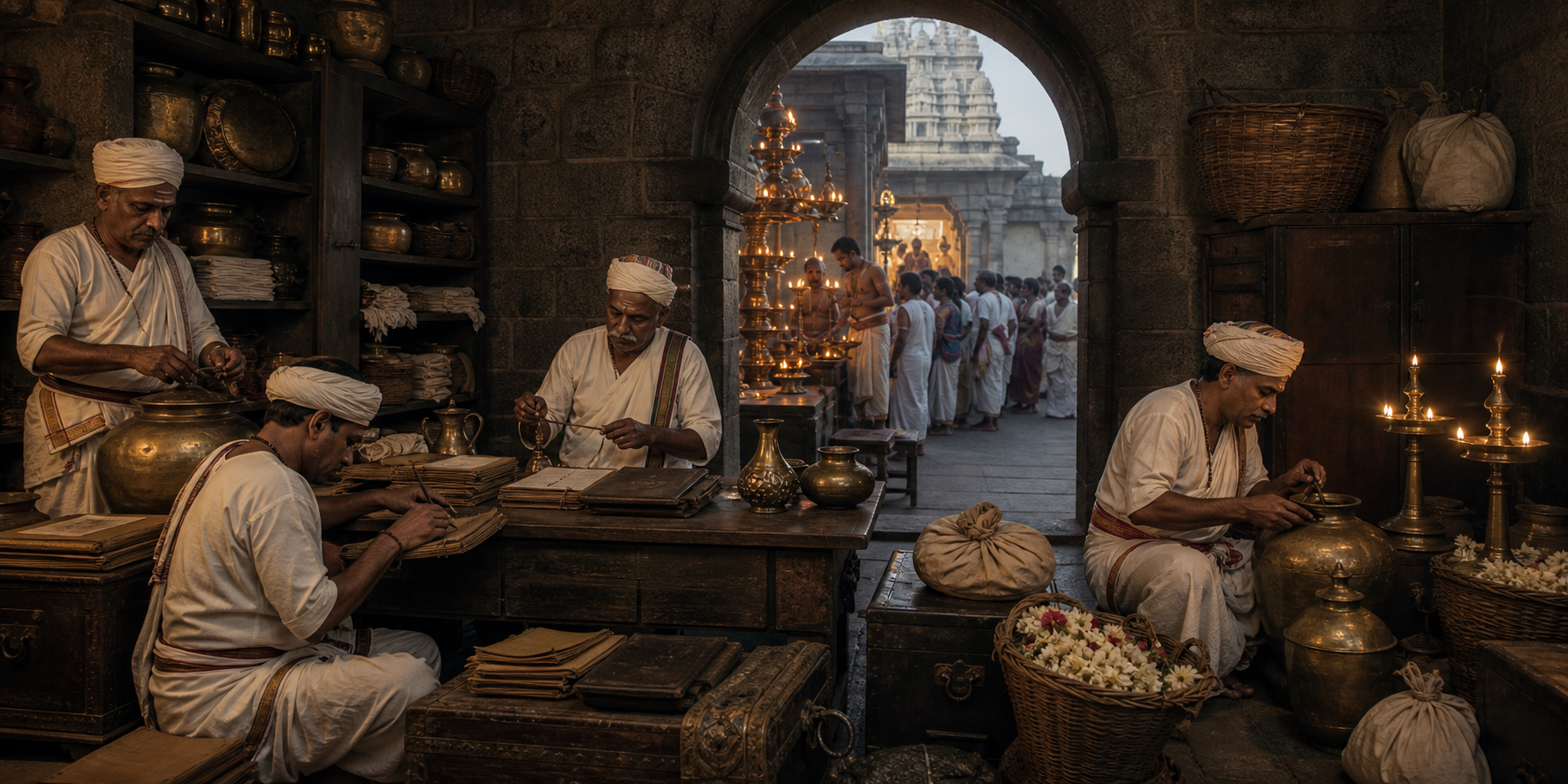
Temple history is often told through deities, acharyas, poet-saints, patrons, architecture, and major festivals. All deserve attention. Yet a living temple also depends on functionaries whose names may never become familiar to most pilgrims. They sustain the conditions within which worship, learning, and community participation can continue.
Remembering Shastri as the First Peishkar corrects that imbalance. It asks you to notice the people who convert reverence into dependable institutional practice. Their contribution may be less visible than a composition or monument, but invisibility is not insignificance. A temple cannot carry its inheritance responsibly if knowledge, duties, and decisions are allowed to become disorderly.
TTD gave this connection institutional expression when it scheduled Shastri’s 137th birth-anniversary commemoration for 17 December 2025 at Annamacharya Kalamandiram in Tirupati. The programme was placed under TTD’s Hindu Religious Projects and Annamacharya Project, bringing administrative memory into a setting concerned with religious and cultural preservation.
That pairing should be interpreted carefully. It shows how TTD chose to frame the commemoration; it does not, by itself, prove that Shastri translated a particular Annamacharya work. What it does establish is a valuable institutional principle: temple functionaries, translators, literary traditions, and devotional communities all participate in the stewardship of a living heritage.
When you see a Jayanthi notice, therefore, do not treat it as calendar filler. Ask three questions: What responsibility did this person carry? What knowledge or practice did that work help preserve? Which part of that responsibility still needs attention now? Those questions turn commemoration from ceremonial remembrance into institutional learning.
Key takeaways for readers and community organisers
- Introduce Shastri with the precise facts: he served as the First Peishkar of the Tirumala temple and is remembered for translation work that supported preservation and accessibility.
- Present administration and scholarship as connected forms of seva. One protects institutional continuity; the other helps knowledge remain intelligible.
- Do not name translations, languages, dates of service, or official duties without a traceable record. Devotional respect does not require biographical embellishment.
- When sharing a translation, retain its provenance: identify the original work, source language, translator, and edition whenever those details are available.
- Use commemorations to recover practical lessons for present institutions, not merely to repeat honorifics or anniversary numbers.
How you can honour Shastri’s legacy accurately
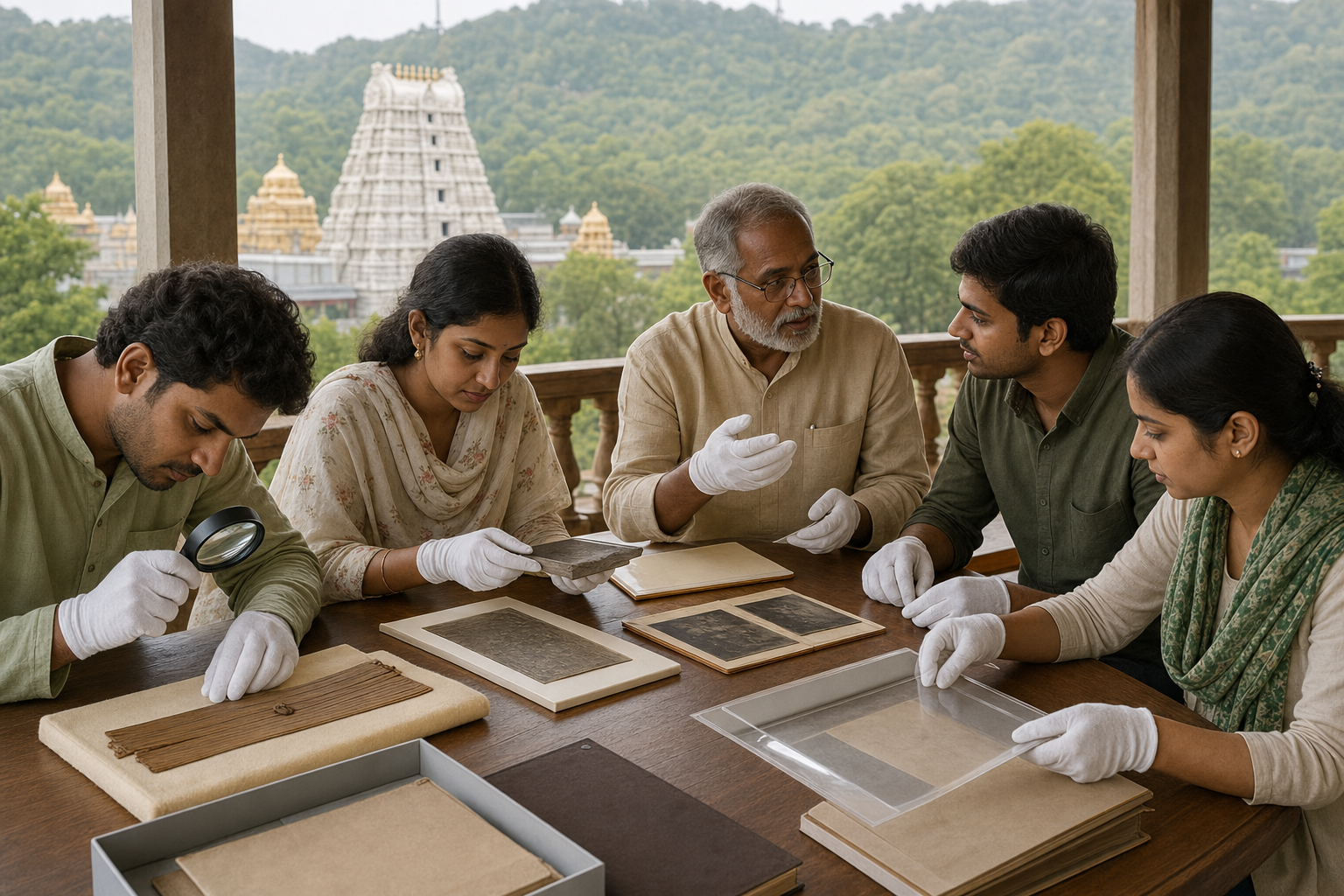
You do not need access to a temple archive to apply the principle embodied in Shastri’s remembrance. You can begin wherever your family, mandir, study group, or cultural organisation handles inherited knowledge.
- Use a minimum verified biography. Record a person’s exact name, role, institution, and documented contribution before adding interpretation. For Shastri, begin with First Peishkar, Tirumala temple, and translation work.
- Mark the boundary between fact and meaning. His combination of administration and translation can reasonably be understood as a model of disciplined seva. That interpretation should not be converted into unsupported details about particular texts or responsibilities.
- Preserve provenance with the material. When digitising a book, copying an inscription, circulating a translation, or preparing a community handout, keep the title page, translator credit, edition information, and source location with the text.
- Keep originals beside translations when possible. A translated version can widen access, but the original enables later readers to check terminology, restore context, and produce better translations.
- Name the people behind continuity. Credit translators, cataloguers, teachers, editors, archivists, and administrators rather than allowing their labour to become anonymous institutional output.
- Turn remembrance into a present duty. At a future Jayanthi or temple programme, ask what records need cataloguing, what texts need responsible translation, and what institutional knowledge is in danger of remaining with only one person.
This approach also carries a wider Dharmic lesson. Across Hindu, Buddhist, Jain, and Sikh traditions, learning is sustained through lineages of practice, teaching, copying, translation, organisation, and service. Different traditions arrange these responsibilities differently, but all depend on people willing to preserve what they received and make it usable without claiming ownership over it.
The next time you visit Tirumala or prepare a cultural programme, look beyond the most visible names. Begin with Shastri’s exact role, resist the temptation to fill archival gaps, and ask how administration and translation can still be practised as seva. That is a more durable tribute than praise alone.
References
