
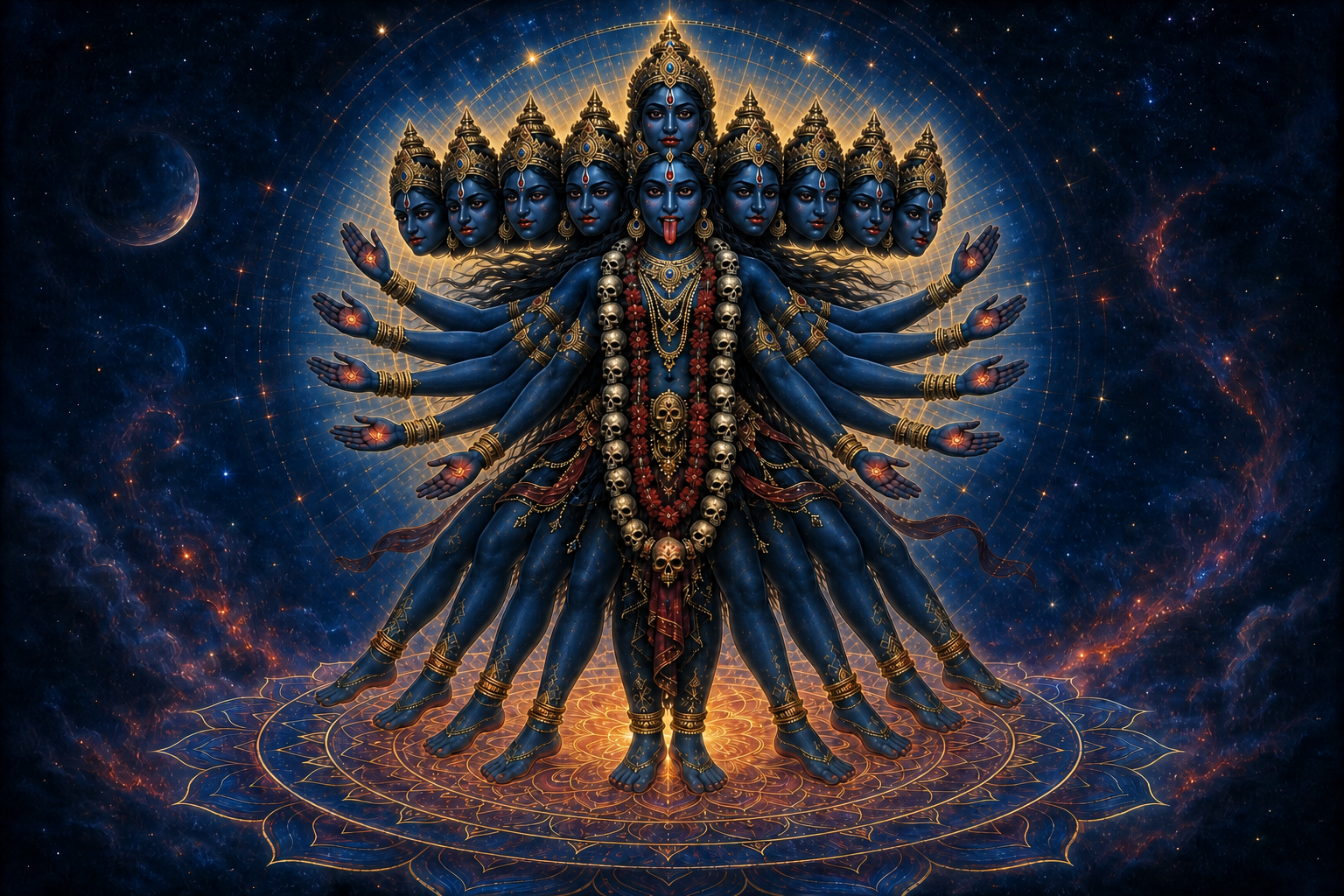
You may be looking at Maha Kali’s ten heads, ten arms, and ten legs and wondering whether the image simply multiplies her ferocity. That reading misses the form’s most useful teaching. Its many directions are not visual excess; they show awareness, power, and responsibility freed from the limits of a single viewpoint.
Read the three features together and the icon becomes practical. The heads ask you to see completely. The arms ask you to respond effectively. The legs ask you to remain steady and accountable wherever that response carries you.
Begin with direction, not multiplication
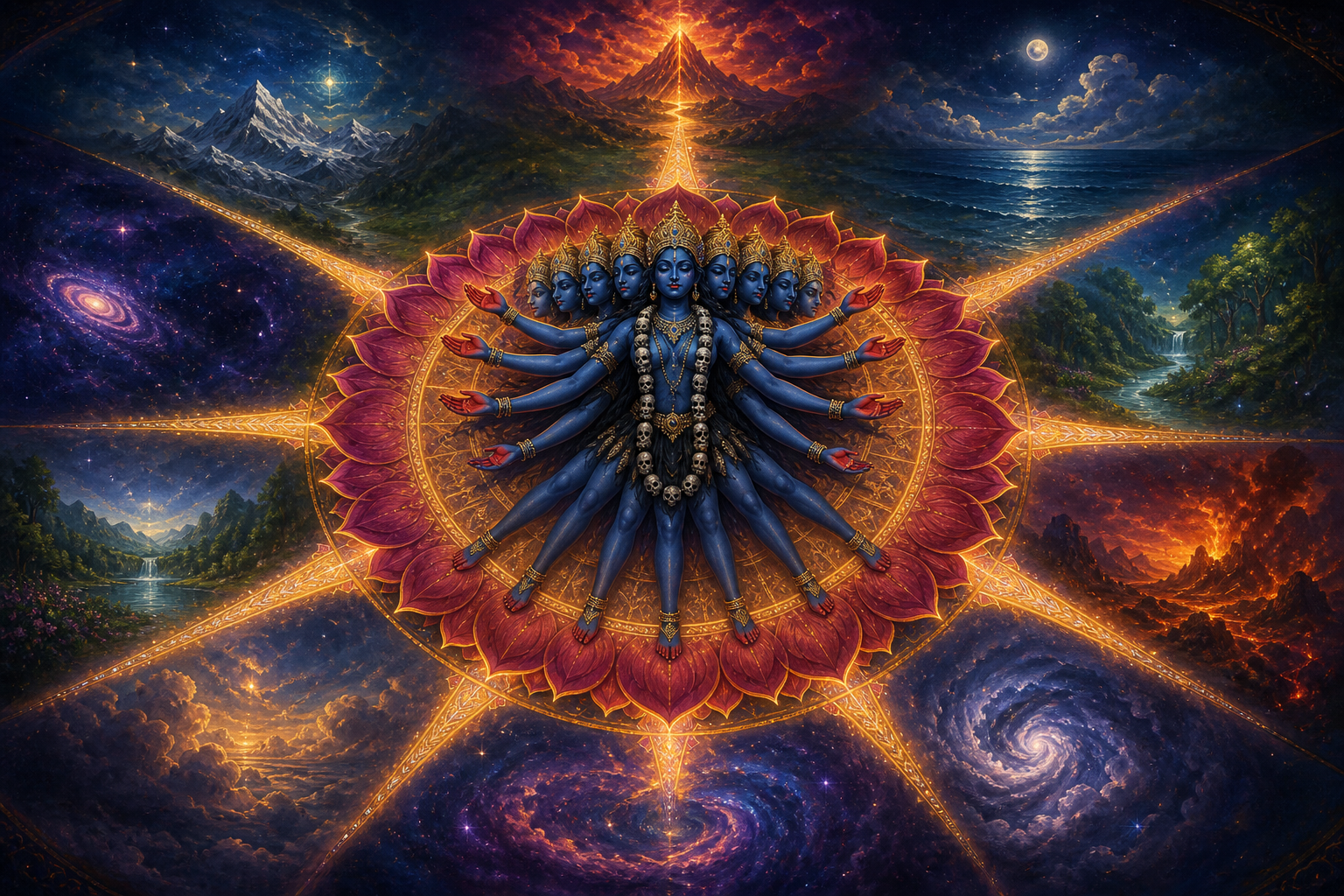
The first mistake is to treat Maha Kali’s features as separate curiosities: ten heads to decode, ten hands to catalogue, and ten legs to explain. The form works more coherently as one multidirectional composition. Repetition gives visible shape to completeness.
The number ten points toward totality through the ten directions, or dasha dik, and the traditional sense of completion associated with ten. Maha Kali is therefore not confined to the direction in which the devotee happens to face her. Her awareness and Shakti extend beyond the observer’s narrow field of vision.
Some practitioners also discern an allusion to the ten Mahavidyas. That is a significant contemplative association, but it should not be turned into a rigid claim that every head always corresponds to one named Mahavidya. This icon appears within several regional and liturgical lineages, so a lineage-specific explanation should remain lineage-specific. Unless your temple or teacher supplies a precise head-by-head correspondence, totality is the sounder interpretive starting point.
This distinction protects you from arbitrary symbolism. You do not need to invent a personality, emotion, or supernatural function for every face. Ask the more demanding question: what would it mean to see, act, and stand without leaving any direction outside dharma?
Read the heads, arms, and legs as one sequence
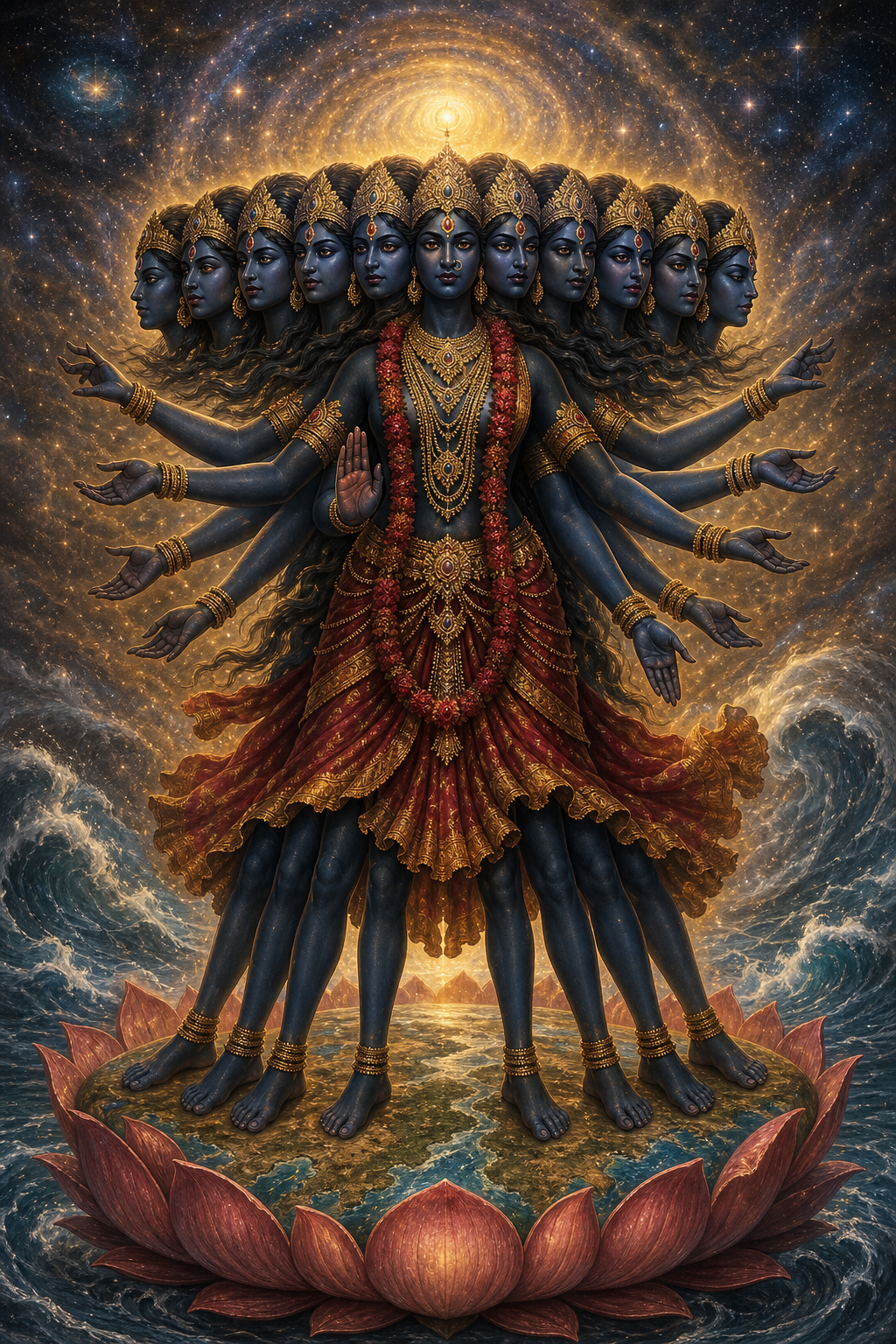
The icon describes a movement from perception to action and then to embodiment. If you isolate one stage, you distort the teaching. Awareness without action becomes detachment from duty. Power without awareness becomes reckless. Movement without a stable ethical ground becomes mere agitation.
The ten heads: widen discernment before deciding
The heads signify complete awareness: the capacity to look beyond one angle, one preference, or one moment. Omniscience is expressed iconographically as vision unobstructed by direction. For a devotee, the immediate lesson is not a claim to possess divine knowledge. It is an instruction to recognize how partial human knowledge usually is.
When you face a difficult decision, use the heads as a check against premature certainty. Name the outcome you want, the perspective you have neglected, the people who will carry the consequence, and the duty you would defend even if your own role were reversed. You may still reach the same decision, but you will reach it with fewer blind spots.
This is why the heads are not symbols of indecision. Seeing many sides does not require endless hesitation. It prepares the mind for a cleaner act.
The ten arms: make power precise
The arms express dynamic Shakti. Their many capabilities cut ignorance, protect dharma, provide guidance, and sustain resolve. Their multiplicity signifies more than raw force. Different conditions require different forms of effective action.
That gives you a useful test whenever someone invokes Kali merely to glorify aggression. Ask what the proposed action will stop, what it will protect, whom it will guide, and what worthy commitment it will sustain. If an interpretation celebrates destruction but cannot identify the dharma being protected, it has detached force from the rest of the icon.
Precision matters here. An arm that cuts is not doing the work of an arm that blesses or protects. In daily life, blunt intensity is rarely a substitute for choosing the capability the situation actually requires.
The ten legs: carry dharma into every domain
The legs extend the same directional grammar into movement and stability. They signify sovereign freedom to move wherever action is required, together with the steadiness to remain grounded while acting. Maha Kali does not merely perceive the whole field; she stands within it.
For you, this is the accountability test. Look at whether an apparently dharmic commitment remains dharmic at home, at work, in public life, and within your own discipline. Public courage does not compensate for private irresponsibility. Nor does private devotion excuse indifference to someone you are able and obligated to protect.
The complete sequence is simple enough to remember: see widely, act skillfully, and stand responsibly. The form’s complexity exists to prevent you from dropping any one of those demands.
Why the fierce form points toward liberation
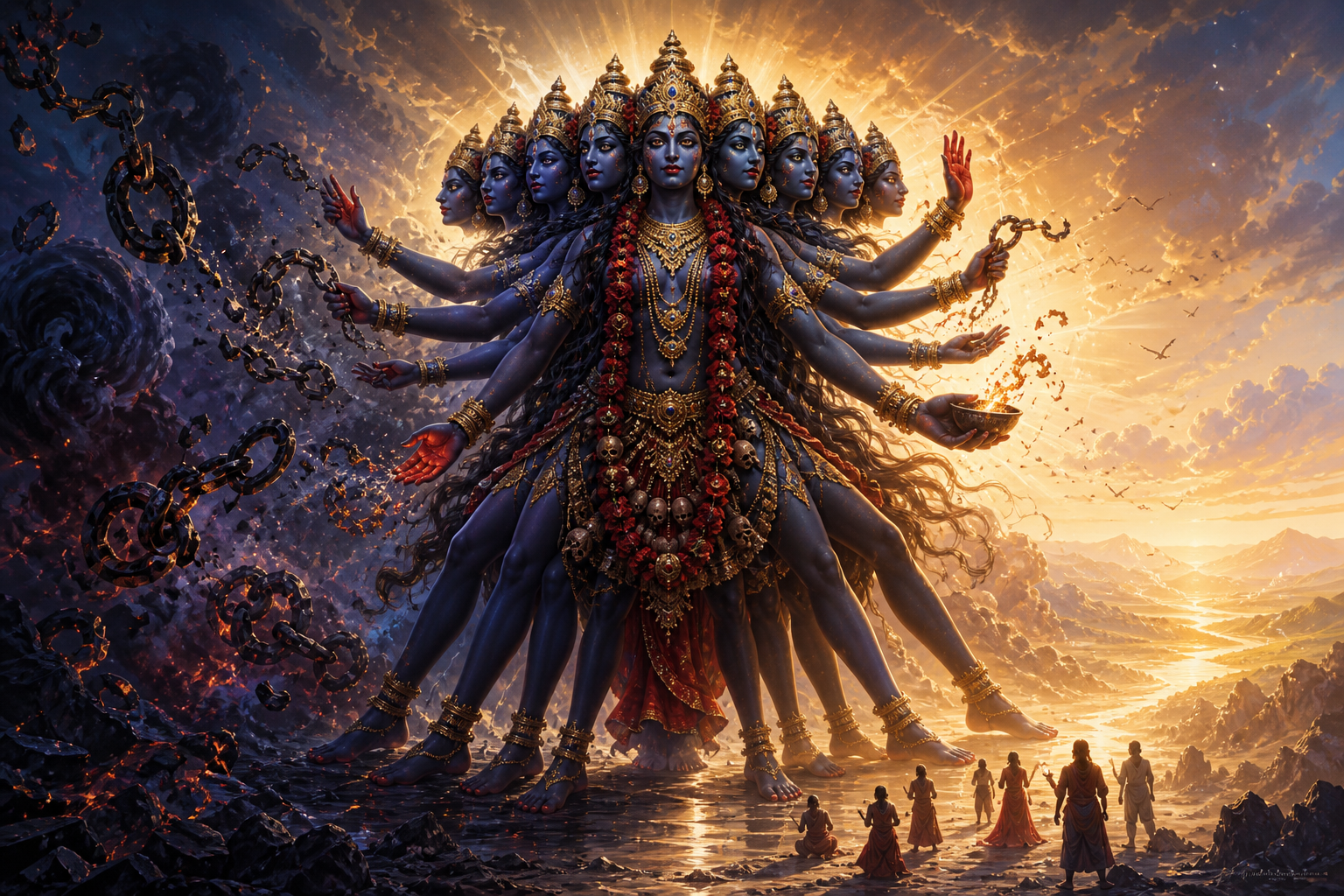
Maha Kali cannot be understood by separating her fierceness from Kala, time. Time ends every arrangement that the ego wants to make permanent. Maha Kali gives that unavoidable power a divine form: limitation is consumed so that what is timeless can be recognized.
Her darkness, garland of heads, and battlefield setting should therefore not be reduced to cruelty. Within this devotional grammar, they confront the ego, fear, attachment, and the refusal to accept impermanence. The frightening surface is purposeful. It makes evasion difficult.
When this imagery unsettles you, do not force yourself to call it pleasant. Use the discomfort diagnostically. Ask what change you are refusing to acknowledge, which part of your self-image you are defending at the expense of truth, and what duty would become clearer if fear did not make the decision. The aim is not fascination with destruction. It is freedom from the inner limitation that prevents right action.
This also clarifies fierce compassion. Compassion does not always appear as softness. It may remove an obstacle, expose a falsehood, or end a pattern that cannot be repaired by indulgence. Yet Kali’s symbolism gives no permission for cruelty in her name. If your interpretation increases contempt, enmity, or pleasure in another person’s suffering, it has failed the form’s movement toward liberation and responsibility.
Other Dharmic paths offer resonant, though not identical, ways of recognizing this pattern. Vajrayana traditions associate Mahakala with fierce compassion that removes obstacles; Jain teaching confronts the inner passions called kashayas; and Sikh ideals of Nirbhau and Nirvair join fearlessness with freedom from enmity. These parallels can deepen mutual understanding, but they should not be used to erase the distinct theology or practice of each tradition.
Turn the icon into a disciplined contemplation
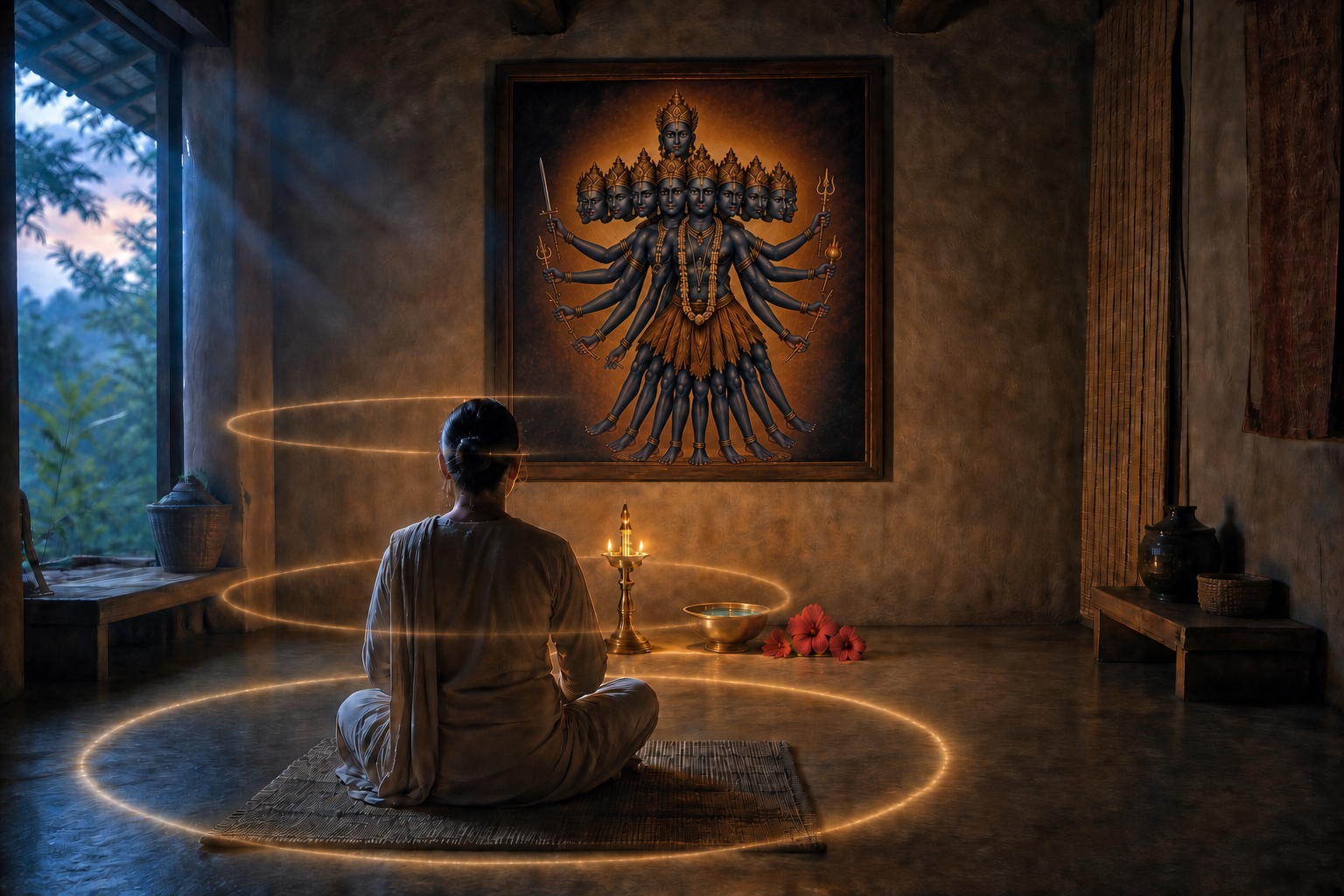
Mantra-japa, homa, and temple darshan belong within living traditions. Follow the method of your lineage or temple when undertaking those practices, particularly when a specific mantra, ritual sequence, or identification of attributes is involved. A self-guided reflection can still help you engage the icon, provided you do not present your own associations as inherited liturgy.
The following contemplation uses the form’s central symbolic relationships rather than assigning an invented meaning to every limb:
- Set the intention. Approach Maha Kali for clarity, courage, and dharmic responsibility, not for the thrill of frightening imagery or the fantasy of power over others.
- Hold the entire form in mind. Notice the heads, arms, and legs together. If your attention fixes on only the most dramatic feature, return to the whole composition.
- Work with the heads. Bring one real concern to mind. Identify the perspective you prefer and the perspective you have been avoiding. Notice the attachment that makes one of them harder to face.
- Work with the arms. Decide what the situation asks you to cut away, protect, guide, or sustain. Choose the capability that fits instead of treating intensity as the answer to every problem.
- Work with the legs. Identify where the decision must become visible in conduct. Name the next action for which you can accept responsibility.
- Return the result to dharma. Ask whether the action reduces ignorance and fear while preserving compassion. If it feeds vanity, hostility, or evasion, examine it again.
Do not manufacture ten personal meanings merely to make your exercise match the number. The traditional association with totality already performs that symbolic work. Your task is to let the whole form correct the narrowness of your attention.
During Navaratri, Kali Chaudas, or an ordinary temple visit, you can apply the same test to your darshan. Notice whether devotion is making you less ruled by fear, more humble about what you know, and more prepared to protect others. Those changes matter more than collecting increasingly elaborate interpretations.
Key takeaways for interpreting the form
- Start with totality. Ten evokes the ten directions and completion; it is not an invitation to invent ten unrelated stories.
- Keep the three functions connected. The heads represent comprehensive awareness, the arms capable action, and the legs stable, accountable movement.
- Read fierceness through Kala and liberation. The imagery confronts time, ego, fear, and impermanence rather than sanctifying cruelty.
- Respect lineage boundaries. A temple or teacher’s specific explanation should take priority over a generic correspondence assembled from mixed traditions.
- Judge contemplation by conduct. A sound reading should produce clearer discernment, more precise action, greater humility, and protection of dharma.
The next time you encounter Maha Kali’s multidirectional form, resist the urge to decode every detail immediately. Follow its central movement instead: widen your sight, choose the right action, and carry that action steadily into the part of life where dharma is asking something of you.
References
