
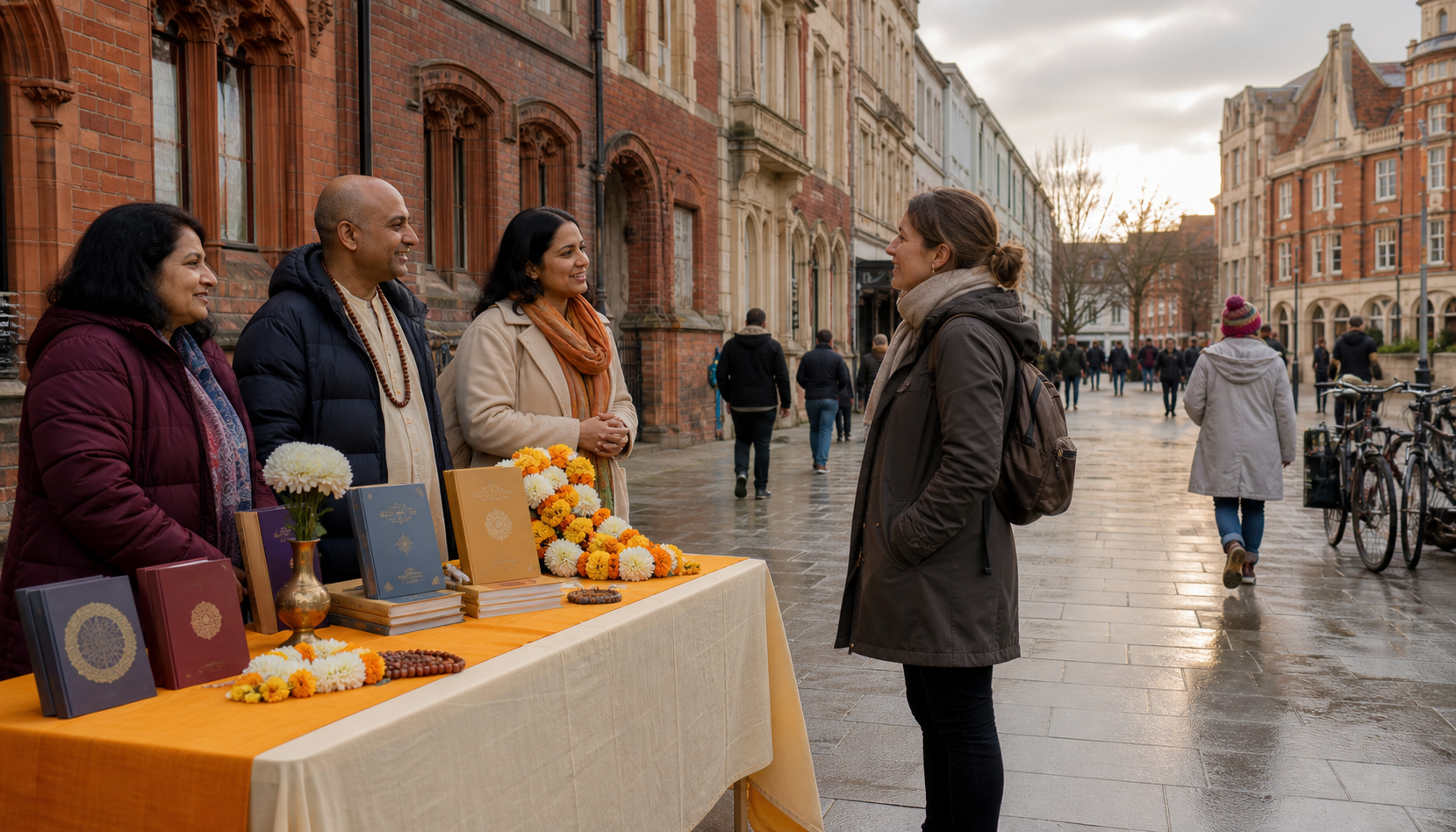
You may have copies of the Bhagavad Gita, a willing group of volunteers, and a place to stand, yet still be unsure what respectful street outreach should feel like. The real test is not how forcefully you can attract attention. It is whether someone can pause, encounter devotion without pressure, ask an imperfect question, and leave with their dignity intact.
Treat the book table as a temporary sacred space. It should be orderly enough to inspire trust, devotional enough to communicate its purpose, and open enough that declining the invitation feels as easy as accepting it. That combination turns public outreach from a sales exercise into seva.
Start with atmosphere, not a pitch

A passerby encounters the atmosphere before hearing an explanation. The arrangement of the books, the sound of kirtan, the handling of sacred texts, and the volunteers’ conduct all communicate what kind of encounter is being offered.
Public book distribution associated with ISKCON can do more than place sacred texts in people’s hands. When books, kirtan, incense, discipline, and conversation support one another, a table can become a temporary living altar in an ordinary public place. Its sacred character does not come from decoration alone. It comes from the relationship between outward presentation and inward practice.
Anyone who carries Krishna within himself, constantly, can go anywhere and turn the place into a sacred pilgrimage.
A.C. Bhaktivedanta Swami Prabhupada, letter to Rupanuga, 3 July 1968
This does not mean pretending that a pavement is a temple or turning devotion into public theatre. It means carrying temple qualities into public conduct: cleanliness, attention, reverence, hospitality, self-restraint, and service.
Before opening, stand where approaching pedestrians will stand and look at the entire scene. Can they understand what the table offers without being intercepted? Is there room to stop without obstructing anyone else? Can they hear kirtan and still speak at a normal conversational volume? Are volunteers attentive, or are they talking among themselves? Are the sacred books visibly cared for?
If the display says reverence but the behaviour says impatience, the behaviour wins. A crowded walkway, an overpowering sound system, careless handling of books, or an argument with a reluctant stranger contradicts the devotional message before any philosophy is discussed.
Build the table so devotion is immediately legible

The Bhagavad Gita should look like the centre of the encounter, not stock on a stall. Order matters because it tells the passerby that the text matters to the people sharing it. You do not need a complicated display. You need a coherent one.
- Confirm the setting first. Make sure the location and event conditions allow the setup you intend. Leave a clear route around the table so participation remains voluntary in practice, not merely in words.
- Give the books visual priority. Keep the display clean, stable, and easy to understand. Do not bury sacred texts beneath bags, refreshments, leaflets, cables, or volunteers’ personal belongings.
- Use kirtan to support the encounter. Devotional sound can establish the table’s identity and invite attention. If the greeter has to shout or a visitor cannot explain why they stopped, rebalance the volume or positioning.
- Treat incense as a responsibility. Use it only where it is suitable and permitted. Fragrance may contribute to the devotional atmosphere, but it should not be imposed on people sharing the space.
- Keep someone attentive to the altar. When volunteers are available, assign responsibility for restoring the display, protecting the books from disorder, and noticing when the physical setup has begun to obstruct conversation.
- Make the volunteers part of the presentation. Calm posture, clean surroundings, attentive listening, and respectful language reveal more about bhakti than elaborate ornamentation can.
Do not confuse sacredness with visual excess. Every object should have a purpose. If an item competes with the books, creates clutter, or makes the table harder to approach, remove it. A restrained display often gives the sacred text more presence because the visitor knows where to look.
The best practical test is simple: can a person approach, understand, pause, converse, and leave without physical or social friction? If any part of that movement is difficult, adjust the setup before asking volunteers to improve their words.
Let the conversation move at the passerby’s pace

A devotional conversation is an invitation, not an interception. Your first sentence should give the other person a real choice. Direct questions such as “Would you like to look at the Bhagavad Gita?” or “What caught your attention?” are more honest than a rehearsed opening designed to make refusal awkward.
Once someone stops, resist the urge to deliver everything you know. Find out what brought that particular person to the table. Someone may be curious about Krishna, trying to understand karma, interested in mindfulness, reconnecting with a family tradition, or simply drawn by the kirtan. Those are different conversations.
- Invite. Say plainly what the table is offering. Do not disguise a devotional encounter as a survey, a generic wellness activity, or casual street banter.
- Listen. Ask what the person already understands and what they actually want to know. Their first question may contain a deeper concern, but let them reveal it rather than deciding it for them.
- Answer one question well. Relate your explanation to the Bhagavad Gita or the bhakti practice represented at the table. Avoid unloading several Sanskrit terms when one clear idea would serve better.
- Check understanding. Ask whether the explanation answered the question. This gives the visitor room to clarify, disagree, or move on.
- Offer without pressure. Let the person look at or receive a book with enough context to know what it is. A refusal is not a failed encounter and does not require a second attempt.
- Close graciously. Thank the person whether or not a book changes hands. The manner of departure is part of the outreach.
Conversations about karma, mindfulness, and ethical living can make dharmic ideas accessible, but familiar vocabulary can also mislead. Do not reduce karma to a catchphrase or present mindfulness as the whole of bhakti. Ask what the visitor means, then explain the concept within the tradition and text you are actually representing.
Keep dharmic pluralism honest
Hinduism, Buddhism, Jainism, and Sikhism have recognisable points of contact through scripture, contemplation, ethical discipline, compassionate action, and service. They are not interchangeable versions of one system. Respectful outreach can acknowledge shared dharmic ground without erasing distinct teachings, histories, practices, or communities.
If someone asks whether all religions are the same, you do not need to force a slogan. You can say that the traditions differ and that respectful dialogue does not require pretending otherwise. Then identify the table clearly: it is a bhakti outreach centred on Krishna devotion and the Bhagavad Gita.
The same honesty matters with diaspora visitors. Do not treat a Hindu surname, Sikh appearance, Buddhist background, or Jain family connection as proof of what someone knows or believes. Public dharma should offer belonging, not an examination in authenticity. Let the person define their relationship to the tradition.
With newcomers, explain unfamiliar terms without making the tradition sound exotic for its own sake. With sceptics, answer the question you can answer and admit when you do not know. With someone who wants an argument, stay calm and refuse the contest. Evidence-informed explanation and open listening are stronger than a victory performed on the pavement.
The boundary between invitation and proselytising pressure is visible in conduct. Can the person decline without being followed? Can they disagree without being belittled? Can they ask about another dharmic path without being treated as disloyal? If not, the table is asking for submission rather than offering service.
Train for discipline, then review what actually happened

A beautiful display cannot compensate for an unprepared team. Before entering the street, agree on the purpose of the service and the behaviour that expresses it. This matters most when the space becomes busy, because volunteers fall back on shared habits when they no longer have time to negotiate every decision.
- State the purpose. The group is creating an accessible encounter with bhakti, sacred text, and respectful dialogue. Moving books is part of the service, not permission to treat people as totals.
- Clarify responsibilities. Where the team permits, decide who will greet, who will care for the display, who will sustain the kirtan, and who is ready for longer philosophical questions. Roles can change, but confusion should not be visible to the public.
- Practise plain explanations. Every volunteer should be able to explain Krishna devotion, bhakti, and the Bhagavad Gita without jargon or inflated claims. Practise responding to “What is this?” before preparing for difficult objections.
- Agree on boundaries. Do not block pedestrians, chase a refusal, manufacture urgency, turn disagreement into spectacle, or pretend to know an answer. Ask permission before photographing or recording a visitor.
- Prepare a graceful handoff. A new volunteer should know when to invite a more experienced devotee into a conversation. The transition should help the visitor, not display hierarchy within the team.
After the session, review the encounter while details are still clear. Book totals can show activity, but they cannot tell you whether the table felt sacred, whether explanations were understood, or whether visitors felt free to choose.
- Which questions appeared repeatedly, and where did volunteers struggle to answer plainly?
- Did the kirtan invite attention while still allowing conversation?
- When did the display become untidy, unattended, or difficult to approach?
- Did anyone feel pressured, crowded, ignored, or drawn into an unnecessary argument?
- Which conversations showed genuine curiosity even when no book was taken?
- What single adjustment should the team make before returning?
Record recurring questions and practical problems without collecting unnecessary personal details. Over time, this gives the group a useful training agenda grounded in real encounters. If visitors repeatedly misunderstand the same explanation, revise the explanation. If conversation collapses whenever kirtan intensifies, change the arrangement. If volunteers gather together while newcomers hover unattended, clarify the greeting role.
This review also protects the devotional purpose of a marathon. Intensity can strengthen discipline, but it can also make quantity the only visible measure. Keep asking whether the method reflects the text being shared. A table that appears successful while leaving people hurried, cornered, or confused has lost the altar quality it was meant to embody.
Key takeaways
- A living altar is created by the alignment of sacred text, devotional sound, physical order, and disciplined conduct.
- Arrange the space so a passerby can approach, understand, converse, decline, and leave without friction.
- Let kirtan and incense serve the encounter; neither should overpower people sharing the public space.
- Begin with an honest invitation, listen for the person’s real interest, answer one question clearly, and accept refusal without another push.
- Name Krishna bhakti directly while respecting the distinct identities of Hinduism, Buddhism, Jainism, and Sikhism.
- Review recurring questions, points of disorder, and the quality of conversations alongside the number of books distributed.
For your next outreach, choose one correction before you arrive: a clearer display, more restrained sound, a shared opening question, defined volunteer responsibilities, or a better review afterward. Make that change observable so the team can tell whether it helped.
A street does not become sacred merely because we call it sacred. It changes when devotion gives ordinary people room to pause, reflect, and encounter the Bhagavad Gita without surrendering their freedom. Build that room carefully, and the book table itself becomes part of the teaching.
References
