
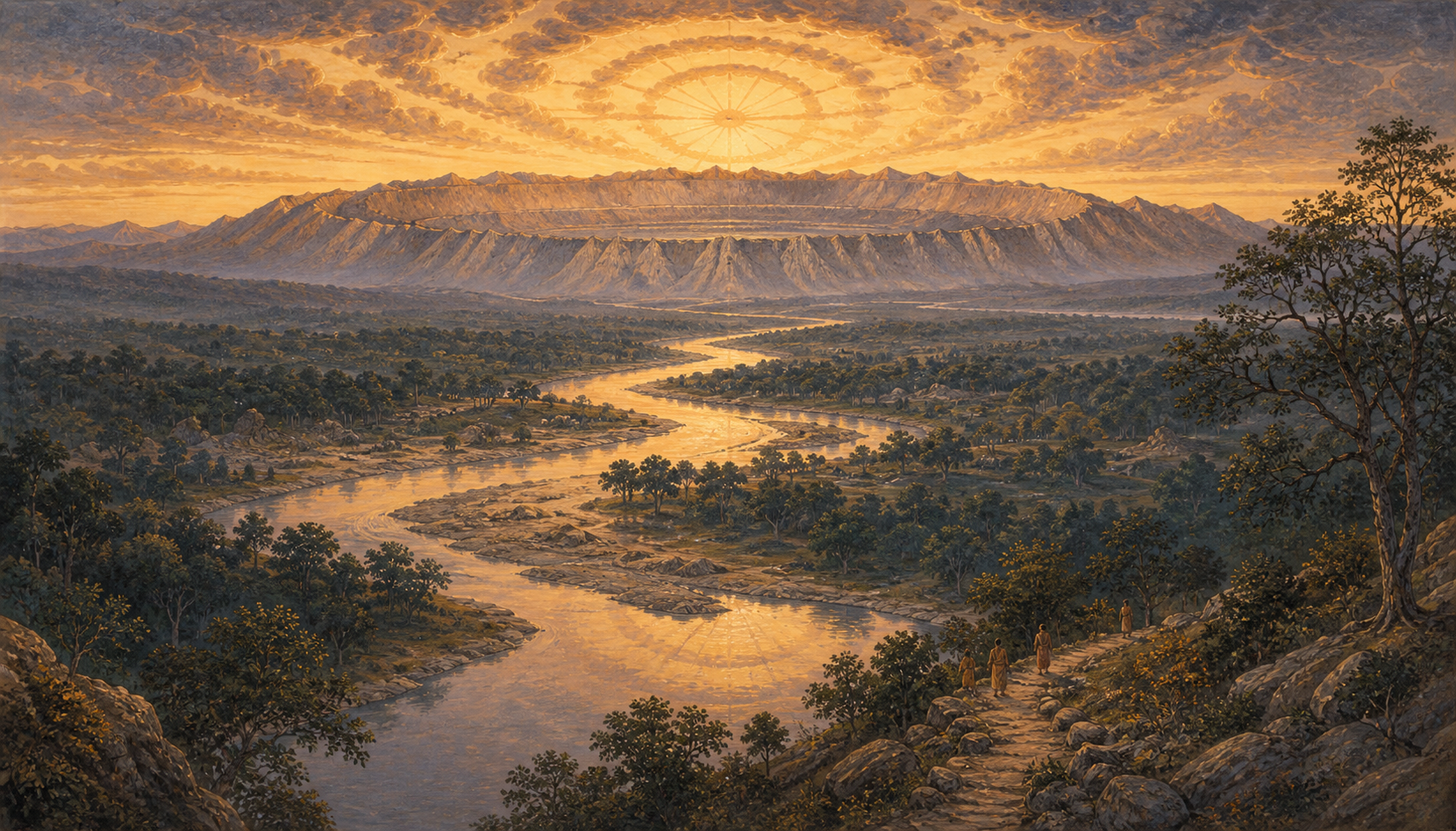
You have encountered Chakravana in an epic-geographical setting and want to know what kind of place it is. Is it a mountain that should appear on a modern map, a spiritual symbol, or a meeting point between geography and sacred meaning?
The most responsible answer is that you do not have to force a choice. Chakravana belongs first to Hindu sacred geography, where a place can participate in a narrative, preserve the memory of divine action, and teach a spiritual truth at the same time. The task is to keep those functions distinct without tearing them apart.
Begin with the few claims that are actually secure
Chakravana is remembered in epic and Puranic contexts as a lofty sacred mountain rising in the Western Sea. It is associated with Vishnu’s protective triumphs and with the Ramayana’s arduous search for Sita. Those elements provide a firm starting point: mountain, western ocean, divine protection, and a demanding search.
They do not, by themselves, establish a latitude, a surviving place-name, or an exact correspondence with a present-day mountain. If you arrived asking where Chakravana is located now, the material available here does not justify placing a confident pin on a modern map.
That limitation does not make the geography meaningless. A modern map mainly asks where a feature sits in measurable space. Sacred geography also asks what happened there, which duties were tested, how divine power entered the landscape, and what the place teaches a person who remembers it. Chakravana should be read with both kinds of question in mind.
- Record the location as it is given: a mountain in the Western Sea.
- Record its narrative associations: Vishnu’s protection and the search for Sita.
- Separate description from identification: a western maritime setting is not yet a modern coordinate.
- Mark interpretation as interpretation: spiritual meaning can deepen the geography, but it should not silently replace it.
This four-part discipline is useful whenever you study a sacred place whose current identification is uncertain. It lets you take the tradition seriously without claiming more than the tradition, passage, or evidence can bear.
Read Chakravana on three levels without collapsing them
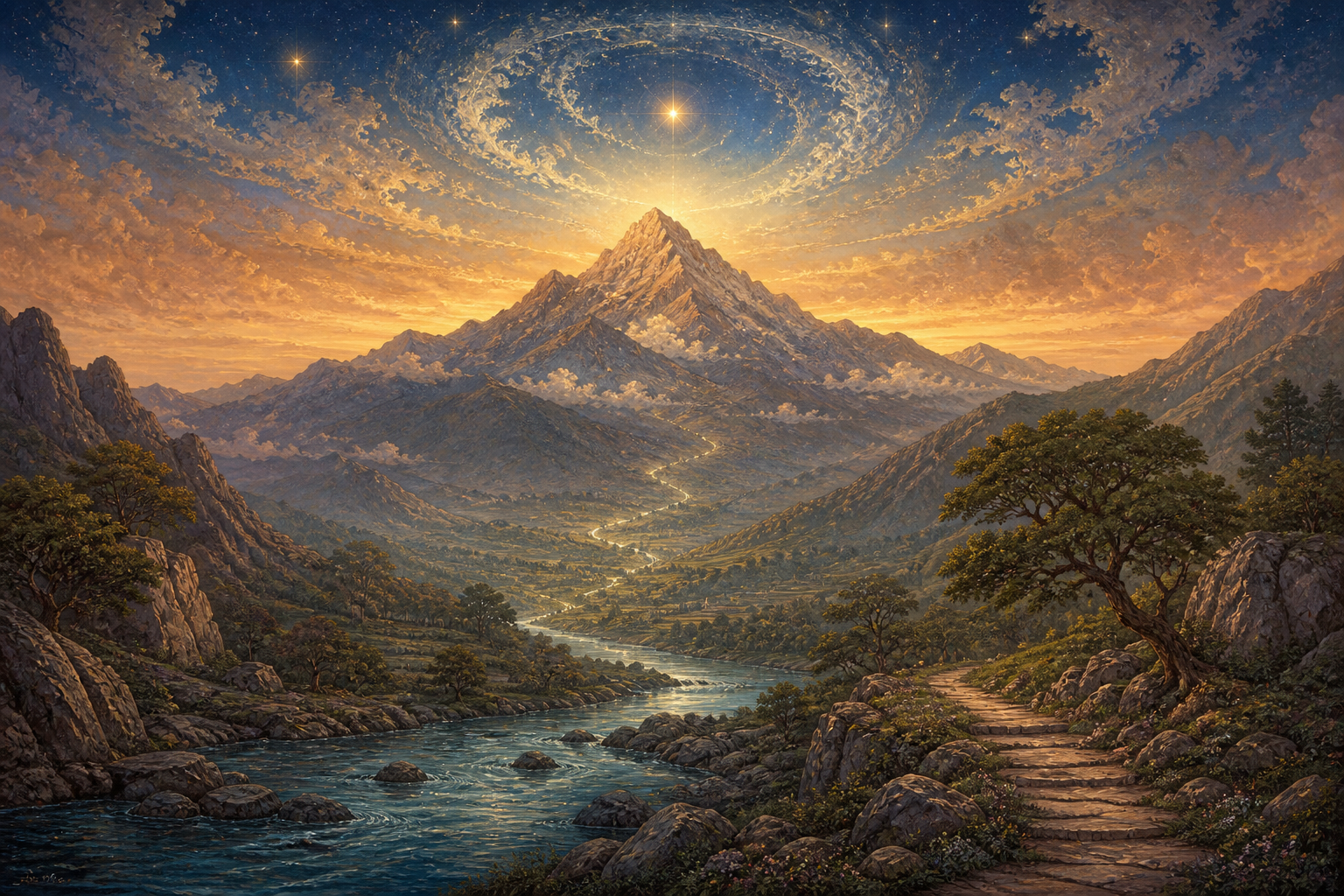
The cleanest way to approach Chakravana is to ask three different questions. Each question reveals something important, but each also has a boundary.
| Level of reading | Question to ask | Boundary to preserve |
|---|---|---|
| Narrative geography | What role do the sea, mountain, and journey play in the sacred account? | Do not replace the place with an allegory before understanding the story. |
| Spiritual symbolism | What does stability amid a turbulent ocean teach about dharma? | Do not present one contemplative reading as the only possible meaning. |
| Civilizational horizon | What does the Western Sea reveal about an imagination attentive to oceans and routes? | Do not turn a maritime image into proof of a particular port, voyage, or date. |
Narrative geography
Begin inside the story-world. The Western Sea gives Chakravana direction and remoteness. The mountain supplies a definite feature within an immense maritime expanse. Its association with the search for Sita places it within a journey marked by distance, difficulty, and the refusal to abandon a righteous purpose.
When you encounter Chakravana in a retelling or textual discussion, first track movement: who is searching, what duty drives the search, and why the landscape makes that duty difficult. This prevents the scenery from becoming decorative. In an epic, terrain can shape the moral pressure of the journey.
Spiritual symbolism
The sea can be contemplated as the instability of samsara, the changing field of conditioned existence. The mountain can be contemplated as steadiness: dharma that does not disappear merely because circumstances are turbulent. A peak rising from the ocean therefore gives visual form to a practical question: what remains worthy of obedience when everything around you is moving?
This is a reading, not a geographic substitution. Chakravana does not need to become unreal before it can carry spiritual meaning. In Hindu sacred geography, physical form and contemplative significance need not compete. The mountain matters within the narrative, and its form also makes moral stability imaginable.
Civilizational horizon
Chakravana’s location in the Western Sea also resists the idea of a landlocked Hindu imagination. Its horizon is maritime. The image belongs comfortably within a civilization attentive to oceans, coastal movement, ports, and pilgrim routes.
Keep the inference proportionate. The seascape supports the conclusion that the ocean was a meaningful geographic and cultural horizon. It does not, on its own, identify a particular historical port or reconstruct a voyage. If a proposed modern identification matters to you, ask for the exact textual wording, the geographical chain connecting it to a current site, and evidence independent of symbolic resemblance.
Avoid the four mistakes that distort sacred geography
- Forcing an exact modern coordinate: Western placement narrows the imaginative direction, but it does not settle a current location. A confident identification needs more than a mountain, a sea, and a matching compass point.
- Reducing Chakravana to a mere metaphor: the mountain functions as a place within sacred narrative before it becomes material for contemplation. Calling it only symbolic erases the geographic texture that gives the symbol its force.
- Using the image as complete historical proof: an oceanic setting can indicate maritime awareness. It cannot, without further evidence, prove a particular route, port, chronology, or political boundary.
- Flattening all Dharmic traditions into one account: mountains, seas, and journeys can serve as teachers across Hindu, Buddhist, Jain, and Sikh frames. That shared sensitivity to landscape does not mean every tradition preserves the same Chakravana narrative.
A simple note-taking habit prevents most of these errors. Put each statement under one of three labels: description, traditional association, or interpretation. The Western Sea is part of the description. Vishnu’s victories and the search for Sita are traditional associations. The sea as samsara and the mountain as steadfast dharma belong to interpretation. You can value all three without pretending that they make the same kind of claim.
Key takeaways
- Chakravana is best approached as a sacred mountain situated in the Western Sea within Hindu epic and Puranic memory.
- Its principal narrative associations are Vishnu’s protective action and the Ramayana’s search for Sita.
- No exact present-day coordinate should be asserted without additional textual and geographical evidence.
- The mountain amid the sea can be contemplated as stable dharma amid the movement of samsara, provided that this is identified as an interpretation.
- Its maritime setting supports a civilizational awareness of oceanic horizons, but not an unsupported reconstruction of a specific voyage or port.
Turn Chakravana into a disciplined contemplation
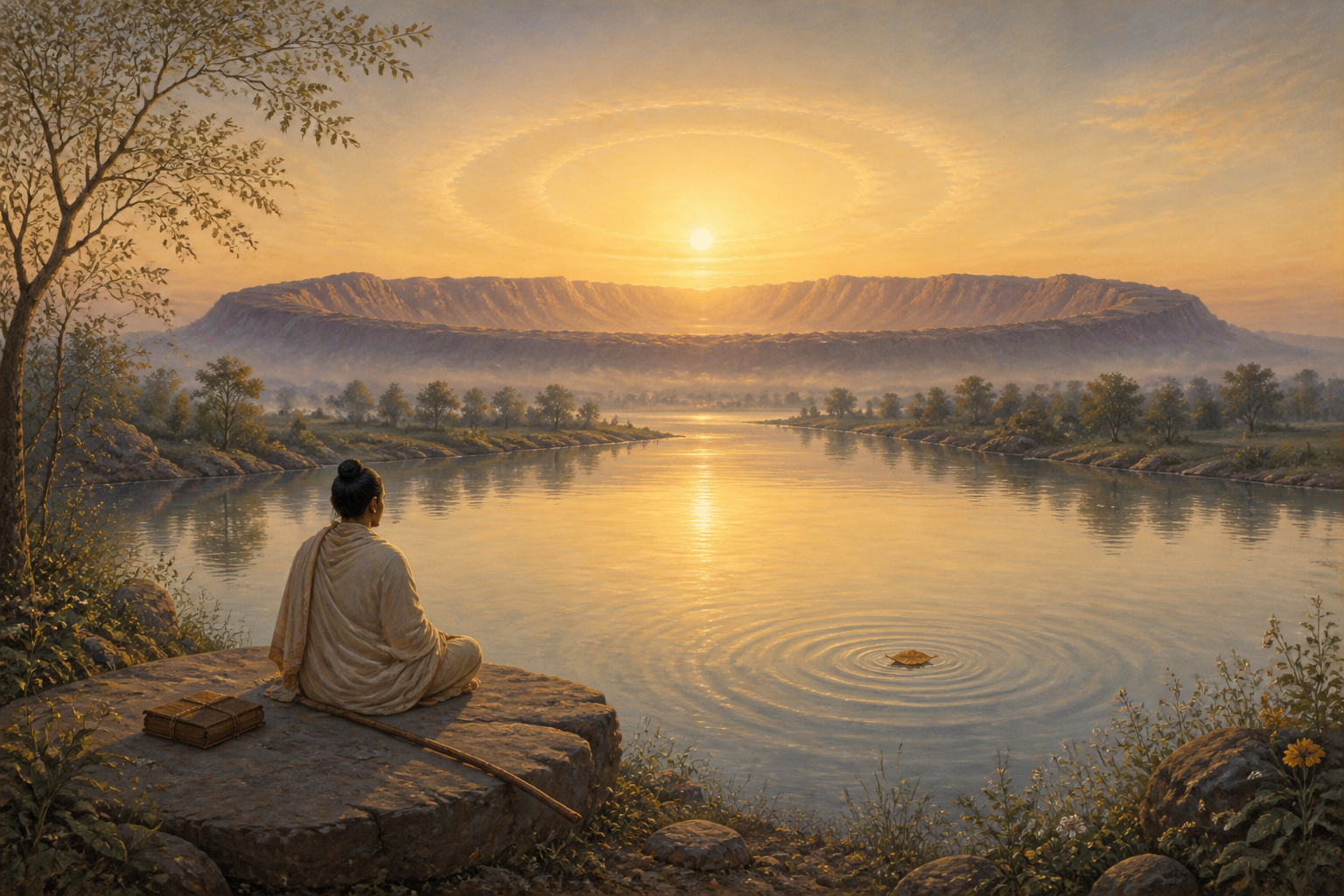
You can use the image of Chakravana in personal reflection or family teaching without presenting the exercise as a prescribed ancient ritual. Treat it as a contemporary contemplation grounded in the traditional image.
- Keep the scene simple. Picture the wide Western Sea and one mountain remaining visible within it. Do not add invented temples, cities, or events.
- Name the movement. Identify one situation in your life whose conditions keep changing. The point is not to dramatize it, but to see its instability clearly.
- Name the mountain. Identify the dharmic obligation that should remain steady within those conditions: truthfulness, care for family, disciplined study, service, courage, or another concrete duty.
- Choose the next act. Write one action that expresses that obligation under present conditions. Make it specific enough to perform, not merely admire.
- Return to the journey. Remember that the search for Sita gives the landscape its ethical urgency. Steadiness is not passive immobility; it sustains purposeful movement through difficulty.
With children, keep the question concrete: the sea changes, the mountain stands, and the search continues. Ask what the travellers must refuse to forget. With older readers, ask the harder version: which principle is genuinely dharmic, and which preference are you merely trying to make permanent?
The next time you meet the name Chakravana, pause before looking for a map pin. Note the sea, the mountain, the journey, and the duty. If historical identification matters, look for precise textual evidence. If spiritual practice is your purpose, choose the stable obligation that will help you move through change without being ruled by it.
References
