
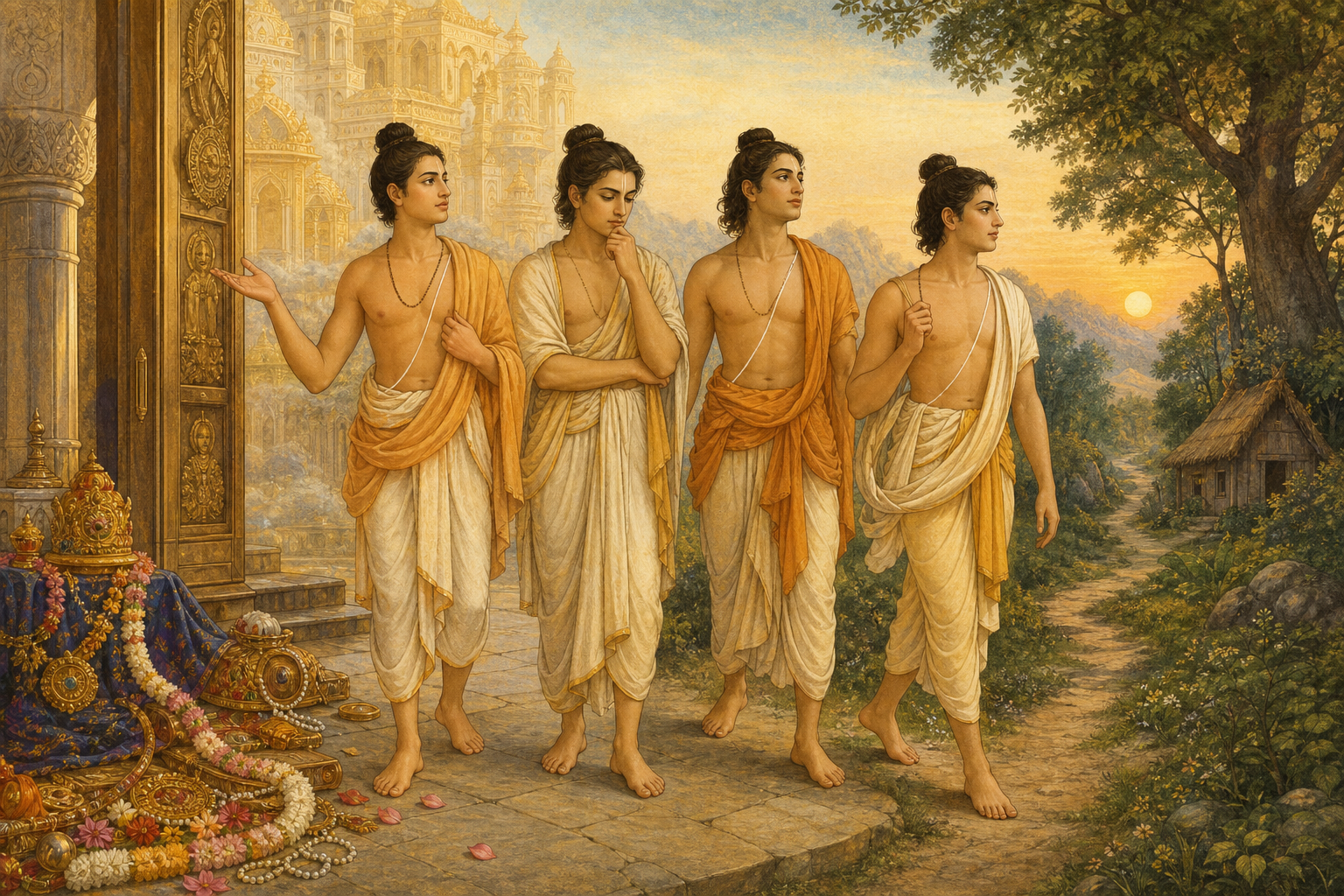
If you keep encountering Sanaka, Sanatkumara, Sanatsujata and Sanandana but cannot remember who teaches what, the names are not your real difficulty. The deeper challenge is seeing why Hindu scripture presents four eternally youthful renunciants instead of one generic image of wisdom.
You need a map that preserves their differences. Once you can connect each sage with a distinct spiritual obstacle—inherited assumptions, accumulated information, fear and attachment, or inconsistency—the Four Kumaras become practical guides rather than distant figures from sacred narrative.
Start with the choice that defines all four sages

The Chatus Sana are the four mind-born sons, or Manasaputras, of Brahma. Their defining turn is their choice of spiritual inquiry rather than progeny. Sanaka, Sanatkumara, Sanatsujata and Sanandana direct their lives toward knowledge, contemplation and freedom from attachment.
That choice does not make family life spiritually inferior. It challenges a narrower assumption: that human fulfilment must be measured only through continuation, possession, position or social approval. The Kumaras show that the search for truth is itself a legitimate and demanding vocation.
Their youth, celibacy and renunciation therefore belong together. Within sacred narrative, they remain eternally young. At the philosophical level, their youth represents awareness that does not become stale; their brahmacharya represents gathered attention; and their renunciation creates room for insight. They retain the seriousness of accomplished sages without acquiring the rigidity that often accompanies accumulated status.
This is the first practical test they offer you: can you approach a familiar question without forcing it to confirm what you already believe? If not, more information may strengthen your certainty without bringing you any closer to wisdom.
Four sages, four different disciplines of wisdom
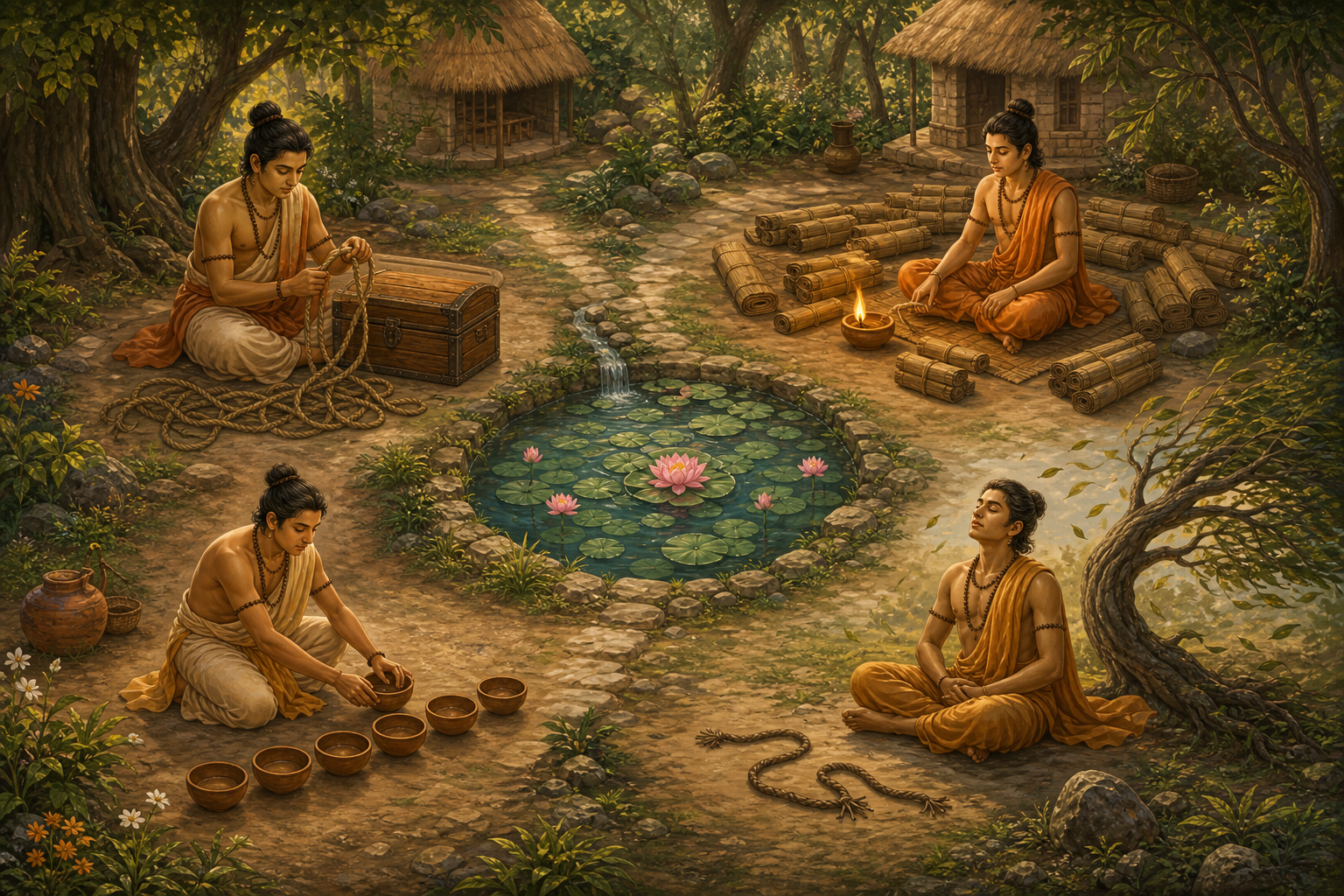
The Kumaras share a life of purity, self-restraint and contemplation, but they should not be flattened into interchangeable saints. Each gives you a different entrance into jnana, the path of spiritual knowledge.
| Sage | Scriptural setting | Distinctive emphasis | When his example is most useful |
|---|---|---|---|
| Sanaka | Puranic narratives, including his presence in Vaikuntha | Vichara, serenity and the courage to question convention | When inherited assumptions or emotional agitation are preventing honest inquiry |
| Sanatkumara | The Chandogya Upanishad, where he instructs Narada | A graded movement from limited forms of knowledge toward bhuma, the boundless reality | When you possess abundant information but still lack orientation or inner clarity |
| Sanatsujata | The Sanatsujatiya dialogue in the Mahabharata’s Udyoga Parva | Deathlessness as realization of the Self rather than extension of bodily life | When fear, attachment or ethical compromise is distorting what you know to be right |
| Sanandana | Puranic tradition, where his individual biography is less extensively developed | Tapas, mauna, devotional steadiness and sustained remembrance of Brahman | When you understand a teaching but do not maintain the discipline needed to embody it |
Use these distinctions diagnostically. If your problem is restlessness, begin with Sanaka’s calm inquiry. If it is information without depth, follow Sanatkumara’s graded method. If fear is producing compromise, attend to Sanatsujata. If insight repeatedly dissolves into distraction, learn from Sanandana’s steadiness.
None of the four offers mere cleverness. Their shared pattern is knowledge disciplined by character. Inquiry requires serenity; higher understanding requires humility; insight into the Self requires ethical mastery; and remembrance requires continuity. Remove those conditions and jnana becomes another possession of the ego.
Read their symbols without turning them into slogans

Eternal childhood means fresh awareness, not immaturity
The Kumaras are youthful, but they are not spiritually undeveloped. Their form holds together qualities that ordinary thinking tends to separate: innocence without ignorance, authority without vanity, and learning without intellectual old age.
You can apply that symbolism whenever you study scripture. Notice the moment when you stop listening because a teaching sounds familiar. Knowing its vocabulary is not the same as allowing it to question you. Eternal youth, as a discipline of awareness, means refusing to let familiarity close the inquiry too early.
Brahmacharya is concentrated purpose, not a casual metaphor
Celibacy is an actual feature of the Kumaras’ portrayal and should not be erased. Yet its philosophical function also matters: their energy is not dispersed among competing desires. Their brahmacharya makes sustained contemplation possible.
A householder need not pretend to possess their outward form of renunciation. You can still adopt its principle while studying or making a consequential decision. Close competing inputs, keep one honest question before you and resist the urge to perform your opinion before you have understood the issue. Concentration is the household expression of the same refusal to be scattered.
Renunciation removes compulsion; it does not remove responsibility
The Kumaras’ non-attachment is not indifference, laziness or hostility toward embodied life. It gives truth priority over convention and appetite. For someone living amid work, family and civic obligations, the immediate question is not whether to abandon those duties. It is whether fear of disapproval, hunger for status or attachment to a preferred result is preventing those duties from being performed according to dharma.
This distinction matters because outward simplicity can coexist with intense ego, while a person carrying substantial responsibilities can act without possessiveness. The sages direct your attention toward the attachment governing an action, not merely its appearance.
Silence is disciplined attention, not an empty absence
Sanandana’s mauna completes the quartet because insight needs a protected interior space. Silence prevents every perception from becoming an immediate reaction. Before sending a difficult reply or entering an argument, examine whether your speech is true, necessary and compatible with compassion. That pause is not passivity. It is where self-mastery becomes visible.
This ethical centre also helps explain the resonances between the Kumaras’ disciplines and other Dharmic traditions: Jain attention to non-violence and many-sided truth, Buddhist investigation of mind, and Sikh commitment to truth and seva all place transformation above empty display. Resonance does not make these traditions identical. It reveals a shared civilizational refusal to separate knowledge from conduct.
Use the Kumaras as a sequence for examining a real problem

The scriptures do not need to be forced into a single combined ritual. The following is a practical reading sequence: it brings the four disciplines to one problem while preserving the distinct contribution of each sage.
- Form the question with Sanaka. State the issue without embedding your preferred answer in it. Ask what is actually true, which assumption you inherited and what evidence would make you revise your view. If you cannot express the question cleanly, remain with inquiry instead of rushing toward a verdict.
- Sort knowledge with Sanatkumara. Separate what you have merely heard, what you understand conceptually and what you have verified through conduct. This exposes the distance between naming a virtue and possessing it. Sanatkumara’s instruction to Narada is especially relevant when learning has become accumulation rather than transformation.
- Expose attachment with Sanatsujata. Name what makes the truth costly. It may be fear of loss, concern for status, attachment to control or unwillingness to admit error. The Sanatsujatiya’s treatment of deathlessness turns attention from preserving the temporary personality toward recognizing the deeper Self; ethical restraint is part of that recognition, not an optional addition.
- Make the insight repeatable with Sanandana. Connect what you have understood to a stable discipline: svadhyaya before habitual distraction, meditation before an important decision, restraint before reactive speech, or quiet remembrance amid ordinary work. Choose a practice you can sustain, because an impressive insight that is never revisited will not reshape conduct.
Then judge the result by its ethical effects. Has the inquiry made you more truthful, less reactive and more capable of compassionate action? Has it clarified your duty, or merely supplied better language for avoiding it? Knowledge that makes you sharper in argument but weaker in self-mastery fails the standard embodied by the Kumaras.
This is also why their wisdom is not reserved for ascetics. A student can use the sequence to distinguish memorization from understanding. A professional can use it before an ethically difficult choice. A householder can use it to separate loving responsibility from possessive control. The outward situations differ; the inner work of attention, detachment and truthful action remains recognizable.
Questions readers often bring to the Four Kumaras
Are the four sages interchangeable?
No. They embody a common commitment to knowledge and renunciation, but their scriptural profiles emphasize different movements of the spiritual life. Sanaka exemplifies serene inquiry; Sanatkumara guides knowledge toward the boundless; Sanatsujata connects deathlessness with realization and ethical mastery; Sanandana embodies the sustained silence and tapas that keep realization alive.
Does their example require everyone to reject family life?
No universal command follows from their personal choice. Their renunciation must be taken seriously, but imitation of its outer form is not the only way to learn from it. For a householder, the central demand is to create enough inner freedom that duty is not ruled by compulsion, vanity or attachment to results.
Which sage should you begin with?
Begin where your present obstruction is clearest. Choose Sanaka when you need a better question, Sanatkumara when learning has become information overload, Sanatsujata when fear is bending your ethics, and Sanandana when your difficulty is consistency. You do not need to manufacture an interest in all four at once.
Take the sage whose discipline most directly exposes your current obstacle. Read his episode slowly, carry one question into your day and change one act of speech, attention or duty in response. That is how the eternal youth of the Kumaras becomes fresh awareness in your own life.
References
