

If you have prayed faithfully and nothing appears to change, Sudama’s meeting with Krishna can be easy to misunderstand. It is not a promise that one humble offering will trigger a material reward. It asks you to examine what delay is doing to your devotion: are you turning prayer into a bargain, treating hardship as proof of rejection, or neglecting the dharmic action still available to you?
Krishna’s grace answers a fear deeper than poverty alone: the fear that having little makes you unworthy of being seen. Sudama arrives with almost nothing, makes no demand, and is received as someone precious. For you, that changes the meaning of waiting. You can wait with honesty, disciplined practice, and dignity rather than panic or spiritual calculation.
Sudama came as a friend, not as a claimant
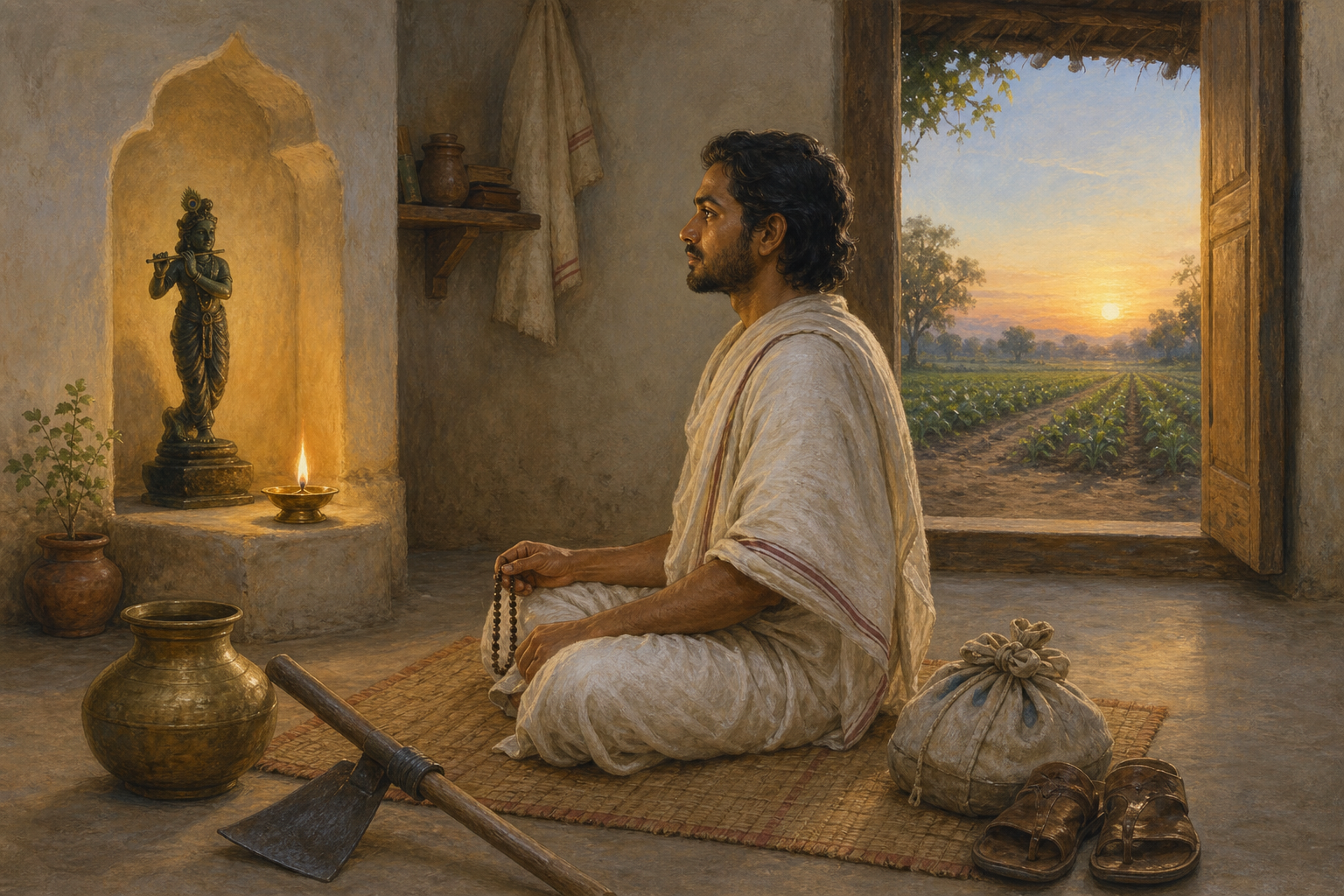
Krishna and Sudama, also known as Kuchela, had studied together in Sandipani’s gurukula during the Dwapara yuga. Their adult circumstances could hardly have been more different. Krishna stood in sovereignty at Dvaraka, while Sudama lived in poverty as a scholar-saint. Encouraged to visit his old friend, Sudama carried a modest gift of flattened rice, or aval. He did not arrive with an impressive offering or a carefully negotiated request. He arrived with shraddha expressed through what he could honestly give.
That distinction is the heart of the encounter. The flattened rice was not payment for divine intervention. Its material value was small, but it carried affection, remembrance, and sincerity. Krishna received the person through the gift; he did not assess the person by the price of the gift.
If you turn this episode into a formula – offer something small, perform the correct ritual, and expect wealth in return – you reverse its moral direction. Sudama did not use devotion to purchase an outcome. His offering revealed a relationship that already mattered to him.
This does not mean that you must hide every need from Bhagavan. Honest prayer can name fear, hardship, desire, and confusion. The useful distinction is between disclosure and demand. Disclosure says, “This is what I am carrying; guide me in dharma.” Demand says, “If I do this for you, you must produce that for me.” One deepens relationship. The other reduces devotion to an exchange.
Before making an offering or undertaking a vrata, ask yourself three questions: Would I still regard this practice as worthwhile if the result arrived differently than I expect? Am I giving within my means, or trying to impress the Divine through strain and display? Is this offering making me more truthful and generous in ordinary life? Your answers will reveal whether shraddha or anxiety is directing the act.
Krishna restored Sudama’s dignity before changing his circumstances

When Sudama reached Dvaraka, Krishna did not make him prove that he belonged there. He welcomed his old companion warmly, washed his feet, honored their friendship, and accepted the aval with delight. Sudama’s poverty did not diminish the welcome. Krishna’s conduct made the social distance between sovereign and impoverished friend irrelevant at the moment of meeting.
The order matters. Recognition came before material transformation. Sudama was not first made prosperous and then judged worthy of affection. He was honored as he stood. Krishna’s welcome therefore challenges a cruel spiritual assumption: that favorable circumstances demonstrate divine approval while hardship demonstrates spiritual failure.
Material relief still matters. The narrative does not romanticize deprivation by ending only with a comforting conversation; Krishna’s anugraha transforms Sudama’s life. But if you look only for the final change in circumstances, you can miss what the welcome already establishes. A person’s worth is not measured by possessions, status, clothing, or the size of an offering.
This is why the devotional names Kuchela Anugraha Moorthy and Sudama Anugraha Murthy carry such force in South Indian traditions. They remember Krishna as the giver of compassionate grace to Kuchela. The image is not merely about a poor man becoming prosperous. It preserves a vision of Bhagavan who receives an unassuming devotee without humiliation.
You can practice that part of the teaching immediately. When someone comes to you with less power, money, confidence, or social standing, do not make help conditional on deference. Receive the person before evaluating the request. Listen without displaying superiority. If you can assist, do so without turning generosity into a performance. Krishna’s welcome becomes ethically meaningful when it changes how you welcome others.
Patient bhakti is alert, not passive
The crane waiting motionless beside a pond offers a useful image for patient bhakti. Its stillness is not sleep, resignation, or indifference. The bird is attentive and ready. In the same way, spiritual patience joins steadiness to the ability to act when the appropriate opening appears.
This corrects two opposite mistakes. Restlessness makes you abandon a sound practice whenever fear rises. Passivity makes you call avoidance “surrender.” Patient bhakti does neither. It keeps the mind anchored while the hands continue the work that dharma presently requires.
- Steadiness: Keep a sustainable devotional anchor instead of changing practices whenever an immediate result fails to appear.
- Attention: Notice duties, appropriate help, honest counsel, and genuine opportunities rather than waiting only for a dramatic sign.
- Readiness: Take the next available dharmic step even when you cannot control the final outcome.
If you are looking for work, prayer does not replace completing an application or asking a trusted person for guidance. If a relationship is strained, bhakti does not excuse manipulation, dishonesty, or the refusal to communicate responsibly. If you are overwhelmed, surrender does not require rejecting suitable assistance. Grace and responsible action do not compete.
Impartial grace also should not be confused with identical outcomes. Impartiality means that wealth and status do not buy Bhagavan’s attention. It does not mean that every devotee receives the same material result on the same timetable. Once grace is reduced to uniform delivery of preferred outcomes, devotion has quietly become transactional again.
Sudama’s changed circumstances are therefore not a guarantee that bhakti will make every devotee wealthy. Nor does the story declare poverty spiritually superior. Its sharper claim is that sincerity is not disqualified by small means, and divine compassion is not purchased through display. That is the truth to carry into a period when you cannot yet see what will change.
A practical Sudama discipline for a difficult season

When uncertainty stretches on, vague advice to “have faith” is rarely enough. Give patient bhakti a concrete shape. The following practice keeps prayer, dana, discernment, and action connected without pretending that you control the timing of grace.
- Name the need plainly. Put it into one honest sentence in prayer or writing. Avoid pious language that conceals what you actually fear or desire.
- Separate the need from the demanded form. State what you hope for, then acknowledge that the right answer, timing, or path may not match the picture you have constructed.
- Keep one repeatable devotional anchor. Choose a prayer, nama-japa practice, meditation, or sacred reading that you can sustain at a regular point in your day. Consistency matters more than making the practice elaborate during a crisis.
- Offer something real and proportionate. Give food, time, attention, knowledge, or service within your capacity. The Sudama principle is not to give what looks impressive; it is to give sincerely without violating responsibilities to those who depend on you.
- Complete the next dharmic duty. Make the necessary call, finish the pending task, seek sound counsel, accept appropriate help, or repair a wrong you can repair. Do not postpone available action while waiting for certainty about the whole path.
- Review the fruit in your conduct. Ask whether the practice is making you less grasping, more truthful, more patient, and more willing to serve. These changes do not prove that a particular external outcome will follow, but they show that bhakti is shaping the person who must meet whatever follows.
If your hardship threatens food, housing, medicine, safety, or essential obligations, do not donate the resources needed to meet those responsibilities. Seek appropriate assistance from family, community, qualified professionals, or public services. Sudama’s modest gift teaches sincerity within one’s means; it does not authorize self-harm, neglect of dependents, or financial recklessness in the name of faith.
The discipline also has recognizable echoes across dharmic paths without making those paths interchangeable. Buddhist equanimity trains the mind not to be ruled by every swing of expectation. Jain aparigraha challenges possessiveness and grasping. Sikh seva joins devotion to concrete service and remembrance of the Divine Name. Sudama’s Vaishnava story remains distinct, yet the practical convergence is valuable: purify intention, loosen the demand to possess, serve where you stand, and remain attentive.
Key takeaways when grace seems delayed
- Do not treat hardship or delay as a verdict on your spiritual worth.
- Tell Bhagavan what you need, but do not turn practice into a contract for one predetermined outcome.
- Give within your means. The sincerity of an offering matters more than its display value.
- Keep a stable devotional practice while continuing the practical work that dharma requires.
- Receive people with dignity before judging what they possess or what they can offer you.
- Look for growth in truthfulness, patience, non-grasping, and service, not only for the external result you requested.
Before your next prayer, place one modest offering before Krishna, name your need without disguise, and identify the next duty that is actually yours. Then stop using delay as evidence that you have been forgotten. Sudama does not teach you to make yourself invisible before Bhagavan. He teaches you to arrive without pretence and allow devotion to reshape how you give, act, receive others, and wait.
References
