
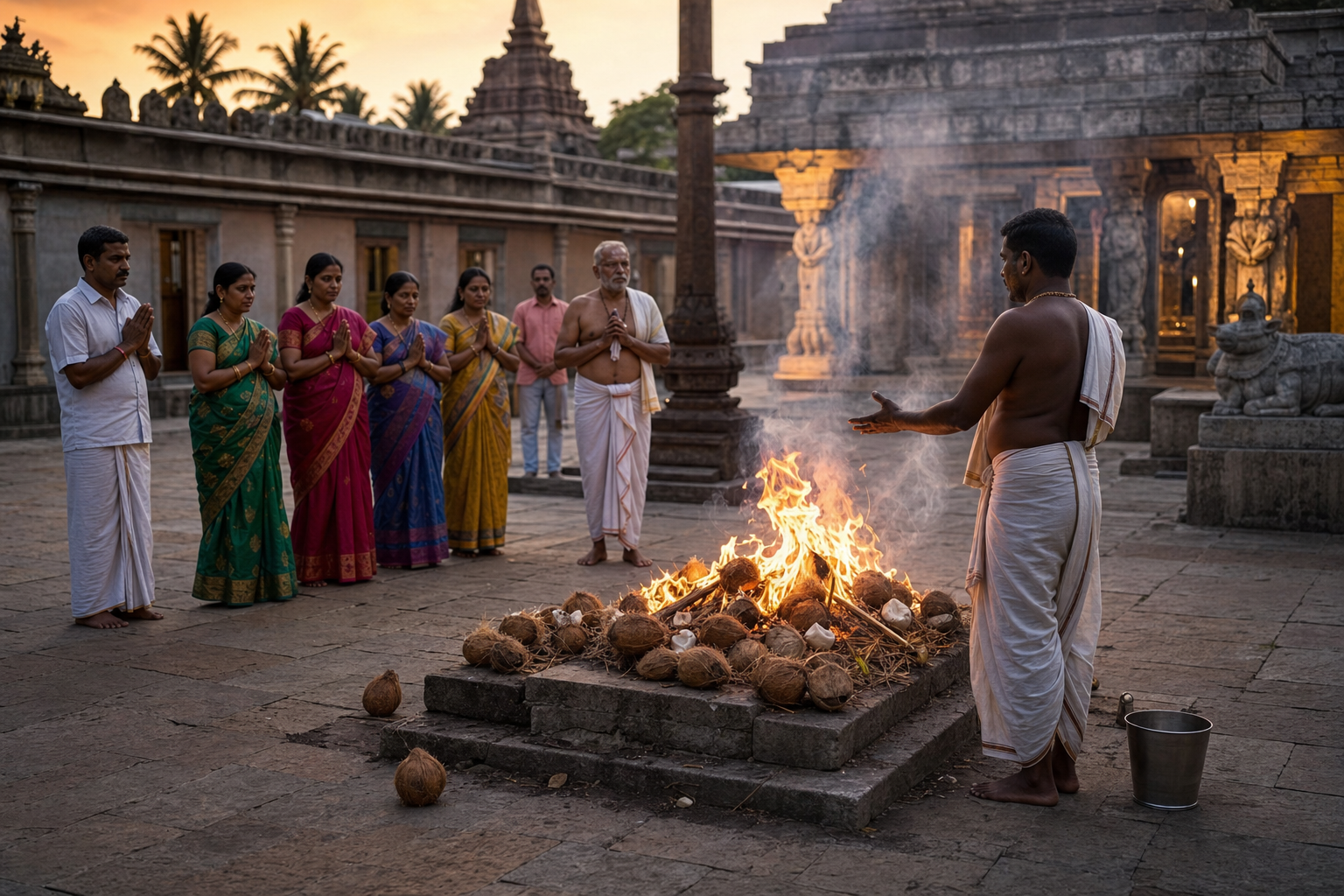
If you are preparing to visit Nayakanahatti, the coconut-burning ritual can raise an immediate question: what are you meant to do with a coconut that is offered to fire rather than broken before the deity? The useful answer begins with intention. You are not there to watch an unusual spectacle. You are there to place something stubborn within you before Agni and accept responsibility for what must change afterward.
You do not need an elaborate vow or a perfect understanding of temple philosophy. You need one honest concern, respect for the temple’s instructions, and a willingness to turn symbolic surrender into conduct.
First, know what makes the temple and its offering distinct
Nayakanahatti Thipperudra Swamy Temple, near Chitradurga in Karnataka, belongs to the devotional world of Virashaivism. Its sacred setting brings together Shri Guru Thipperudra Swamy’s samadhi and the Shivling installed by him. The samadhi keeps the Guru’s memory present, while the Shivling remains a living focus of worship. Keep both dimensions in mind when you enter: this is a place of lineage as well as a place of continuing sadhana.
The coconut is consigned to a sanctified fire rather than simply struck against a stone. That difference changes the inner tempo of the act. Breaking is immediate; burning is a process. A hard, enclosed object dries, blackens, cracks and is gradually reduced to char and ash. The devotee is invited to contemplate transformation rather than demand an instant result.
Local memory connects the custom with occasions during Swamiji’s journeys on foot when devotees approached him for guidance and brought coconuts as humble offerings. The details vary in oral retellings. You do not need to force those versions into a single definitive origin story. Their common centre is more important: devotees brought what they could, surrendered what burdened them, and sought a better direction.
If someone at Nayakanahatti tells the story differently from the version you have heard elsewhere, listen for that shared devotional purpose. Oral traditions often preserve meaning through several tellings rather than through one standardized account.
Read the coconut as a map of the inner person

A coconut works as a spiritual symbol because its structure is visible and familiar. Its fibres, hard shell and water allow you to contemplate several layers of the self without pretending that the fruit contains a rigid theological code.
- The fibrous exterior can represent accumulated habits, distractions and attachments – the strands in which attention becomes entangled.
- The hard shell can represent ahankara: the defensive ego that insists on control, status or being proved right.
- The water within can represent the clarity that remains available when agitation and pretence are relinquished.
- The complete coconut can represent the whole burden being offered, not merely the part you find convenient to surrender.
Do not spend your entire visit trying to assign one private problem to each physical layer. The symbolism should clarify your intention, not become another puzzle. A more useful question is direct: what hardness are you carrying, and what would become possible if you stopped protecting it?
Agni gives the offering its direction. Within Hindu ritual life, fire can serve as witness, receiver and purifier. Here, the coconut does not disappear without a trace. Its form is visibly altered. That makes the fire an exacting symbol: surrender cannot mean hiding the same pride beneath devotional language. It must mean allowing your habits to lose their former shape.
This meaning also helps you explain the ritual without flattening different Dharmic traditions into one practice. Hindu homa, the lighting of lamps, Buddhist offerings, Jain disciplines of self-restraint and Sikh traditions of humility and service are not interchangeable rites. They nevertheless make related ethical demands: reduce self-centredness, discipline the mind and let reverence become compassionate action. The Nayakanahatti observance is specifically rooted in its Virashaiva setting; its values can still be recognized across the broader Dharmic family.
Let the physical process clarify rather than diminish devotion
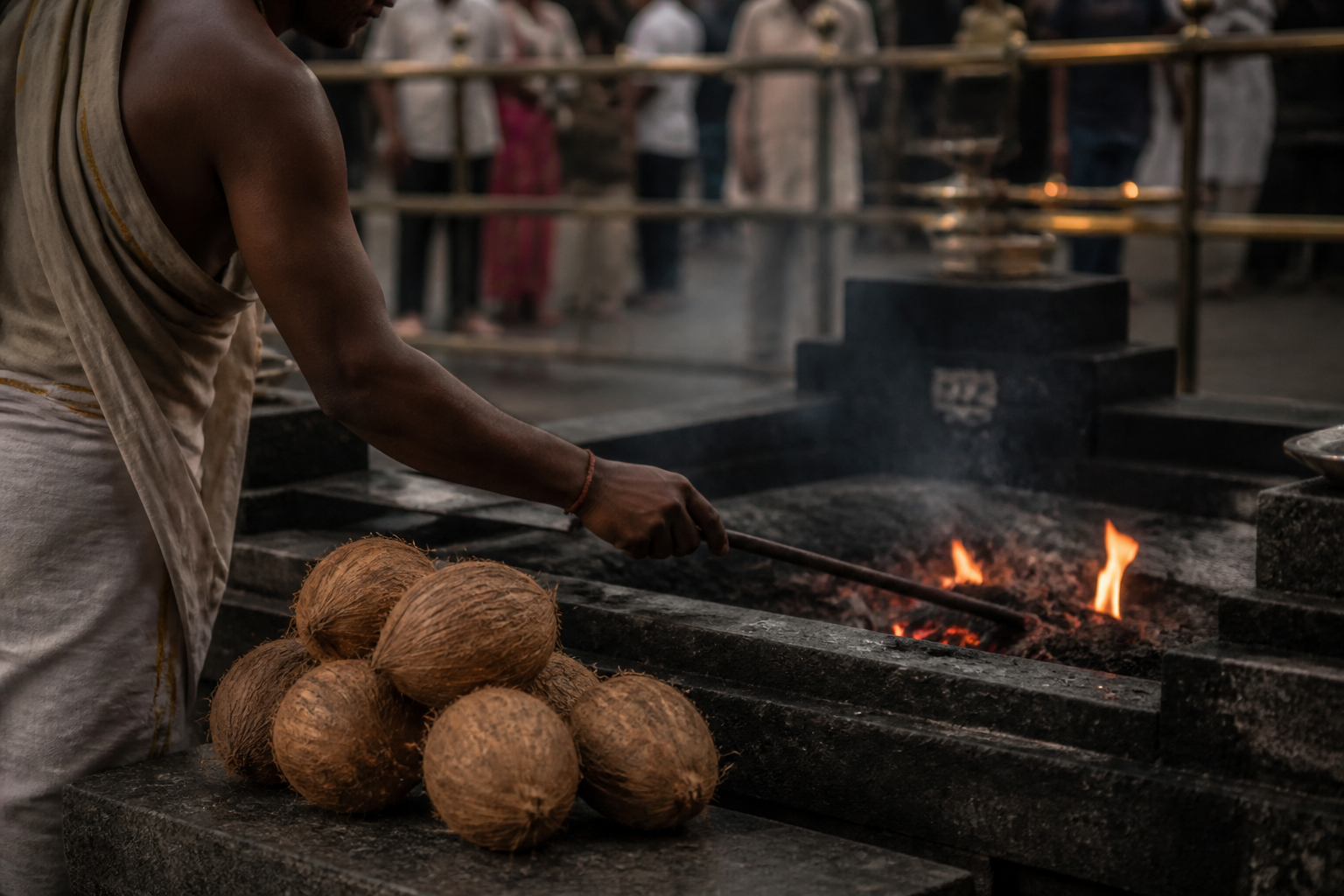
A burning coconut can crack or pop loudly. That sound does not require a supernatural explanation. Heat drives moisture from the coconut, carbonizes the husk and shell, and releases volatile components from its oils. Rapidly expanding steam produces the characteristic crackling and popping. The once-resistant form eventually becomes brittle charcoal and ash.
This physical account does not cancel the ritual’s meaning. It prevents a category mistake. Combustion tells you how the object changes; devotion concerns why you have offered it and what discipline you accept in response. The same event can be materially intelligible and spiritually significant without using science to prove theology or using theology to deny an observable process.
It also gives you a practical rule: do not read every crack, delay or fragment as a personalized omen. A louder coconut is not necessarily a more accepted offering, and a coconut that burns differently is not reliable evidence of divine favour or rejection. The natural variation of moisture, shell and heat is enough to produce different behaviour. Keep your attention on prayer and resolve rather than trying to decode the flames.
The same understanding should make you more careful around the fire. Use only the designated offering space and follow the directions given by temple attendants. Do not lean over the flames, rearrange burning material or retrieve an offering. Keep children close and loose clothing away from the fire. These are not interruptions to devotion; disciplined conduct around Agni is part of the reverence being expressed.
Turn the offering into a practice that survives the fire

The ritual becomes useful when you connect it to one change you can actually make. Asking vaguely for every obstacle to disappear leaves the entire responsibility outside you. Naming one pattern – resentment, dishonesty, uncontrolled speech, fear of a necessary duty or the need to receive credit – gives surrender an ethical consequence.
- Orient yourself to the sacred setting. Recognize the samadhi, the Shivling and the lineage in whose presence the offering is made.
- Name one burden without decorating it. Instead of thinking only of external enemies or bad fortune, ask whether pride, avoidance or attachment is shaping your response.
- Form one corresponding resolve. If the burden is harsh speech, resolve to correct a specific conversation. If it is pride, perform a needed act of service without seeking recognition.
- Offer the coconut only in the manner directed by the temple. Do not improvise a private fire ritual or obstruct the communal flow of worship.
- Let the coconut go without bargaining over the outcome. Surrender is weakened when it becomes a demand that the Divine produce the result you have already chosen.
- Before the day ends, take one action consistent with your resolve. Apologize, speak the truth, complete the neglected duty or help the person you have been avoiding.
The last step is the one most easily omitted. Fire can transform the offered object, but it cannot automatically reform your speech, relationships or decisions. If you symbolically offer ahankara and then demand privilege in the queue, the contradiction has already appeared. Temple practice reaches its purpose when the quietness felt near the samadhi becomes steadiness in ordinary life.
You can also involve children without frightening them or turning the moment into entertainment. Ask them to notice the coconut’s change, then invite them to choose one simple act of truthfulness, patience or helpfulness. That connects an unforgettable sight with character rather than superstition.
Key takeaways for a respectful visit
- Expect a Virashaiva temple practice centred on Shri Guru Thipperudra Swamy’s sacred lineage, not a tourist performance.
- Understand the burning coconut as a symbol of surrender, purification and the gradual softening of inner rigidity.
- Treat the sounds and visible changes as normal effects of heat, moisture and combustion, not as a system for predicting your future.
- Follow the temple’s current instructions and use only the designated fire area; local guidance takes priority over assumptions brought from elsewhere.
- Choose one ethical action to carry home. The offering is incomplete if nothing changes after you leave the temple.
Bring your concern to Nayakanahatti, but also bring your willingness to work on it. Stand before the fire with one clear intention, leave the coconut there, and carry the discipline with you. What turns to ash should not be rebuilt through the same old conduct on the journey home.
References
