
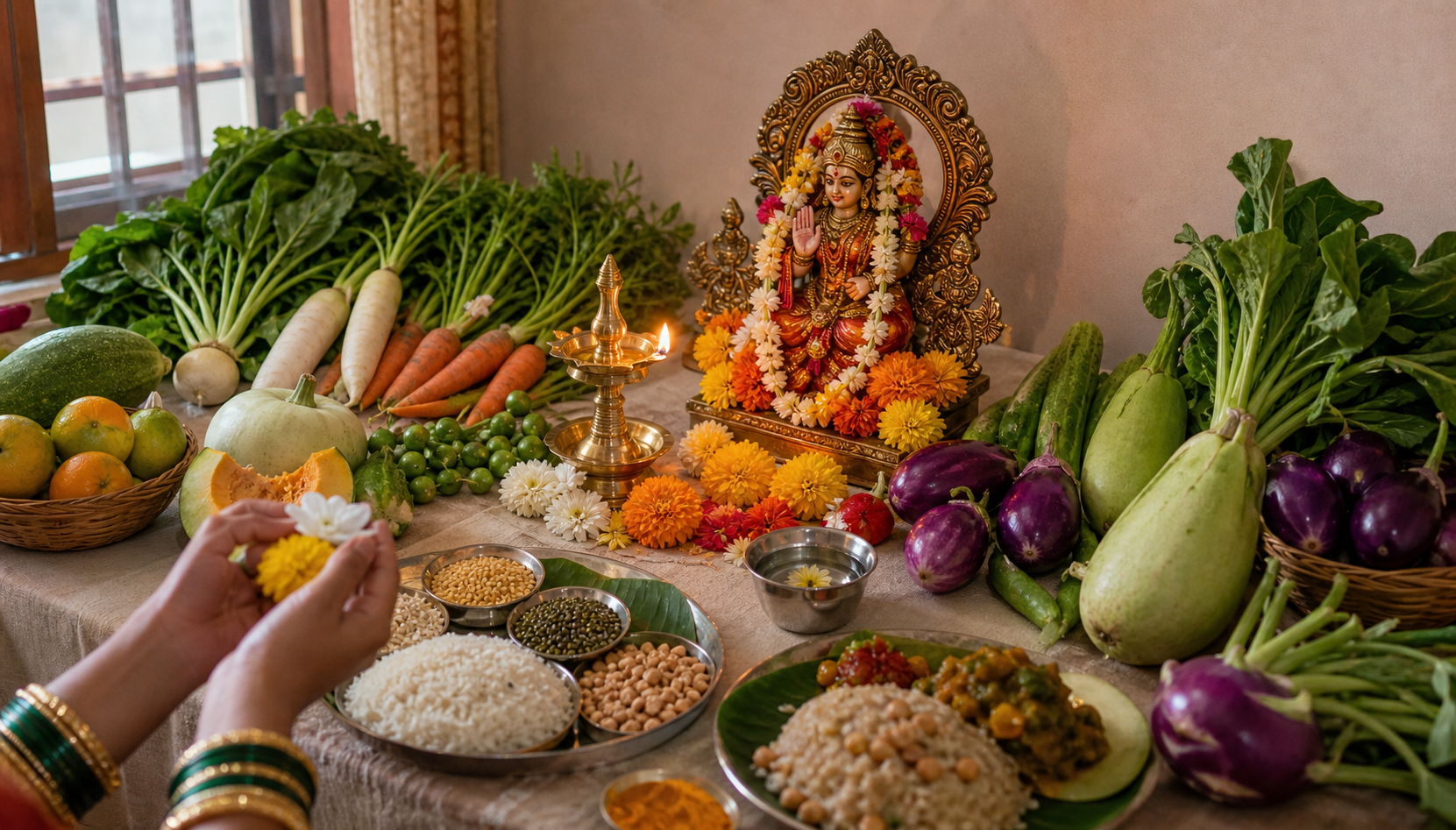
If you have marked January’s festivals but still aren’t sure what to do at home, begin with one decision: don’t reduce Shakambari worship to an altar display. The vegetables, fruits, greens, and grains represent nourishment received from Devi, and the worship becomes complete in spirit when gratitude changes how you obtain, use, and share food.
This gives you a practical way to organize the month. Confirm the calendar locally, make the Shakambari offering with food your household can actually use, choose a definite act of sharing, and carry that discipline into Makar Sankranti and Magha Maas.
Read January as a sequence of connected disciplines
In the North Indian lunar reckoning, January 2026 crosses from Paush into Magha. The transition matters because the month’s observances emphasize different but related duties: gratitude for nourishment, reverence for the forces that sustain life, personal purification, and generosity.
- Shakambari worship: Recognize food, water, soil, and vegetation as forms of sustaining grace. Offer seasonal produce and let the offering correct wasteful habits.
- Makar Sankranti: Honor the Sun’s entry into Makara Rashi and the harvest cycle. Regional forms include Pongal, while common practices include Surya arghya, til and jaggery preparations, shared meals, and charity.
- Magha discipline: Give greater attention to snan, japa, dana, and steady observance. Magh Mela at Prayagraj expresses these disciplines through pilgrimage and sacred bathing, but a household can follow the same ethical direction through a consistent morning practice and mindful charity.
These aren’t three interchangeable festivals, and they don’t require one uniform ritual. Think of them as three questions. How are you receiving nourishment? How are you acknowledging its cosmic and agricultural conditions? What discipline will ensure that gratitude survives after the festive meal?
Choose one answer for each question. You might offer seasonal greens for Shakambari Jayanti, share til and jaggery during your family’s Sankranti observance, and maintain a short morning japa-and-dana routine during Magha. A modest practice repeated with attention is more coherent than an ambitious calendar that collapses after one day.
Confirm the date before planning the ritual
The firm planning point for 2026 is that Shakambari Jayanti falls on January 3. It is the concluding day of Shakambari Navratri, also called Pausha Navratri in this context, rather than a disconnected one-day celebration.
That civil date doesn’t eliminate the need for a local check. Tithis and muhurats are determined astronomically, and a regional panchang or temple may specify the relevant observance window differently for your location. Before making a sankalpa, arranging a vrata, booking darshan, or inviting others, check a trusted local panchang, your temple notice, or the almanac used by your family.
- Write down the civil date and the locally applicable tithi window.
- Ask whether your temple observes the full Navratri, only the Jayanti, or a separate produce offering and distribution program.
- Confirm when the main puja or darshan takes place rather than assuming that a generic calendar gives the complete local schedule.
- If your household has an inherited paddhati, use its procedure and ask your family priest or temple about any timing conflict.
Community observances are especially prominent in Madhya Pradesh, Rajasthan, Karnataka, Tamil Nadu, and parts of the Himalayan region. If a nearby temple outside those areas doesn’t advertise a large celebration, that doesn’t prevent a sincere home observance. It simply means you should avoid borrowing an elaborate regional format without understanding it.
Use the same care with Makar Sankranti. Its astronomical basis is the Sun’s movement into Makara, but its foods, names, and public customs vary across Bharat. Pongal in Tamil Nadu belongs to the same broad seasonal moment without making every regional ritual identical. Follow the calendar and customs of the place or parampara in which you are actually worshipping.
A simple Shakambari puja you can perform at home
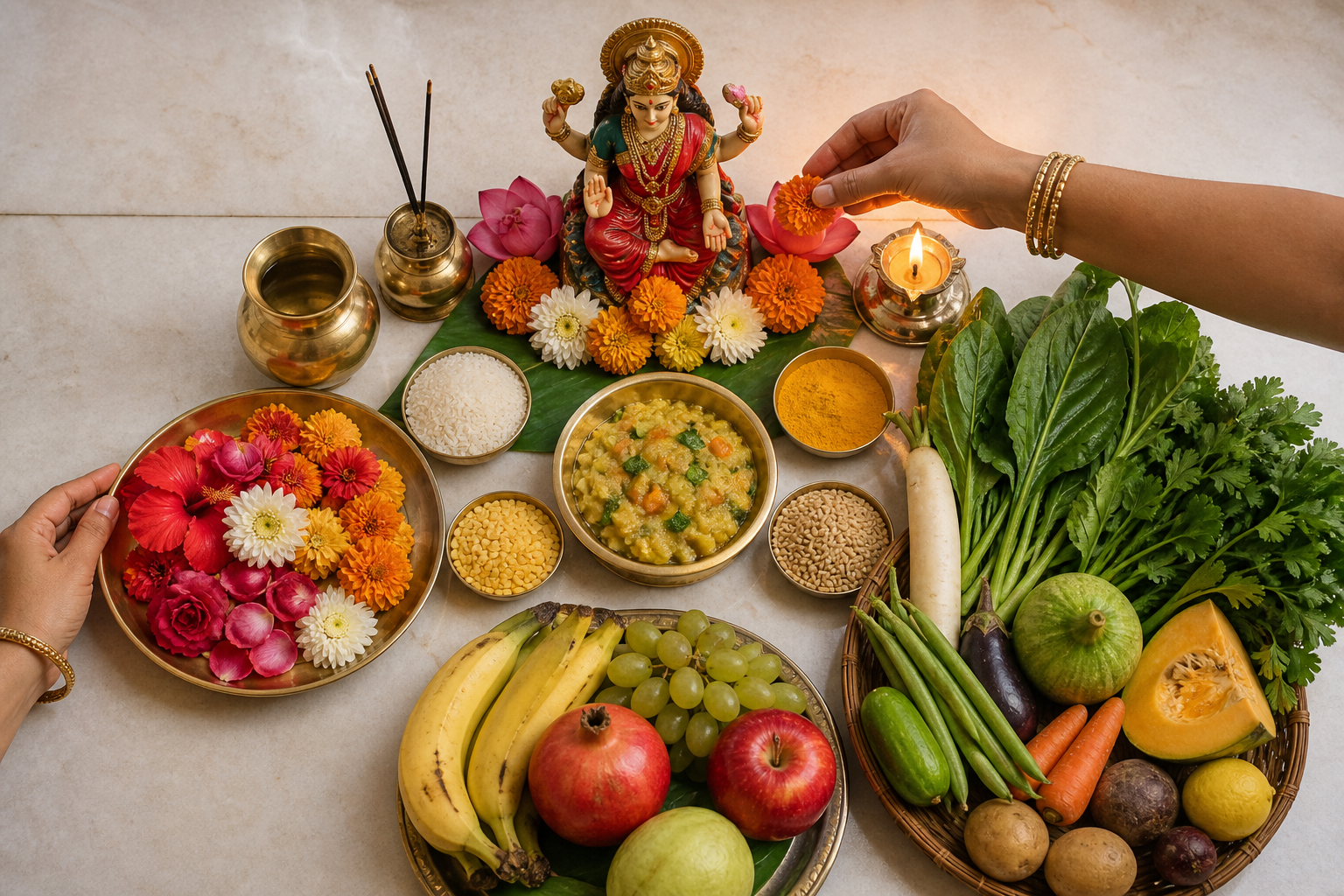
Shakambari Devi is worshipped as the nourishing manifestation of the Goddess and is traditionally represented with green leaves and vegetables. The name and imagery direct your attention toward actual sustenance: leafy greens, fruits, gourds, grains, and the living systems from which they come.
The following practice is intentionally simple. Use it when you don’t have a prescribed family method. If your guru, temple, or household follows an established procedure, that procedure takes precedence.
- Confirm the observance. Check the local panchang and temple schedule before deciding the time of your worship. For the 2026 Jayanti, begin with January 3 and then verify the local tithi and puja window.
- Choose usable seasonal food. Select fresh leafy greens, vegetables, fruits, gourds, or grains that are available in your area. Spinach, methi, coriander, and seasonal fruits are appropriate examples. Buy an amount your household can cook, share, or donate without waste.
- Clean the worship space. If your schedule and tradition permit, prepare the space around sunrise. Arrange the produce neatly before the image or murti of Devi. The arrangement can be beautiful, but beauty should come from care rather than excess.
- Light the lamp. Settle yourself before beginning. State your sankalpa in the manner customary to your family. If you don’t use a formal Sanskrit sankalpa, hold a plain intention: to receive food with gratitude, avoid waste, and help nourish another person.
- Offer prayer or attentive silence. Recite the Devi stotra used in your household, chant a familiar Devi prayer, or sit silently in gratitude for food and water. Don’t improvise a supposedly traditional mantra when you don’t know one; sincere silence is preferable to presenting invented words as scripture.
- Prepare a simple sattvic meal. After the worship, use the produce according to your household’s rules for prasada. Keep the meal centered on gratitude and sufficiency rather than turning the day into a display of abundance.
- Complete the act through sharing. Donate fresh produce, support a community kitchen, or bring appropriate food to a neighbor who needs it. Decide on the recipient before the puja so that seva is part of the observance rather than an afterthought.
You don’t need a large altar or a rare ingredient. In fact, importing decorative produce that nobody will eat works against the meaning of the worship. Local and seasonal food makes the relationship between Devi’s abundance, the land, and your own consumption easier to see.
If children are participating, give them a real responsibility. They can arrange the greens, identify what is in season, or help select the portion that will be shared. An elder can then recount the devotional memory of Shakambari ending scarcity with green abundance. The lesson becomes concrete: food is sacred enough to offer, valuable enough not to waste, and necessary enough to share.
Make food sharing part of the worship, not its leftovers
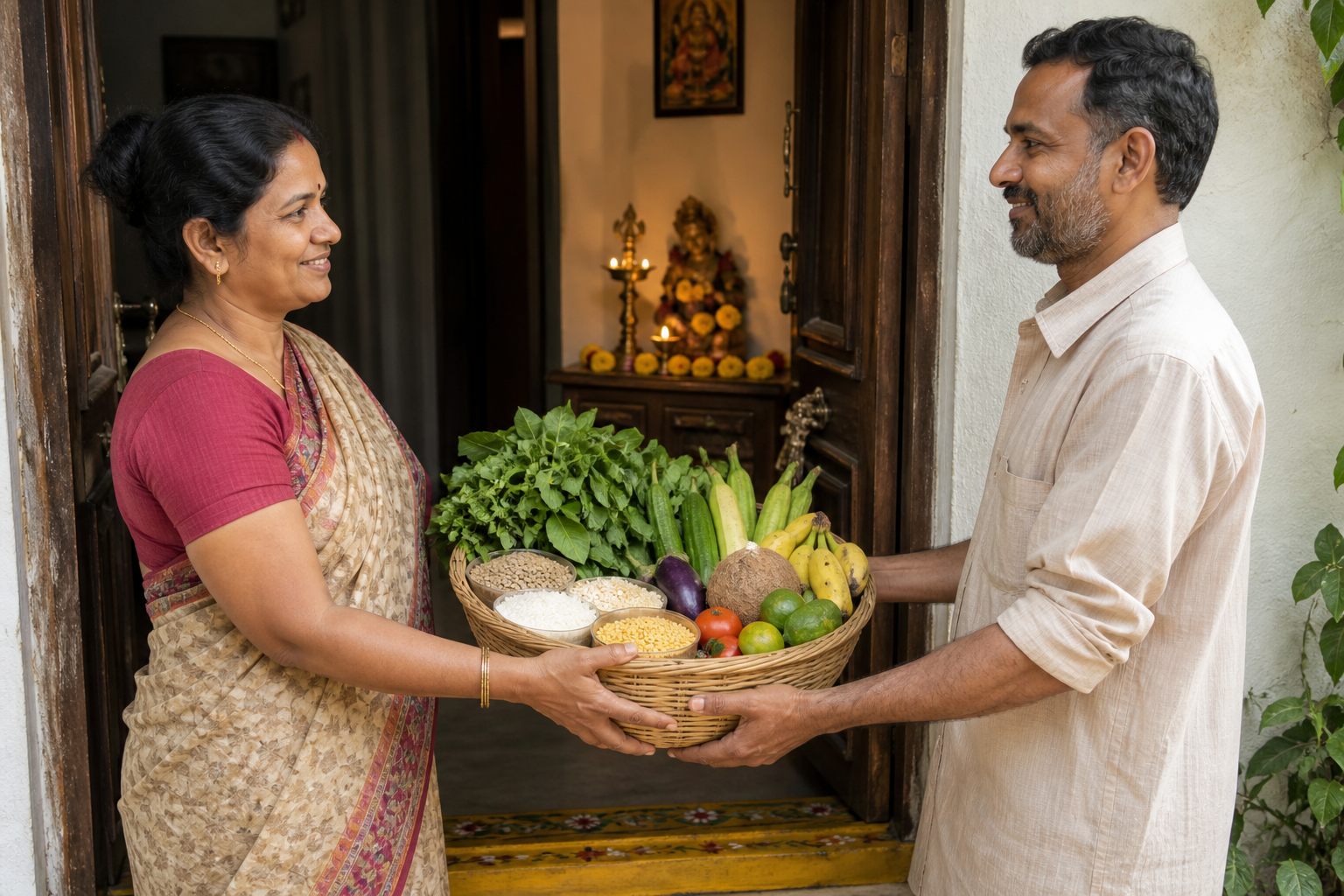
The easiest mistake is to purchase a generous display, complete the puja, and only afterward wonder what to do with the perishables. Reverse that order. Decide how the food will be used before you place it on the altar.
- Offer what is edible. Choose produce you would confidently serve in your own home. An altar isn’t a place to hide bruised food or items that are already deteriorating.
- Give what is wanted. Ask a community kitchen, temple, or recipient which foods they can accept. A useful donation answers a need; it doesn’t transfer the donor’s disposal problem to someone else.
- Share while it is fresh. Plan the handoff before perishable food loses quality. If a kitchen cannot accept altar offerings, keep its fresh donation separately and treat that parallel gift as part of your seva.
- Use the remainder fully. Cook suitable offerings, distribute prasada according to your tradition, and compost unavoidable plant scraps where that option exists. Minimal waste is a more faithful expression of abundance than an oversized arrangement.
This approach connects puja to the agricultural world instead of treating food as a prop. Someone prepared the soil, protected the crop, carried the produce, and made it available to your household. Water, sunlight, seed, labor, transport, and cooking all meet in one offering. When you notice that chain, gratitude stops being vague.
You can also make one measurable household commitment for the weeks that follow. Buy seasonal vegetables in quantities you can finish. Set aside a regular share for annadana. Plan one weekly meal around ingredients already at home. The commitment doesn’t need to be dramatic; it needs to change what happens in your kitchen after the flowers and lamps are put away.
Carry the same vow through Sankranti and Magha
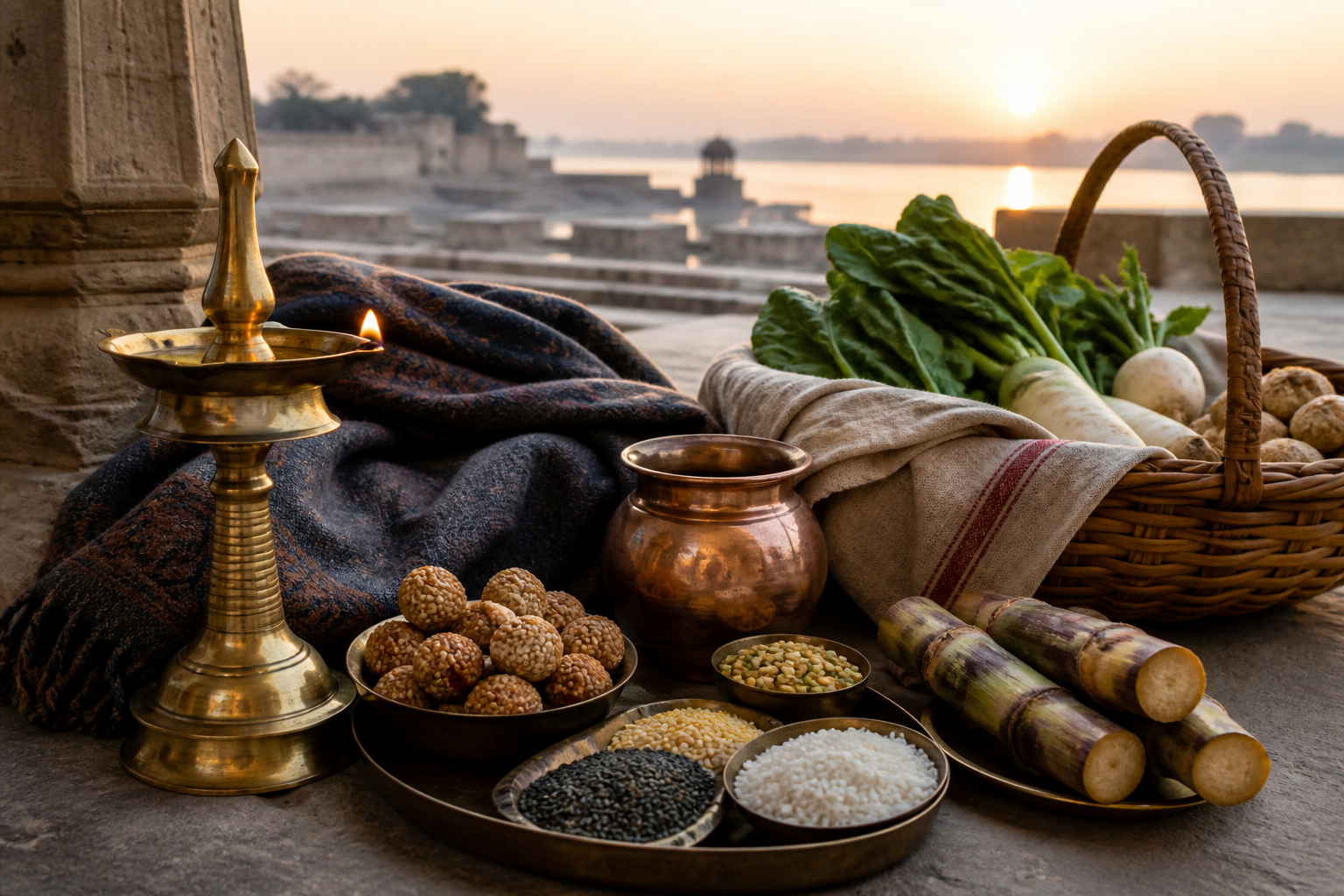
Shakambari Jayanti can establish the discipline that guides the rest of January. At Makar Sankranti, offer arghya to Surya according to your custom, prepare the seasonal foods of your region, and make space for kinship, community, or charity. The familiar use of til and jaggery can become more than a festive menu when the food is consciously shared.
During Magha Maas, shift from a single celebration to repetition. The traditional emphasis falls on snan, dana, vrata, and japa. Magh Mela at Prayagraj centers pilgrimage and sacred bathing at the confluence, but you don’t have to imitate a pilgrimage you cannot make. A household practice of morning cleansing, lighting a lamp, reciting japa, and giving mindfully can keep you aligned with the season’s purpose.
Choose a routine small enough to sustain. Put the lamp and mala where you will use them. Decide in advance what form of dana you will undertake. Attach the practice to a stable point in your morning rather than waiting for a free hour that may never appear.
Shared ethics without erasing distinct traditions
Shakambari Jayanti is a Hindu observance. Its ethics nevertheless resonate across the dharmic family: Jain ahimsa, Buddhist attention to food and interdependence, and Sikh seva through langar all place moral weight on how living beings are treated and how nourishment is shared. That resonance is worth recognizing without claiming that every tradition performs the same festival or explains it through the same theology.
The most respectful common ground is action. Feed someone without demanding recognition. Avoid needless waste. Treat agricultural labor with dignity. Let devotion make your consumption more attentive. Unity becomes credible when it preserves difference while strengthening a shared duty toward life.
Key takeaways for your January observance
- Shakambari Jayanti falls on January 3 in 2026 and concludes Shakambari Navratri, but you should still verify the local tithi and temple schedule.
- Build the home offering from fresh, seasonal vegetables, greens, fruits, gourds, or grains that can be eaten or shared afterward.
- Use your family’s established paddhati when one exists; otherwise, keep the puja simple with a clean altar, lamp, Devi prayer or silent gratitude, sattvic food, and seva.
- Arrange produce donation before the ritual so that generosity isn’t reduced to disposing of excess food.
- Carry the discipline forward through Surya worship and sharing at Makar Sankranti, then through regular snan, japa, and dana during Magha.
- Recognize common dharmic values such as ahimsa and seva without flattening Hindu, Buddhist, Jain, and Sikh traditions into one practice.
Open the panchang used in your region, confirm the Shakambari observance, and write down one offering, one recipient, and one Magha practice. Once those three choices are definite, January stops being a crowded festival list and becomes a discipline you can actually live.
References
- DharmaRenaissance Blog — January 2026 Hindu Festivals: Auspicious Tithis, Makar Sankranti, Magh Mela Highlights
- DharmaRenaissance Blog — Shakambari Jayanti 2026: Celebrating the Nourishing Goddess on Navaratri’s Sacred Finale
