

When your duty to one person seems to violate your duty to another, being told to “do the right thing” is not much help. You need a way to distinguish Dharma from habit, social pressure, fear, loyalty, and self-interest.
Dharmic thought gives you a disciplined test: look for the action that best sustains life, trust, moral order, and the possibility of shared flourishing. It will not make every choice painless. It will help you reject false duties, see who bears the hidden cost of your decision, and act without pretending that your preference is a universal principle.
Dharma begins where legitimate duties collide

Easy choices rarely test your Dharma. The real test comes when several claims are valid at once: family needs your time, work requires reliability, a friend expects loyalty, and your conscience refuses silence. Each claim may deserve respect, but they cannot all automatically decide the matter.
This is why Dharma cannot be reduced to obedience. Sva-dharma, the duty arising from your particular role and circumstances, matters because responsibilities are real. A parent, teacher, employer, citizen, monk, householder, and public official do not carry identical obligations. Yet role-based duty is bounded by sādhāraṇa-dharma: ethical principles that apply across roles, including non-harm, compassion, integrity, fairness, restraint, and responsibility.
A manager cannot turn concealment into Dharma merely by calling it loyalty to the organisation. A relative cannot turn domination into Dharma by calling it care. A spiritual practitioner cannot turn indifference into Dharma by calling it detachment. When a supposed duty depends on needless cruelty, deception, humiliation, or a self-serving exception, examine the claim again.
Context still matters. Telling the truth does not require using it as a weapon. Compassion does not require hiding a truth that others need in order to make a responsible choice. Dharma asks you to hold truth and compassion together: say what must be said, choose a fitting time and manner, and remain accountable for the foreseeable effects.
This context-sensitivity is not moral relativism. “Whatever feels right to me” has no reliable standard outside the self. Dharma asks a harder question: what does this situation require from me if the well-being of the whole matters as much as my comfort, reputation, or immediate advantage?
Cosmic law becomes practical through what you uphold
Dharma derives from the Sanskrit root dhri, meaning to uphold or sustain. Calling it cosmic law therefore does not remove ethics from ordinary life. It places every ordinary action inside a larger order. Your conduct either supports or weakens the relationships, institutions, communities, and ecosystems on which life depends.
The older idea of ṛta points to an ordered reality rather than a universe of isolated objects. Dharma is your ethical participation in that order. You do not create interdependence by believing in it; you learn to act as though the consequences moving through that interdependence matter.
You can examine that participation at three levels:
- Within yourself: Is the action arising from clarity, or are anger, greed, fear, vanity, and attachment disguising themselves as principle?
- Within relationships: Does it honour legitimate commitments without treating another being merely as a tool?
- Within the wider order: Does it preserve trust, fairness, social cooperation, and the conditions needed by other forms of life?
Karma makes this framework consequential: intentions and actions shape what follows. Moksha keeps moral life from becoming a performance for praise or status; inner freedom requires loosening the compulsions that distort judgement. Lokasangraha, the holding together and welfare of the world, prevents spirituality from becoming an excuse to withdraw from responsibility.
Yoga, meditation, and mindful breathing can support this work, but they do not certify that a decision is dharmic. Their practical value is the pause they create between impulse and action. Use that pause to name the desire you are protecting, the fear you are avoiding, and the person or living being who may pay for your choice. Inner steadiness becomes meaningful when it produces more responsible conduct outside you.
Four Dharmic traditions illuminate a shared ethical field
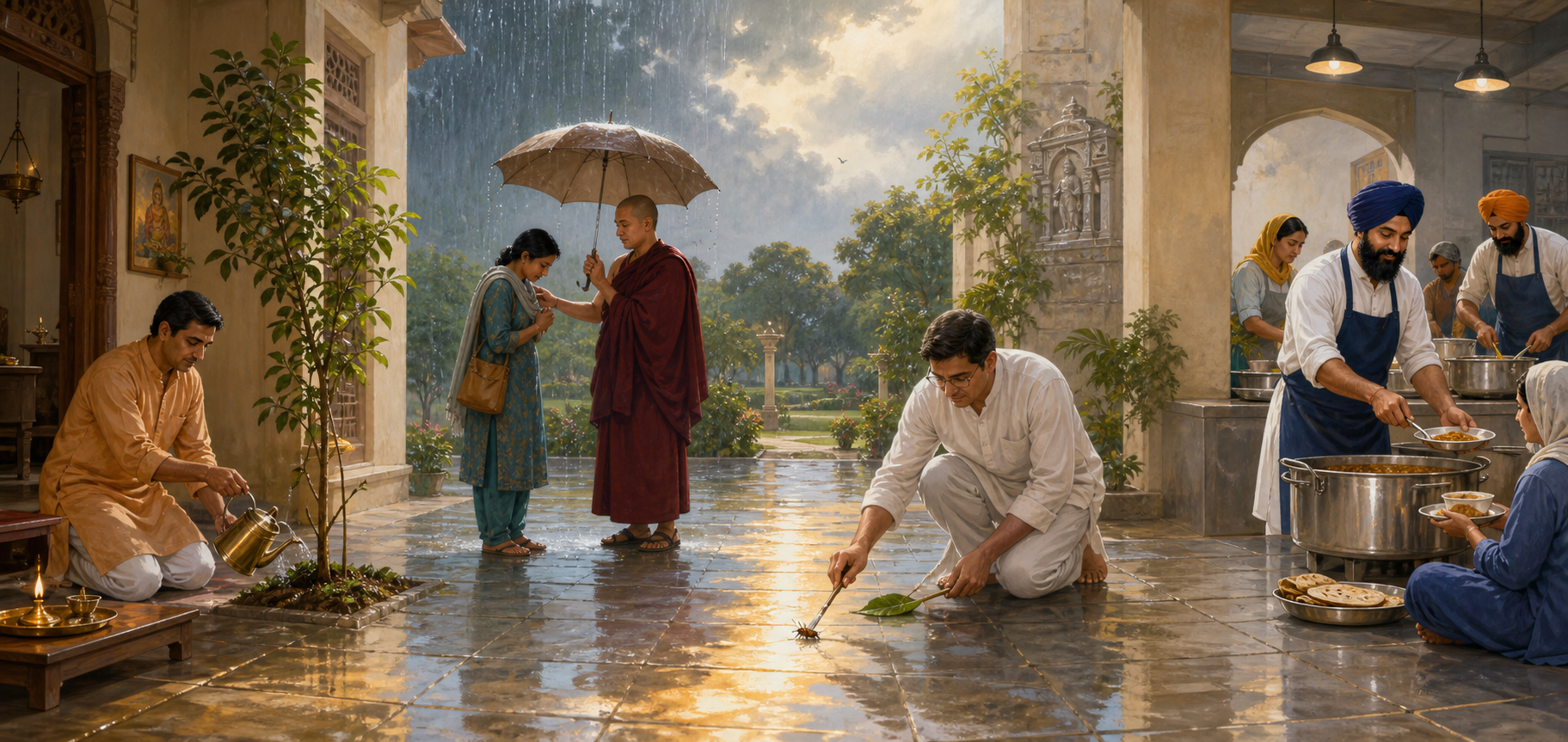
Hinduism, Buddhism, Jainism, and Sikhism are distinct traditions with their own teachings, disciplines, histories, and spiritual aims. Their shared ethical ground should not be mistaken for sameness. It is better understood as a family of practical lenses that challenge self-centred action from different directions.
| Tradition | Ethical emphasis | A question you can ask |
|---|---|---|
| Hinduism | Sva-dharma, sādhāraṇa-dharma, and lokasangraha | Does my particular duty respect universal values and help hold the wider order together? |
| Buddhism | Sila, karuna, and dana: ethical discipline, compassion, and generosity | Is my conduct disciplined and compassionate, or am I acting from grasping and aversion? |
| Jainism | Ahimsa, aparigraha, and anekantavada: nonviolence, non-possessiveness, and many-sided understanding | Can I reduce harm, loosen possessiveness, and admit that my view may be incomplete? |
| Sikhism | Seva and sarbat da bhala: selfless service and the welfare of all | Does this choice serve only my group, or does it contribute to the good of all? |
These are decision lenses, not exhaustive descriptions of the traditions. Their usefulness lies in the blind spots they expose. An action can look dutiful from within your role while remaining needlessly harmful. It can feel compassionate while allowing irresponsibility to continue. It can benefit your community while shifting the burden onto outsiders. It can defend a true insight while assuming that your partial view is the whole truth.
Apply the lenses together when the stakes are unclear. If your preferred option requires you to ignore harm, cling to possession or status, dismiss another viewpoint without examination, or define welfare so narrowly that only your circle counts, slow down. The discomfort is useful. It may be showing you the difference between Dharma and tribal interest.
The Ishta principle adds an important boundary to this shared framework: people may approach spiritual truth through different chosen forms and paths. Unity does not require a single mode of worship. Nor does pluralism mean that every action is ethically equal. You can honour another person’s spiritual path without surrendering your duty to oppose cruelty, dishonesty, or exploitation. Respect for diverse paths and moral discernment belong together.
A Dharma check for decisions that resist easy answers
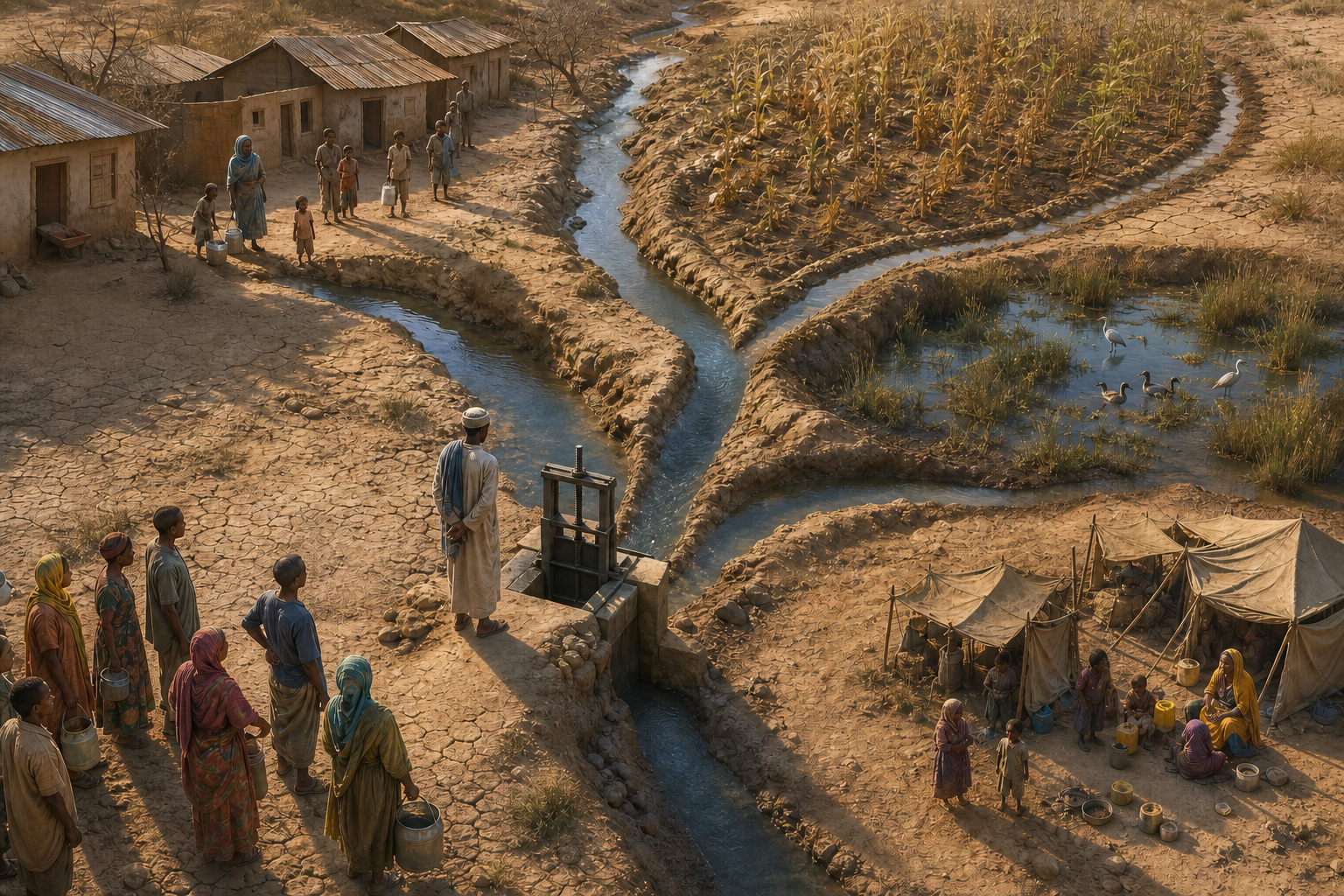
When you are caught between duties, do not begin by asking which option makes you look virtuous. Work through the decision in concrete terms:
- Name the actual action. Replace “What should I do?” with a precise choice: accept, refuse, disclose, delay, apologise, intervene, withdraw, or repair. Vague wording lets you avoid the moral centre of the decision.
- List everyone who carries a consequence. Include people who are absent, less powerful, outside your group, or unable to object. Where relevant, include animals, ecosystems, and those who will inherit the result later.
- Separate responsibility from ego. Identify the real promise, role, competence, or authority behind your duty. Then ask whether you would make the same claim if no praise, advantage, fear, or loss of status were attached to it.
- Apply the universal ethical floor. Set aside options that depend on needless harm, deliberate deception, exploitation, or humiliation. A role does not place you beyond the moral duties shared by all.
- Test the effect on the whole. Ask what would happen to trust and cooperation if people in your position routinely acted this way. This turns lokasangraha from an ideal into a social test.
- Look for the view you are missing. State the strongest case against your preferred option. If possible, listen to the person most affected by it. Anekantavada does not demand indecision; it asks you not to mistake one angle for complete knowledge.
- Choose, act, observe, and repair. Dharma is not finished when you decide. Watch the consequences. If new knowledge reveals avoidable harm, correct the course instead of defending the original choice merely to protect your pride.
Suppose a colleague asks you to hide an error. Loyalty is a genuine relationship duty, but concealment may transfer the cost to people who had no part in the mistake. Public humiliation would tell the truth while ignoring compassion. Silent protection would preserve comfort while weakening accountability and trust.
A more dharmic course would usually be to establish the facts, use the appropriate channel, avoid needless shaming, disclose what responsible correction requires, and help repair the damage. The point is not to split the difference mechanically. It is to honour truth, non-harm, service, responsibility, and the welfare of the whole in the same course of action.
Sometimes every available option carries a cost. Dharma does not promise moral innocence in a damaged situation. It asks you not to hide the cost, not to place all of it on the powerless, and not to call your own convenience necessity. Choose the course that sustains the most essential goods while reducing avoidable harm, then accept responsibility for what remains.
Your Dharma extends beyond private virtue

Personal decency matters, but Dharma also asks what your habits help normalise. Fair dealing at work, dependable care within family, service in the community, and responsible participation in public life all shape the moral environment that other people must inhabit. A society cannot sustain trust when individuals demand ethical institutions while making private exceptions for themselves.
The same reasoning reaches beyond human relationships. Reverence for Mother Earth becomes practical when you treat other species, biodiversity, finite resources, and future generations as morally relevant. Before purchasing, discarding, building, or supporting a policy, ask whether the choice reduces unnecessary harm, conserves what cannot easily be restored, and avoids shifting environmental costs onto people or beings with less power.
Aparigraha sharpens this ecological test. The question is not only whether you are permitted to possess something, but whether attachment to accumulation is creating harm that you refuse to see. Ahimsa asks you to reduce that harm. Lokasangraha asks whether the surrounding system can continue to support shared life. Sarbat da bhala refuses a definition of prosperity that excludes those bearing its costs.
This also gives you a standard for evaluating institutions and public claims. A policy, movement, or leader does not become dharmic by adopting sacred language. Examine conduct: Are burdens distributed fairly? Are leaders accountable to the standards they apply to others? Is disagreement answered with reason or humiliation? Are minority paths allowed to coexist? Are social and ecological costs acknowledged rather than concealed? Dharma is measured by what an arrangement upholds.
Key takeaways
- Dharma is not whatever your role, group, or preference demands; particular duties remain bounded by universal ethical responsibilities.
- Calling Dharma cosmic law means treating your conduct as part of an interdependent moral, social, and ecological order.
- Hindu, Buddhist, Jain, and Sikh ethical lenses are distinct, yet each can expose self-interest hidden inside a claim of duty.
- Pluralism protects diverse spiritual paths without requiring indifference toward harmful conduct.
- Inner disciplines create space for discernment, but Dharma becomes visible through responsible action, honest consequences, and repair.
Take one unresolved decision you are carrying and write it as a concrete action. Name the duties, the affected beings, the hidden cost, and the view you may be missing. Eliminate any option that requires you to conceal that cost from those who will bear it. Then choose the most sustaining course left, act with compassion, and remain willing to correct what you could not yet see. That is how cosmic order becomes lived Dharma.
References
