
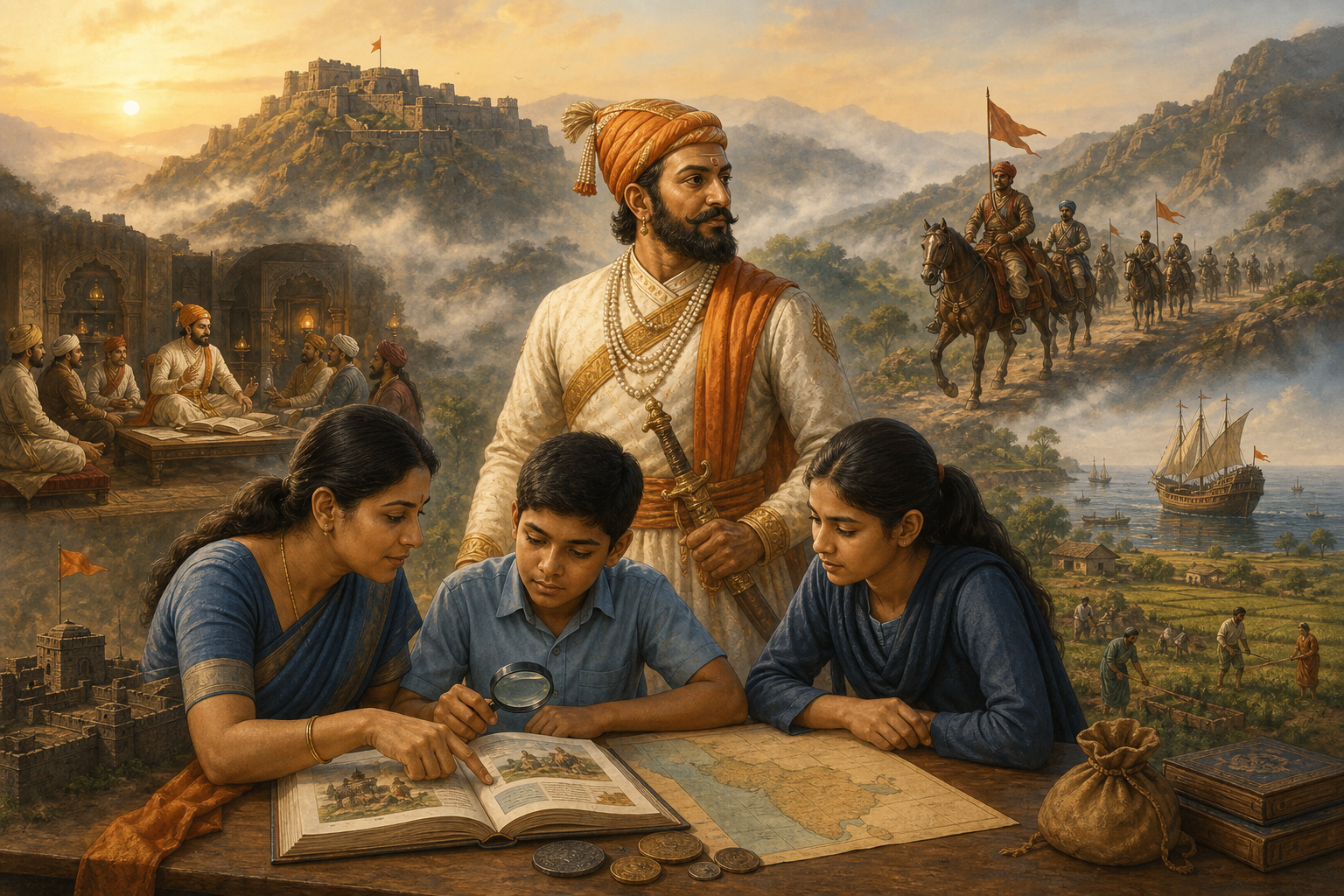
If you are opening the revised Class 8 history curriculum with your child or students, do not let the discussion collapse into a verdict on whether more pages about Shivaji Maharaj are simply good or bad. The useful question is what learners can now understand that a passing mention could never teach them.
The scale of the change is substantial. Coverage has grown from just 68 words to more than 2,200 words within a 22-page chapter titled Rise of the Marathas. That creates room to study chronology, decisions, statecraft, society and consequences. Whether the opportunity becomes real education depends on how the chapter is read and taught.
More pages should produce deeper questions, not a longer memory test
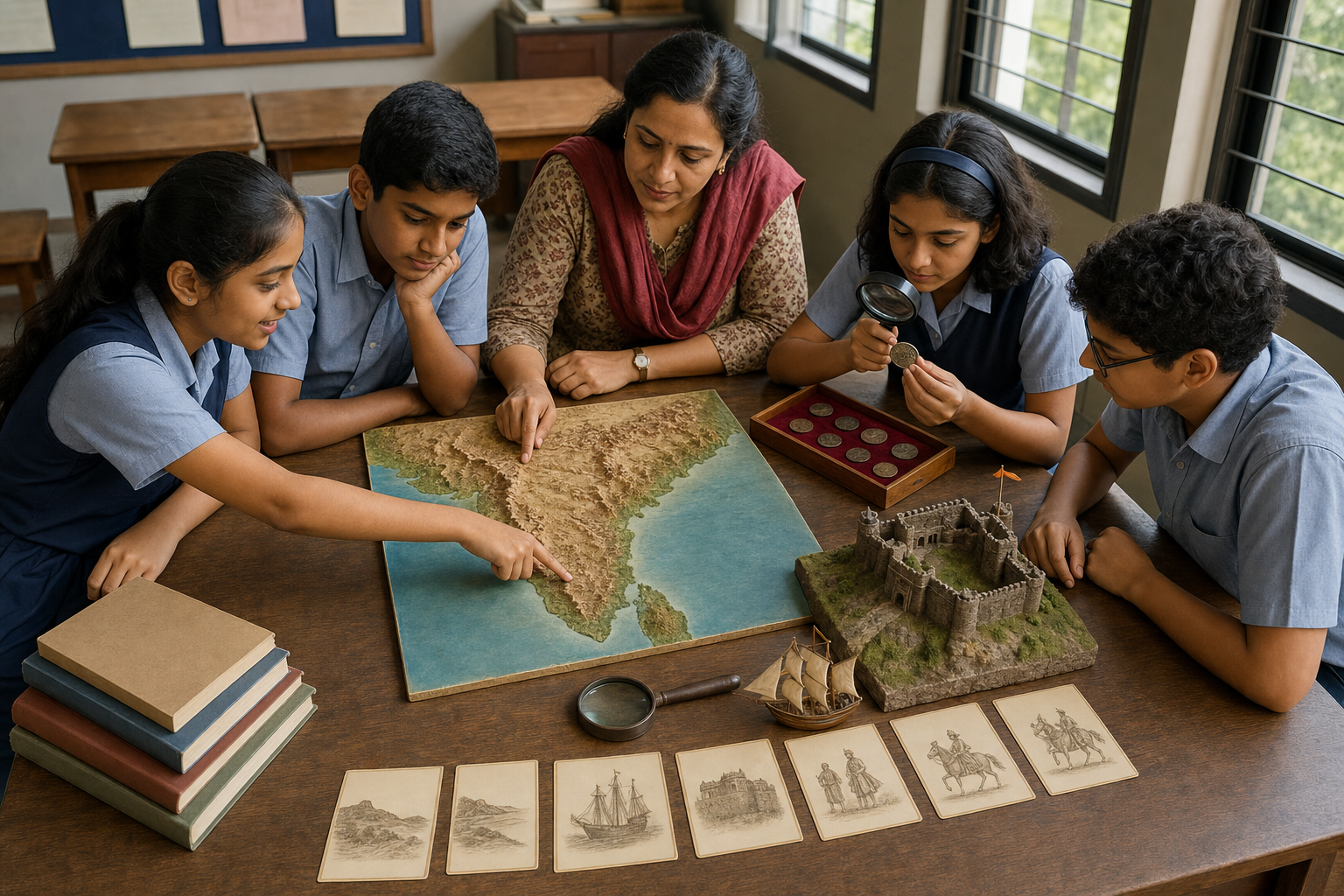
A brief mention usually supports recognition: the student remembers a name and perhaps associates it with a movement or period. A sustained chapter can support explanation. The learner can follow a sequence, identify conditions behind change, examine choices made by historical actors and connect those choices to later developments.
That distinction should set the standard for the revised curriculum. Do not judge success by how many additional facts a student can reproduce. Look for whether the student can do the following:
- Reconstruct the main sequence of change without merely repeating textbook sentences.
- Explain how a condition, decision and consequence are connected.
- Identify where the chapter discusses leadership, administration, society or regional change.
- Separate a fact stated in the text from an interpretation built from that fact.
- Support a judgement about leadership with evidence rather than admiration alone.
This is why the expansion matters pedagogically. Length is not an achievement by itself, but it permits the continuity and cause-and-effect reasoning that compressed coverage tends to exclude. If the student still leaves with only a list of names, the additional space has not been used well.
Read Shivaji Maharaj as a maker of history, not an isolated personality
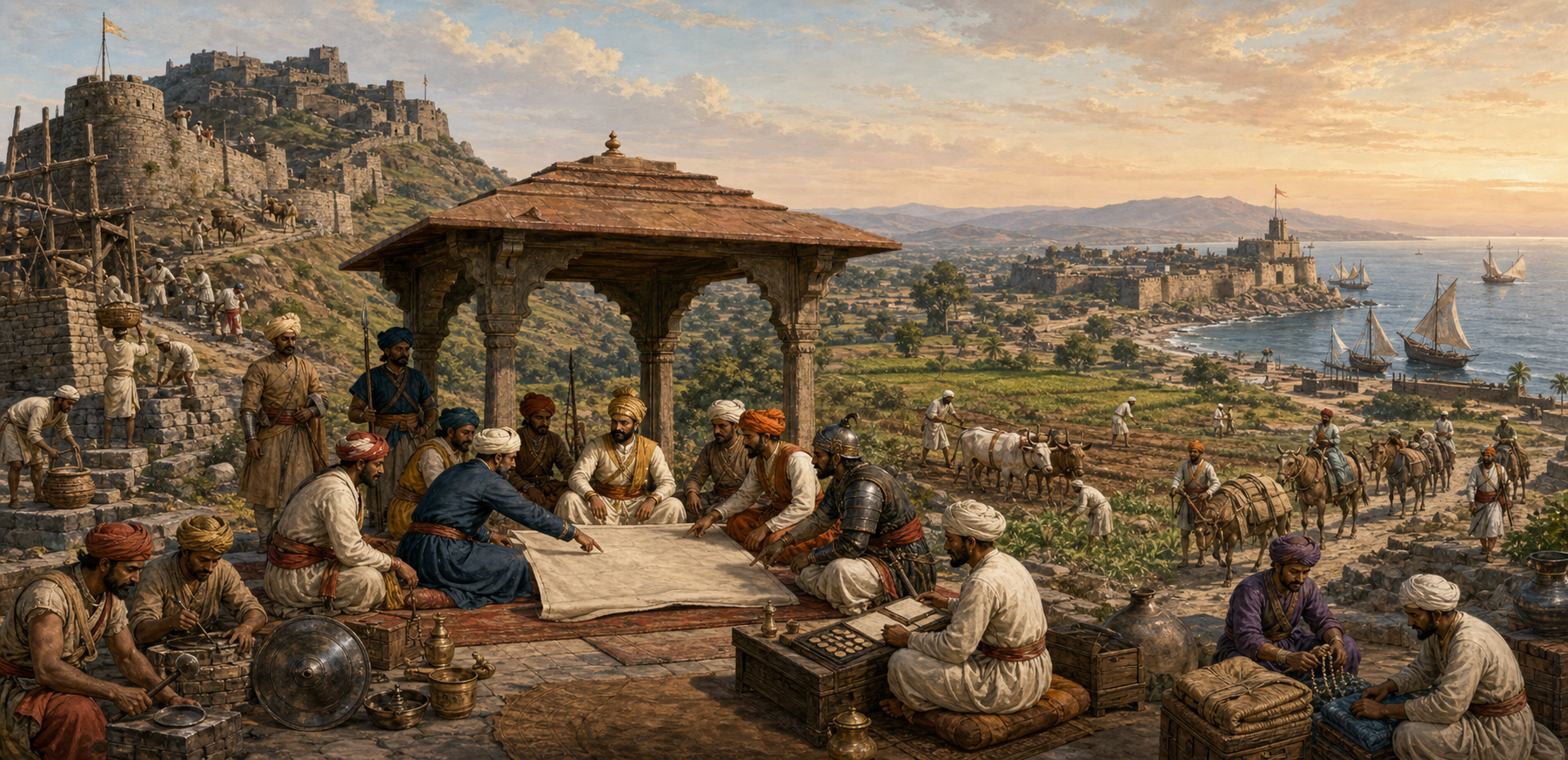
Shivaji Maharaj properly stands at the centre of this subject, but the chapter title matters. Rise of the Marathas places his leadership within the emergence of the Marathas as a major force in early modern India. The learner therefore needs to understand both the person and the historical process.
Whenever the text describes an action, ask what situation made that action necessary. Then ask what changed because of it. This prevents the student from treating courage as if it operated outside circumstances. It also prevents the opposite error of discussing large social forces while making individual decisions seem irrelevant.
Statecraft should be read in the same disciplined way. A textbook reference to governance or administration is not merely another fact to underline. The student should identify the problem being addressed, the method chosen, the result described and any limitation the assigned text reveals. Where the chapter does not supply enough evidence, the honest answer is that the question remains open.
The regional setting also deserves attention. A strong reading asks how change developed within a particular society and how it affected a wider Indian landscape. That is more useful than treating regional history as a detachable appendix to a supposedly separate national story. It helps the student notice how Indian history is formed through the interaction of regions, communities, political choices and cultural continuities.
Use a repeatable method to work through the expanded chapter

A longer chapter can overwhelm a Class 8 learner if every paragraph appears equally important. The following method turns the reading into a set of manageable intellectual tasks. It works for home study as well as classroom preparation.
- Map the sequence before memorising details. On the first reading, record only the order in which the chapter presents major conditions, actions and changes. Use the chapter’s own time markers and do not insert material from memory or social media.
- Build a causal chain. For each major development, write four labels in the margin: condition, decision, response and outcome. Some passages will not supply every element. A blank is better than an invented connection.
- Keep a statecraft ledger. When the chapter discusses leadership or governance, note the problem, the action taken, the stated result and the trade-off, if one appears. This changes vague praise into analysis of how authority was exercised.
- Mark the level of each statement. Label a statement as text, inference or value judgement. Text means the claim is directly present in the assigned material. Inference means the learner has connected facts. Value judgement means the learner is evaluating conduct. None of these categories is forbidden, but they should never be confused.
- Finish with a teach-back. Close the book and explain how the chapter moves from its starting conditions to the rise named in its title. Reopen the chapter only after the explanation is complete, then correct missing links rather than rewriting everything.
This method gives parents a better way to help than asking, “Have you learned the chapter?” Ask the child to show the causal chain. If an arrow connects two events, ask which sentence or passage justifies it. If the child cannot find support, the arrow should be revised, qualified or removed.
Teachers can use the same method to move discussion beyond recitation. Put a claim on the board, request textual evidence, invite a counter-question and then let the class refine the claim. The aim is not to force uncertainty into every conclusion. It is to show students that historical confidence should grow from evidence and reasoning.
Keep Dharmic pride and historical discipline on the same side
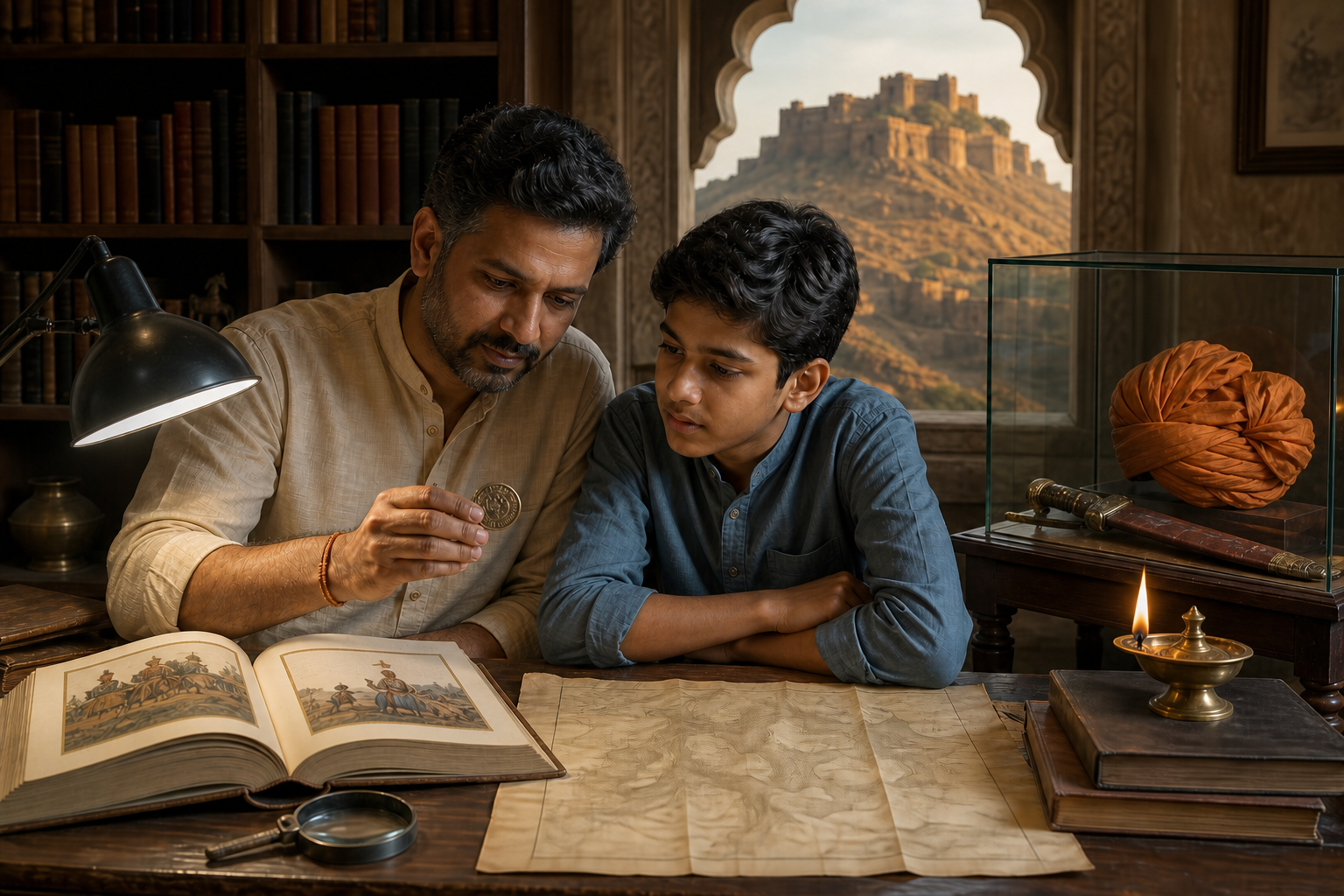
A pro-Hindu understanding of Indian history does not benefit from lower evidentiary standards. It benefits from higher ones. If Shivaji Maharaj’s importance is taught through sequence, context, statecraft and consequences, the learner receives something more durable than ceremonial praise: an account that can be explained, defended and thoughtfully evaluated.
A Dharmic reading can legitimately ask where courage, ethical leadership and service appear in public life. The fuller curricular treatment creates space to examine such shared values alongside statecraft and society. But these values should function as questions for inquiry, not as automatic labels attached to every action.
For example, “Shivaji Maharaj was a great leader” is a conclusion, not yet an analysis. Ask which choices support that judgement, what consequences followed and what evidence the chapter supplies. The respectful form of study is not to suspend criticism. It is to make praise precise.
The wider Dharmic frame also needs care. Hinduism, Buddhism, Jainism and Sikhism should not be flattened into interchangeable traditions. Students can still notice civilizational currents such as duty, ethical restraint, courage, service and responsibility toward collective life. The useful comparison identifies a shared concern while respecting differences in doctrine, history and expression.
There are several common ways to lose this balance. Turning the chapter into a tribute alone removes causation. Treating greater length as automatic proof of completeness removes evaluation. Replacing the assigned text with unsupported online claims removes evidence. Demanding memorisation before the learner understands the structure removes meaning. Each failure can be corrected by returning to the same questions: What is the claim, what supports it, what changed and what remains uncertain?
Key takeaways
- The revision is a major expansion: Shivaji Maharaj’s coverage has moved from 68 words to more than 2,200 words in a 22-page Rise of the Marathas chapter.
- The educational gain should be measured through chronology, causal reasoning and evidence-based judgement, not the quantity of memorised detail.
- The chapter’s scope calls for studying Shivaji Maharaj’s agency together with Maratha state formation, society and regional change.
- Students should distinguish statements found in the text from their own inferences and moral evaluations.
- Dharmic pride becomes stronger when admiration is tied to specific decisions, consequences and evidence.
When you next open the chapter, begin with a blank sheet headed Conditions, Decisions, Consequences and Evidence. Fill it only from the assigned text. Then ask the learner to make a clear judgement about Shivaji Maharaj and show how the evidence supports it. That small discipline is how expanded curricular space becomes serious historical education.
References
