
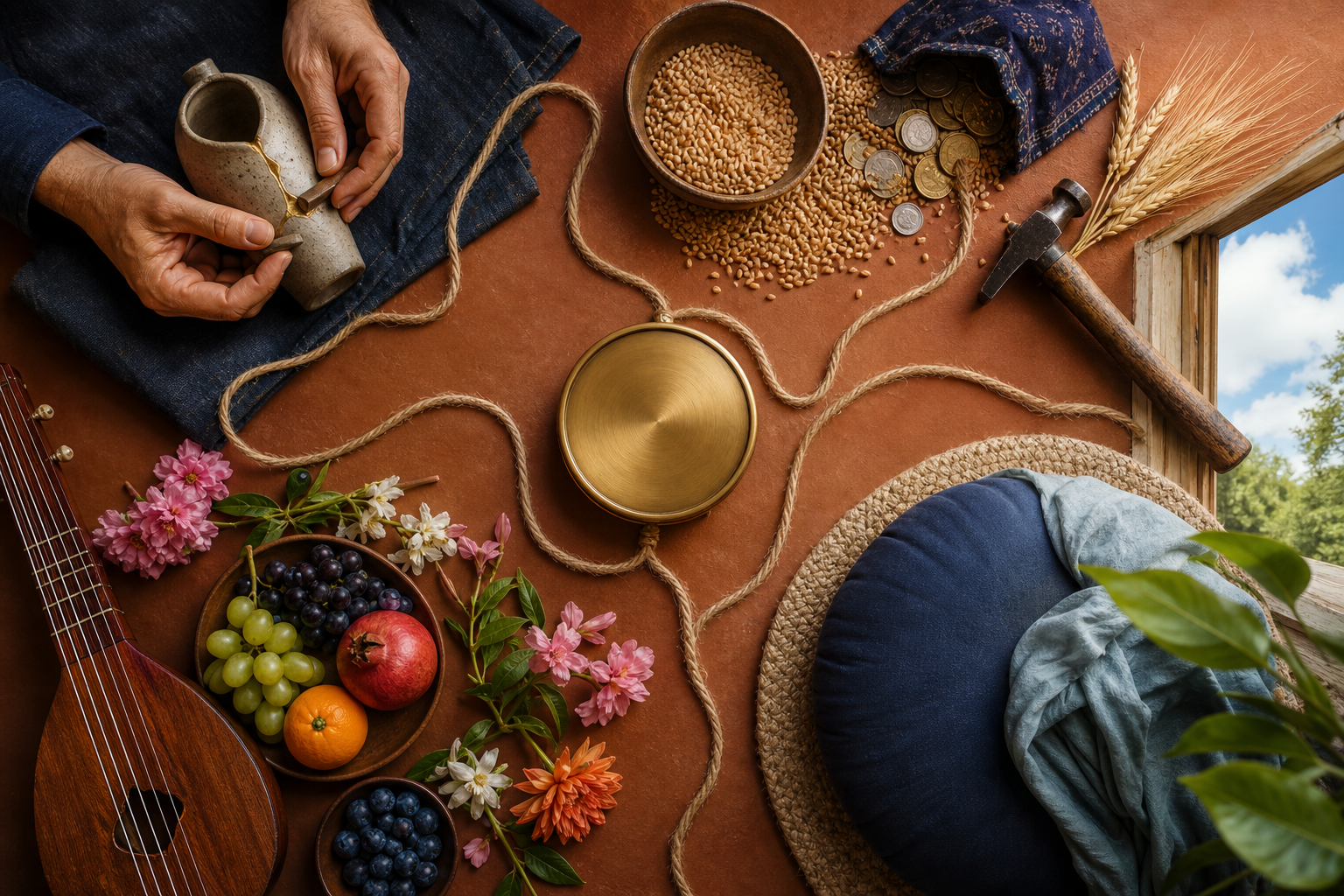
You know the scene: Vishnu rests upon Ananta Shesha in the cosmic ocean, while a lotus rises from His navel and carries Brahma. But what, exactly, are you being asked to see? Is this a divine genealogy, a sequence of events, or a symbolic account of why creation can exist at all?
The most useful approach is to read the relationships before trying to reconstruct a timeline. Vishnu is still. The lotus emerges. Brahma appears upon it. That arrangement distinguishes the sustaining ground of existence from the creator who brings forth the ordered cosmos.
Begin with relationships, not a literal timeline
Padmanabha is an epithet of Vishnu formed from padma, the lotus, and nābha or nābhi, the navel or life-giving center. Its meaning is not merely that Vishnu possesses an unusual bodily feature. The name identifies Him as the one from whose center the lotus of creation arises.
In the Puranic scene associated especially with the Bhagavata Purana and Padma Purana, Vishnu reclines upon Ananta Shesha in the cosmic ocean as a lotus emerges from His navel and bears Brahma. Brahma is the creator, but he does not appear as an independent first principle. His creative office is carried by a lotus whose own origin lies in Vishnu.
This is why Vishnu’s repose matters. Creation does not begin with panic, collision, or a deity straining to manufacture something outside Himself. The cosmos unfolds from a center that remains composed while sustaining what proceeds from it. Stillness here is not inactivity. It is inexhaustible presence.
Key takeaways
- Padmanabha means lotus-naveled Vishnu: the lotus of creation issues from His central, life-giving point.
- Brahma’s place on the lotus identifies his role as creator while showing that creative activity depends upon Vishnu’s sustaining presence.
- Vishnu’s reclining posture presents cosmic order as an effortless unfolding from a serene ground, not as the result of agitation.
- The composition should be read as a relationship among source, manifestation, and created order, not as ordinary human anatomy enlarged to cosmic scale.
Let each element perform its own symbolic work
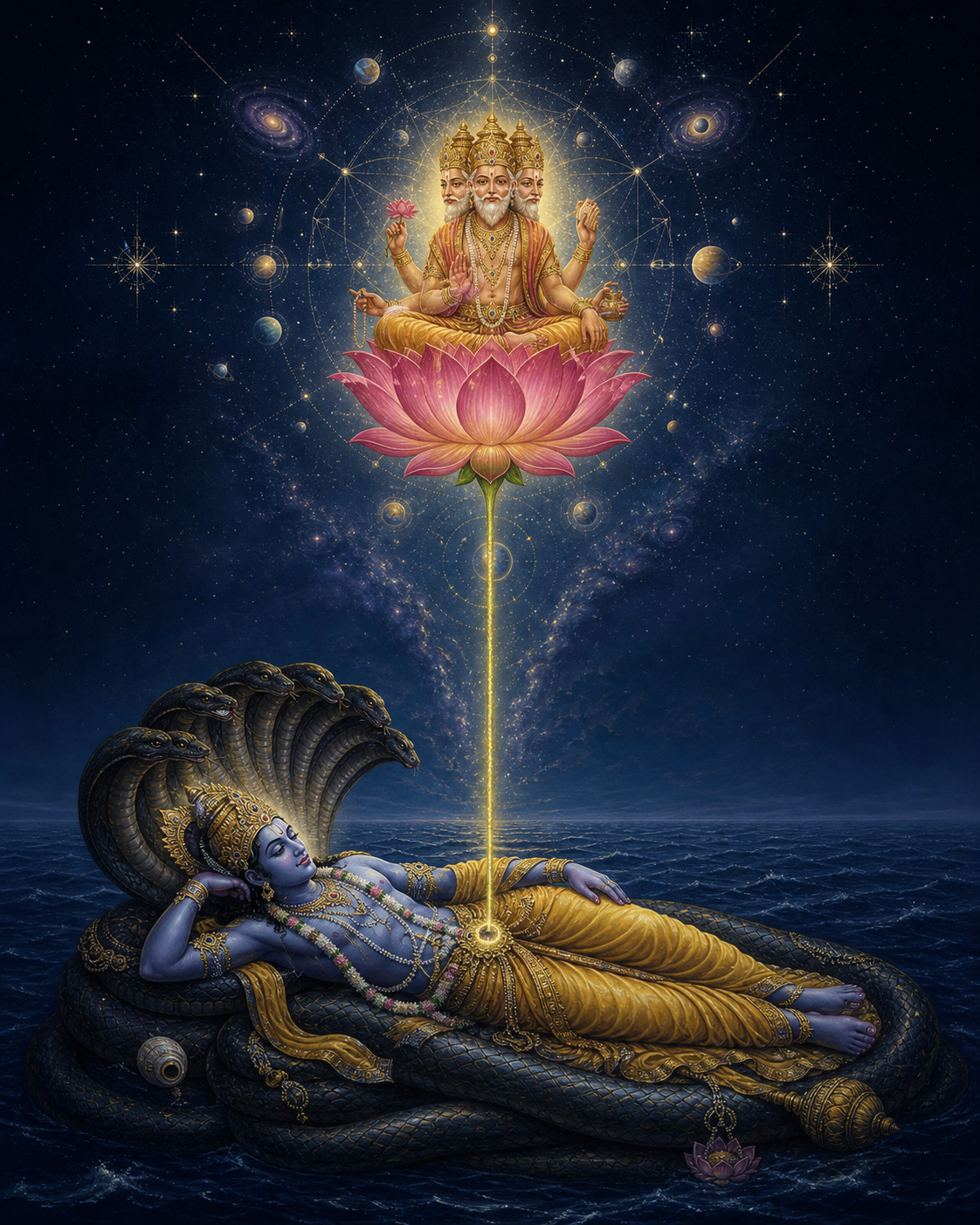
The scene becomes clearer when you resist turning every element into a synonym for the same vague idea. Vishnu, the navel, the lotus, and Brahma each do different work. Their placement creates a visual grammar.
| Element | Symbolic work | What to notice |
|---|---|---|
| Reclining Vishnu | The serene and sustaining ground from which manifestation proceeds | The center remains composed while the cosmos unfolds |
| The navel | Origin, nourishment, equilibrium, and the intimate center of life | The lotus is connected to Vishnu rather than floating independently |
| The lotus | Purity, wisdom, clarity, and emergence without contamination | It grows in water yet represents an unstained unfolding |
| Brahma upon the lotus | The creator operating within an order already grounded and sustained | The creator is carried by the manifestation arising from Vishnu |
| Ananta Shesha and the cosmic ocean | The setting of Vishnu’s cosmic repose | The entire composition belongs to a scale larger than an ordinary earthly event |
The navel is essential. It evokes both origin and nourishment: a living being is connected to its earliest bodily support through the navel, while the centered body also makes the navel a natural sign of balance. In Padmanabha, the immeasurable source of the cosmos is therefore shown through a form that is intimate and immediately recognizable. Transcendence is not presented as remoteness.
The lotus adds a second teaching. It is rooted amid water and organic conditions but opens without displaying the impurity of its surroundings. In Vaishnava creation symbolism, this makes the lotus more than a beautiful platform for Brahma. It portrays manifestation as capable of expressing purity and intelligible order even while appearing within the changing cosmos.
Keep the navel and lotus together. If you retain only the lotus, you get a general emblem of purity. If you retain only the navel, you get an abstract point of origin. Together they say that ordered, luminous manifestation remains joined to a sustaining center.
Why Brahma can be creator while Vishnu is the source
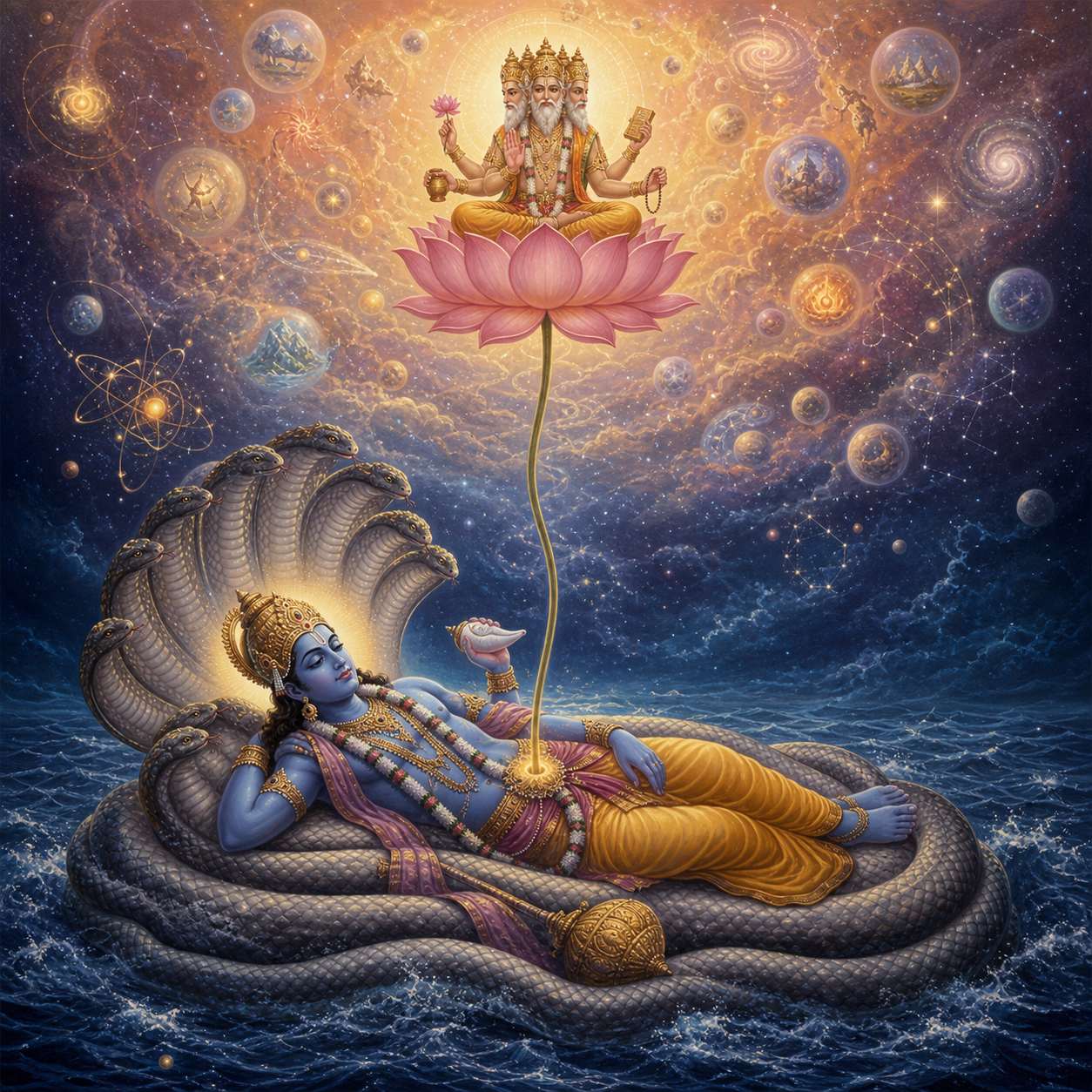
The apparent puzzle disappears once you distinguish a role within the cosmos from the ground on which that role depends. Brahma is identified as the creator. Vishnu is depicted as the one from whom the lotus bearing Brahma arises. These are complementary claims inside the symbolism, not rival answers to the same question.
If you ask who carries out the work of creation, the scene points to Brahma. If you ask what sustains the creator, the creative power, and the order in which creation becomes possible, it points back through the lotus to Vishnu. The tableau is therefore less concerned with what happened at the first instant of a clock than with what creation depends upon at every level.
This distinction also protects the image from several common misreadings:
- Biological literalism: The navel is not an attempt to describe cosmic anatomy. It uses the body’s sign of origin and nourishment to express a metaphysical relationship.
- Decorative reduction: The lotus is not present merely because it is auspicious or visually pleasing. Its purity and connection to Vishnu are necessary to the meaning.
- Divine rivalry: Brahma’s dependence in the composition does not make his creative role unreal. It places that role within a larger Vaishnava account of divine order.
- Passive-preserver reduction: Vishnu’s stillness does not mean that He enters the scene only after creation. The lotus makes His sustaining presence the very condition from which the creator appears.
Creation, preservation, and dissolution can consequently be understood as coordinated rhythms rather than disconnected operations. The image anchors those rhythms in Vishnu’s presence. What changes is the manifested order; what does not become exhausted is the ground that supports it.
This is also a practical way to hear the name during a recitation of the Vishnu Sahasranama. Do not let Padmanabha pass as one more item in a sequence. Pause mentally at its internal movement: center, lotus, Brahma, cosmos. A compact name then becomes a complete theological diagram.
Turn the image into a disciplined contemplation
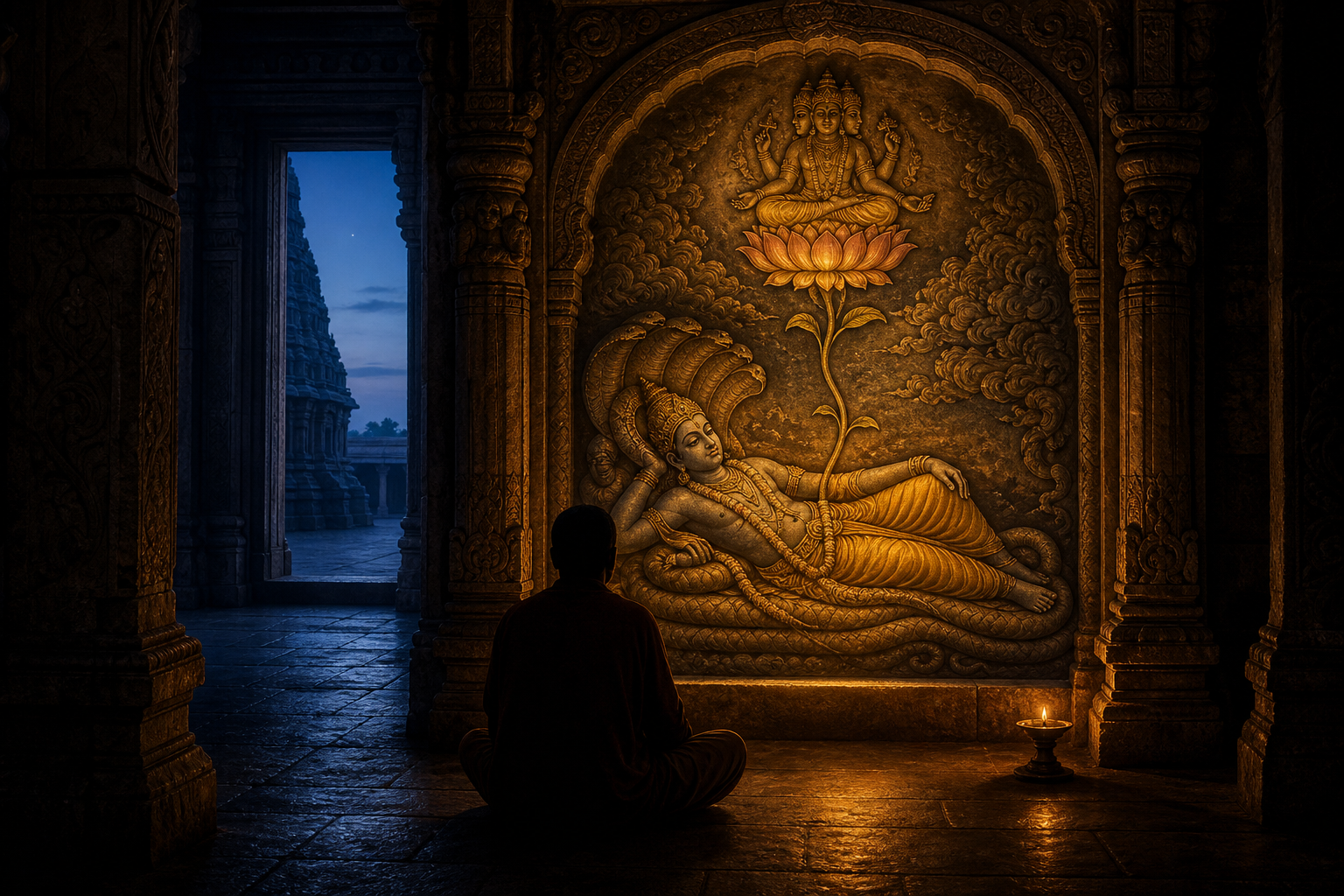
Padmanabha becomes useful in practice when contemplation preserves the structure of the image. The aim is not to escape responsibility or imitate divine repose. It is to distinguish your steady center from the duties, plans, and reactions emerging around it.
You can use the following as a simple contemporary contemplation based on the traditional symbolism:
- Settle your posture and allow attention to rest gently around the navel region. Do not force the breath or manufacture a sensation.
- Bring to mind Vishnu reclining upon Ananta Shesha. Notice that His stillness supports the scene rather than withdrawing from it.
- Visualize the lotus arising from the navel. Let it represent ordered manifestation: something can emerge without displacing or exhausting its source.
- Recall one responsibility currently provoking reactivity. Place it conceptually on the lotus as something that requires your care but is not the deepest center of your identity.
- Repeat the name Padmanabha in japa, then identify one concrete dharmic response: a truthful conversation, a duty completed carefully, restraint in speech, or help offered without seeking recognition.
The test of the contemplation is conduct. If it merely produces an attractive inner picture, it has stopped too early. The lotus should appear in the quality of the action that follows: clear without harshness, engaged without possessiveness, and responsible without agitation.
Yoga philosophy also associates the navel region with manipura and with qualities such as vitality, steadiness, and discernment. That resonance can support concentration, but the two frameworks should not be collapsed. Padmanabha is a Vaishnava theological and iconographic form; manipura belongs to a yogic map of the subtle body. You can let one illuminate the other without pretending they are identical teachings.
The same visual sequence can guide darśana. At the Sree Padmanabhaswamy Temple in Thiruvananthapuram, the reclining Vishnu makes this cosmic symbolism tangible. Whether you encounter the form in a temple or in a household image, begin with Vishnu’s repose, follow the lotus from its source, and then attend to Brahma. That order prevents the eye from treating the figures as unrelated sacred objects.
Recognize the shared lotus without erasing differences
The lotus travels widely across the dharmic traditions, but a shared symbol does not produce a single interchangeable theology. The responsible comparison asks what the lotus is doing in each setting.
- In the Padmanabha form: The lotus emerges from Vishnu, bears Brahma, and expresses pure, ordered creation grounded in the divine center.
- In Buddhism: The lotus commonly evokes awakening that arises without being stained by the mud of ignorance.
- In Jain traditions: It conveys purity and serene spiritual presence and is associated with Padmaprabha.
- In Sikh teaching: The lotus metaphor can express how a person lives amid worldly currents without becoming bound by attachment.
The family resemblance is real: purity need not require flight from the conditions of ordinary existence. Yet the surrounding questions differ. Padmanabha uses the lotus to explain the relation of Vishnu, Brahma, and cosmic manifestation. Buddhist, Jain, and Sikh uses place the emphasis elsewhere. Respect begins by recognizing both the common vocabulary and the distinct sentence each tradition forms with it.
When you compare lotus symbolism across traditions, ask three questions: What is the lotus connected to? What appears upon or through it? What spiritual problem is it answering? Those questions reveal more than simply noting that every tradition values purity.
The next time you encounter Padmanabha, follow the image from the still center outward. Then bring that movement into your own day: establish what must remain grounded, identify what must be created, and let the quality of the source govern the quality of the action.
References
