
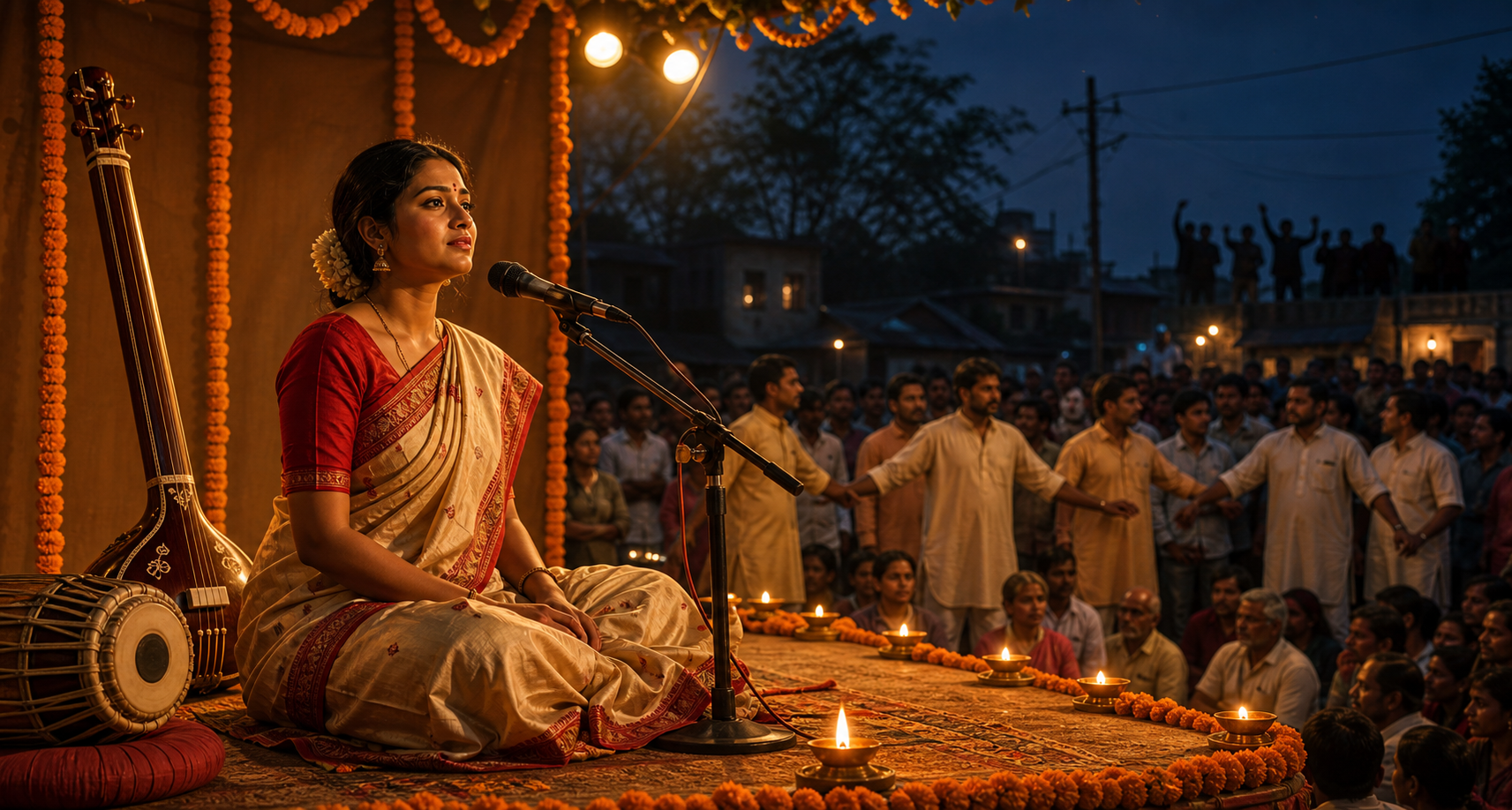
If you came to the Midnapore episode with one narrow question – can secularism be invoked to drive a Hindu devotional song from a public stage? – the answer is no. A listener may dislike the song, request another one, criticise the programme, or leave. The line is crossed when preference becomes abuse, intimidation, or an attempt to control the performer.
What you should defend is larger than one repertoire: the singer’s agency, a woman’s physical safety, the audience’s right to gather peacefully, and a plural order in which devotional and non-devotional music can both be heard. You can defend all four without prejudging an investigation or blaming an entire community.
Separate the reported incident from the final verdict

During a public performance in Midnapore, vocalist Lagnajita Chakraborty was reportedly confronted with the demand "No More Jago Maa, sing something secular" while performing a devotional song. Eyewitness accounts described verbal abuse and alleged physical intimidation. Police subsequently detained an accused person, and an investigation was underway.
Those details justify concern, but they do not all carry the same evidentiary weight. A witness allegation is not a judicial finding, detention is not conviction, and an investigation is a process rather than a verdict. If you discuss the incident, use the verbs that match its status: "reportedly confronted," "alleged intimidation," "detained," and "under investigation." Do not add physical contact, motive, or organised involvement unless evidence establishes it.
Precision is not timidity. Inflated claims make a legitimate concern easier to dismiss and can expose uninvolved people to suspicion. Excessive caution can cause a different failure by reducing alleged intimidation to a mere disagreement over music. Keep the focus where it belongs: a performer was entitled to sing without being coerced, and the allegation deserves a fair investigation.
Secularism protects devotional music; it does not erase it
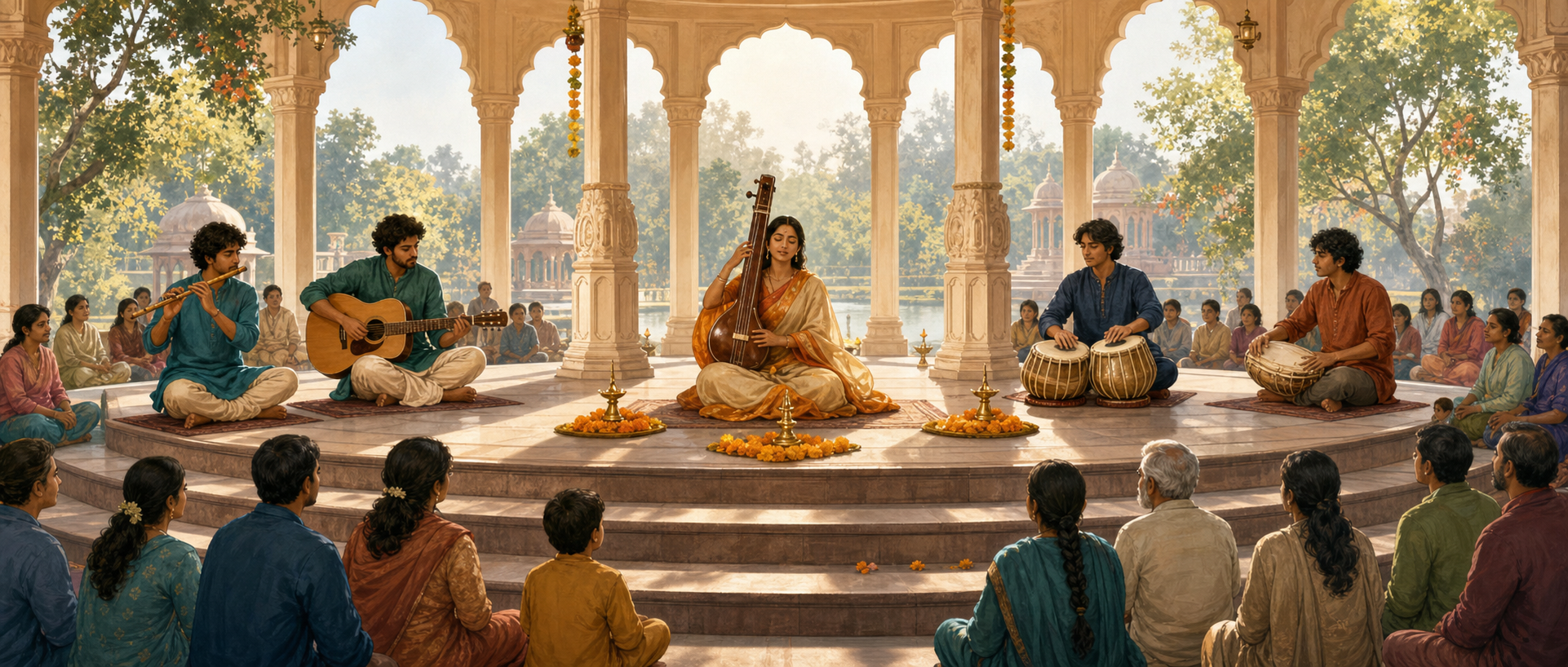
The word "secular" was reportedly used as though it gave one listener authority to replace a devotional selection. That reverses the purpose of pluralism. Secularism in a diverse society does not require a culturally empty stage. It makes room for people of different faiths, and for people of no faith, without allowing any one of them to rule the stage through pressure.
Articles 19 and 25 of India’s Constitution provide the relevant principles of expression, conscience, and religion. Their precise legal application depends on the facts and setting, but the civic principle is plain: devotional and secular expression can coexist. Hindu devotional art does not become less worthy of protection merely because it openly names the sacred.
Jago Maa carries a recognisable place in Bengal’s devotional repertoire and is associated with Durga. Forcing it out would not produce neutrality. It would substitute one person’s ideological preference for the artist’s judgement and the cultural character of the song.
You can use four distinctions whenever a similar dispute arises:
- A request asks for a song and accepts that the artist may decline.
- Criticism expresses disagreement without threatening the performer or disrupting the event.
- Curation belongs to the artist and organiser within the programme they agreed to present.
- Coercion uses abuse, threats, restricted-stage access, or physical intimidation to stop or change the performance.
The first three can exist in a free cultural life. The fourth attacks the freedom that makes disagreement possible. If you object to a programme, you can speak to the organiser, decline to attend, publish a measured criticism, or organise another event. You do not acquire a veto by becoming the most intimidating person in the venue.
The same rule must operate in every direction. A singer may choose Jago Maa, a folk composition, or a non-devotional song. Defending Hindu expression does not require silencing someone else’s lawful repertoire. It requires protecting the artist’s choice consistently – especially when that choice is visibly Hindu and therefore vulnerable to being mislabelled as incompatible with secular public life.
Build the safety response before anyone approaches the stage
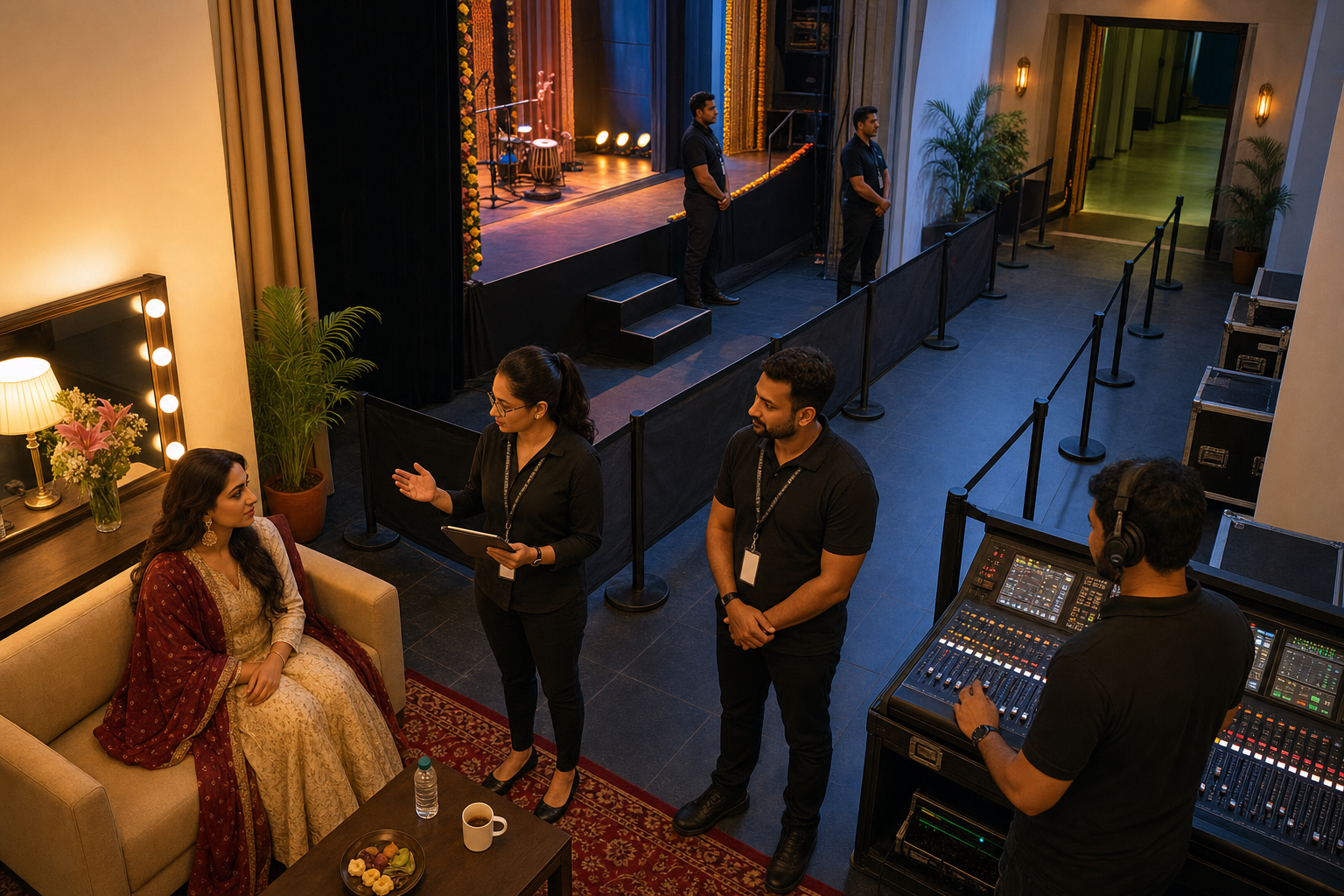
A confrontation involving an agitated spectator and a woman performer is a safety incident before it is an ideological debate. Organisers lose valuable time when nobody knows who may pause the programme, who controls access, or who contacts security. The remedy is a short plan agreed before the doors open.
Before the performance
- Name one incident lead. This person must have clear authority to pause the programme, direct volunteers, and contact venue security or police when necessary.
- Control the path to the stage. Position volunteers or security where an audience member would have to cross into a restricted area, rather than relying on intervention after the person reaches the performer.
- State the conduct rule. Tell the audience that song requests are discretionary and that abuse, threats, intimidation, and unauthorised approaches to the stage will end participation in the event.
- Agree on pause and exit decisions. The performer, stage manager, and security lead should know who signals a pause, where the safe exit is, and who decides whether the programme can resume.
- Give complaints a safe route. Identify the person or desk that will receive audience concerns. A visible grievance channel reduces the excuse for confronting the artist directly.
When a disruption begins
- Respond to conduct, not viewpoint. A respectful request from the audience is not a security incident. Abuse, threats, continued disruption, or movement into a restricted stage area requires intervention regardless of the person’s politics or religion.
- Protect the performer before debating the demand. Do not turn the microphone into a forum for negotiating with an intimidating spectator. Pause the performance and create distance if safety is uncertain.
- Divide the jobs. One designated person should manage the disruption, another should contact security or police if warranted, and another should note the time, words used, immediate witnesses, and available recordings.
- Preserve original evidence. Keep unedited recordings and first-hand notes. Edited clips may omit the sequence that investigators need to understand what happened.
- Resume only with the artist’s agreement. Restoring the programme should not mean pressuring a shaken performer to continue for the sake of appearances.
If you are in the audience
Your first duty is to avoid creating a second confrontation. Alert the event lead or security instead of surrounding the accused person. If there is immediate danger, move to safety and seek professional help rather than prioritising a recording.
- Write down only what you personally saw and heard. Separate that from what another spectator told you.
- If it is safe and permitted to record, retain the original file with its full sequence.
- When giving an account, distinguish description from inference: exact words and movements are observations; motive and communal intent are interpretations until supported by evidence.
- Do not publish an unverified name, affiliation, or allegation merely because it is circulating online.
- Do not join a retaliatory crowd. A counter-mob can increase danger, obscure evidence, and turn protection of the artist into another public-order problem.
Defend Hindu expression without assigning collective guilt
A firm pro-Dharma response should neither dilute the alleged wrongdoing nor enlarge it beyond the evidence. The conduct of an accused individual does not become the intention of every person who shares that individual’s religious identity. At the same time, calls for communal calm must not become a way to avoid examining possible hostility toward Hindu devotional expression.
If evidence establishes that the demand was motivated by hostility to a Hindu song, that motive should be named plainly. But establish the sequence in the right order: identify the conduct, examine the evidence of motive, determine individual responsibility, and then require an institutional response. Starting with collective blame skips every safeguard that protects truth.
This is also the more effective form of cultural advocacy. A communal argument can quickly displace the singer and her freedom from the centre of the discussion. A precise demand keeps attention on responsibilities that can be enforced: investigate the alleged harassment, protect the performer, apply due process, secure future stages, and ensure that Hindu devotional music is not treated as an intrusion into Bengal’s own cultural life.
Dharmic values give us a disciplined way to hold firmness and restraint together. Ahimsa does not mean leaving an artist undefended. It means restraining aggression without manufacturing another cycle of aggression. Compassion does not mean pretending that intimidation is harmless. It means refusing to punish people who did not commit it. Dharma requires institutions to protect dignity while judging the accused through evidence.
If you speak for an organisation, issue a statement with four parts: affirm the performer’s artistic freedom and safety; describe unsettled claims as allegations; support investigation and due process; and reject retaliation or collective blame while demanding concrete safeguards. Missing any one of those parts leaves the response vulnerable either to minimisation or escalation.
Key takeaways
- Secularism protects the freedom to perform devotional music as well as non-devotional music; it is not a command to remove Hindu expression from public culture.
- A song request remains legitimate only while the performer is free to decline it. Abuse or intimidation turns preference into coercion.
- Police detention signals an official response, not proof of guilt. Preserve the distinction between an allegation, an investigation, and a verdict.
- Every public performance needs a named incident lead, controlled stage access, a clear conduct rule, and a pause-and-exit plan agreed with the artist.
- Witnesses help most by protecting safety, preserving original evidence, and separating what they observed from what they inferred.
- Possible anti-Hindu motive should be investigated and named if established, while responsibility remains with the people whose conduct the evidence supports.
Before the next community concert, ask one practical question: who has the authority to stop an unauthorised approach to the stage? If the organiser cannot answer, press for a plan before the doors open. Artistic freedom is tested when a performer sings something a listener dislikes and still finishes safely. Let Jago Maa and a secular composition share Bengal’s cultural stage by artistic choice, not by the permission of the loudest heckler.
References
