

If your panchang shows two Jyeshtha months in 2026, it is not a printing error. The first is Adhika or Pratham Jyeshtha, while the following one is Nija Jyeshtha. Your immediate task is to identify which dates your own regional calendar assigns to each month.
You do not need an elaborate austerity programme to observe Purushottam Maas meaningfully. Confirm the local dates, choose a sustainable sankalpa, and give the additional month a clear devotional purpose.
Why Jyeshtha appears twice in 2026
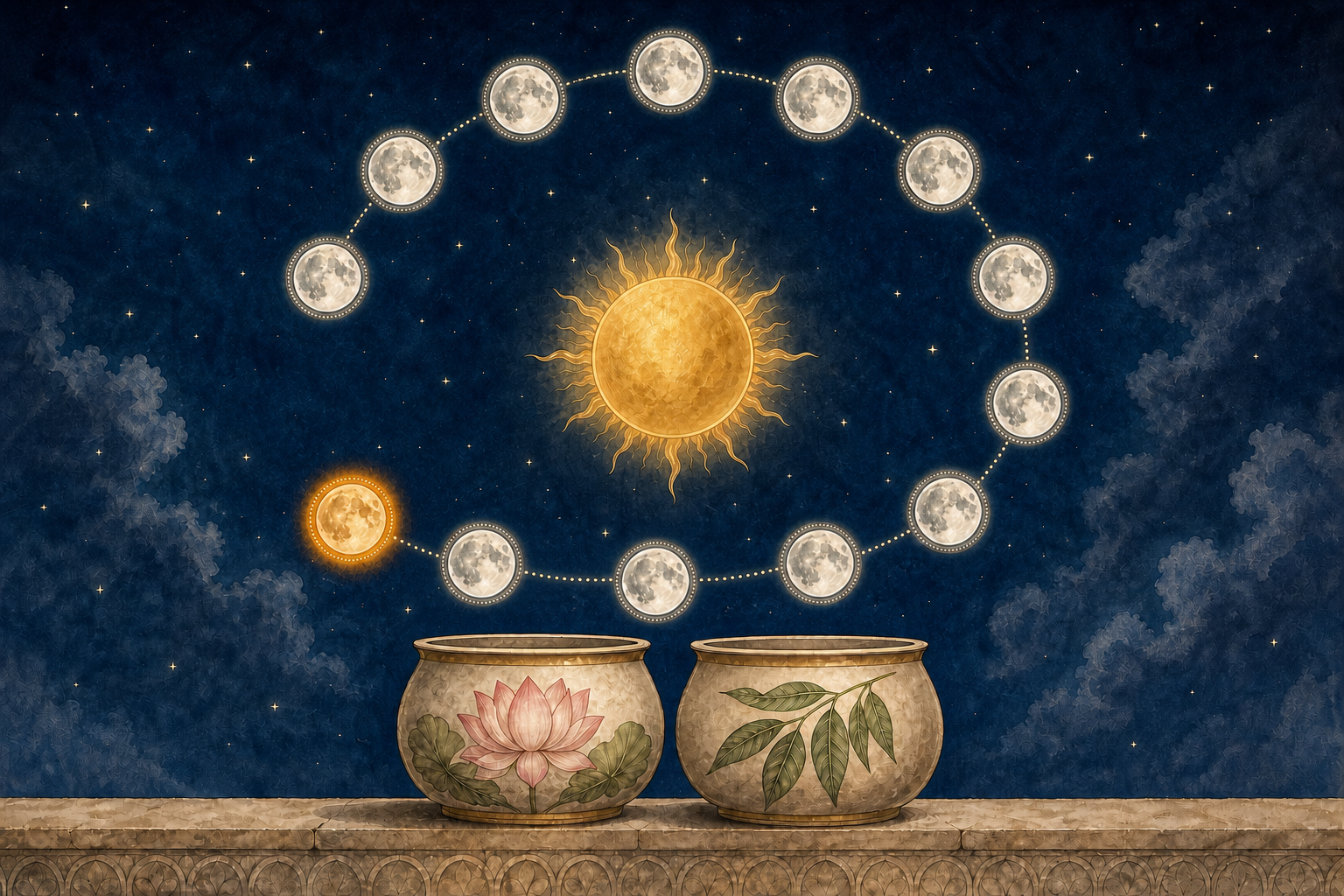
The Hindu calendar coordinates lunar months with the solar year. An intercalary month is inserted when a lunar month passes without a Surya Sankranti, meaning that the Sun does not enter a new rashi during that lunar month. This adjustment keeps the calendar’s lunar observances connected with their proper seasonal setting.
In the 2026-2027 Parabhava Nama Samvatsara, that adjustment produces two consecutive Jyeshtha months. The additional month comes first; the regular Jyeshtha follows it. The names you encounter depend on region and sampradaya:
- Adhika Jyeshtha: the additional Jyeshtha created by the calendrical adjustment.
- Pratham Jyeshtha: another practical label for the first of the two Jyeshtha months.
- Nija Jyeshtha: the regular Jyeshtha that follows the additional month.
- Purushottam Maas: the devotional name widely used in Vaishnava traditions, emphasizing dedication to Bhagavan Vishnu.
- Adhika Masam or Adhik Maas: general regional forms of the term for an intercalary lunar month.
- Mala Maas: another traditional name, though it should not be mistaken for a declaration that the month lacks spiritual value.
When relatives, temples, or calendars use different names, compare the sequence before assuming that they disagree. If one calendar says Pratham Jyeshtha and another says Adhika Jyeshtha, both may be identifying the same first month. The distinction that matters is whether a date falls in the additional Jyeshtha or the subsequent Nija Jyeshtha.
How to confirm the correct dates where you live
There is no responsible universal start-and-end line to copy without knowing your location and calendrical tradition. Adhik Maas boundaries can vary with geography, time zone, local sunrise, and the Amanta or Purnimanta system. A date circulated for one region may therefore be unsuitable for a family following another regional panchang.
Use this sequence before writing the month into your household calendar:
- Choose the place of observance. Use the city where you will actually perform the vrata, not the location of a temple calendar found online.
- Choose one trusted panchang. A regional panchang, temple almanac, or community calendar should be your primary reference throughout the month.
- Identify its month system. Check whether it follows Amanta or Purnimanta reckoning. Do not combine the opening date from one system with the closing date from another.
- Locate both Jyeshtha labels. Mark which one is Adhika or Pratham and which one is Nija. This prevents later confusion when a festival notice says only “Jyeshtha.”
- Verify each observance separately. Check the locally assigned tithi, paksha, nakshatra when relevant, and sunrise rule rather than assuming that every annual observance simply occurs twice.
- Confirm your interpretation locally. If your family’s custom matters, ask the temple or acharya which panchang and month convention the community follows.
A useful question for a temple is not merely, “When does Purushottam Maas begin?” Ask which panchang is being used, whether Purushottam Maas means the first Jyeshtha in that calendar, and which local civil dates contain its opening and closing tithis. That wording exposes the assumptions behind the answer.
Once you have confirmed the boundaries, copy them into the calendar your household actually checks. Add the relevant paksha and vrata dates from the same panchang. Mixing calendars midway through the month is a common way to turn a simple observance into an avoidable dispute.
Build a Purushottam Maas sankalpa you can keep
Purushottam Maas is especially suited to japa, paath, vrata, daana, and seva. The mistake is to treat the extra month as a reason to announce several demanding practices at once. A modest discipline maintained consistently is more useful than an ambitious list abandoned after the opening enthusiasm fades.
Build your sankalpa from four parts:
- Select one devotional anchor. Depending on your lineage, this could be daily japa, Vishnu Sahasranama, or a manageable portion of Srimad-Bhagavatam. Keep the choice clear enough that you always know whether it has been completed.
- Attach it to an existing household cue. Perform it after morning puja, at the usual evening lamp, or at another stable point in your day. A fixed cue removes the daily negotiation over when to begin.
- Add one form of restraint. Simplify a nonessential habit or consumption pattern that normally scatters your attention. The restraint should release time and awareness for sadhana, not merely create discomfort.
- Connect worship with service. Decide in advance how daana or seva will be expressed. Giving money, useful goods, food, attention, or labour should respond to a genuine need rather than becoming a last-minute gesture performed only to complete a ritual checklist.
Families can make the month easier to sustain by choosing a shared evening paath or seva commitment while allowing each person to keep an individual practice. Children can participate through a short prayer, respectful listening, or a concrete act of care. They do not need an adult-sized austerity imposed on them for the observance to matter.
A sattvic diet or food-related vrata is common in many homes, but devotion does not require unsafe fasting. If dietary restriction conflicts with your health needs or prescribed care, do not improvise. Seek appropriate medical guidance and ask your acharya for a non-food vrata, such as disciplined speech, reduced nonessential consumption, added paath, or seva.
Decide before the month begins what you will do after a missed day. The practical rule should be to resume at the next available opportunity, not to accumulate an intimidating debt of unfinished practice. Purushottam Maas is meant to restore attention to dharma, not turn remembrance into bookkeeping.
Know what to postpone and what should continue
Many Hindu traditions defer new material undertakings during Adhik Maas while encouraging worship, study, charity, and inner renewal. That distinction is more precise than saying that “nothing auspicious can be done.” The month redirects initiative; it does not suspend dharmic responsibility.
- Continue existing duties. Work, caregiving, promised obligations, and necessary household responsibilities do not become spiritually invalid because an intercalary month has begun.
- Review optional new undertakings. If a materially significant beginning can be scheduled freely, consult the same local panchang or family acharya you used to establish the month’s dates.
- Do not delay what is necessary. An urgent responsibility should not be neglected merely because the month is also called Mala Maas.
- Use the month for inward beginnings. Japa, scriptural reading, vrata, daana, seva, and the repair of neglected spiritual routines belong naturally to this period.
- Do not duplicate festivals by assumption. Two Jyeshtha months do not give you permission to invent a second occurrence of every annual observance. Follow the placement provided by your regional panchang.
This distinction also helps in a religiously diverse Dharmic family. Jain communities may undertake additional vrata and scriptural reading during an intercalary month, while Buddhist and Sikh traditions maintain their own lunar-linked sacred rhythms. The shared civilizational regard for sacred time does not make the rituals interchangeable. A household can share restraint, study, compassion, and seva while allowing each tradition to retain its own authority and form.
If two elders give different instructions, first check whether they follow different regional calendars or sampradayas. A disagreement about dates or permitted ceremonies may arise from calendrical convention rather than disregard for dharma. Establish the convention before debating the conclusion.
Key takeaways
- Jyeshtha occurs twice in 2026 because the lunisolar calendar inserts an additional month when a lunar month has no Surya Sankranti.
- The first month is Adhika or Pratham Jyeshtha; the following regular month is Nija Jyeshtha.
- Purushottam Maas is a widely used Vaishnava devotional name for the additional month.
- Your correct start and end dates depend on location, local sunrise, time zone, regional panchang, and Amanta or Purnimanta reckoning.
- Confirm every festival and vrata through one consistent local calendar rather than assuming that all Jyeshtha observances repeat.
- Choose one sustainable devotional practice, one meaningful restraint, and one form of daana or seva.
- Defer optional material beginnings when your tradition directs it, but continue necessary duties and existing responsibilities.
Open your local panchang before making a broad plan. Mark Adhika Jyeshtha and Nija Jyeshtha separately, confirm the boundaries with your temple or acharya, and write down a sankalpa simple enough to begin on the first locally observed day and maintain through the last.


References
