
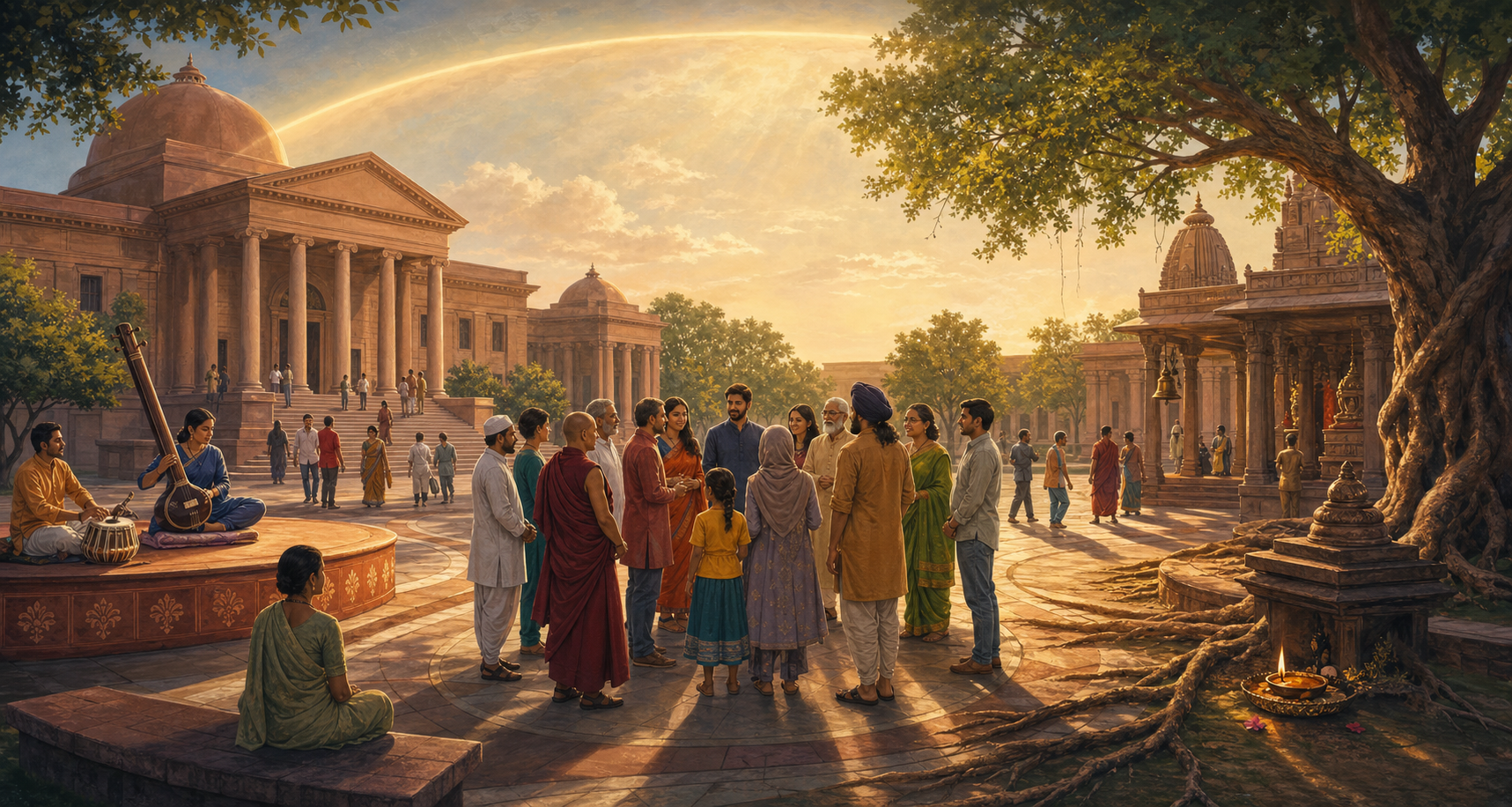
You see a judge attacked for a religious-freedom ruling or a singer threatened over a devotional song. Do you call it censorship, legitimate criticism, a public-order intervention, or partisan theatre? If you answer from identity alone, you can miss the real issue: who used coercive power, under what rule, and with what evidence.
You need a standard that works before you know which party, community, artist, or institution will benefit from it. The Dharmic case for freedom is strongest when it protects peaceful Hindu practice without turning liberty into a privilege reserved for Hindus. Here is a practical way to judge such disputes, speak about them accurately, and respond without making the conflict worse.
Three freedoms form one civic ecosystem

Institutional, artistic, and religious freedom are distinct, but they rarely survive separately. A religious community may possess a formal right to worship, yet that right becomes fragile if administrators can disregard court orders. An artist may be free on paper, yet unable to perform if an organizer can rush the stage or threaten violence. A judge may hold office securely in theory, yet feel pressure if political disagreement is repackaged as a removal campaign.
| Freedom | What it protects | Warning sign | Proper channel for disagreement |
|---|---|---|---|
| Institutional freedom | Independent, rule-bound decision-making by courts and public bodies | Threats, political retaliation, selective non-compliance, or punishment for an unpopular lawful decision | Appeal, review, reasoned criticism, investigation under the applicable standard |
| Artistic freedom | The ability to create and perform within lawful and agreed conditions | Physical intimidation, discriminatory interference, or a demand imposed through fear | Curatorial choice announced in advance, criticism, peaceful protest, or refusal to attend |
| Religious freedom | Peaceful worship, ritual, teaching, assembly, and devotional expression | Ideological dislike presented as a safety rule, or unequal treatment of comparable practices | Neutral regulation tied to a concrete legal or public-order need |
None of these freedoms means that every act must be permitted everywhere. Venues can establish programs. Authorities can address genuine threats. Courts can be criticized, and religious claims can be contested. The decisive question is whether a restriction follows a known law or policy, addresses an identifiable harm, and applies without communal favouritism.
This is where Dharma offers more than an identity label. Dharma concerns the right ordering of conduct and power. It asks rulers, institutions, communities, and individuals to remain within their proper duties. A Dharmic public order therefore cannot be reduced to whichever group can apply the most pressure. It requires restraint, truthful description, due process, and equal dignity.
Use a simple reciprocity check. Would you accept the same rule if it protected a Buddhist chant, Jain observance, Sikh kirtan, secular song, Muslim devotional performance, or Hindu procession? If changing the identity changes your standard, you are defending a faction rather than freedom.
Use six questions before deciding that freedom was violated
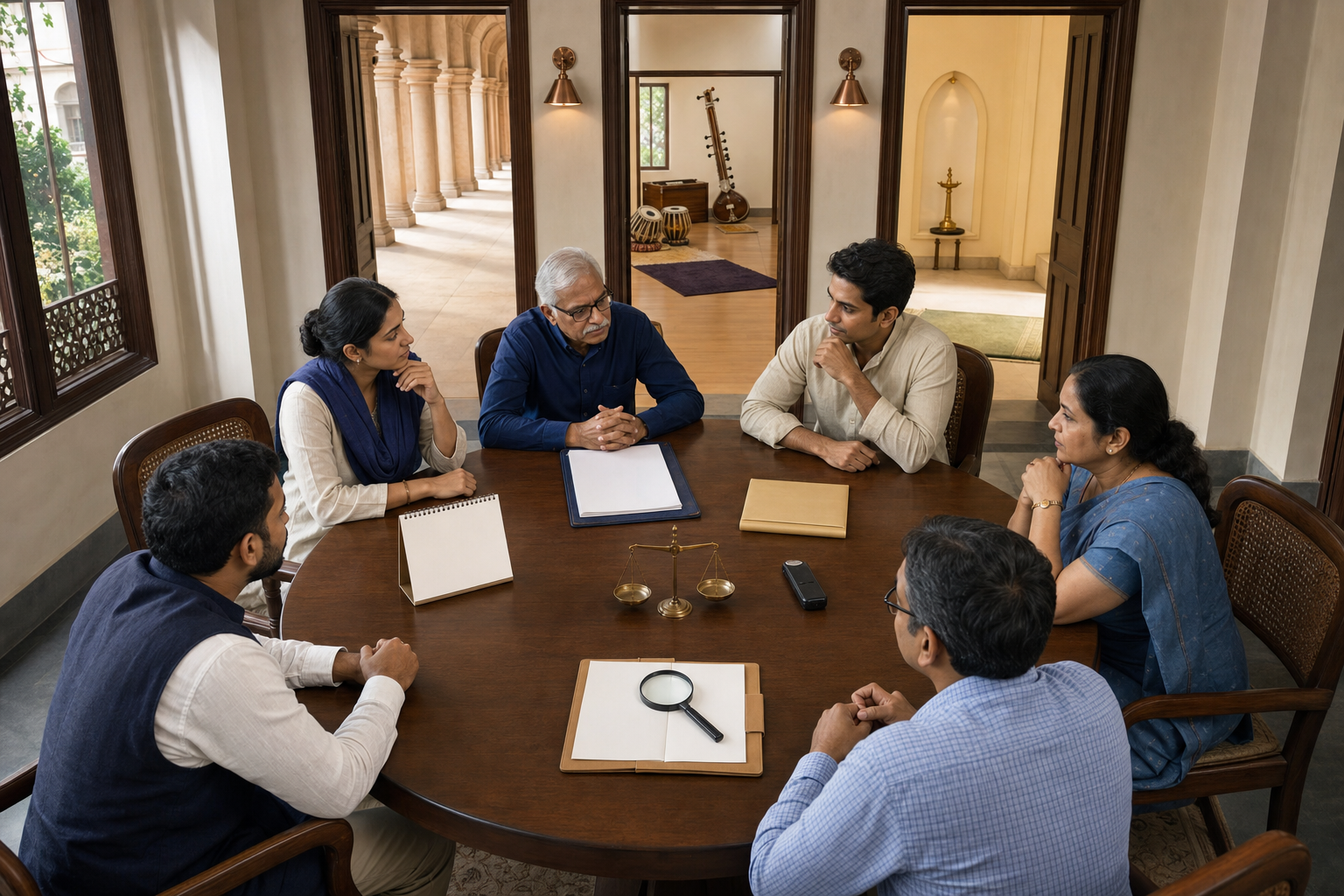
A short video or partisan caption usually collapses several separate questions into one emotional claim. Slow the sequence down. These six questions will tell you whether you are looking at criticism, regulation, coercion, or institutional retaliation.
- What exact act was restricted? Name the song, ritual, judgment, procession, exhibition, or speech. Do not substitute a vague category such as “religious activity” for the conduct that actually occurred.
- Who exercised power? A spectator expressing dislike is different from an organizer controlling the stage, a police officer issuing an order, an administrator withholding permission, or legislators seeking a judge’s removal. The greater the coercive power, the greater the obligation to give a lawful and reviewable reason.
- What rule existed before the dispute? Ask for the venue agreement, written policy, statutory basis, judicial order, permit condition, or safety protocol. A restriction invented after people object is less credible than a neutral condition communicated in advance.
- What evidence supports the claimed harm? Distinguish a concrete danger from ideological discomfort. “Some people may object” is not the same as evidence of an imminent safety problem. If public order is invoked, ask what specific risk was identified and how the proposed measure addresses it.
- Was the response narrower than the harm? Security, scheduling, crowd separation, or a limited operational condition may solve a real problem. Cancelling an entire observance or silencing a performer may be excessive when a less coercive measure would work.
- Would comparable cases receive comparable treatment? Compare the rule, venue, safety conditions, and conduct rather than merely comparing religions. Equality does not require unlike events to be managed identically, but officials should be able to explain any material difference.
Precise verbs matter as much as precise questions. An allegation is not a finding. An arrest is not a conviction. A removal motion is not proof of misconduct. A court’s protection of a ritual is not necessarily judicial endorsement of every theological or historical claim associated with that ritual. When you preserve those distinctions, you make accountability more credible rather than less urgent.
Be equally careful with the word “secular.” In a plural society, secular governance should prevent the state from imposing a faith or discriminating between communities. It should not function as a command to purge peaceful Hindu expression from public culture while leaving coercive conduct unexamined. Devotional and non-devotional art can share civic space; neither needs to erase the other.
Two disputes show where the freedom test becomes demanding
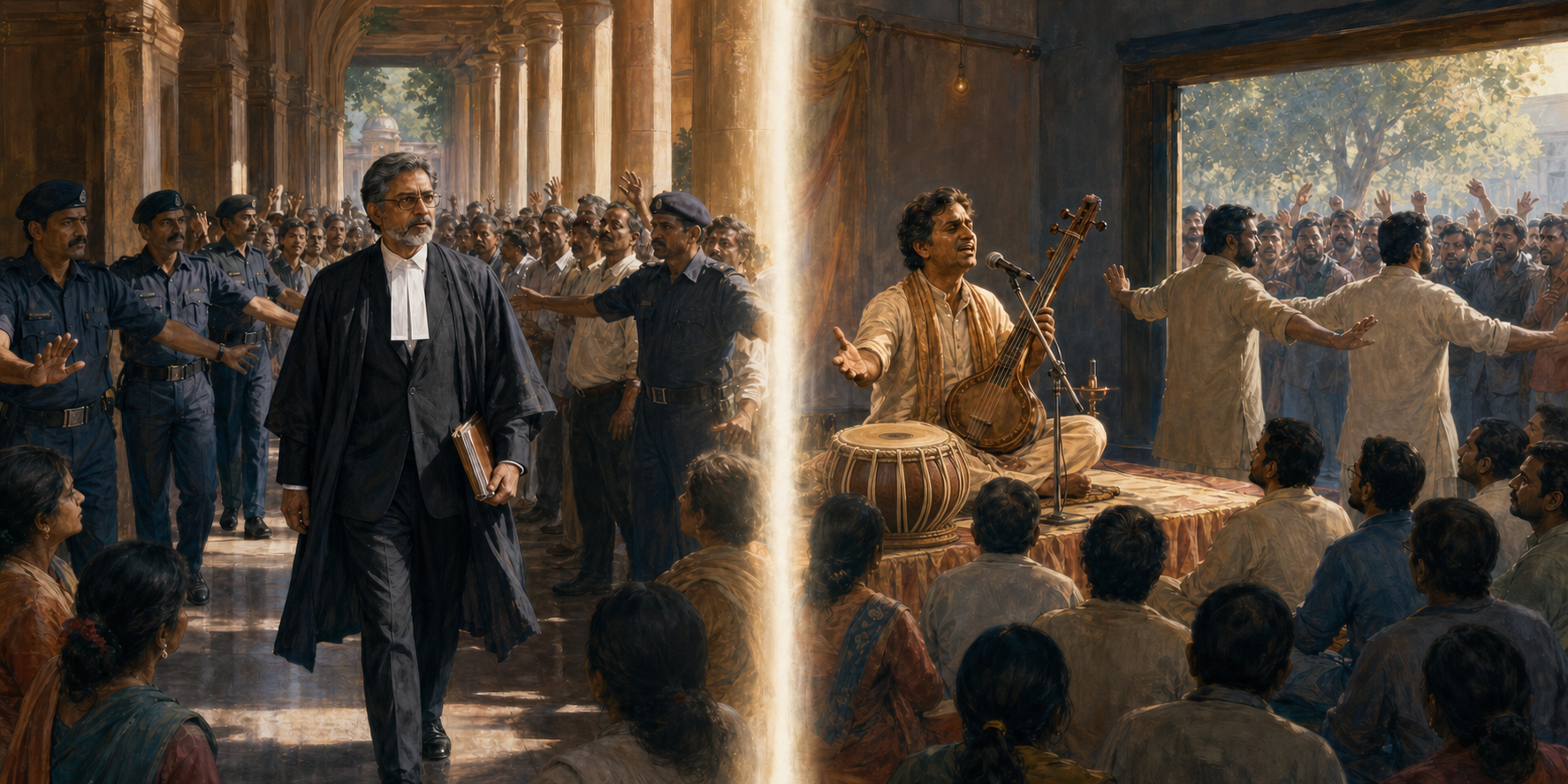
Judicial disagreement is not proved judicial misconduct
India deliberately sets a high threshold for removing judges. Articles 124(4) and 218 centre the process on “proved misbehaviour or incapacity”. That language separates a grave constitutional remedy from ordinary political or jurisprudential disagreement.
The distinction became central when 107 MPs supported a motion concerning Madras High Court Justice G.R. Swaminathan. Fifty-six retired High Court and Supreme Court judges reportedly described the effort as an attempt to browbeat judges, and the motion was ultimately disallowed. The numerical prospect of removal is not the only concern. A campaign can exert pressure even when it is unlikely to cross the constitutional threshold.
Your test should be unsentimental. Identify the alleged conduct and ask whether the case presents evidence of misbehaviour or incapacity. If the complaint is really that a judge used religious vocabulary, recognized a tradition, or reached a result that political actors dislike, the proper response is reasoned criticism and whatever appellate or review process the law permits. Removal should not become an appeal conducted through Parliament.
Nani Palkhivala raised the same structural danger after 198 MPs reportedly signed a 1970 petition seeking to impeach Justice J.C. Shah following an order against a corrupt government servant. The enduring lesson is not that judges are immune from accountability. It is that accountability mechanisms lose legitimacy when they are repurposed to punish unwelcome decisions.
The underlying litigation concerned permission to light the Karthika Deepam on the Deepathoon at Thirupparankundram, a major Murugan kshetra. The decision reportedly followed a litigation history reaching back to 1920 and earlier judicial pronouncements. That history matters because a continuing observance, a newly asserted practice, a disputed title, and a genuine safety concern require different legal analysis. Compressing all four into a communal slogan prevents serious judgment.
Thirupparankundram also contains layered Hindu and Muslim claims. A court need not erase one community’s memory to protect another community’s lawful practice. It must identify rights, boundaries, evidence, prior decisions, and operational risks. Once a competent court gives an enforceable order, executive agencies should follow it or challenge it through lawful channels. Reports that police impeded implementation despite the contemplated accompaniment of devotees by CISF personnel therefore raise a separate institutional question from the merits of the ritual itself.
Curatorial choice ends where intimidation begins
A public event can have an artistic brief. An organizer may commission a devotional program, a secular program, or a mixture of the two. The legitimate way to exercise that choice is to agree on the repertoire before the performance or use a clearly stated process for changes. It is not to impose a new demand through physical intimidation.
Bengali singer Lagnajita Chakraborty alleged that TMC leader and event co-organizer Mehboob Malik rushed the stage, threatened her, and demanded a “secular” song after she performed “Jago Ma”. Malik was reportedly arrested after a police complaint. Those facts must retain their procedural status: the allegations deserve investigation, the arrest records a law-enforcement action, and guilt belongs to the legal process rather than to social-media judgment.
The artistic principle does not depend on the final criminal determination. A performer should be able to follow an agreed program without fear of assault. An organizer who objects can use the microphone, pause the program through the designated stage manager, or address the contractual issue afterward. A spectator can complain, leave, or protest peacefully. None of those alternatives requires a threatening rush toward the artist.
Calling a devotional song insufficiently secular also confuses neutrality with cultural absence. “Jago Ma” belongs to Bengal’s living devotional culture, including the wider world of Durga worship. Protecting its performance does not prohibit secular music, compel belief, or deny another community’s art. It protects coexistence at the point where one person’s preference risks becoming another person’s fear.
These disputes operate at different constitutional levels, but the diagnostic discipline is the same. A judge can be criticized; a singer can receive artistic direction; a ritual can be regulated for a genuine legal reason. Freedom is endangered when disagreement abandons the appropriate process and recruits threats, selective obstruction, or extraordinary institutional penalties.
What to do when you witness a freedom dispute
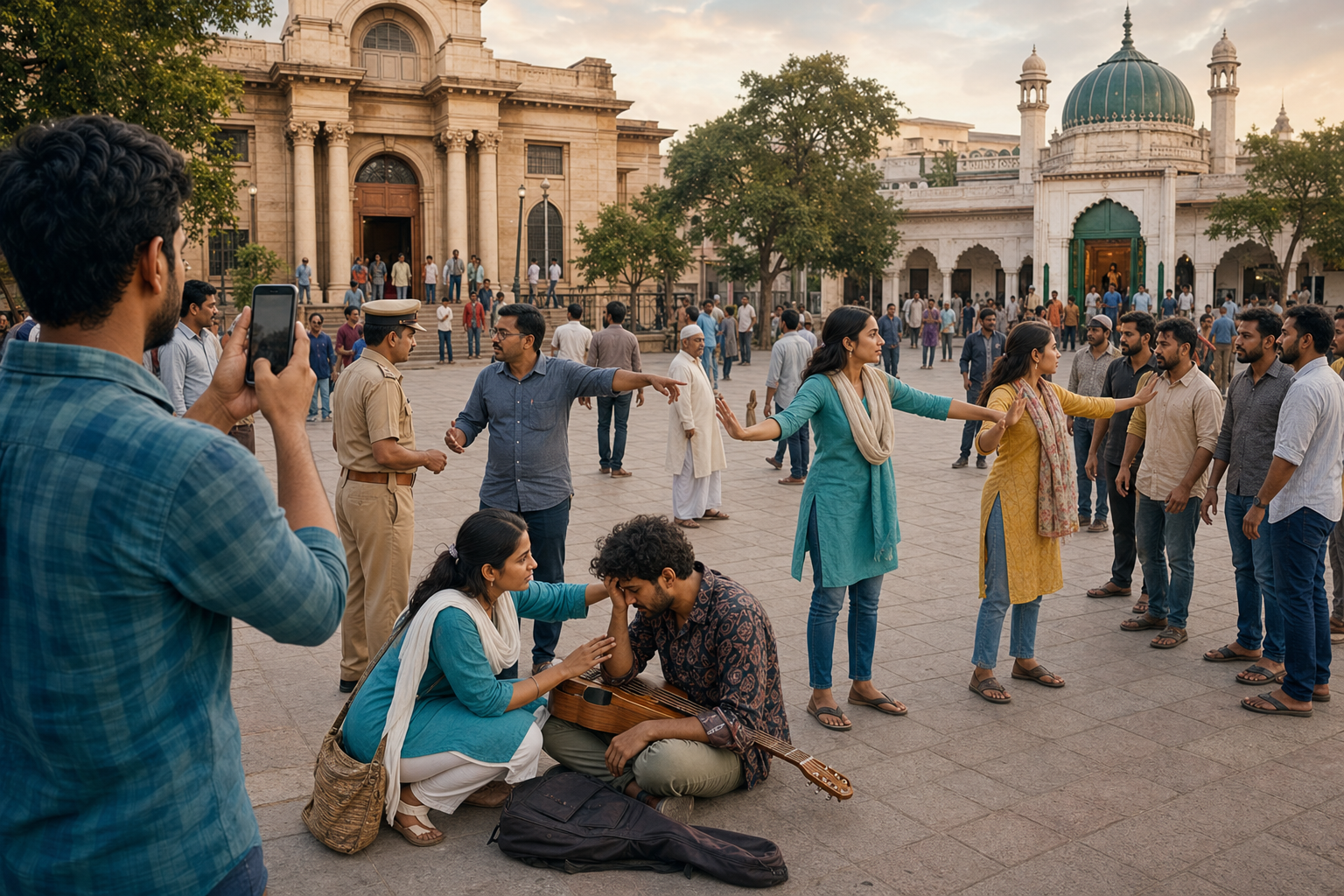
If you are the performer, devotee, organizer, or witness
- Move away from immediate danger. Do not turn a stage confrontation, procession obstruction, or sacred-site dispute into a physical test of courage. Use exits, security personnel, or police assistance. A record can be rebuilt; an injury cannot.
- Preserve original evidence. Keep the complete video or audio file, not only an edited clip. Record the date, approximate time, location, sequence of events, names or roles of those present, and the exact words you personally heard. Retain programs, permits, contracts, messages, notices, and screenshots with their surrounding context.
- Separate observation from inference. Write “the person approached the stage and said…” before writing what you think motivated the act. Mark facts learned from someone else as second-hand. This makes a complaint easier to assess and protects you from repeating an unsupported accusation.
- Ask for the rule in writing. If an official or organizer restricts a song, rite, procession, or gathering, request the legal provision, permit condition, venue policy, or safety reason. Note who made the decision and whether a review channel exists.
- Report threats or violence through the proper channel. Give authorities the preserved material and retain proof of submission. For case-specific legal strategy, especially where a public official, criminal allegation, court order, or property dispute is involved, consult an Indian lawyer rather than relying on viral advice.
- Use legally accurate public language. Say “alleged,” “a complaint was filed,” “was arrested,” or “the court found” as applicable. Do not publish private addresses, encourage a crowd to confront someone, or state guilt before adjudication. Those actions can endanger people and create legal exposure.
- Do not self-enforce a court order. Obtain the official text, confirm whether it remains operative, and seek implementation through counsel and the responsible authorities. A screenshot of one paragraph may omit conditions that govern what can happen on the ground.
If you run a temple, arts body, school, or civic institution
Freedom becomes much easier to protect when procedures exist before a controversy. Build a small incident protocol rather than improvising under political or crowd pressure.
- Publish the program and intervention rules. State who may change a performance, stop an event for safety, or alter a procession route. Make the distinction between artistic curation and emergency control explicit.
- Assign named roles. One person should manage the stage or ritual, another should handle safety, and another should preserve the incident record. A politically influential guest should not automatically control all three.
- Record reasons at the time of decision. If a restriction is necessary, identify the evidence, authority, duration, and review process. “Secularism” or “sentiment” alone is not an operational safety explanation.
- Create a court-compliance process. Designate who obtains the official order, who confirms its current status, which agency must implement it, and how operational questions will be referred back to counsel or the court.
- Maintain a heritage file. For recurring religious observances, preserve old permissions, maps, schedules, photographs, administrative correspondence, judgments, and reliable accounts of prior practice. When history becomes disputed, an organized record is more useful than collective memory alone.
- Offer review outside the initial decision-maker. A performer, devotee, employee, or community representative should be able to challenge a restriction without returning only to the person who imposed it.
- Audit comparable treatment. Periodically compare how the institution handles similar attendance levels, sound limits, security concerns, devotional content, and access requests across communities. Correct unexplained disparities before they harden into precedent.
If you are speaking as a citizen
Your most useful contribution is often evidentiary discipline. Share the fullest reliable record available. Link to the actual judgment or official action when you have it. State what remains contested. Ask the six questions even when the person under pressure belongs to your own community.
Peaceful petitions, legal challenges, institutional complaints, professional solidarity, and carefully documented public criticism keep the dispute within constitutional channels. Threatening counter-mobilization does the opposite. It tells institutions that the winning side should be whichever crowd appears more dangerous, a rule that will eventually be used against every minority and every inconvenient tradition.
Key takeaways
- Freedom is not immunity from criticism; it is protection against unlawful coercion, discriminatory restriction, and retaliation through improper institutional means.
- Ask what happened, who exercised power, which prior rule applied, what evidence supported the restriction, whether the remedy was narrow, and whether the same standard would survive reversed identities.
- Disagreement with a judgment belongs in reasoned criticism and lawful review. Judicial removal belongs to the constitutional threshold of proved misbehaviour or incapacity.
- An organizer may curate a program in advance, but threats and physical intimidation are not curatorial tools.
- Preserve complete evidence, describe procedural status accurately, report danger lawfully, and never turn a court order or viral allegation into permission for self-help.
- A pro-Hindu defence of liberty gains moral force when it also protects peaceful expression and worship outside the Hindu fold.
If you serve a temple, cultural association, school, or arts venue, make one practical move now: create a one-page incident protocol with a safety lead, an evidence checklist, a decision log, a legal contact, and a review path. Freedom is hardest to defend in the first confused minutes of a confrontation. Preparation moves those minutes away from fear and back toward Dharma, evidence, and law.
References
- The Dharma Dispatch — Justice G.R. Swaminathan Impeachment: Why Judicial Independence and Dharmic Harmony Matter
- Hindu Human Rights — Artistic Freedom on Trial: Lagnajita Chakraborty Allegedly Threatened for ‘Jago Ma’
