

You may have encountered Kalpataru halfway down a footnote and wondered why an explanation of Advaita Vedānta seems to require explanation after explanation. The difficulty is not simply dense Sanskrit. It is that Kalpataru belongs to a layered conversation, and every layer assumes that you can still hear the earlier voices.
Once you place Amalananda at the correct level of that conversation, the work becomes far more intelligible. You can see which problem he inherits from Vācaspati Miśra, which objection he is answering, and why a small point of grammar may carry a large metaphysical consequence.
First place Kalpataru in the correct textual lineage
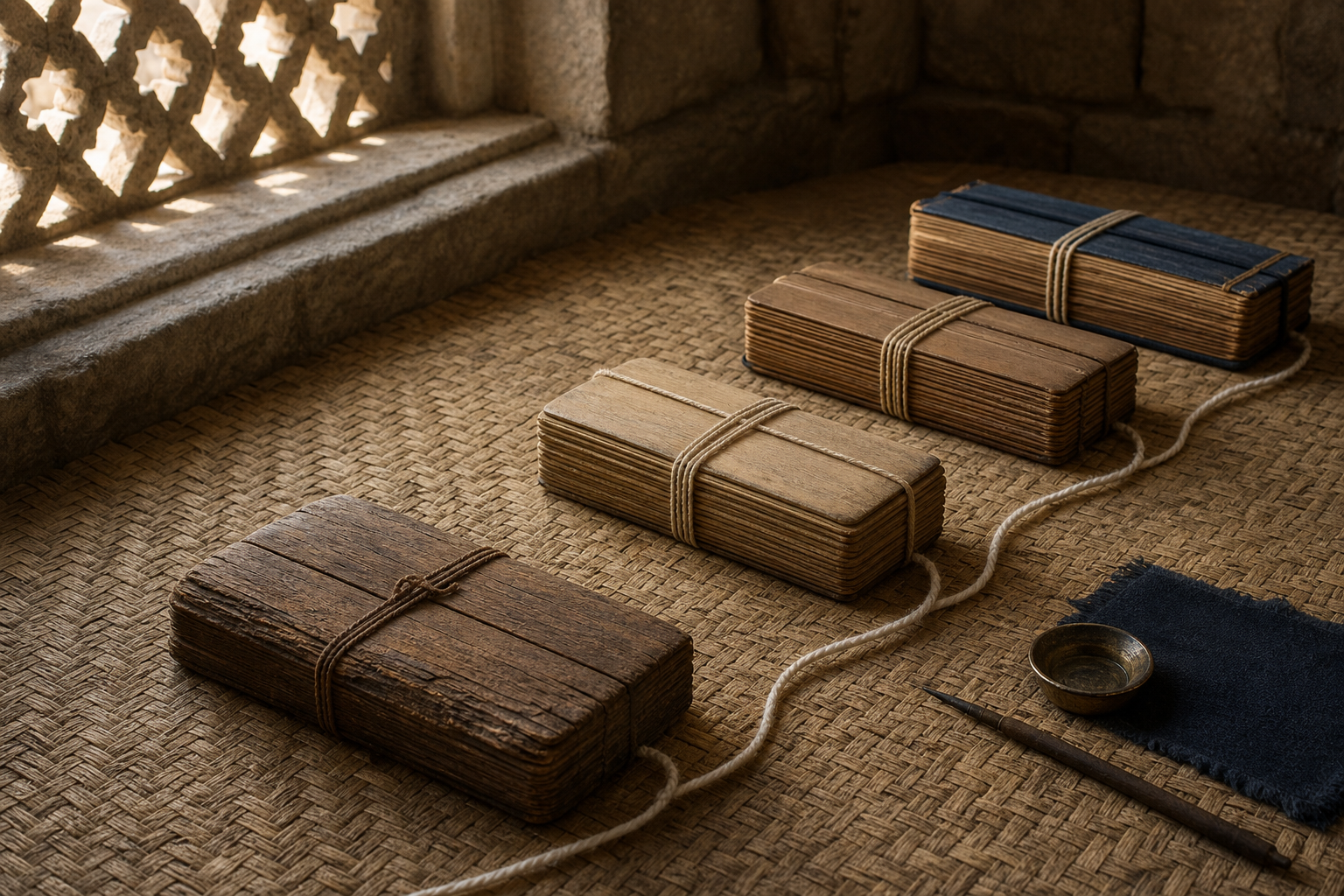
Do not approach Kalpataru as an independent introduction to Advaita. It is a commentary on a commentary within the interpretation of a foundational Vedānta text. Its immediate purpose becomes clear only when you keep that hierarchy in view:
- The Brahma Sūtra supplies the compact aphoristic text around which the discussion is organized.
- Śaṅkara’s Brahma-sūtra-bhāṣya interprets those sūtras from the standpoint of Advaita Vedānta.
- Vācaspati Miśra’s Bhāmatī comments on Śaṅkara’s exposition and develops its philosophical arguments in greater detail.
- Amalananda’s Kalpataru is a thirteenth-century extended exposition of the Bhāmatī.
- Appaya Dīkṣita’s Kalpataru Parimala later illuminates Amalananda’s work and adds another layer to the teaching tradition.
This is not merely a chronological list. It tells you how to diagnose a difficult passage. If Amalananda’s wording feels abrupt, the missing premise may be present in the Bhāmatī. If the Bhāmatī itself seems to enter a debate midway, return to the relevant portion of Śaṅkara’s commentary. Reading vertically through one passage is usually more revealing than reading a later commentary horizontally while ignoring the text beneath it.
The title also gives you a useful image. Kalpataru means “wish-fulfilling tree.” Here the “tree” is not a separate scripture or a collection of inspirational sayings. It is a branching scholastic resource: definitions, objections, replies, textual interpretations and doctrinal consequences grow from the roots established by the earlier commentarial layers.
What Amalananda contributes to the Bhāmati discussion
Amalananda does not discard the Bhāmatī and begin again. His contribution is to make its reasoning more exact. He clarifies definitions, tightens arguments, exposes assumptions and answers objections. That work matters because an Advaita conclusion may depend on the precise relationship among a means of knowledge, the removal of ignorance and the meaning of a scriptural sentence.
Three concerns should be especially visible in your notes:
- Pramāṇa: What counts as a means of valid knowledge in the argument, and what kind of knowledge is being established? Do not translate pramāṇa once and then treat the translation as self-explanatory. Record how it functions in the particular dispute.
- Avidyā: What does ignorance explain at this point in the reasoning? Separate the technical problem from the everyday sense of being uninformed. Ask what would become unintelligible if the stated account of ignorance were rejected.
- The identity of Ātman and Brahman: How does the interpretation move from the words of śruti to a non-dual conclusion? Identify the grammatical or epistemological step that carries the argument rather than writing only “non-duality” in the margin.
These concerns are connected. If you isolate them into unrelated glossary entries, you will miss the structure of the reasoning. A discussion of pramāṇa may determine how a statement of identity can communicate knowledge. That knowledge bears on the removal of avidyā, which in turn bears on why the identity of Ātman and Brahman is not treated as the production of a new reality.
Your most useful question is therefore not “What does this Sanskrit term mean in general?” Ask, “What work must this term perform for the present argument to succeed?” That shift turns vocabulary collection into philosophical reading.
Read the objections as part of the teaching
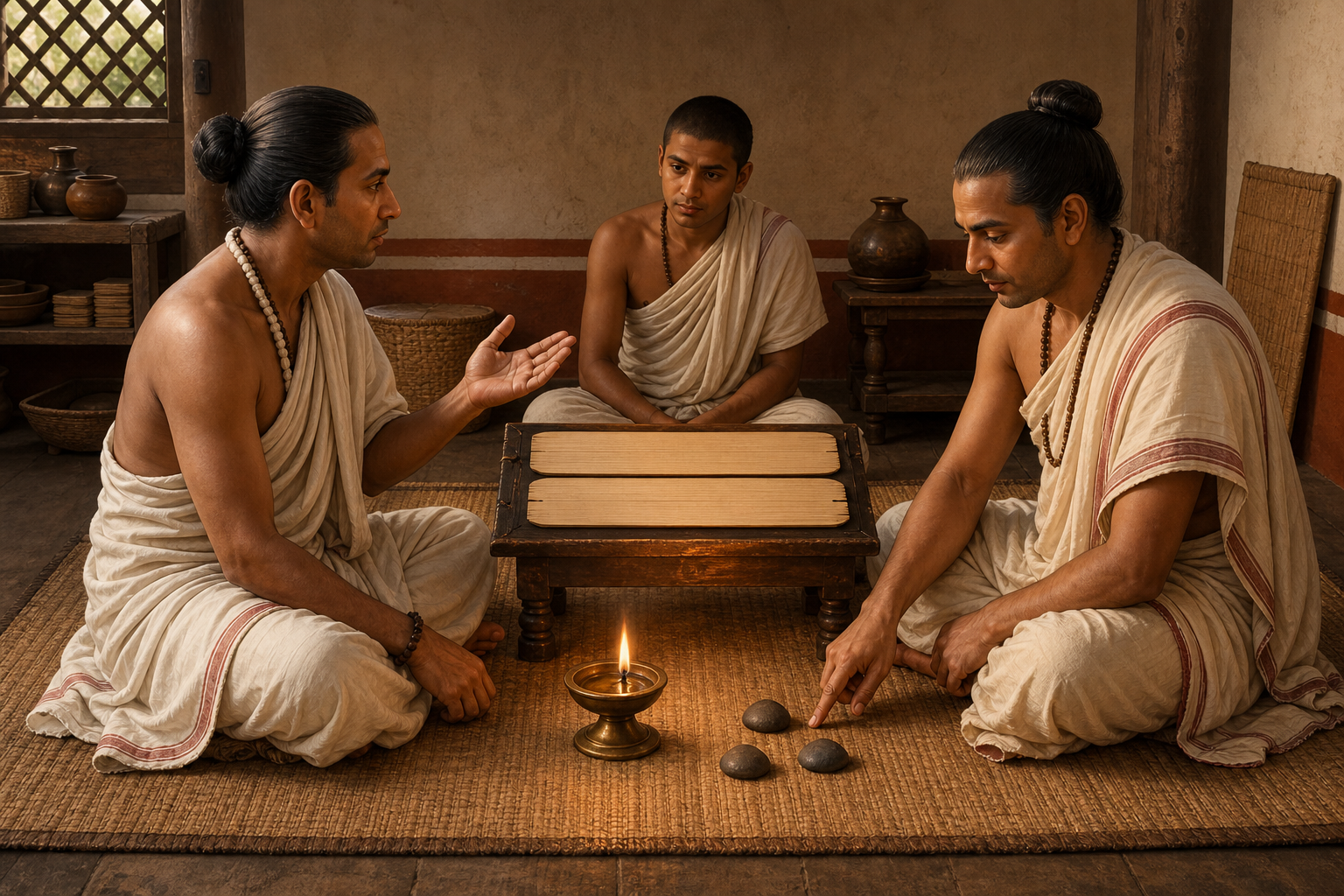
Kalpataru proceeds through careful interpretation and dialectical exchange. Positions are tested against objections associated with intellectual rivals including Nyāya, Mīmāṃsā and Dvaita. You should not treat those objections as interruptions to the “real” Advaita teaching. They reveal exactly where a definition, inference or reading of śruti must bear weight.
| Signal in the passage | What to record | Why it matters |
|---|---|---|
| A term is defined or qualified | The working meaning and the alternative being excluded | The later conclusion may depend on that exclusion |
| An objection is introduced | The objection’s premises and intended consequence | You must not mistake an opponent’s claim for Amalananda’s conclusion |
| A reply rejects one premise | The precise point of rejection | The reply may leave other parts of the objection intact |
| A scriptural sentence is analyzed | The grammatical reading and its philosophical effect | Textual interpretation and metaphysics are operating together |
| The discussion returns to its thesis | The conclusion in one sentence, plus the reason it now follows | This tests whether you followed the argument rather than its vocabulary alone |
The recurring movement from linguistic detail to metaphysical conclusion is central to the method. A grammatical distinction is not pedantry when different readings produce different accounts of knowledge or reality. When a passage slows down over a word, case ending or sentence relation, resist the urge to skip ahead. Write down the two possible readings and the consequence of accepting each one.
This habit also makes cross-tradition comparison more responsible. The concern with valid knowledge can be placed beside Buddhist discussions of pramāṇa; the testing of viewpoints can prompt comparison with the Jain discipline of anekāntavāda; and the contemplative concern with divine unity can open a conversation with Sikh reflection. But resemblance of question or method does not prove identity of doctrine. Compare the precise problem each tradition is addressing before declaring that their answers are the same.
A passage-by-passage method for studying Kalpataru
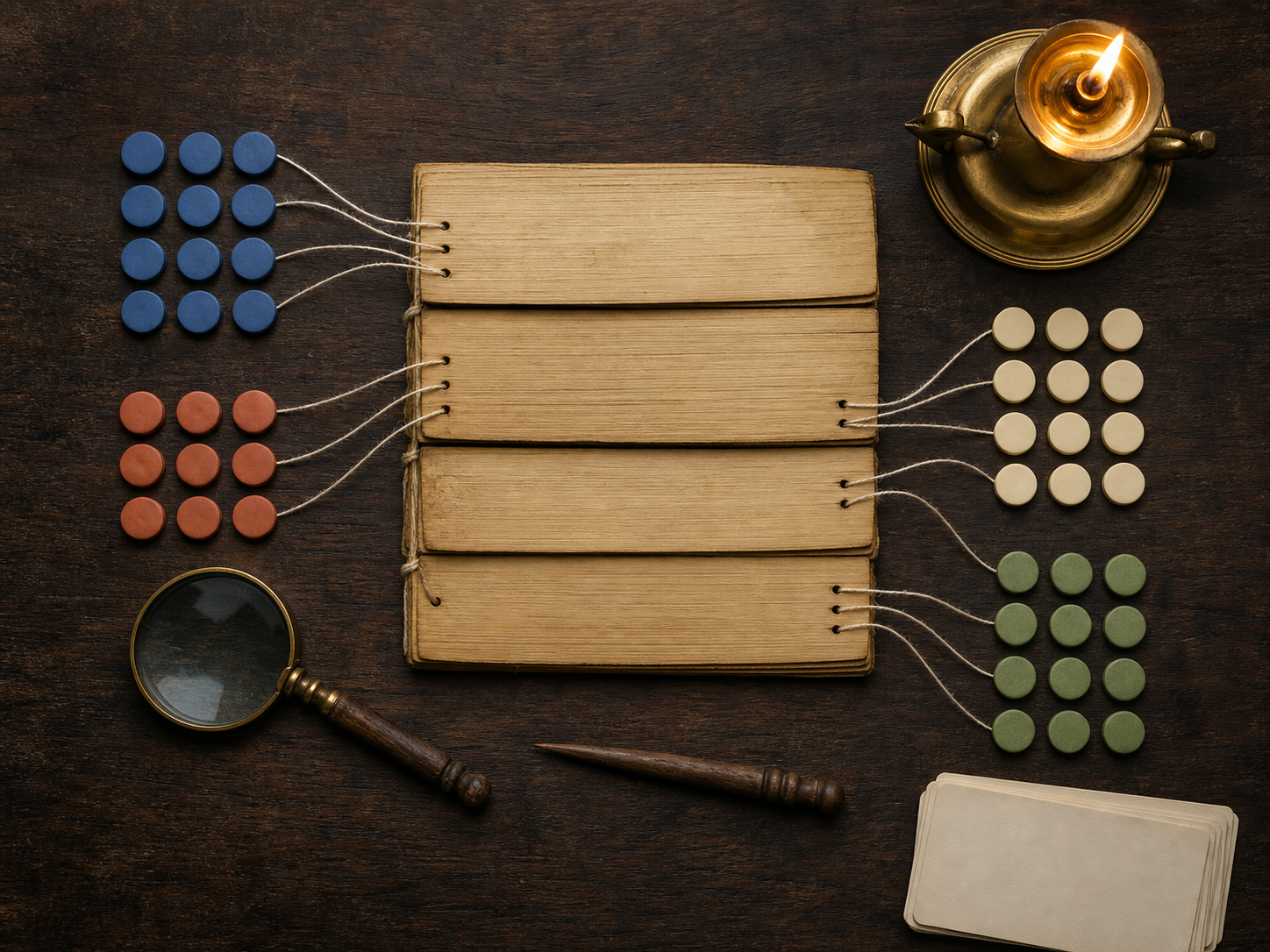
You do not need to master every layer before beginning. You do need a method that prevents the layers from collapsing into one anonymous voice. Work with a single argument unit and follow this sequence:
- Define the target. Choose one passage or one doctrinal question. “Understand Kalpataru” is too large a task; “trace how this passage connects knowledge and ignorance” is workable.
- Read the corresponding passage in Śaṅkara. Write its main conclusion in your own words. Do not yet import the later commentaries.
- Add the Bhāmatī. Mark what Vācaspati explains, expands or problematizes. This establishes the discussion Amalananda actually inherits.
- Separate the voices in Kalpataru. Label the inherited position, the objection, the answer and the final resolution. If you cannot identify who is speaking, postpone doctrinal conclusions.
- Build a local vocabulary ledger. For each technical term, record its function in this passage rather than copying a broad dictionary equivalent.
- Rewrite the reasoning as premises and consequence. Use plain statements such as “If this interpretation is accepted, then this objection follows.” Any gap you cannot fill marks the exact place to reread.
- Consult the Kalpataru Parimala after identifying the difficulty. Appaya Dīkṣita’s clarification is most useful when you can state what remains unclear. Otherwise one more explanatory layer may only multiply unfamiliar sentences.
A compact note for each unit can contain four lines: the question, the strongest objection, Amalananda’s decisive reply and the consequence for Advaita. Add a fifth line only when a grammatical decision controls the result. This format forces you to preserve the argumentative movement while keeping the commentarial hierarchy visible.
Choose a reading route that fits your purpose
- If you are new to Advaita: begin with the relevant portion of Śaṅkara’s Brahma-sūtra-bhāṣya, then move through Bhāmatī and Kalpataru. Do not use the later commentary as a substitute for learning the underlying question.
- If you are doing philosophical research: move vertically through all the layers for one dispute. Track definitions and rejected alternatives; these are often more revealing than a detached summary of the conclusion.
- If your interest is contemplative: first establish what the argument actually claims. Only then turn it into reflection. Extracting a pleasing sentence before identifying the speaker can turn an opponent’s objection into apparent Advaita teaching.
- If you are comparing Dharmic traditions: compare one dimension at a time, such as a means of knowledge, a method of answering objections or an account of unity. Shared vocabulary should begin an inquiry, not end it.
Key takeaways
- Kalpataru is best read as Amalananda’s exposition of the Bhāmatī, not as a stand-alone primer on Advaita Vedānta.
- The working lineage is Brahma Sūtra, Śaṅkara’s commentary, Vācaspati Miśra’s Bhāmatī, Amalananda’s Kalpataru and Appaya Dīkṣita’s Kalpataru Parimala.
- Track pramāṇa, avidyā and the identity of Ātman and Brahman as connected parts of an argument, not as isolated definitions.
- Always distinguish an objection from Amalananda’s reply before assigning a doctrinal position to him.
- When grammar receives sustained attention, record the competing readings and the metaphysical consequence of each.
- Use comparisons with Buddhist, Jain or Sikh thought to sharpen questions while preserving the distinct conclusions of each tradition.
Your next step need not be an attempt to read the entire commentarial chain. Select one passage in Śaṅkara, carry it through the Bhāmatī and Kalpataru, and produce a four-line argument map. When you can state the objection, reply and consequence without blurring the speakers, Amalananda’s dense scholastic tree has begun to yield its intended fruit.
References
