

If someone tells you that enslaved people were better off than poor wage workers because an owner fed and housed them, do not begin by debating the quality of the food. That concedes the wrong question. Begin with the powers the enslaved person did not possess: the power to refuse, leave, keep a family together, protect the body, receive wages, or remain beyond the auction block.
The decisive distinction is not between generous and stingy providers. It is between a person who may enter or leave an employment relationship and a person who can be sold, punished, sexually coerced, and separated from children. Once you keep that distinction in view, the familiar language of paternal care stops disguising ownership.
Key takeaways
- Provision is not consent. Food, shelter, and clothing do not compensate for the loss of legal personhood.
- Judge slavery by the powers an enslaver possessed, not by an enslaver’s description of his own kindness.
- Quotas, surveillance, flogging, sale, family separation, and sexual coercion were mechanisms of domination, not incidental workplace abuses.
- However exploitative wage labor may be, a wage worker and a saleable human being do not occupy the same legal or moral category.
- A Dharmic response applies satya to euphemism, ahimsa to institutional violence, and karuna to the people whose suffering the euphemism hides.
The myth changes the subject from ownership to maintenance

In an 1845 letter to an English abolitionist, a prominent South Carolina politician and planter argued that slaveholding was more humane than wage labor. An employer might pay a shilling and let a laborer starve, he reasoned, while an enslaver bore the continuing cost of supplying an enslaved person’s needs.
This argument performs three substitutions. It substitutes an owner’s expenses for a worker’s consent. It substitutes continued survival for compensation. And it substitutes the possibility of personal kindness for rights that the enslaved person could enforce.
An enslaver may spend money on food, shelter, clothing, supervision, and medical attention because keeping a captive alive preserves the captive’s productive value. That expenditure does not become a wage merely because the captive benefits from part of it. A wage belongs to the worker. Maintenance remains under the controller’s discretion.
You can expose the substitution with a counterfactual. Suppose the person disliked the food, rejected the assigned work, wished to move, demanded payment, or wanted to live with a spouse and children elsewhere. Could that person make the choice without permission and without facing violence or sale? If not, the provision being praised existed inside captivity.
The rhetoric also compares the worst condition of free labor with an idealized picture of enslavement. Nineteenth-century wage workers could certainly face hunger, insecurity, and exploitation. But acknowledging those harms does not establish that ownership was humane. It establishes that poverty and labor exploitation also deserve criticism. One injustice cannot convert another into benevolence.
Watch what disappears whenever this myth appears. The speaker will usually discuss meals, housing, and the owner’s financial burden while leaving out sale, punishment, non-exit, family separation, and sexual power. Restore those omitted powers before comparing material conditions. Otherwise, you are comparing the whole reality of free poverty with a carefully edited portrait of slavery.
Coercion was the machinery, not a departure from it
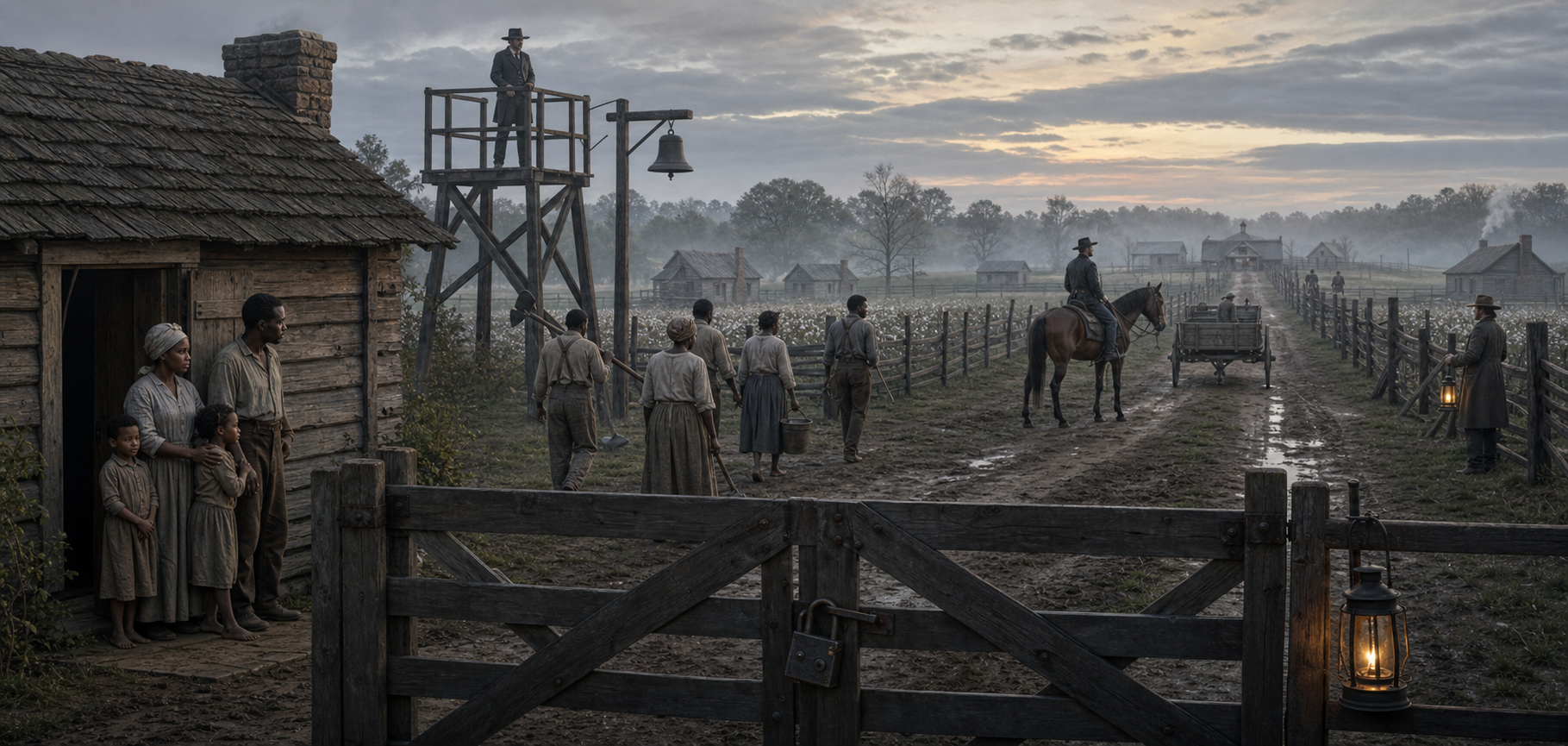
Solomon Northup described a cotton regime in which workers rose before dawn, stopped briefly for a cold meal at noon, and continued until dark. The day’s cotton was then weighed against an assigned quota. A shortfall did not lead to a discussion about fatigue, illness, or working conditions. It exposed the worker to flogging.
During peak picking, this arrangement joined extraction to surveillance. The enslaver set the output, controlled the weighing, judged the quality, and imposed the penalty. Even collapse did not necessarily interrupt the demand for labor: an exhausted person could have water thrown over the body and be ordered back to work.
The disciplinary scale recorded in that setting was brutally specific:
- Leaves or dirt in a cotton basket could bring twenty-five lashes.
- Breaking a branch could bring fifty.
- Standing idle could bring one hundred.
- Fighting with another enslaved person could bring two hundred.
- Running away could bring five hundred.
Those numbers belong to a particular recorded disciplinary code; they should not be presented as one uniform schedule followed on every plantation. Their significance lies elsewhere. The punishable conduct ranges from an alleged quality defect to rest, conflict, and escape. Bodily pain enforced both production and captivity.
This is why the defense that only some owners were cruel misses the structure. A personally restrained enslaver could choose not to exercise every power available to him. The enslaved person still lacked a guaranteed right to that restraint. A system should be judged by the rights it secures and the powers it authorizes, not by the nicest conduct it happens to permit.
The auction market made the underlying status unmistakable. Buyers inspected bodies, examined teeth, questioned skills, and required people to be stripped for scrutiny. Families could be divided because the transaction treated each person as a separately saleable unit. A mother’s plea to remain with her children carried no binding force against the trader’s commercial decision.
Family separation was not merely an emotional hardship added to a labor system. The possibility of sale gave an enslaver leverage over attachment itself. A spouse, parent, or child could be removed, and the person facing that loss had no ordinary contractual remedy. The same ownership logic that extracted labor also invaded kinship.
Women and girls faced another dimension of control. Harriet Jacobs was pursued sexually by her owner beginning at age fifteen, and even efforts to seek protection could provoke threats involving the sale of her children.
"Slavery is terrible for men; but it is far more terrible for women."
Harriet Jacobs, Incidents in the Life of a Slave Girl
Her distinction identifies a form of domination that an economic comparison cannot measure. When one party controls another person’s movement, children, livelihood, and bodily safety, sexual pressure does not occur between equals. The threat need not be spoken every time; ownership has already established the imbalance.
Use five questions to test any benevolent-slavery claim
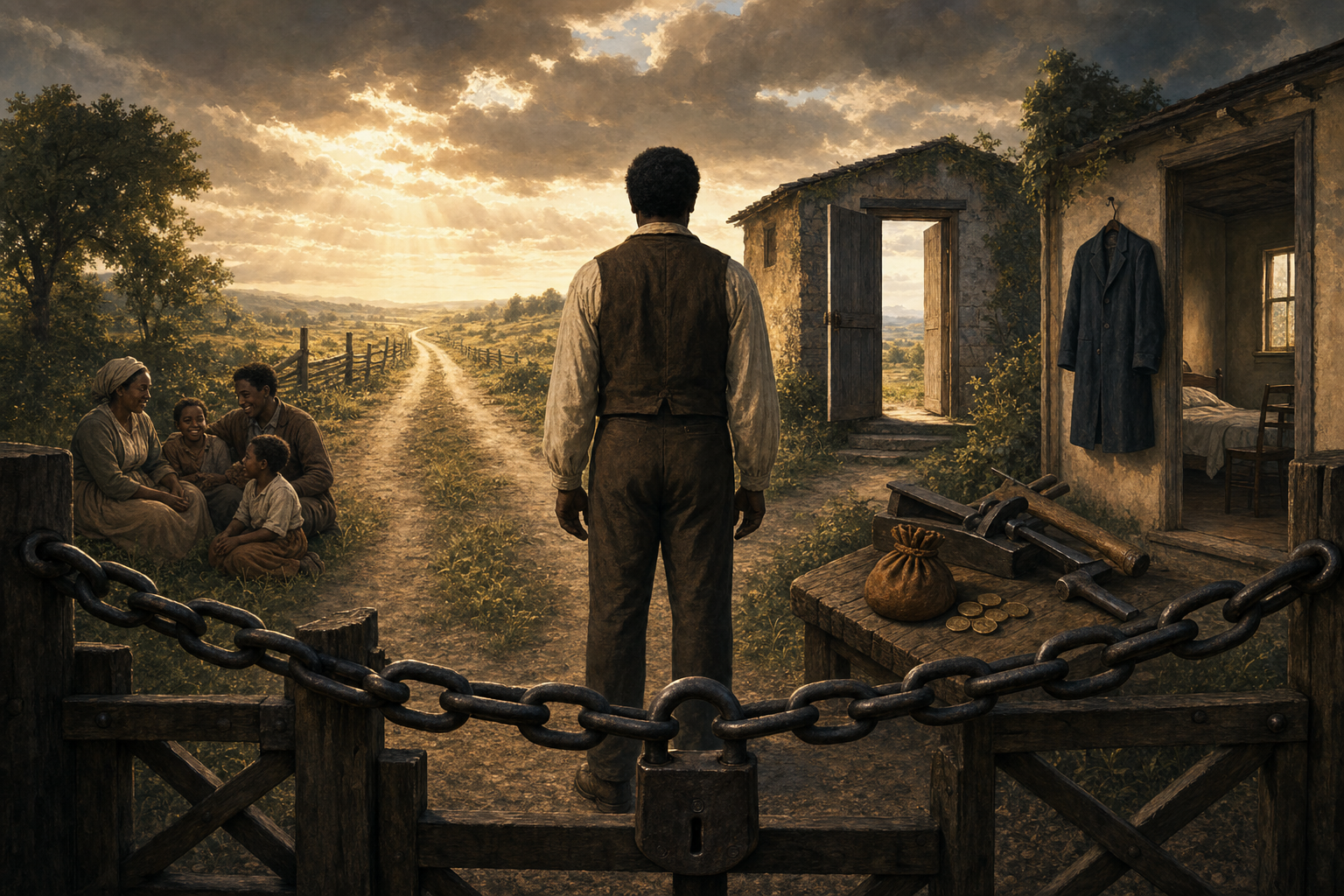
You do not need to answer every paternalist claim with a catalogue of atrocities. A short diagnostic usually reveals whether the speaker is discussing human welfare or defending ownership. Ask these questions in order.
- Was the person legally treated as a person or as saleable property? If another human being could buy, sell, or transfer the worker, the relationship was not employment with unusually generous benefits. Property status governs every later question.
- What could the person refuse? Consent matters only when refusal is possible. Ask what happened when a worker rejected an assignment, missed a quota, resisted an overseer, or attempted to escape.
- Who controlled movement and family life? A person who cannot relocate, live with a chosen spouse, or prevent the sale of children does not possess the ordinary agency assumed in a labor contract.
- Who controlled the body? Look for authorized whipping, confinement, sexual pursuit, armed surveillance, and the use of dogs. These are not questions about whether work was tiring. They reveal who held coercive power.
- Was material support a right or an owner’s choice? Food and shelter cannot function as adequate compensation when the recipient cannot demand a wage, select another provider, or leave. Provision controlled by the enslaver can also become another instrument of obedience.
If a defense discusses rations but cannot answer these questions, it has changed the metric. It asks you to measure the owner’s inputs while ignoring the human powers taken from the enslaved person.
This test also prevents a common false equivalence. A nineteenth-century wage worker might have possessed few realistic choices. Hunger can make formal freedom painfully thin. Yet the wage worker retained legal personhood and at least the theoretical power to refuse an employer, move, or organize. The enslaved person faced a legal order that permitted sale, physical punishment, family separation, sexual coercion, and potentially death.
The difference is therefore more than a dispute over which labor arrangement delivered a better bundle of goods. Wage exploitation concerns unjust conditions imposed on a person. Chattel slavery makes the person part of what is owned. That is an ontological distinction before it is an economic one.
Keeping the categories distinct does not minimize harsh labor conditions. It gives you more accurate language. You can condemn poverty, dangerous work, starvation wages, and employer abuse without pretending that every exploited worker is legally saleable. Precision strengthens moral criticism because it identifies the power that must be opposed.
The same precision should govern historical discussion. An example of an owner who avoided extreme violence cannot vindicate a system that authorized it. Nor can an example of an impoverished free worker prove that enslavement was protective. Anecdotes about individual treatment do not answer questions about legal status, exit, bodily autonomy, and family security.
A Dharmic reading begins with disciplined attention

A cross-Dharmic response need not pretend that Hindu, Buddhist, Jain, and Sikh traditions are identical. It can begin from a shared moral discipline expressed through satya, ahimsa, and karuna: truth, non-violence, and compassion. Each principle directs your attention to something pro-slavery mythmaking tries to remove.
- Apply satya to the language. Replace "care" with a complete account of the relationship. Ask who could sell whom, who could leave, who set the quota, and who wielded the lash. Truth requires the inconvenient powers as well as the convenient provisions.
- Apply ahimsa to the institution. Do not judge only an owner’s stated intention. Examine the violence required to extract labor and prevent exit. If surveillance, flogging, dogs, sexual threats, and family sale sustain the order, violence is structural even when it is not inflicted every hour.
- Apply karuna to the person under control. A ledger of food and housing cannot register a mother’s loss of her children, a husband’s despair after separation, or a girl’s fear of sexual pursuit. Compassion restores the human reality that an owner’s cost calculation excludes.
This method also keeps compassion from becoming vague sentiment. You can name the exact injury: denied personhood, forced labor, bodily punishment, severed kinship, sexual domination, or sale. Naming the injury tells you why the claim fails and what evidence would be needed to evaluate a similar claim elsewhere.
Be equally careful with slavery analogies in present-day arguments. If a situation does not involve ownership of persons, forced non-exit, sale, or comparable control over body and family, call the harm by its more accurate name: exploitation, coercion, abuse, or deprivation. Treating every severe injustice as interchangeable can obscure the distinctive machinery of each one.
When you next encounter a polished defense of slavery, do not get trapped in an argument over whether an owner sometimes supplied adequate meals. Write down the five questions. Put personhood, refusal, movement, family, and bodily control back into the discussion. If the defense cannot survive their return, it was never a defense of human welfare. It was an attempt to make domination sound like care.
References
