

If you have just seen another alarming message about a Hindu family, shop, or temple in Bangladesh, you face two duties at once: take the danger seriously and avoid feeding the rumor system that can make it worse. You need to distinguish a warning from an incendiary claim, protect people before debating facts, and demand more than a temporary police presence after the damage.
During the six months preceding December 27, 2025, monitors counted more than seventy blasphemy-linked incidents. Available tallies ranged from 71 to more than 78. That variation limits precision, but it does not erase the recurring pattern: a religious accusation can become the trigger for collective violence against Hindus. Recurrence supports a finding of patterned targeting. It does not, by itself, prove that every episode came from one centrally directed organization.
The danger begins before the first physical attack

The decisive period often begins while an allegation is still moving from phone to phone. By the time a house, business, or place of worship is attacked, the information failure has already become a security failure.
- An accusation appears, often through social media, before its origin or authenticity has been established.
- Emotionally charged forwarding carries the accusation farther and faster than verification can follow.
- A crowd assembles while preventive policing, factual verification, and public communication lag behind.
- The target expands beyond the person accused. Homes, shops, temples, and the security of a wider Hindu neighborhood can all be placed at risk.
- Even after the immediate crowd disperses, fear continues to alter schooling, commerce, worship, festivals, and movement after dark.
This sequence explains why the allegation itself must be handled as a potential instrument of violence. Whether a claim is false, manipulated, misunderstood, or still unverified, it cannot become a license for a crowd to punish an individual, a family, or an entire community. Due process is not a technicality added after calm returns. It is the barrier that prevents accusation from becoming collective punishment.
The harm also cannot be measured only by counting damaged buildings. Hindu families have reported restricting festivals and travel after dusk, withdrawing children from local schools, closing shops early, and reducing public worship. When ordinary visibility begins to feel dangerous, intimidation has already changed civic life without needing a new attack every day.
If you are documenting the consequences, therefore, track more than broken property. Ask whether children have returned to school, whether businesses can keep normal hours, whether worshippers can gather without fear, and whether families can resume their routines. Those are practical tests of whether security has actually been restored.
Read the incident numbers without overstating them
The strongest advocacy is exact about what the available numbers establish and what they do not. Inflating a defensible claim makes it easier for officials or partisan critics to dismiss the underlying danger.
- Scale is not the same as a final census. More than seventy incidents in six months establishes a serious recurring problem, but counts ranging from 71 to more than 78 should not be presented as one undisputed total.
- A pattern is not automatically a command structure. Repeated rumor, mobilization, delayed intervention, and attacks on Hindu targets show a recognizable method. They do not prove a single organizer behind every case.
- A link is not a verdict. The term blasphemy-linked means that an accusation functioned as a trigger or mobilizing claim. It does not mean that the accusation was proved, nor that an accused person caused the violence committed against them.
- An incident count is not a victim count. The available figure does not establish how many people were injured, displaced, or otherwise harmed, so do not invent those totals.
- Visible damage is not the full social cost. Changes in schooling, business hours, worship, travel, and family behavior reveal effects that a property tally will miss.
A defensible public formulation is simple: monitors recorded more than seventy blasphemy-linked incidents in the six months preceding December 27, 2025, while available tallies ranged from 71 to more than 78. Preserve the date, link the figure, and state that the exact count varies. That wording communicates urgency without claiming a precision the available material does not support.
Use the same discipline with words such as systematic, coordinated, and organized. Systematic can describe a repeated method or predictable pattern. Coordinated usually implies evidence of actors working together. Organized may imply a structure, leadership, or plan. If case-level evidence establishes only the first, do not casually claim all three.
What to do when a blasphemy allegation starts circulating
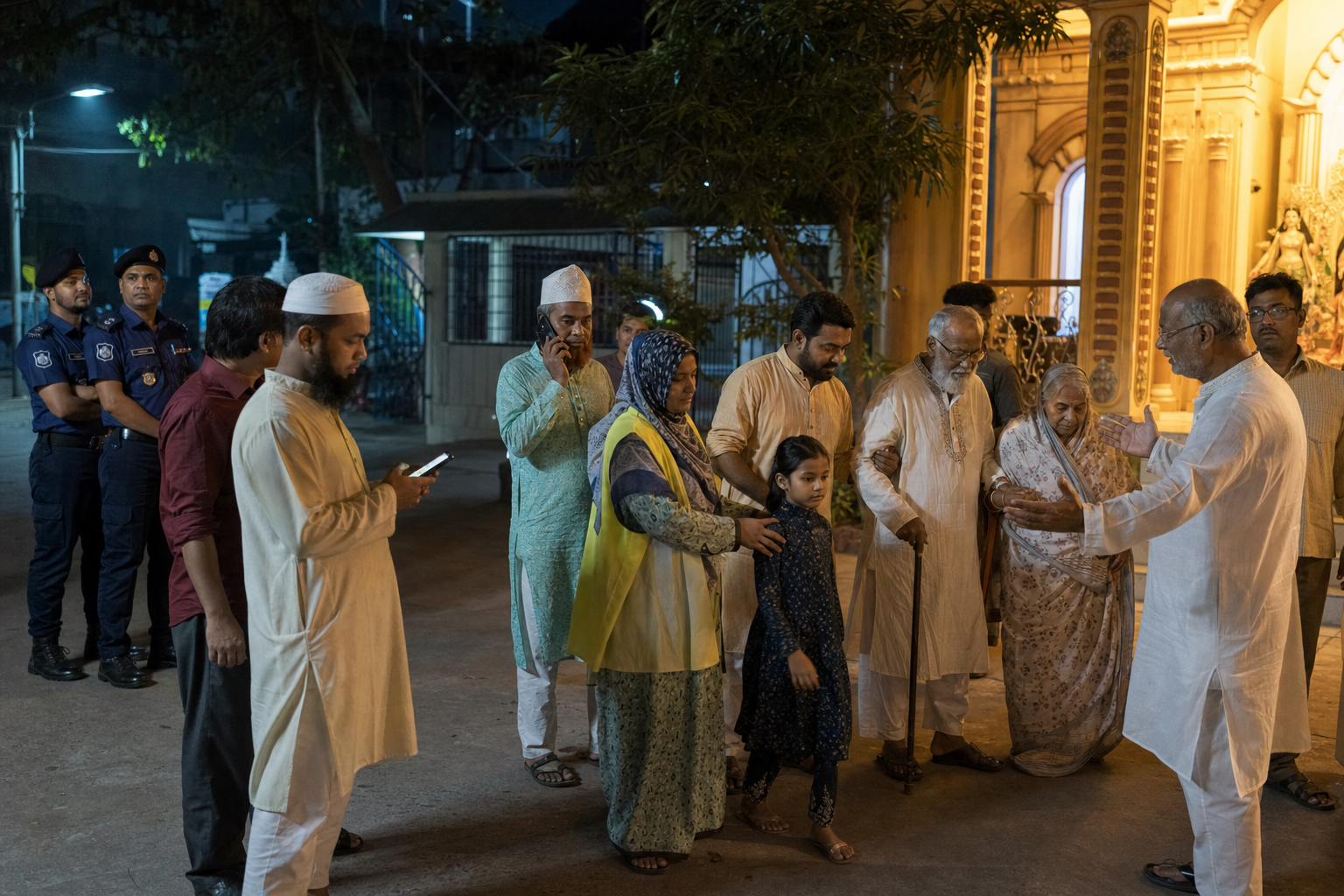
Your response depends first on whether anyone is in immediate physical danger. If you are close to the threatened location, online verification never takes priority over personal safety. If you are far away, your job is to reduce confusion and route verified information to people who can act.
- Triage the immediate threat. Establish the exact locality, the time of the latest direct observation, whether a crowd is forming, whether an attack has begun, and whether anyone is trapped. If danger is immediate, follow local emergency guidance and move only when a safer route and destination are known. Do not confront a gathering or stand at its edge to obtain footage.
- Stop unnecessary amplification. Do not publicly forward the alleged blasphemous material, the accused person’s identity, a home address, a temple approach route, or the real-time location of a shelter. Reposting an accusation in order to condemn it can still spread the accusation and expose its target.
- Verify the core fields. Identify the original uploader if possible, the exact place, when the image or video was captured, whether the material is current, and whether a direct witness can confirm the event independently. A screenshot proves that a message appeared on a screen; it does not prove that the underlying claim is true or that an attached image shows the stated location.
- Preserve evidence privately. Retain the original URL, account name, visible timestamp, screenshots of threats, and a simple chronology of what appeared when. Keep untouched copies and restrict sensitive material to investigators, legal representatives, or trusted rights monitors. Do not require a vulnerable person to identify themselves publicly merely to make the alert appear credible.
- Separate allegation from event status. Mark each item as an unverified allegation, verified threat, crowd gathering, confirmed attack, confirmed property damage, or official action. Do not combine these stages into one dramatic message. Clear status labels let responders see what is happening now rather than what someone fears may happen next.
- Send a structured alert through more than one trusted route. Contact local emergency or law-enforcement channels, a trusted community coordinator, legal-aid contact, and a credible rights-monitoring network where available. Include only what is needed to act: location, time last verified, immediate threat, people or site at risk, evidence status, agencies already notified, and a safe callback method.
A practical alert can fit into eight fields: location; time last verified; present threat; people or site at risk; direct evidence available; location of original files; authorities or community contacts notified; and safe callback details. Keep shelter addresses and vulnerable identities out of any public version.
If you are in the diaspora, coordination is usually more useful than public speculation. Confirm a reliable local contact, help route legal or trauma support, translate a confused stream of messages into a factual chronology, and keep exposed locations private. Do not pressure a threatened family to become the public face of a campaign while it is still trying to become safe.
What an accountable response must deliver
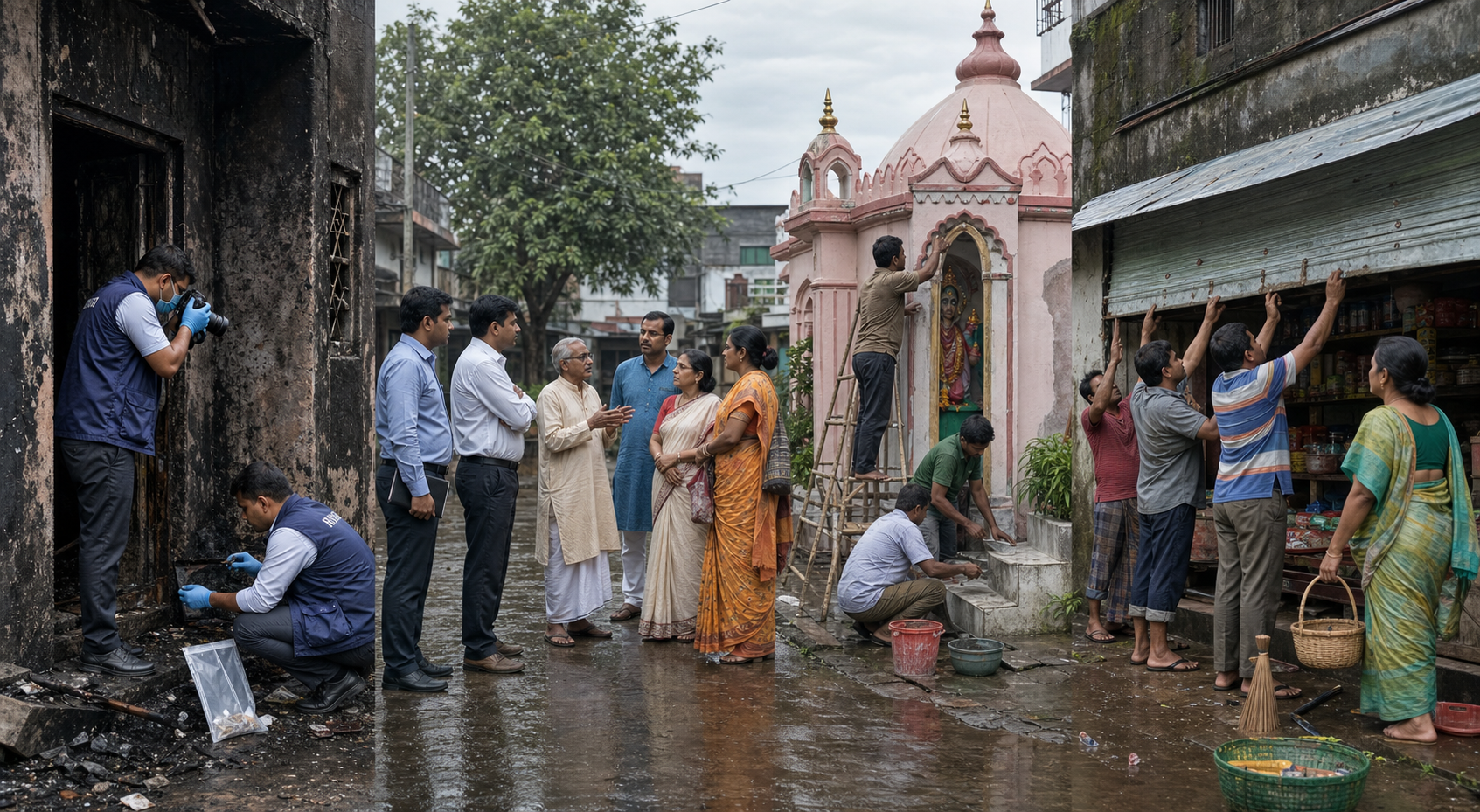
You can judge a state, civic, or diplomatic response by observable tasks rather than statements of concern. The central question is not whether leaders condemned violence after it occurred. It is whether institutions interrupted the chain from allegation to mobilization, protected those at risk, and pursued lawful accountability afterward.
Protection, investigation, and prosecution
- Protect the accused person, nearby Hindu households, businesses, and places of worship as soon as a credible threat emerges.
- Use a clear protocol to verify the allegation without circulating inflammatory material or surrendering the decision to a crowd.
- Preserve the digital trail, including the origin and amplification of calls for violence, alongside physical evidence from any attack.
- Investigate instigators and perpetrators independently rather than treating communal calm as a substitute for determining responsibility.
- Move cases toward timely prosecution while protecting victims and witnesses from renewed intimidation.
- Correct false or misleading public claims quickly enough to reduce further mobilization.
- Check whether affected families can safely resume school, commerce, worship, and ordinary movement.
An arrest announcement is a starting point, not a completed response. Ask what happened after the first news cycle: Was an investigation opened? Was evidence preserved? Were victims able to participate safely? Did the case progress? Were threatened locations protected against retaliation? Measure institutional performance from the first credible warning to protective action, not from the first press conference.
Equal protection also requires a firm separation between an allegation and mob punishment. Any claim concerning religious offense must be handled through lawful procedures and constitutional protections. No alleged expression can justify attacking relatives, neighbors, businesses, or temples.
Civil society, media, and early warning
Community resilience needs infrastructure, not just appeals for harmony. Documentation, legal aid, trauma-informed counseling, community hotlines, and verified early-warning networks address different parts of the same problem. The hotline surfaces a threat; verification keeps it from becoming another rumor; an incident log preserves the record; legal support helps a victim enter the justice process; counseling addresses harm that continues after visible violence ends.
A shared incident log should use consistent fields: date, district or locality, nature of the allegation, how it first circulated, verification status, time a crowd appeared, targets threatened or attacked, time authorities were alerted, protective action taken, case status, and continuing needs. Publish only what can be disclosed without exposing victims or witnesses. Consistent fields make recurring failures easier to identify than a folder of unrelated screenshots.
Newsrooms and advocacy accounts should name an allegation as an allegation in every headline and update. They should distinguish a threatened attack from confirmed damage, avoid displaying provocative material merely for attention, withhold identifying details that increase danger, and visibly correct information that changes. Researchers can then map recurring incident types, rumor routes, and gaps in institutional response without turning unverified social-media traffic into fact.
Regional cooperation without communal blame
India-Bangladesh cooperation can focus on minority protection, law-enforcement capacity, judicial training, and reliable channels for raising urgent protection concerns. International engagement is most useful when it asks measurable rule-of-law questions and keeps citizen safety above partisan spectacle.
Dharmic solidarity also has a clear role. Hindu, Buddhist, Jain, and Sikh organizations can share documentation practices, legal-support knowledge, verified alerts, and trauma-care resources. That solidarity should include respectful engagement with Muslim neighbors who defend equal citizenship and reject mob violence. Protecting Hindus and refusing collective blame are not competing positions. Both follow the same principle: responsibility belongs to individuals who incite or commit harm, established through evidence and law.
Key takeaways
- Treat every blasphemy accusation as an unverified claim until a lawful process establishes facts; never treat it as permission for collective punishment.
- In a live emergency, protect people and sensitive locations first. Do not confront a crowd or amplify names, addresses, shelter locations, or provocative content.
- Cite the scale accurately: more than seventy blasphemy-linked incidents over six months, with available counts ranging from 71 to more than 78 as of December 27, 2025.
- Do not turn evidence of a recurring pattern into an unsupported claim that every incident had one central organizer.
- Judge accountability by preventive protection, evidence preservation, independent investigation, timely prosecution, victim protection, rumor correction, and the safe return of ordinary life.
- Defend Bangladesh’s Hindus firmly while rejecting blame directed at an entire religious community.
If you help run a temple committee, diaspora network, newsroom, or rights group, turn the live-alert checklist and accountability test above into a one-page protocol now. Assign responsibility for verification, safety escalation, evidence custody, and public communication before the next allegation appears. Your goal is straightforward: slow the rumor, speed the protection, preserve the evidence, and keep demanding due process after public attention moves on.
References
