
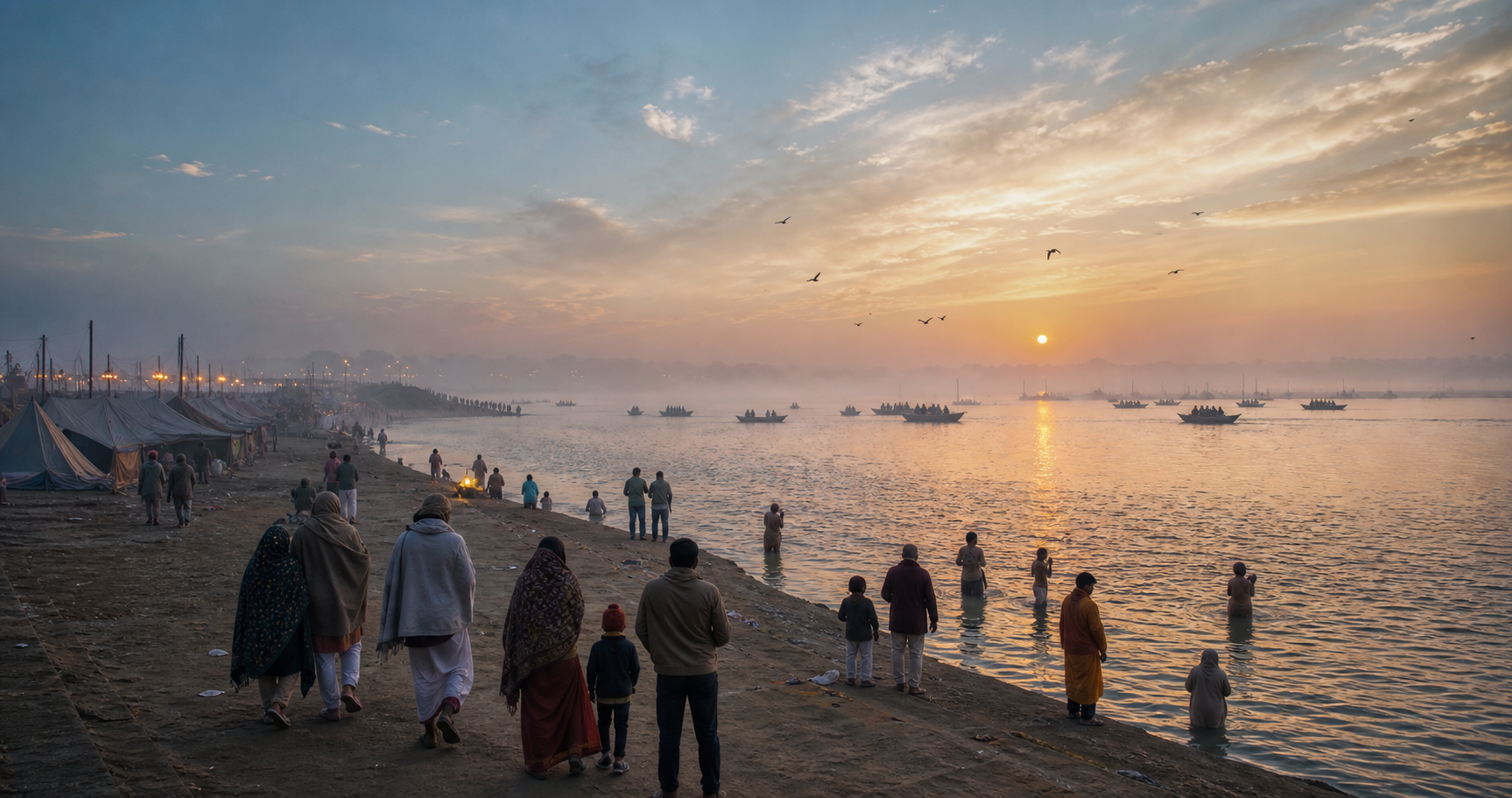
If you are deciding when to visit Prayagraj – or whether a home observance would serve you better – the 2026 calendar presents three different choices. The Magh Mela runs from January 3 to February 1, Makara Sankranti falls on January 14, and Mauni Amavasya follows on January 18.
You do not need to treat these as three boxes to tick. Choose the date whose discipline you can sincerely keep, decide what your snan or home observance will mean, and leave room for official crowd and transport directions. That is a sounder foundation for pilgrimage than trying to collect every auspicious moment.
Read the 2026 calendar as three distinct invitations
Makara Sankranti and Mauni Amavasya both fall within the Magh pilgrimage season, but they arise from different calendar principles. Sankranti is tied to the Sun’s transit into Makara, while Mauni Amavasya is tied to the Amavasya tithi of the lunar month of Magha. The Mela provides the wider period in which pilgrims can undertake snan, prayer, charity and disciplined living.
| Date or period | Primary emphasis | What it means for your plan |
|---|---|---|
| January 3-February 1 | Magh Mela at Prayagraj, centred on snan at the Triveni Sangam, prayer, seva and personal discipline | Use this wider window if the continuity of Magh practice matters more to you than attending on one highlighted date. Confirm final local notices before travelling. |
| January 14 | Makara Sankranti and Uttarayana Punyakalam, with gratitude to Surya, the harvest, the earth and the beings that sustain life | Choose this date when the solar transition and the wider harvest observances are central to your sankalpa. |
| January 18 | Mauni Amavasya, with mauna, fasting or simplicity, japa, snan, dana and remembrance | Choose this date when inward silence and restraint are the heart of your observance. Check a trusted regional panchang for the locally applicable tithi and snan period. |
This distinction prevents a common planning mistake. January 14 is not simply an early version of January 18, and January 18 is not merely another Sankranti bathing day. One brings solar movement, harvest gratitude and shared celebration to the foreground. The other asks you to reduce speech, consumption and distraction. The wider Mela season lets you practise without pretending that spiritual value exists only on the most prominent dates.
Treat the published dates as your devotional framework, not as a final transport timetable. Local authorities may refine access arrangements, routes and crowd controls, while regional panchang calculations and time zones may affect the observance of a lunar tithi. Verify both kinds of information: administrative guidance tells you how to enter safely, and the panchang tells you when your tradition observes the tithi.
Choose the pilgrimage you can actually keep
Go for Makara Sankranti if gratitude is your centre
A January 14 pilgrimage places your Sangam snan within a larger pan-Indian day of solar worship, harvest thanksgiving, food sharing and charity. It is the clearest choice if your family already observes Sankranti or if you want your pilgrimage to connect Surya worship with responsibility toward land, food, animals and community.
Make that connection concrete before you leave. Decide what gratitude will require from you after the bath: sharing food, making dana, reducing waste, helping another pilgrim or changing one careless habit toward the natural world. Without such a commitment, harvest symbolism can remain decorative. With it, the journey continues after you return home.
Go for Mauni Amavasya if silence is your centre
January 18 is better suited to a vrata organised around mauna, prayer and inner restraint. Define your silence precisely. You might keep it from waking until the completion of snan, during the approach to the Sangam, or for a set period after returning to your lodging. A clear boundary is easier to honour than a vague intention to speak less.
Mauna must not prevent necessary communication with companions, officials or anyone responding to a safety problem. Tell your group about the vrata beforehand, carry essential identification and break silence when communication is needed to prevent harm. Disciplined silence is meant to reduce ego and distraction, not create danger or shift responsibility onto other people.
Use another Mela date if steadiness is your centre
You can make a serious Magh pilgrimage without travelling on January 14 or January 18. The season’s broader rhythm supports pre-dawn practice, Sangam snan, japa, kirtan, meditation, charity and simple living throughout the Mela period. This may be the wiser choice if a highlighted date would make the journey impractical for your household.
Do not assume that a date without a major festival label will automatically be quiet. Check current crowd, route and transport advisories before fixing your journey. The useful distinction is spiritual rather than predictive: an ordinary Mela day gives you more freedom to build the visit around sustained practice instead of a particular festival observance.
Before booking, write down five decisions:
- Your chosen date and the dharmic reason for choosing it.
- The vrata or restraint you will begin before reaching the Sangam.
- The prayer, japa or period of silence you intend to keep.
- The act of dana or seva that will complete the observance.
- The official travel, access and crowd guidance you still need to verify.
If you cannot state the first four clearly, delay the booking long enough to settle them. A train ticket can bring you to Prayagraj, but only a deliberate sankalpa turns movement into pilgrimage.
Give the Sangam snan a beginning, middle and end
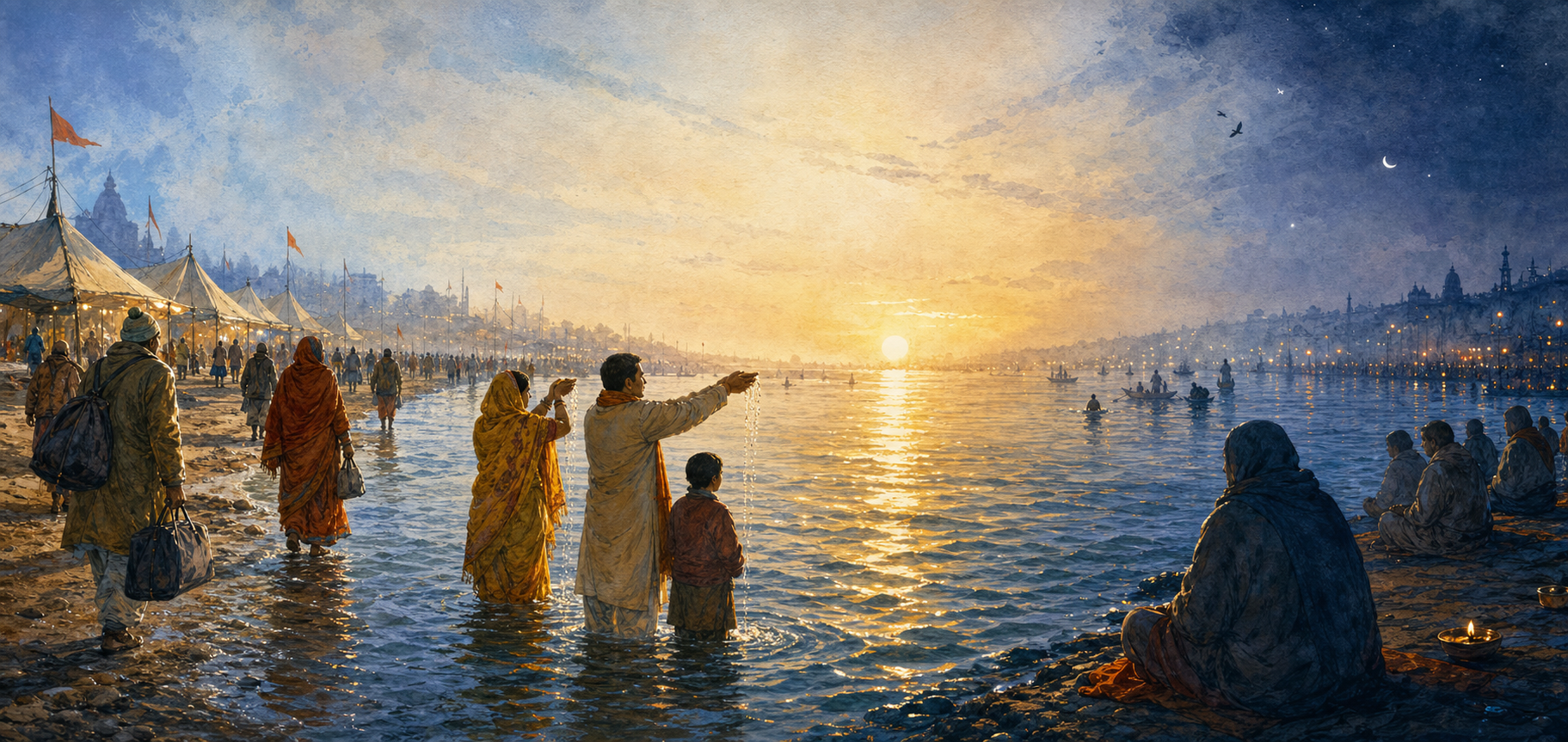
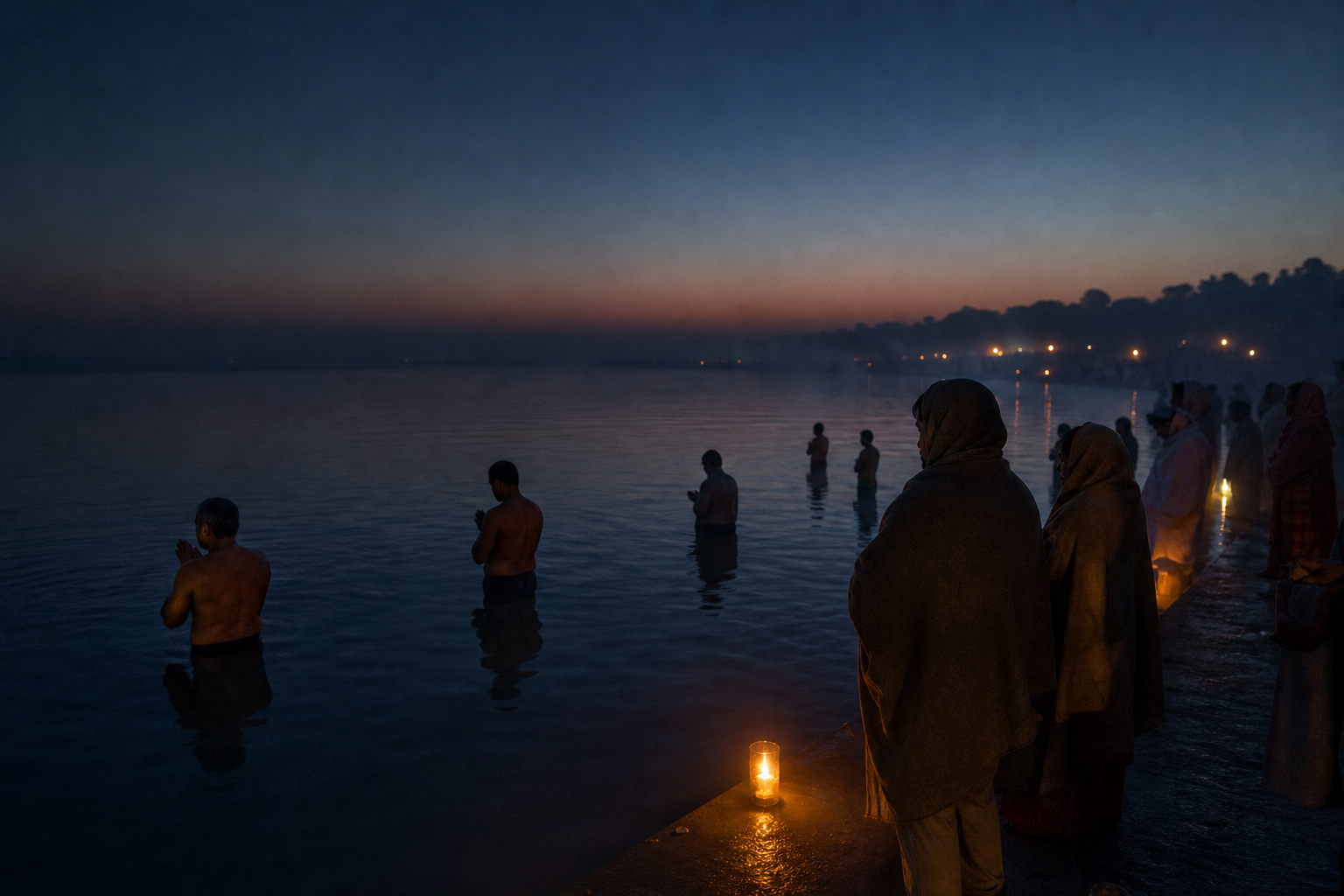
At Prayagraj, the physical centre of the pilgrimage is the Triveni Sangam, where the Ganga and Yamuna meet with the revered, mystical Saraswati. Yet the bath should not become an isolated act squeezed between arrival and departure. Give it a sequence that joins intention, action and ethical follow-through.
- Begin with intention. Before approaching the water, name the habit, attachment or failure of conduct you are bringing under discipline. Keep the resolve short enough to remember after the Mela.
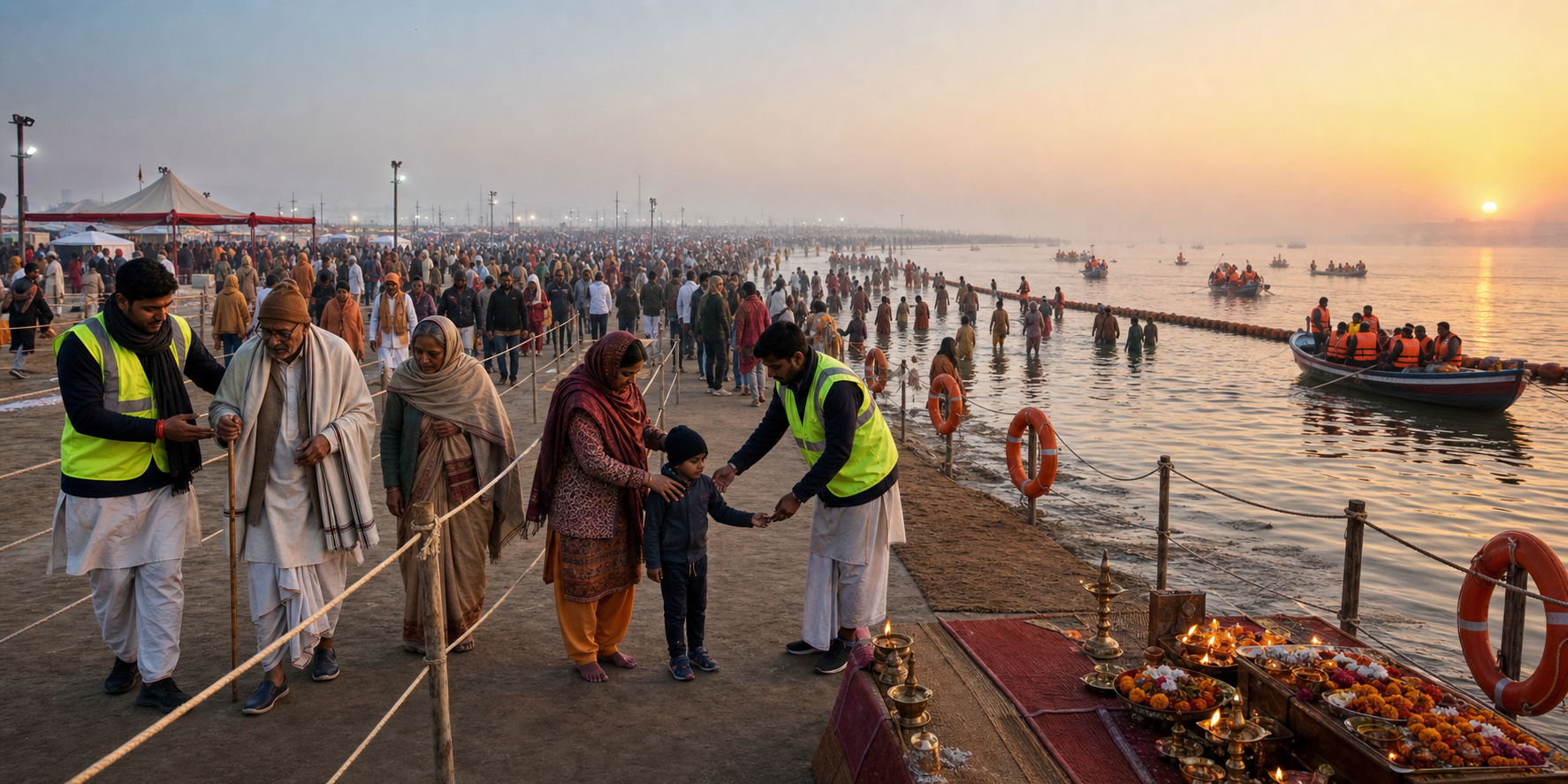
- Approach without competition. Follow the access route, crowd instructions and bathing arrangements in force that day. No private muhurta requires you to push through others or disregard a restriction.
- Perform snan with attention. Let the immersion signify ethical recommitment rather than the mechanical removal of consequences. If you cannot safely enter the water or access is restricted, wait, follow local directions or make a mindful home observance instead.
- Remain for practice. After bathing, allow time for prayer, japa, quiet meditation or scriptural reflection. On Mauni Amavasya, protect the silence instead of immediately returning to conversation and devices.
- Complete the act through dana or seva. Give within your means and without display. Charity is not an admission fee for punya; it is the outward correction of self-centred practice.
- Leave the place cleaner. Carry your packaging, food waste and other belongings away. Reverence for sacred water is contradicted when ritual activity adds to the burden placed upon it.
The most important safety rule is also a dharmic one: do not make your devotion another person’s hazard. Crowd-management directions take priority over a private schedule. Keep companions informed, make allowances for anyone who cannot undertake the same physical austerity, and never measure sincerity by how much discomfort a pilgrim can endure.
Environmental care belongs inside the ritual, not beside it. Bring only what you can manage, avoid disposable excess, and do not leave offerings or their packaging at the riverbank. The Sangam is not a background for worship. The waters themselves are the sacred presence you came to honour.
Keep the observance whole when you remain at home
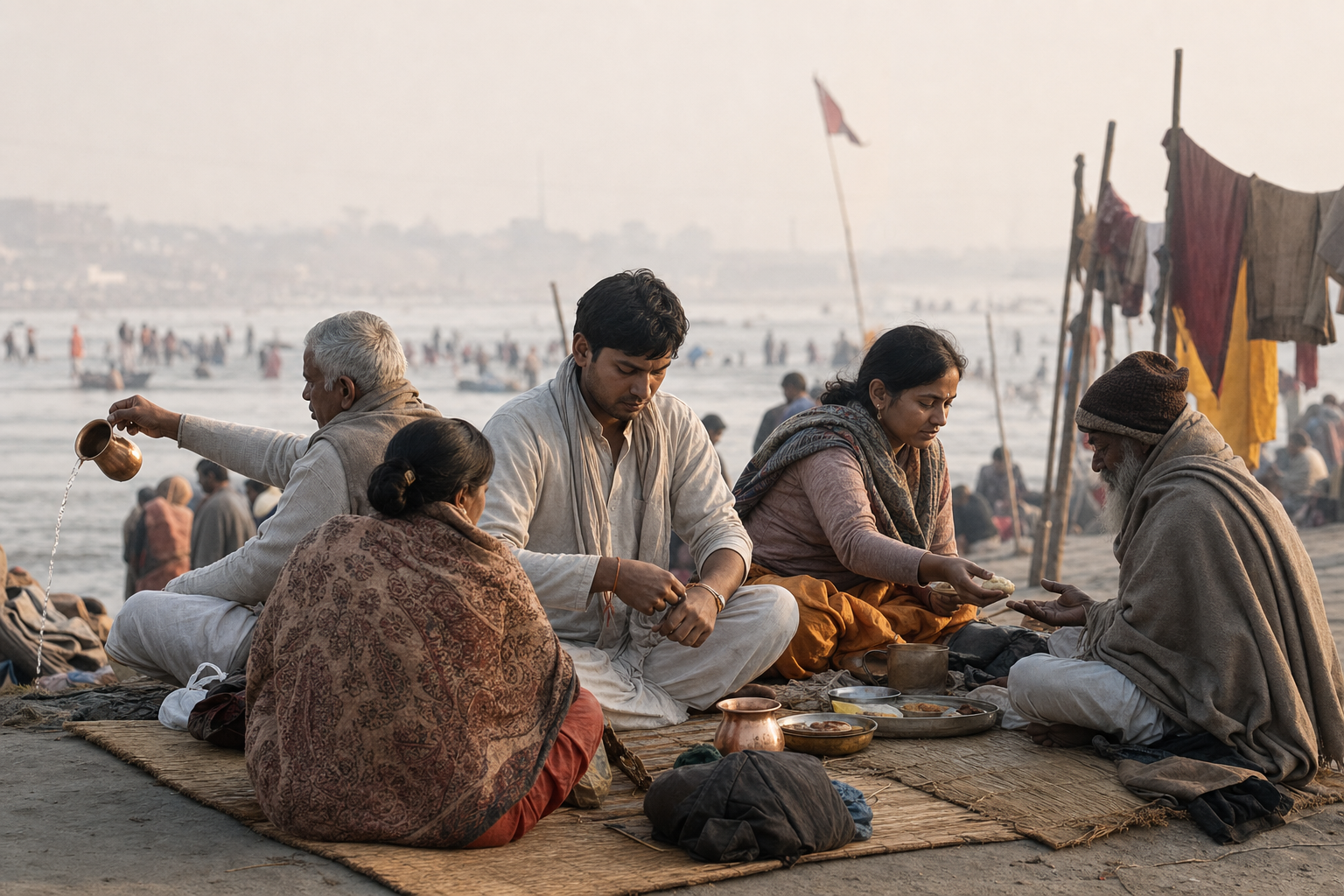
Travel is not the test of whether your observance is real. If health, family duty, distance or crowd conditions keep you away from Prayagraj, you can still organise the day around purity of intention, restraint, prayer and generosity. Do not imitate every feature of a Mela camp in miniature. Keep the practices that you can perform attentively.
For Makara Sankranti on January 14, rise for a sunrise observance, offer arghya to Surya, prepare food associated with your family or region, and share some of it. Sesame and jaggery express the season in many homes. Where Pongal is the inherited practice, kolam, newly harvested rice cooked with milk and jaggery, and gratitude toward cattle bring the harvest relationship into view. Choose an act of charity that makes the day’s abundance available beyond your own household.
For Mauni Amavasya on January 18, begin with a mindful bath at home and keep a defined period of silence. Add japa, a diya, scriptural reading and a simple sattvic meal or upavasa according to your capacity and tradition. Tarpan may be included where it belongs to your family practice. If fasting would be unsafe for you, choose another form of restraint; mauna, simplicity, charity and freedom from excess already give the day a demanding ethical form.
The regional observances surrounding January 14 also show how unity can be recognised without flattening difference. Tamil Nadu’s Pongal thanks nature and honours the agrarian web of nourishment. Assam’s Magh or Bhogali Bihu joins the harvest to community feasts, bhelaghar structures and Meji bonfires. The Lohri season across Punjab, Haryana, Delhi and neighbouring regions gathers families around fire, song, sesame, jaggery and sharing. At Sabarimala, Makaravilakku culminates a season shaped by Ayyappa devotion, vows and austerity.
These are not interchangeable costumes for one generic festival. Their rituals, languages and inherited memories deserve to remain distinct. Their kinship lies at the level of dharmic orientation: gratitude rather than entitlement, reciprocity rather than consumption, discipline rather than impulse, and community rather than isolation.
The same care is needed when speaking of the wider dharmic family. Hindu mauna, Buddhist noble silence, Jain disciplines of non-violence and self-mastery, and Sikh simran can illuminate shared respect for inward restraint. They should not be collapsed into a claim that every tradition performs the same rite or gives ritual bathing the same meaning. Unity becomes stronger when it does not require sameness.
Key takeaways for your 2026 observance
- The 2026 Magh Mela is scheduled for January 3-February 1, but local administrative notices should guide your final travel and access plan.
- Choose January 14 when Makara Sankranti, Surya worship and harvest gratitude are central to your sankalpa.
- Choose January 18 when Mauni Amavasya, silence and restraint are central, and verify the applicable tithi through a trusted regional panchang.
- You do not need a highlighted bathing date to undertake a meaningful Magh pilgrimage; the wider season supports sustained practice.
- Give snan an ethical consequence through a specific vrata, dana or seva, and responsibility toward the river environment.
- If you remain at home, a mindful bath, prayer, silence, simple food and charity can form a complete observance within your capacity.
Before you make the journey, put three lines at the top of your plan: the date you have chosen, the restraint you will keep and the service that will follow. Then verify the panchang and the current Prayagraj advisories. You will arrive with more than an itinerary; you will arrive knowing what the pilgrimage asks of you.
References
- DharmaRenaissance Blog – Auspicious 14 Jan 2026: Makara Sankranti, Pongal, Magh Bihu and Makaravilakku in Radiant Unity
- DharmaRenaissance Blog – Magh Mela 2026 at Prayagraj (Allahabad): Key Dates, Sacred Snan, and Spiritual Significance
- DharmaRenaissance Blog – Mauni Amavasya 2026: Sacred Silence, Auspicious Snan and Magh Mela at Triveni Sangam
