
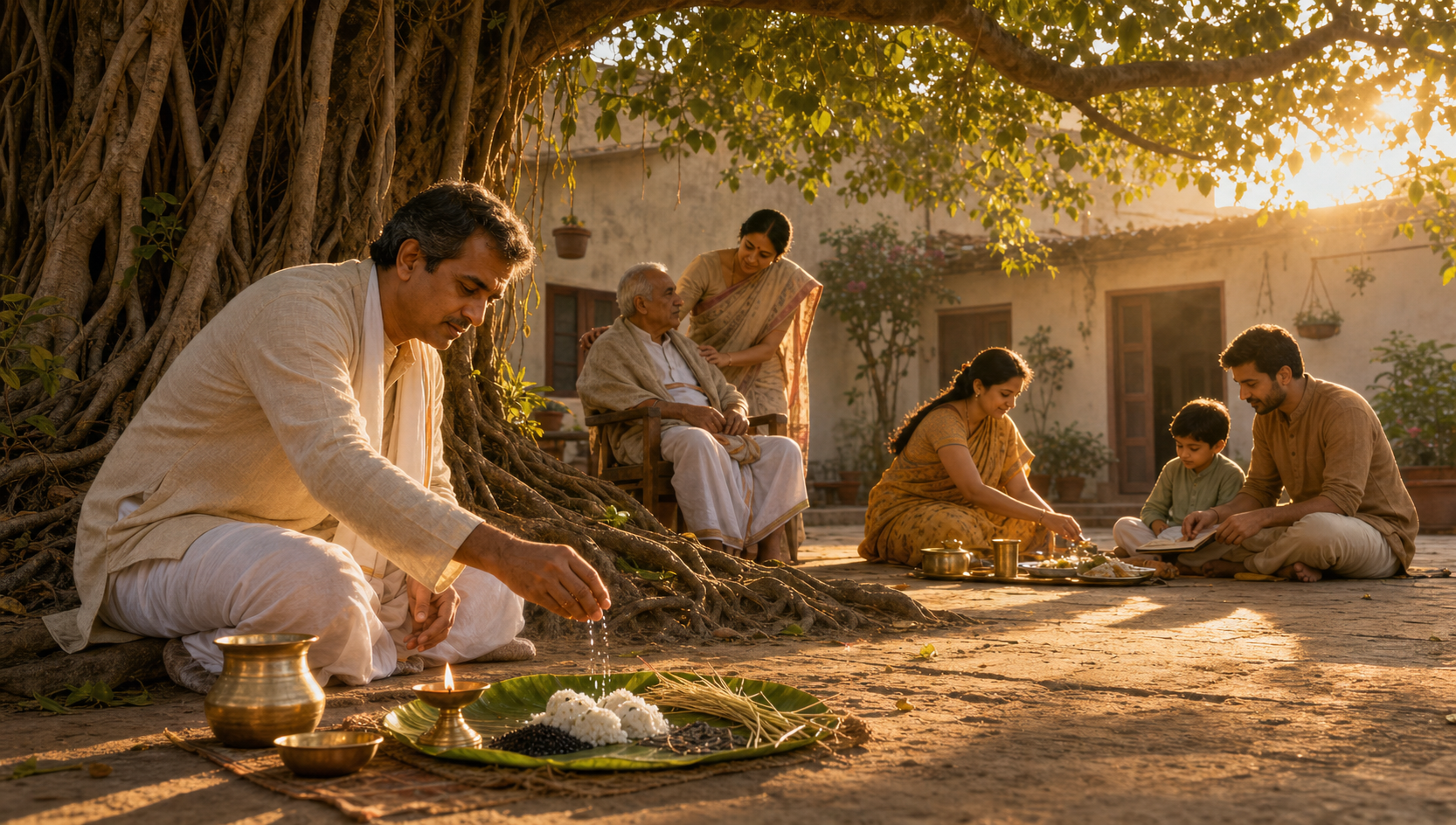
If you are wondering whether ancestral duty ends when a Shradh rite is completed, the Pitrgatha gives a clear answer: it does not. Sacred remembrance has a ritual form, but its moral test appears afterward—in the way you treat elders, speak truth, share what you possess, and carry your family’s better inheritance forward.
This makes ancestral duty possible even when your family history is incomplete, your observance must be abbreviated, or you live far from the place where earlier generations performed it. The Pitrgatha in Matsya Purana 204.3–17 does not reduce remembrance to sentiment. It asks you to turn gratitude into conduct.
Read ancestral duty as reciprocity, not a transaction
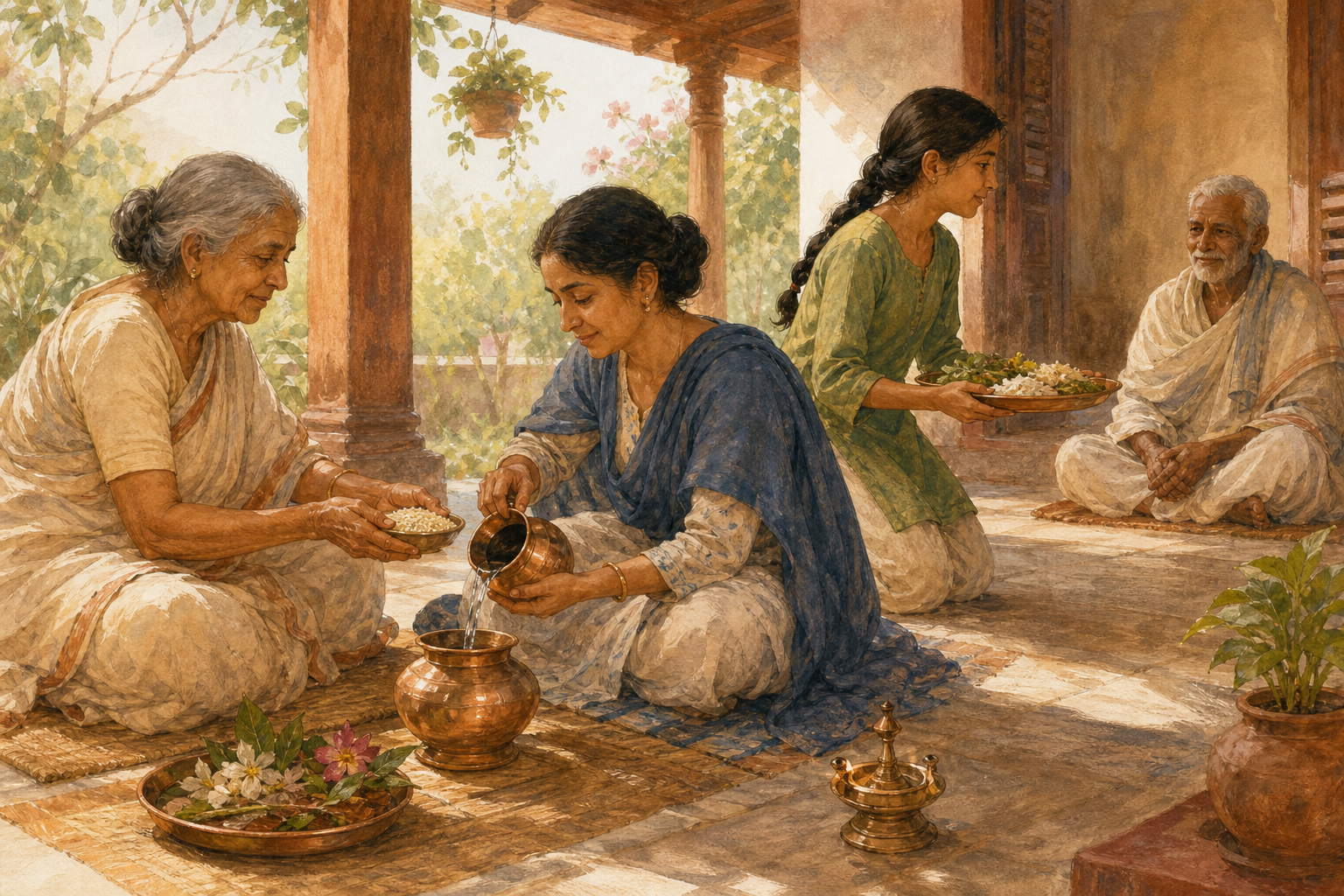
The Pitrgatha, also called the Song of the Manes, gives departed ancestors a voice. They bless their descendants and express hopes for the family’s well-being, unity, prosperity, and moral direction. This literary choice matters: the ancestors are not treated as inert names from a vanished past. They remain part of a relationship between generations.
That relationship is reciprocal. Descendants remember, offer, serve, and preserve. The ancestors answer with blessing and moral expectation. Yet reciprocity should not be mistaken for a bargain in which an offering purchases a desired result. Blessing is associated with righteous conduct, especially satya, or truthfulness, and dana, or generosity. The quality of your life therefore belongs inside the meaning of the observance.
You can examine your own ancestral duty through five practical questions:
- Memory: Can you name the people whose labour, sacrifice, knowledge, or care helped make your present life possible?
- Truth: Can you tell their stories without inventing virtues, concealing known failures, or repeating family legend as established fact?
- Care: Are the living elders and vulnerable members of your family receiving attention, dignity, and practical help?
- Fairness: Do your dealings with relatives, workers, neighbours, and strangers reflect the integrity you invoke during worship?
- Continuity: What worthy value, skill, story, or responsibility will reach the next generation because you deliberately transmitted it?
This test reveals a common contradiction. A household may arrange a careful observance while neglecting an elderly relative, dividing property dishonestly, humiliating a dependent, or refusing a clear responsibility. Ritual precision cannot make those actions righteous. In the moral world of the Pitrgatha, remembrance and conduct must point in the same direction.
Join Shradh to the conduct of ordinary days
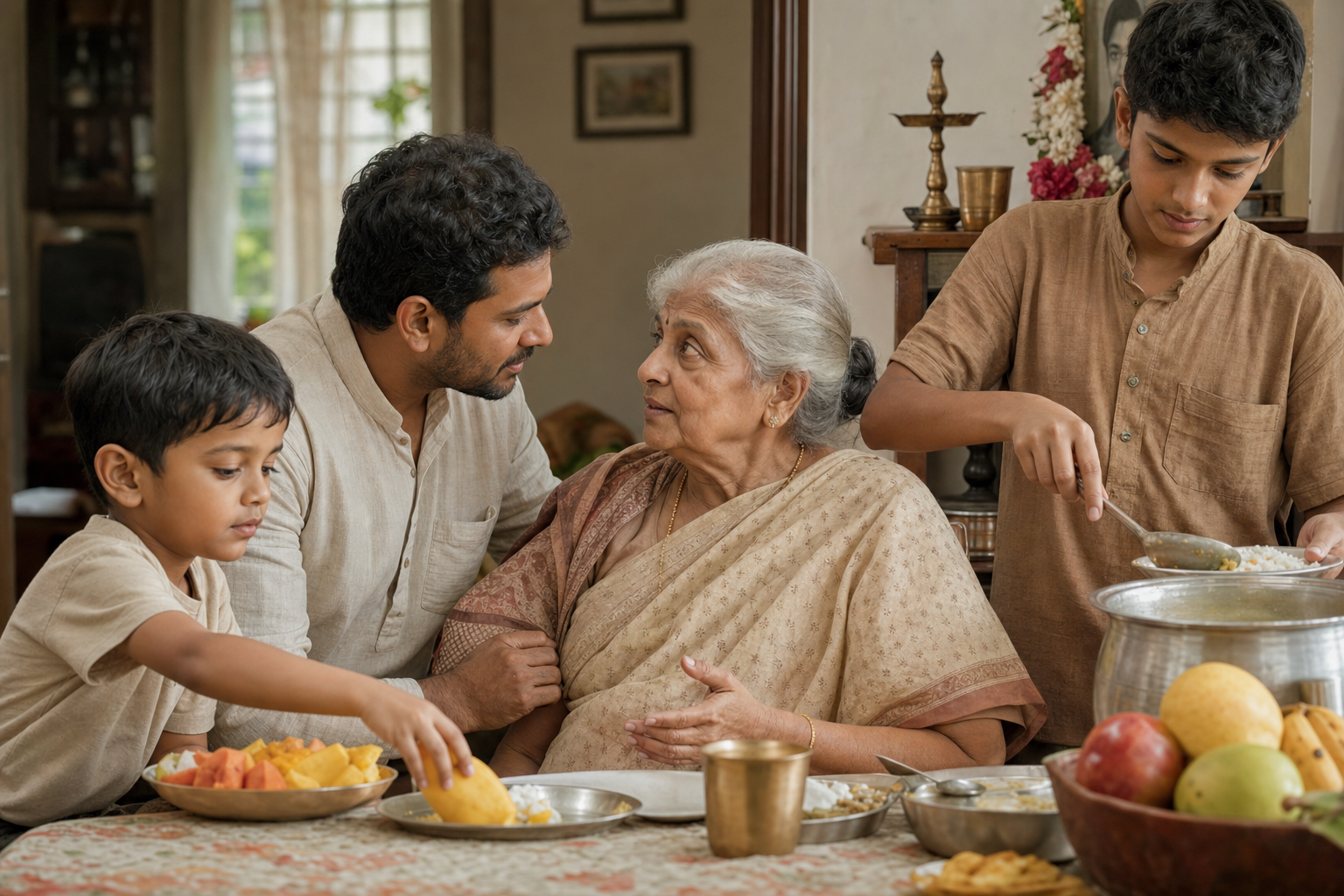
Shradh, prayer, tarpan, and shared meals give ancestral remembrance a visible time and place, especially during Pitru Paksha. They interrupt forgetfulness. They bring names back into family speech and create an occasion on which gratitude can be expressed collectively rather than left as a vague private feeling.
Daily dharma performs a different task. It demonstrates whether the virtues honoured during the rite govern the household once the gathering is over. Care for elders, equitable dealings, charity, community service, compassion, and truthful speech are not decorative additions to ancestral worship. They are ways in which inherited dharma becomes present action.
Ritual and ethics should therefore not be made competitors. Ethical action is not a reason to dismiss a family’s sacred forms, and ritual performance is not permission to ignore moral failure. If circumstances allow you to perform the inherited observance, do so with sincerity and appropriate guidance. Then give the remembrance a concrete consequence.
A workable annual pattern is:
- Before the observance, write down the names you intend to remember. Add one reliable fact, teaching, sacrifice, or unresolved responsibility associated with each person.
- During the observance, follow the form preserved by your household or the guidance of a trusted person in your tradition. Do not present an improvised act as an authoritative rite if you do not know that it is one.
- Connect the day to one act of dana, service, reconciliation, or care. Choose an act that answers a real need rather than one selected only for appearance.
- Give any unfinished duty a date. Calling an isolated elder, correcting an unfair family account, preserving a deteriorating record, or fulfilling a neglected promise becomes more real when someone is responsible and a date is named.
- Review the commitment within the following month. An intention that disappears after the ritual has not yet become a family practice.
The scale of the action matters less than its honesty. A modest duty completed is more meaningful than a grand declaration that changes nothing. The relevant question is not whether the act looks impressive, but whether it repairs neglect, shares benefit, or preserves something worthy.
Use a five-step practice to carry lineage forward
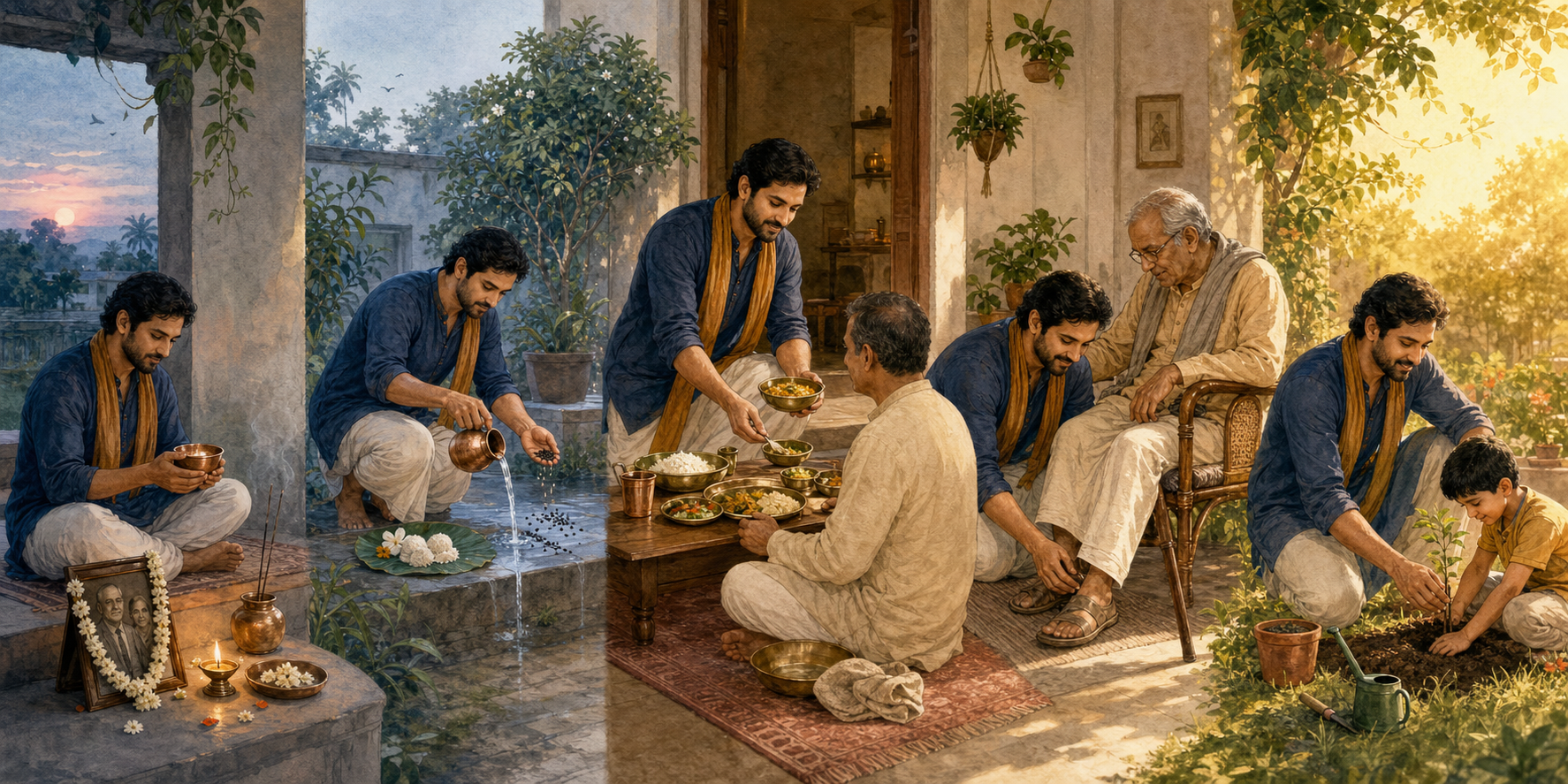
Ancestral remembrance becomes vague when every forebear is praised in the same general language. You can make it more truthful by working with one person, one inheritance, and one duty at a time. This practice is useful before Pitru Paksha, at a family gathering, or whenever a child asks where the family came from.
- Choose one ancestor. Use a name if you know it. If you do not, identify the relationship or branch of the family without pretending to know more than you do.
- Record what reached you. It may be a value, livelihood, language, devotional practice, recipe, craft, opportunity, warning, or example of endurance. Distinguish a verified memory from a story whose accuracy is uncertain.
- Decide what deserves continuation. Gratitude does not require imitation of every inherited custom. Preserve what serves dharma; do not give harmful conduct authority merely because it is old.
- Convert the inheritance into an action. Teach the skill, preserve the photograph, record an elder’s account, offer practical care, perform service, practise dana, or correct conduct that contradicts the virtue being honoured.
- Transmit the context. Tell the next person not only what the family does, but whose life gave the practice meaning and what responsibility comes with receiving it.
A simple family record can use six fields: name, relationship, what is known, what was received, what should continue, and the next action with its date. Add a separate note for uncertainty. That small distinction protects remembrance from becoming mythology presented as biography.
This approach also prevents legacy from becoming passive pride. An ancestor’s generosity is not inherited merely by speaking about it. You inherit it ethically when you become generous. A forebear’s courage is not yours by surname alone. It becomes part of your lineage again when you act courageously in a situation that actually requires it.
Handle distance, lost customs, and difficult lineages honestly

Urban life and diaspora can separate you from a family priest, ancestral home, local sacred geography, or relatives who remember the customary procedure. An abbreviated observance under those conditions need not become careless. Preserve what you genuinely know, seek guidance where ritual details matter, and resist filling gaps with confident invention.
When you cannot reproduce the full inherited form, keep three things visible: sincere remembrance, an ethical act dedicated to that remembrance, and the transmission of a reliable family story. These do not establish that every shortened practice is ritually identical to a traditional observance. They do keep distance from turning into indifference.
Inter-traditional families need similar care. Hinduism, Buddhism, Jainism, and Sikhism all give meaningful places to gratitude, compassionate action, service, and the inheritance of moral example, but their particular rites and theological understandings are not interchangeable. You can respect each form without flattening the differences. Let truthful memory and service provide common ground while each member observes according to their own tradition.
Some lineages also contain abandonment, injustice, addiction, violence, prejudice, or unresolved conflict. Ancestral duty does not require you to rename harm as virtue. Satya requires truthful memory; equitable conduct requires that inherited wrongdoing not be repeated. You may honour genuine sacrifice, preserve what was worthy, and still end a destructive pattern.
The same distinction applies to living relationships. Care for an elder does not require concealing abuse or placing yourself in danger. Where direct contact is unsafe, use firm boundaries and seek appropriate support; practical care, when warranted, can sometimes be arranged without surrendering safety. Dharma should not be invoked to force someone back into preventable harm.
Truthful remembrance is often more demanding than idealisation. It asks you to receive a mixed inheritance with discrimination: gratitude without falsehood, continuity without blind repetition, and reform without contempt for everyone who came before you.
Key takeaways
- Ancestral duty in the Pitrgatha extends beyond a completed rite into truthfulness, generosity, care, fairness, and service.
- Shradh creates a sacred occasion for remembrance; daily conduct shows whether that remembrance has moral substance.
- Ancestral blessing is best understood as part of a reciprocal relationship, not as a result purchased by an offering.
- If formal rites are abbreviated, preserve sincerity, seek reliable guidance, act ethically, and transmit what you know without inventing certainty.
- Honouring a lineage means continuing what is dharmic and refusing to repeat what is harmful.
- A useful observance ends with a named responsibility, a responsible person, and a date—not only with a feeling of reverence.
Before your next ancestral observance, choose one name and one unfinished duty. Write both down. Complete the duty, preserve the story behind it, and pass that story to someone younger. That is how remembrance stops being a look backward and becomes living dharma.
References
