

If you came to the Mundaka Upanishad looking for a Hindu account of how the universe began, its images may initially feel elusive. A spider spins a web. Plants rise from the soil. Hair grows from a living body. None of these gives you a date, a sequence of physical events, or a mechanism that modern cosmology could test.
That is precisely why the images matter. They redirect you from asking when matter first appeared to asking a more intimate question: what is the relationship between everything that changes and the reality on which change depends? Once you read the symbols at that level, creation becomes a practical teaching about your own mind, identity and freedom.
Begin with the question the symbols actually answer
The Mundaka Upanishad is not trying to replace astronomy or describe a physical manufacturing process. Its creation teaching is ontological: it asks what kind of reality the world possesses, where its apparent independence comes from, and whether the changing universe can be its own ultimate ground.
This becomes clearer through the distinction between apara vidya and para vidya. Apara vidya includes the Vedas, ritual disciplines and forms of learning that order the mind. Para vidya is direct knowledge of Brahman, the imperishable reality. The distinction gives you an essential reading rule: knowing a cosmological teaching is not yet the same as knowing Brahman.
You can memorize every stage of emanation and still remain identified with a frightened, possessive or restless self. Cosmology becomes spiritually useful only when it changes how you see the experiencer, the experienced world and their ground. Treat the account as a contemplative map, not as information to collect.
A simple test will keep your reading on course. After meeting a symbol, restate its teaching without the picture. With the creation images, the central claim is that changing forms arise in dependence on the imperishable, remain dependent while they appear, and do not turn their ground into one more changing object among them.
Key takeaways
- The creation images answer a question about dependence and ultimate reality, not a question about the age or physical construction of the universe.
- The spider, plants and hair express one shared insight, but each image corrects a different misunderstanding.
- The movement from Brahman to life, mind, senses and elements can be used as a map for tracing experience back to its ground.
- The two birds move the teaching from cosmic creation to your present identity as experiencer and witness.
- The symbols have done their work when they deepen discernment, detachment and ethical conduct rather than merely expanding your vocabulary.
Read the three creation images as complementary safeguards
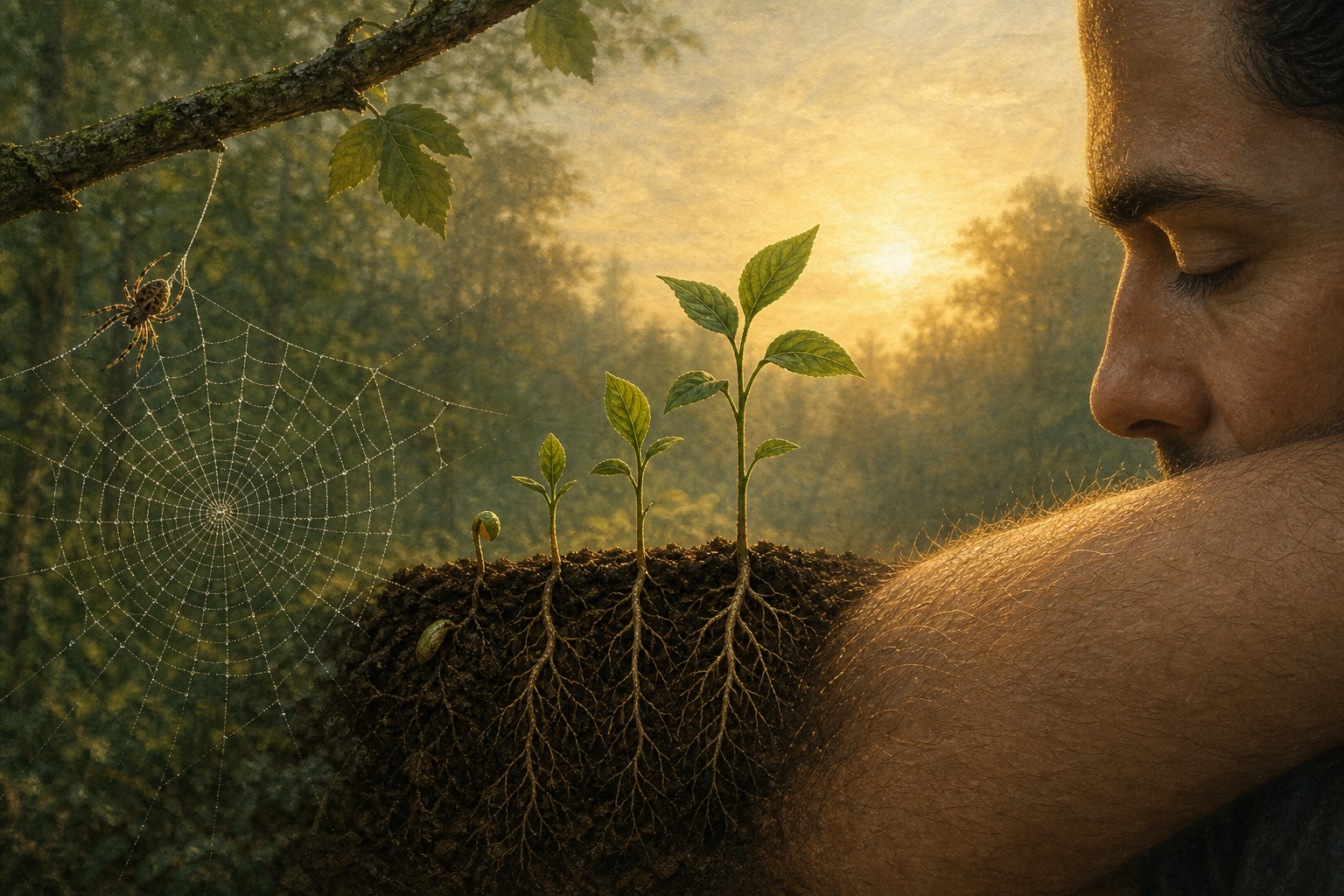
The three familiar images should not be forced into a single literal picture. A universe cannot simultaneously be a web, vegetation and hair. Their agreement lies elsewhere: arising is natural, the effect remains dependent on its source, and the source is not reduced to the temporary forms that appear.
| Image | What to notice | Misreading it corrects |
|---|---|---|
| Spider and web | The web issues from the spider and can be withdrawn by it. | Do not picture the source as merely a distant artisan standing outside creation. |
| Plants and earth | Many distinct forms arise from and remain rooted in a common ground. | Do not let visible diversity hide the dependence shared by all forms. |
| Hair and living body | Growth occurs naturally from a living basis, without resembling strenuous human manufacture. | Do not project human effort, limitation or anxiety onto the imperishable source. |
The spider is especially useful when you imagine Brahman as an external maker who obtains material from somewhere else. The image draws source and manifestation into a closer relationship: the web is not independent of the spider from which it comes. Withdrawal also introduces dissolution. Manifestation is neither self-originating nor permanently fixed.
The earth-and-plants image shifts your attention from withdrawal to multiplicity. One ground supports shoots that differ in shape, size and appearance. When human differences feel absolute, use this image to examine the mistake. Distinction does not require total separation, and variety does not prove that each being possesses an independent ultimate ground.
Hair growing from a living body is the least dramatic image, which is its strength. It removes the noise of cosmic spectacle. Creation need not be imagined as a difficult project undertaken by a magnified human personality. The image teaches effortless emergence while leaving the living source intact.
Do not make any one analogy carry the entire doctrine. A spider can be separated from its finished web in ordinary experience; earth is not conscious in the way Brahman is understood; hair is not identical with the person from whom it grows. An Upanishadic analogy guides attention through a selected resemblance. It is not an equation between Brahman and an ordinary object.
When you encounter any spiritual metaphor, ask two questions: “What precise relationship is this image revealing?” and “Where does the resemblance stop?” Those questions let the symbolism teach you without turning poetry into crude literalism.
Follow the cosmological sequence inward, not forward in time
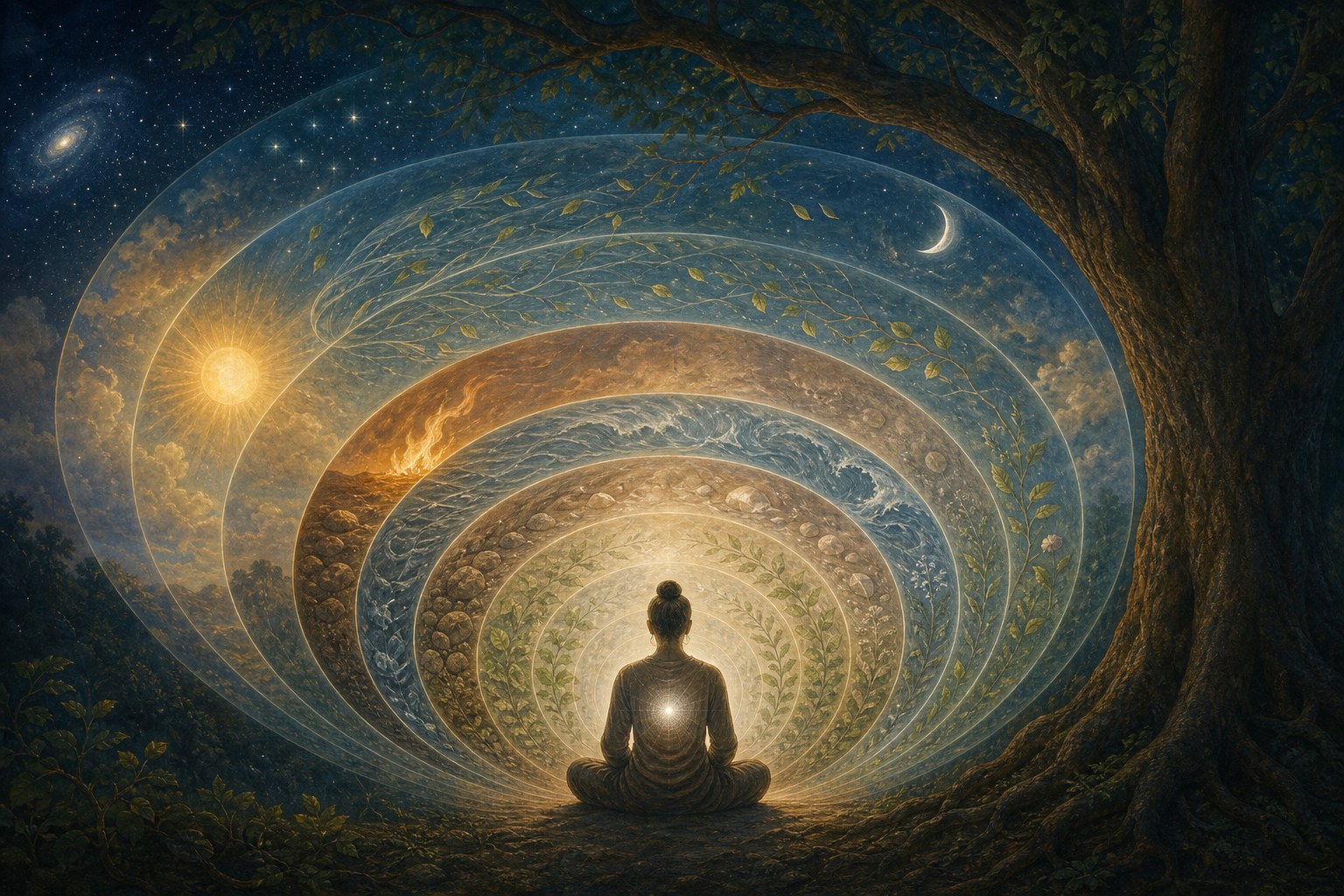
The account also names a procession from the imperishable reality into the structures of experienced life: prana, mind, senses, space, air, fire, water and earth. Reading this as an early attempt at laboratory physics creates needless confusion. The elemental terms belong to a contemplative ordering of experience, not to the periodic table.
The useful movement is from the subtle ground toward increasingly tangible experience. Life-breath, cognition, sensory contact and the elemental world are not presented as isolated domains that sustain themselves. Their place within one emanative vision directs attention back to the imperishable on which the whole field depends.
You can use that ordering in reverse. Begin with an object that currently commands your attention. Notice its material form. Notice the sense through which it is known. Notice the mind interpreting the sensory impression. Notice the living presence within which that mental event occurs. Then ask whether any object, sensation or thought is present independently of the awareness in which you know it.
This is not a demand for a quick verbal answer such as “everything is Brahman.” Repeating the conclusion can become another form of lower knowledge. Stay with the actual contrast: the object changes, the sense impression passes, the interpretation shifts, and yet knowing remains present through those changes. The practice gives the cosmological hierarchy a point of contact in immediate experience.
Keep one distinction firm. Dependence does not mean that ordinary differences cease to function. Fire is not water, a thought is not a stone, and your responsibilities do not disappear because all are traced to one ground. Unity at the level of Brahman is not permission to become careless at the level of conduct.
The two birds reveal why the creation teaching matters
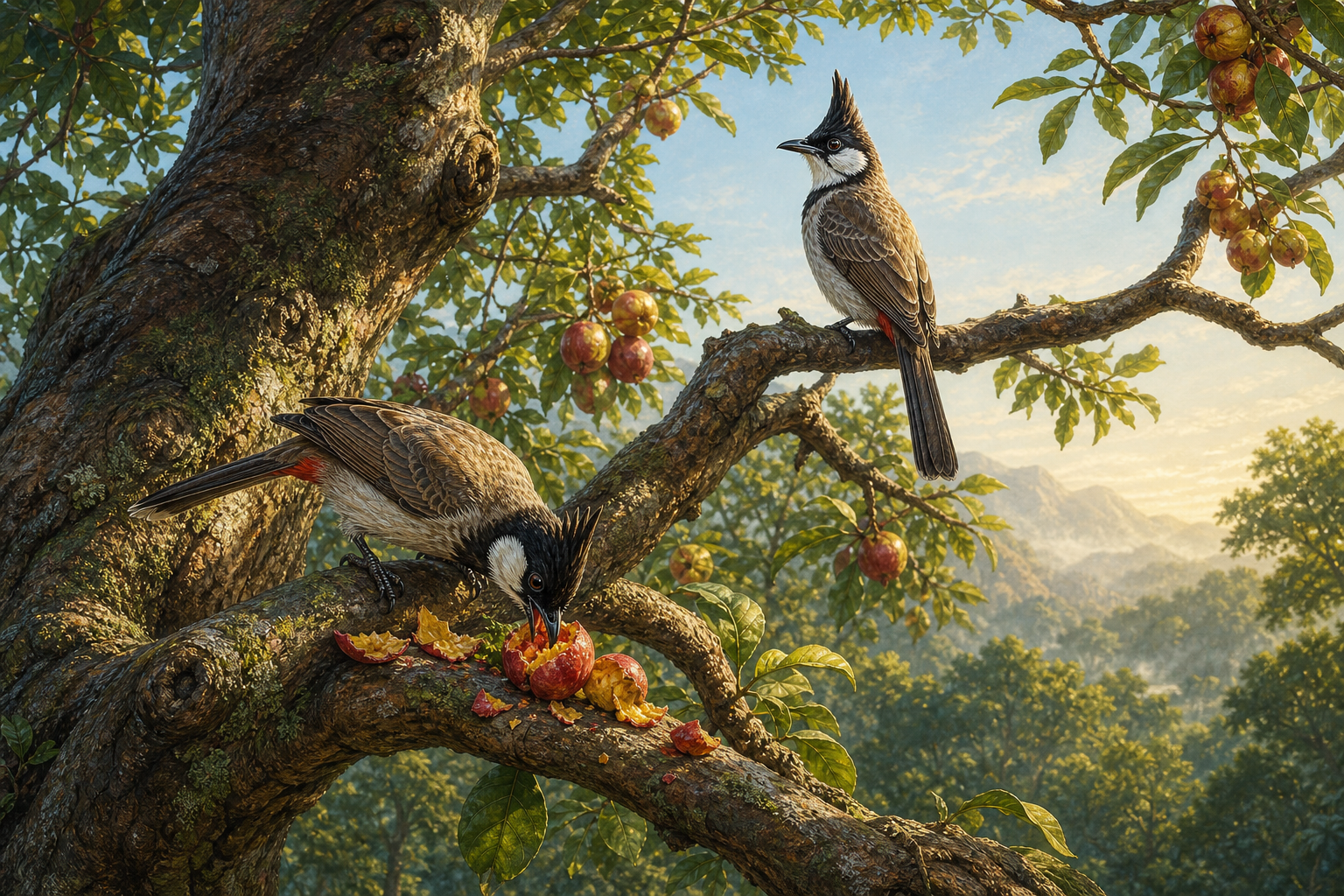
The parable of two birds resting on the same tree completes the movement from cosmic origin to lived self-knowledge. One bird eats the fruits, encountering sweetness and bitterness. The other does not consume them. It witnesses in serenity.
The fruit-eating bird represents the individual as experiencer: “I succeeded,” “I failed,” “I gained,” “I lost.” Its life is organized around the changing taste of each fruit. The witnessing bird represents the Self understood in relation to Brahman. Freedom begins when the first bird turns toward the second and ceases to take its fluctuating experiences as the whole truth of what it is.
This is why the parable belongs beside creation symbolism. The world of fruit, appetite and consequence is the experienced order of change. The witness is not another fruit within that order. Just as the imperishable cannot be reduced to one created object, the witnessing Self cannot be reduced to one passing thought, emotion or role.
Use the image at the moment a “fruit” becomes overwhelming. Name the experience plainly: praise, insult, pleasure, disappointment, attraction or fear. Then notice the difference between the experience and the awareness that knows it. You do not need to deny the taste. You need to stop treating the taste as the complete definition of the one who knows it.
Witnessing should not be confused with emotional suppression or withdrawal from duty. The fruit-eating bird remains on the same tree as the witness. The practical change is not escape from the created world but freedom from total identification with its alternating outcomes. That freedom should make truthful action, restraint and compassion more possible, not less.
Use the symbols without flattening their spiritual purpose
A disciplined practice can keep the teaching from becoming either empty abstraction or forced literalism. Choose the image that addresses your present misunderstanding, then let it govern a short period of observation.
- Name the confusion. Are you treating the world as self-sufficient, diversity as absolute separation, creation as human-like manufacture, or a passing experience as your complete identity?
- Select the corrective image. Use the web for dependence and return, plants for diversity grounded in unity, hair for effortless emergence, or the birds for experiencer and witness.
- Watch arising and passing. Observe a sensation, thought or emotion from its appearance through its change or disappearance. Do not interfere merely to produce a spiritual-looking result.
- Trace the appearance to its conditions. Notice the object, sensory contact, mental interpretation, living presence and awareness involved in the experience.
- Translate insight into conduct. Before the next consequential action, ask what changes if the other person is not ultimately separate from the same ground you seek within yourself.
The last step is essential. If unity remains only a metaphysical slogan, it can coexist with vanity and harshness. A real shift in vision should weaken the impulse to exploit, deceive or dehumanize. Humility, non-violence, truthfulness and compassion are not decorative additions to contemplation; they show whether your understanding has begun to reach conduct.
You may also recognize resonances across the Dharmic traditions: Buddhist attention to conditioned arising, Jain respect for the many-sided character of truth, and Sikh devotion to the One beyond limiting form and name. Use such resonances to encourage serious dialogue and ethical kinship. Do not use them to erase doctrinal differences. Brahman, Buddhist accounts of arising, Jain anekantavada and Sikh Ik Onkar retain their own vocabularies, arguments and spiritual settings.
The most common failure is stopping at admiration. The images are beautiful, but beauty alone does not free the fruit-eating bird from grief. The next time a thought, possession or social role feels absolutely defining, choose one creation symbol and follow its logic all the way back: this appeared, it depends, it changes, and it is known. Then act from the steadier awareness that the inquiry uncovers.
References
