
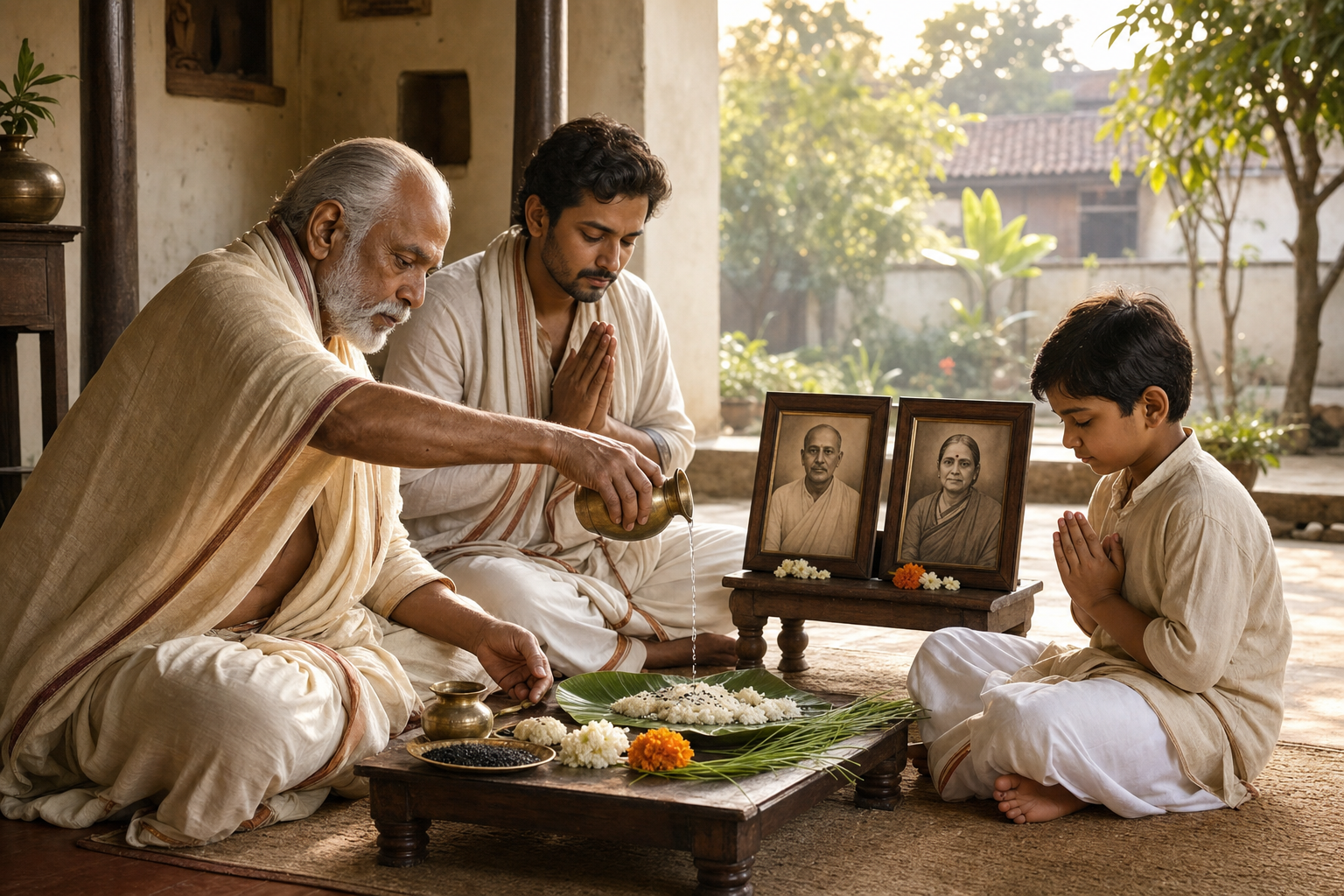
You may have inherited the word shraddha, a photograph of a grandparent, or a family observance during Pitru Paksha without inheriting a clear explanation of what ancestral dharma requires. When the procedure is uncertain, remembrance can easily become either anxiety about doing something wrong or a vague sentiment with no effect on how you live.
A steadier approach connects three things: remember those who made your life possible, make whatever offering is appropriate to your tradition, and conduct yourself in a way that honors the lineage. You do not need to invent a ritual to begin. You do need to understand why remembrance, offering, and ethical responsibility belong together.
The Pitrs turn ancestry into a living relationship
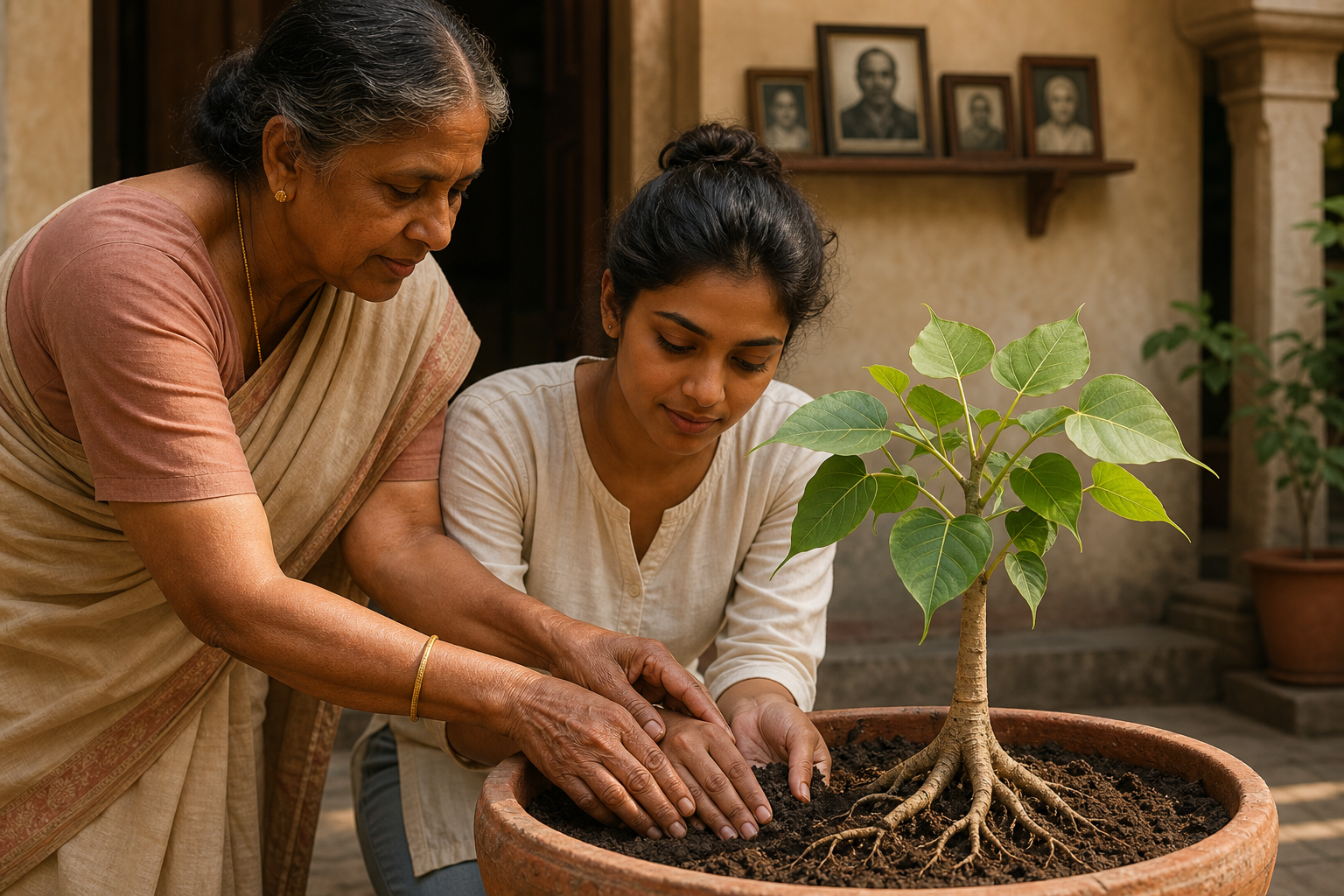
Within the cosmic vision associated with the Markandeya Purana, the Pitrs hold a dignified place among the guardians of continuity and order. They are not merely a collection of private memories. They represent the bond through which life, obligation, knowledge, and identity pass from one generation to another.
This changes the question you bring to ancestral practice. Instead of asking only, “What must I give so that I receive a blessing?” ask, “What have I received, and what am I responsible for carrying forward?” The first question can make worship transactional. The second places you inside an intergenerational relationship governed by gratitude and dharma.
Offerings and blessings still matter within this relationship. Descendants remember and offer; the Pitrs, in turn, are associated with prosperity, clarity, and inner steadiness. Yet the exchange is better understood as alignment with rita, the order that holds beings and duties together, rather than as a bargain. Sincerity matters because the inner disposition of the person making the offering is part of the offering.
Traditional classifications include names such as the Agnishvattas and Barhishads, each connected with particular sacred functions. The terminology is not identical in every textual or ritual setting. That variation gives you a practical warning: do not treat every mention of the Pitrs as though it describes only your recently deceased relatives, and do not improvise a specialized rite merely because you recognize the name of a class of ancestral beings. The sacred order of the Pitrs is wider than personal genealogy, while household remembrance remains one way a family participates in that order.
Ritual and character answer different parts of the same duty
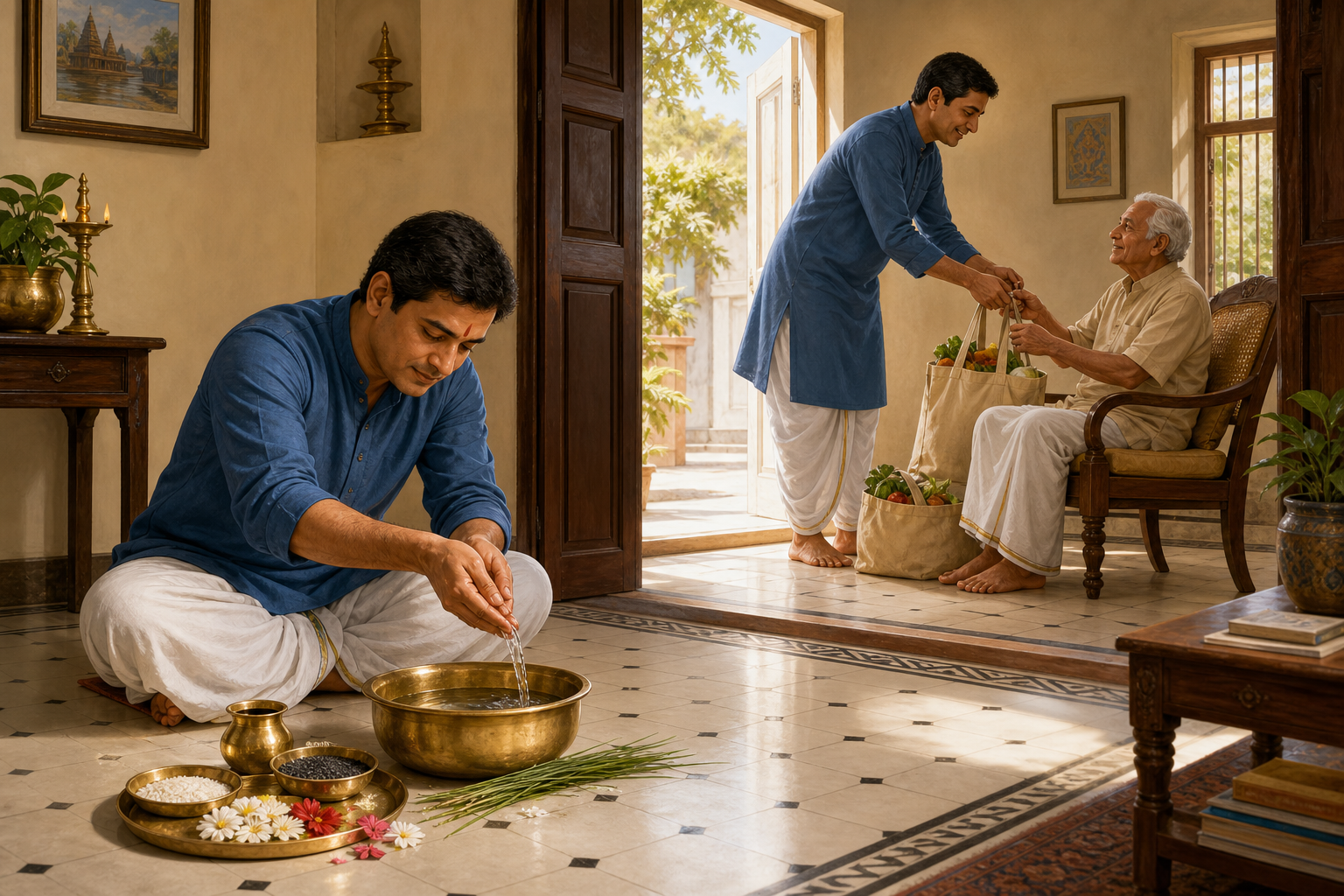
Ancestral dharma is weakened in two opposite ways. One reduces everything to ceremonial performance. The other declares that good intentions make inherited observances unnecessary. Neither approach holds ritual and conduct together.
Shraddha gives remembrance a deliberate form. It directs attention away from casual nostalgia and toward gratitude, continuity, and obligation. Daily conduct answers a different question: what becomes of that gratitude after the observance ends? Truthful speech, generosity, fidelity to commitments, and care for others show whether remembrance has entered your character.
- Remembrance preserves identity. Learn the names, relationships, struggles, and worthy qualities that can still be established within your family. Record uncertainty honestly instead of turning guesses into family history.
- Offering disciplines gratitude. Give attention, food, or service without making the act a display of your own virtue. The point is to acknowledge what was received, not to place yourself at the center.
- Truthful conduct protects the lineage. An impressive observance cannot repair dishonesty that continues unchanged. Choose a real obligation in family or community life and fulfill it.
- Generosity carries memory beyond the household. Feeding or helping someone in need turns private gratitude into social responsibility. It prevents ancestral reverence from becoming self-enclosed.
Ethical conduct is not a convenient declaration that formal rites no longer matter. In the same way, ritual is not a receipt that cancels unethical conduct. If your family maintains a particular shraddha procedure, learn it from a trustworthy elder or a competent guide within that tradition. If the procedure has been lost, begin with sincere remembrance and service while you seek guidance; do not assemble a supposedly ancient rite from unrelated fragments.
A responsible practice when family customs are unclear
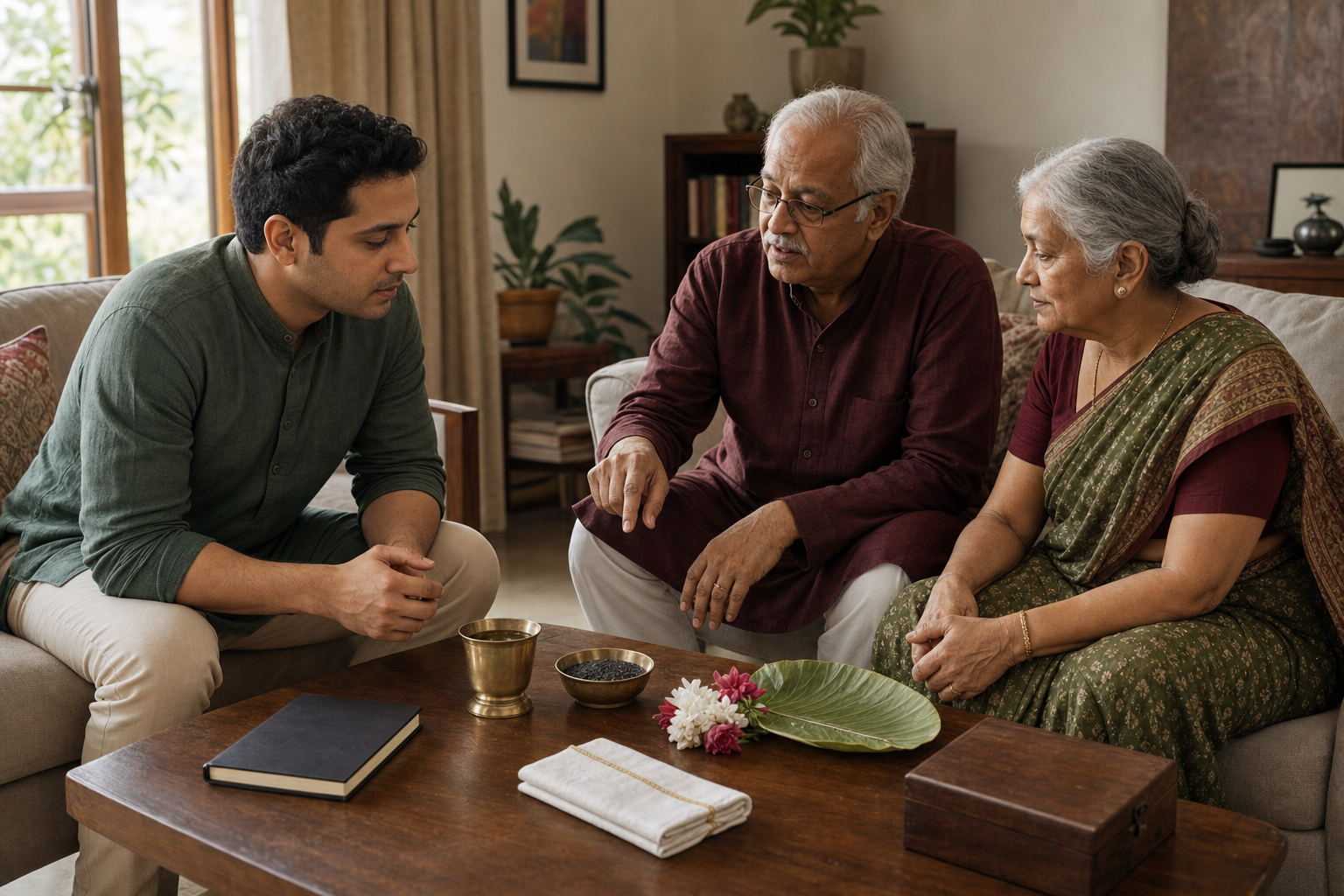
You can begin honoring your ancestors even when you do not yet know the complete ritual tradition of your household. Keep the beginning modest and distinguish a personal act of remembrance from a formal rite whose details you have not learned.
- Identify whom you are remembering. Write down the names and kinship relationships you know. Add a verified memory, teaching, sacrifice, or act of courage associated with each person. Where a name or story is uncertain, mark it as uncertain.
- Ask what your household actually practiced. Speak with older relatives about the occasion, the person who conducted it, the language used, and whether it belonged to an annual observance, Pitru Paksha, an amavasya, or another family-specific occasion. Separate recurring custom from something done only once.
- Choose a simple act you can perform sincerely. Lighting a lamp on an amavasya evening, sitting quietly with the names of your forebears, or sharing their stories with younger family members can restore attention to the lineage without pretending to be a complete shraddha ceremony.
- Connect remembrance with giving. Offer food or practical help to someone in need. Make the act in a spirit of gratitude, without presenting charity as a mechanical purchase of ancestral favor.
- Attach remembrance to a present duty. Repair a neglected family responsibility, keep a promise, speak truthfully in a difficult matter, or offer service where your household has withdrawn from its obligations. Select something concrete enough that you will know whether you completed it.
- Preserve what you recover. Keep names, relationships, photographs, and reliable stories together so that the next generation receives more than a ritual date. A lineage is easier to honor when its memory has not been allowed to disappear.
This sequence does not claim that a lamp, a family conversation, or an act of service is identical to every prescribed shraddha rite. It gives you an honest starting point: remembrance without fabrication, generosity without bargaining, and ethical action without postponement.
Four distortions that ancestral dharma asks you to avoid
The meaning of the Pitrs becomes clearer when you notice what does not belong in the practice.
- Fear without understanding. If every observance is presented as appeasement of dangerous ancestors, gratitude disappears. The relationship becomes a threat-management exercise rather than an alignment with continuity and dharma.
- Pageantry without moral consequence. Expense, display, or exact performance can become a distraction if the person conducting the rite remains careless toward living parents, dependents, relatives, or community obligations.
- Romanticizing everything inherited. Honoring a lineage does not require calling every past action righteous. Truthful memory can preserve sacrifice and wisdom while acknowledging harm, error, or unfinished duties. Dharma, not nostalgia, is the standard.
- Turning ancestry into superiority. Gratitude for your forebears should deepen humility. It does not prove that your family is worth more than another. The proper fruit of remembrance is responsible conduct and compassion, not inherited arrogance.
A related mistake is to flatten Hindu, Buddhist, Jain, and Sikh approaches into one ritual system. Their doctrines and observances differ, and those differences should be stated honestly. The area of resonance lies in the value of gratitude, memory, service, and righteous living. Dharmic unity does not require ritual sameness; it requires the maturity to recognize shared ethical ground without erasing distinct traditions.
Key takeaways for your own observance
- The Pitrs represent more than remembered relatives; they belong to an ancestral order connecting generations, duties, and cosmic harmony.
- Ancestral dharma joins remembrance, appropriate offering, and ethical responsibility. Removing any one of these leaves the practice incomplete.
- Shraddha is better approached through gratitude and sincerity than through fear or an expectation of automatic reward.
- When a formal family procedure is unknown, begin with honest remembrance, a modest observance, service, and careful recovery of the household tradition.
- Do not claim that an informal gesture completes a formal rite you have not learned. Seek guidance within the relevant family or sampradaya tradition.
- The most durable memorial to your ancestors is conduct that makes the inheritance of the next generation more truthful, compassionate, and responsible.
Before your next occasion of remembrance, write down the ancestral names you know and ask your family for the stories you do not. Then choose a duty that will make gratitude visible in your conduct. A lineage stays alive when memory changes what you do next.
References
