
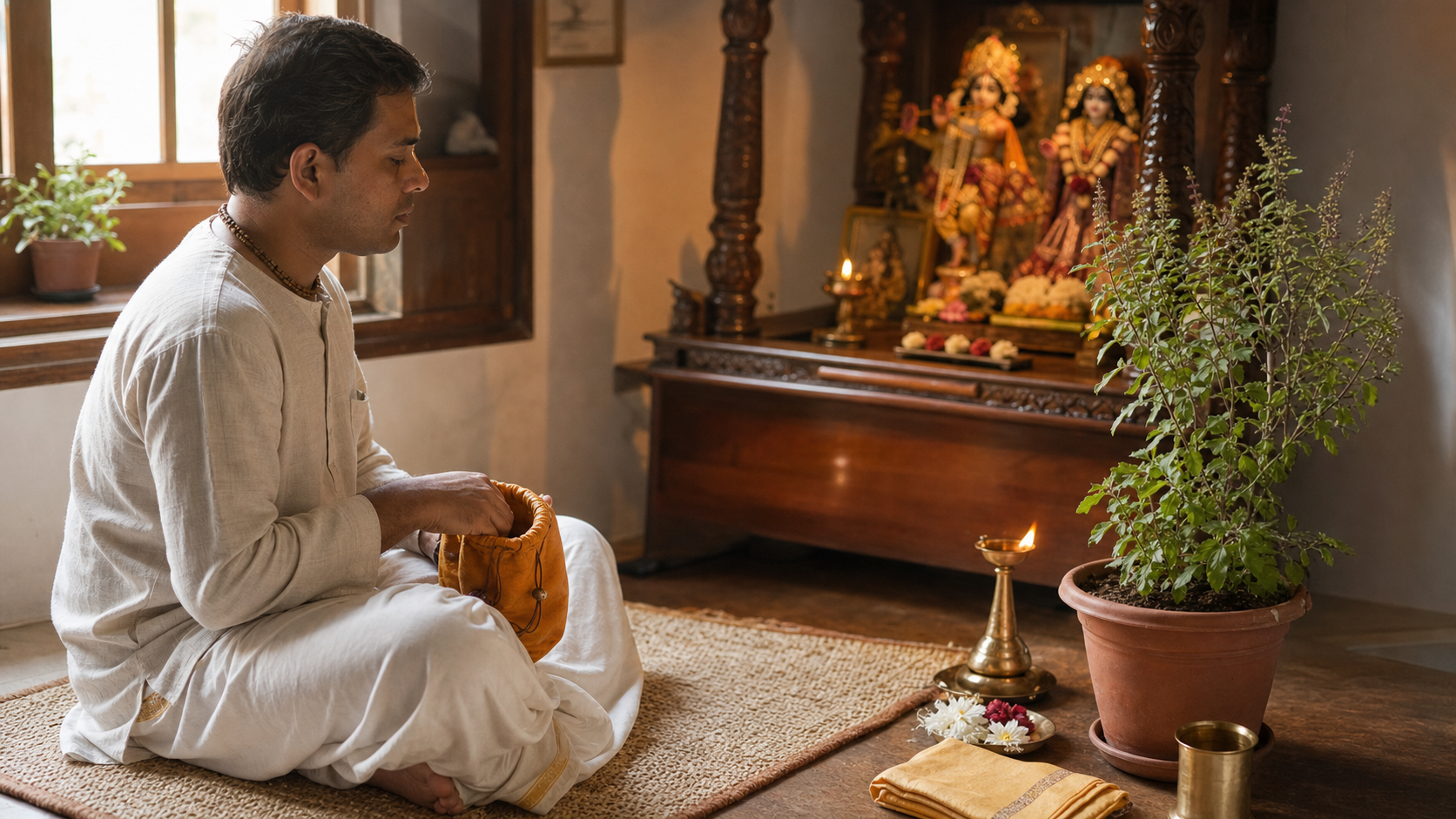
You may be chanting regularly yet still wonder whether anything is changing. Or you may want to add Tulasi seva but worry that a living sacred presence will become one more item on a religious checklist.
Gaudiya practice gives you a demanding but workable answer: devotion deepens when sacred sound, attentive hearing, worship, conduct and service become parts of one movement toward Krishna. You do not need to manufacture an elevated feeling. You need a daily practice honest enough to reveal your motives and steady enough to reshape what you do next.
Build one daily cycle instead of collecting practices

Lord Nityananda Prabhu and Lord Sri Caitanya Mahaprabhu expressed the basic devotional pattern through chanting Krishna’s name, worshipping Krishna, hearing about Krishna and sharing that remembrance with others. These are not four unrelated religious duties. Chanting directs your attention. Hearing corrects the ideas you bring to the relationship. Worship gives that relationship an embodied form. Service and responsible sharing prevent devotion from closing in on itself.
Your starting motive may be mixed. You may want peace, help with a difficulty, philosophical understanding or a sense of belonging. Gaudiya bhakti does not require you to pretend that those motives are absent. It asks you to let sincere practice examine them. Before chanting, form a plain intention: let me listen rather than bargain, and let this remembrance make me more fit to serve.
- Choose a stable daily anchor. Attach practice to a part of the day you already recognise, such as the quiet beginning of the morning. A modest routine that you keep is more useful than an elaborate one that must be renegotiated every day.
- Begin by addressing Krishna. Acknowledge that you are entering a relationship, not operating a technique. Ask for sincerity and humility in words you understand.
- Chant and listen. While chanting the holy name, give your attention to the sound you are making. When the mind leaves, notice where it went and return to the name. The return is part of the practice; self-reproach only creates another distraction.
- Hear something that can govern conduct. Take a short teaching or sacred narrative concerning Krishna and ask one practical question: what does this require of me today? Hearing becomes transformative when it corrects a choice, not merely when it supplies more information.
- Perform one concrete service. Care for Tulasi, put the worship area in order, fulfil a neglected responsibility or help someone without advertising it. The immediate act links remembrance to seva before the mood of practice fades.
- Carry one ethical instruction into the day. Choose a situation in which you will speak more truthfully, reduce harm, restrain self-importance or respond with compassion. This is where devotional intention meets dharma.
Do not judge this cycle only by whether chanting felt intense. Calm, emotion and concentration can vary. The first question is simpler: did you actually attend to Krishna, and did that attention alter the next thing you did?
Let Tulasi seva train attention and responsibility

Within Gaudiya Vaishnavism, Tulasi is not treated as devotional decoration. She is revered as Krishna’s pure devotee and described as an eternal consort and a manifestation of the Lord’s internal potency. That theological claim changes the posture of care. You are not using a plant to produce a spiritual state; you are approaching seva through a living presence honoured by the tradition.
Daily Tulasi service may include suitable care, offerings, circumambulation, a lamp, prayers and chanting the Hare Krishna maha-mantra. The important distinction is between completing a gesture and serving attentively. Before acting, observe. What does the living plant need? Is the surrounding area orderly? Are you about to water from habit even though watering may not be needed? Sacred intention does not release you from practical responsibility.
- Attend before you offer. Look at Tulasi’s condition and provide the care that is actually appropriate rather than performing an automatic motion.
- Keep ritual gentle. Circumambulate without crowding or disturbing the plant. Add a lamp, prayer or offering only in a way that can be carried out safely and consistently.
- Chant as service, not background sound. If you chant near Tulasi, let the act have your attention instead of combining it with messages, chores or entertainment.
- Care for the whole setting. Cleanliness and order around Tulasi are part of the service. Leaving the space better than you found it is a small but reliable check on devotional seriousness.
- Seek practical help when growth is poor. Do not respond to a struggling plant by adding more water as an act of penance. Ask a knowledgeable local grower about the conditions that need correction.
Healthy, abundant Tulasi growth can be understood within the tradition as a sign of a flourishing devotional culture, especially when careful tending accompanies sincere collective practice. It should not become a verdict on an individual’s spiritual worth. Plant health also depends on competent care. Let poor growth prompt observation, advice and responsibility, not shame or superstition.
If you cannot responsibly maintain Tulasi at home, ownership need not become a test of devotion. You can assist with established Tulasi service in a temple or community setting, or undertake another quiet form of seva that you can genuinely sustain. It is better to serve within your actual capacity than to acquire a sacred responsibility for the sake of appearance.
Srila Jiva Gosvami’s emphasis on the inconceivable nature of the Divine protects sacred reality from being reduced to the limits of ordinary logic. It does not make carelessness sacred. Wonder should deepen your attentiveness: Krishna cannot be contained by your categories, yet devotion becomes accessible through particular acts of affection, reverence and responsibility.
Measure maturation by what devotion changes

A pleasant devotional experience may encourage you, but it is not a complete measure of growth. Gaudiya practice aims at purification of intention. Its more dependable signs appear in how you listen, relate and act.
- Attention: You notice mechanical chanting sooner and return to the holy name without turning distraction into a drama about yourself.
- Relationship: Prayer becomes less exclusively transactional. The devotional image of Krishna as parent, refuge, true wealth and very life gradually shifts the centre of security from possession toward reliance on the Divine.
- Conduct: Truthfulness, nonviolence, gratitude and compassion become choices you make when they cost convenience or pride, not merely ideals you affirm during worship.
- Service: You become more willing to do necessary work that brings no recognition. Seva starts displacing the demand to be seen as a devotee.
- Community: Practice makes you easier to correct and more careful with another person’s dignity. Spiritual vocabulary no longer serves as a shield against accountability.
At the end of each week, write brief answers to four questions: Where did remembrance interrupt a selfish reflex? What service did I avoid because nobody would notice it? Whom did my speech diminish? What repair will I complete now? This review keeps spiritual self-assessment tied to observable conduct.
A difficult answer does not prove that chanting has failed. It may show that attention is exposing what an automatic routine allowed you to overlook. Make the needed repair, simplify the practice if it has become unsustainable, and return without a dramatic vow. Steadiness is built through honest returns.
Share bhakti without turning dharmic unity into sameness

Sharing remembrance of Krishna belongs to the Gaudiya devotional pattern, but it remains seva only while the other person’s dignity is intact. Pressure, triumphalism and careless claims about other traditions contradict the humility that chanting is meant to cultivate.
The wider dharmic family offers real points of recognition. Hindu japa, Sikh simran, Buddhist maitri-bhavana, Jain anupreksha and attentive hearing of sacred narratives can all discipline attention and weaken self-centred habits. Sincerity, truthfulness, ahimsa and compassion also provide a meaningful ethical meeting ground across Hindu, Buddhist, Jain and Sikh paths. Shared direction does not mean identical theology, authority or spiritual aim.
- Ask before explaining. An invitation preserves agency; an unsolicited sermon usually closes the attention you hoped to engage.
- Name the tradition behind the claim. Say that Gaudiya Vaishnavas understand Tulasi or the holy name in a particular way. Do not present a lineage-specific teaching as though every dharmic path defines it identically.
- Describe the practice clearly. Explain what chanting, hearing or seva asks a person to do. Avoid making promises about instant peace, material gain or spiritual status.
- Find common ground without erasing difference. You can honour simran, maitri, anupreksha or ahimsa while still explaining Krishna-centred bhakti on its own terms.
- Let conduct carry the message. Patience, truthful speech and reliable service make devotion intelligible before argument does.
Dharmic unity is strongest when it can bear honest distinctions. Respect does not require you to blur doctrines, and conviction does not require you to belittle another path. The practical test is whether sharing Krishna’s name leaves the encounter more truthful, more compassionate and freer of self-display.
Key takeaways
- Join chanting, hearing, worship and service into one daily cycle rather than treating them as separate religious tasks.
- Bring mixed motives into practice honestly; sincerity grows when you stop protecting bargaining, pride and appearance from examination.
- Serve Tulasi as a living sacred responsibility. Observe actual needs, maintain the setting and seek practical help when care is not working.
- Assess devotional growth through attention, ethical conduct, willingness to repair harm and unseen service, not emotion alone.
- Share Gaudiya teachings by invitation, identify lineage-specific claims clearly and honour common dharmic values without pretending all paths are identical.
Tomorrow, do not expand your entire routine. Choose a stable daily anchor, chant with one honest intention, hear one teaching and perform one service before moving on. If Tulasi is in your care, begin by noticing what she actually needs. Let the day’s evidence appear later, when truth, restraint or compassion costs you something.
References
- Dandavats — Purification and Transcendent Elevation: Sincere Chanting, Bhakti Practice, and Dharmic Unity
- Dandavats — Serving the Divine Through Tulasi: Gaudiya Insights on Bhakti, Wonder, and Sacred Growth
