

If you have ever been told that Hindu unity requires Shaivas and Vaishnavas to blur their differences, Singhanath Temple offers a more useful answer. This is a shrine to Shiva in which Narasimha, the man-lion form of Vishnu, is depicted in devotion. Distinction remains visible, yet reverence crosses the boundary.
That makes the temple valuable for more than architectural appreciation. It gives you a concrete way to think about sectarian harmony: name each tradition accurately, observe the relationship being presented, and resist turning unity into sameness.
Begin with the image, but do not overstate it
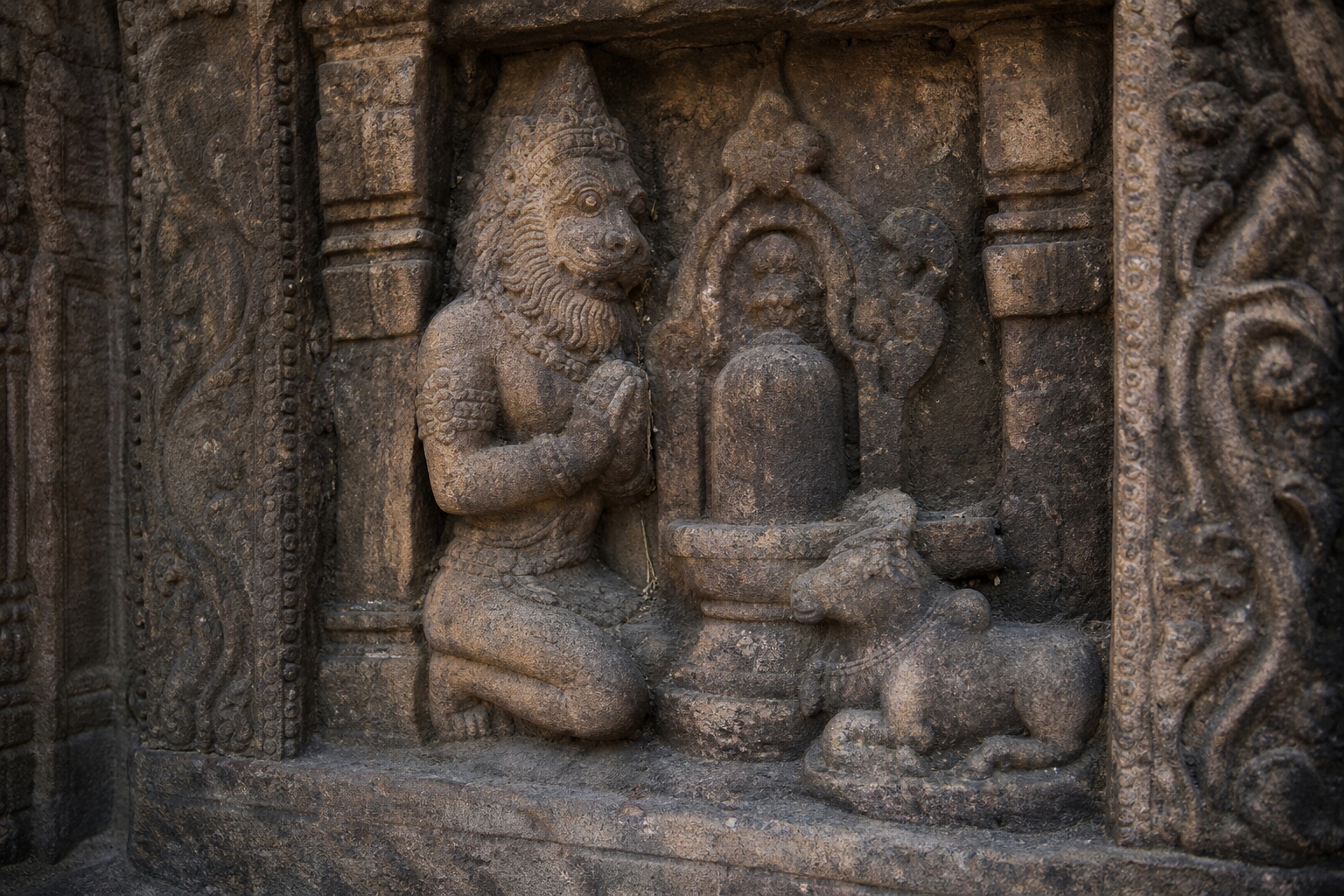
Singhanath Temple, also spelt Simhanath, stands at Gopinathpur in the Baramba or Badamba region of Odisha’s Cuttack district. It is a Shiva shrine whose imagery shows Narasimha venerating Shiva. That relationship is the heart of its significance.
A Shaiva approaches Shiva as the central focus of devotion. A Vaishnava directs devotion toward Vishnu and his forms, including Narasimha. Singhanath does not hide those identities behind a vague idea of spirituality. The figures remain recognisable, and the act of reverence becomes meaningful precisely because the distinction remains.
Read the imagery in three passes:
- Identify before interpreting. Establish that the presiding shrine is Shaiva and that the worshipping figure is Narasimha. If you collapse both into generic divinity at the outset, you lose the relationship the image presents.
- Notice the action. The important fact is not merely that Shiva and Narasimha appear in the same precinct. Narasimha is represented in devotion. Gesture and orientation carry the theological meaning.
- Separate evidence from inference. The image supports mutual reverence across devotional lineages. It does not prove that every Shaiva and Vaishnava school holds identical doctrines or that every historical worshipper explained the scene in the same way.
This narrower reading is also the stronger one. Singhanath demonstrates that a sacred setting can affirm one deity without presenting reverence for another as a threat. It does not require us to invent a historical dispute that the temple supposedly resolved. Here, “sectarian” describes devotional affiliation; it should not be treated automatically as evidence of hostility.
The architecture gives distinct elements a shared order
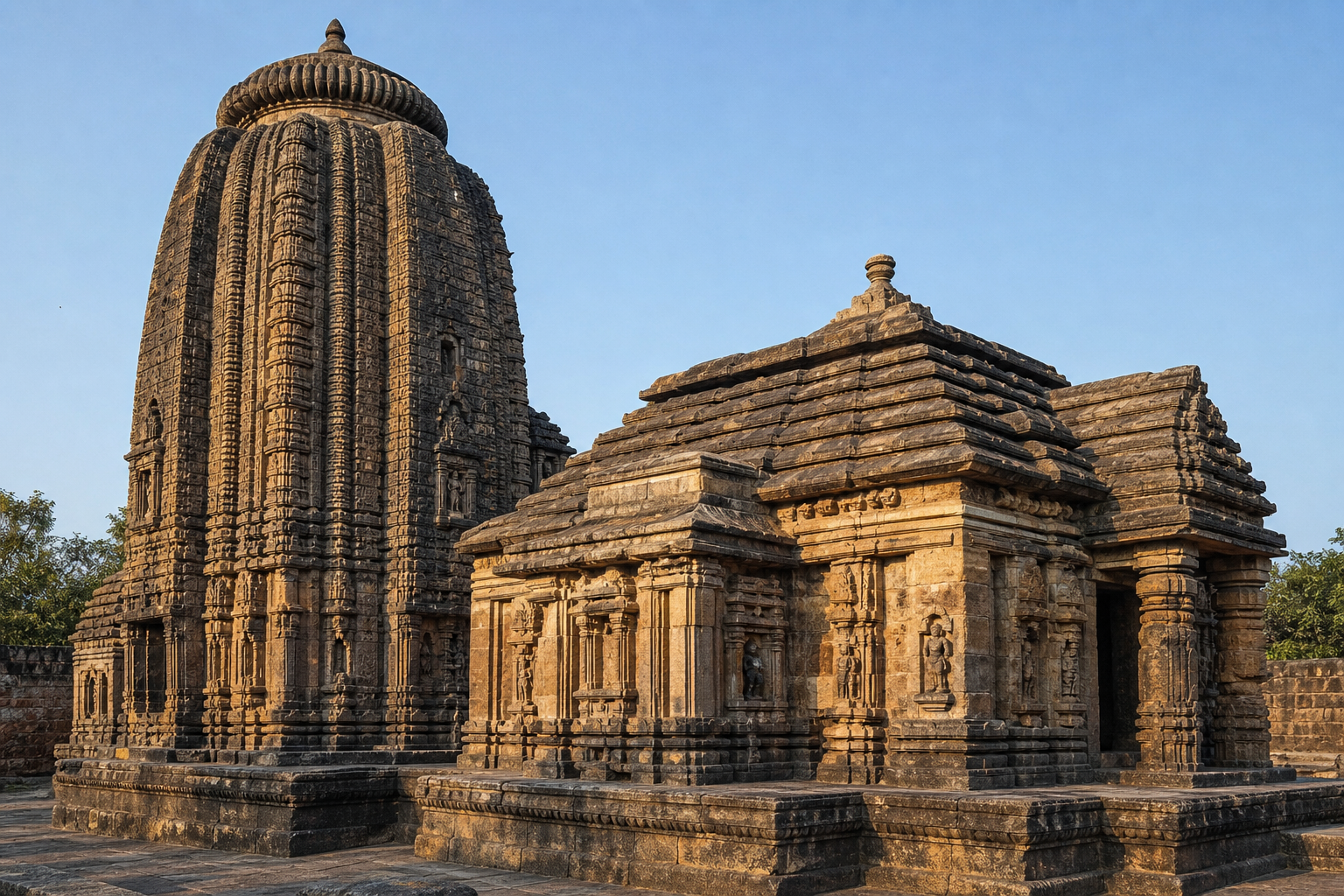
The temple’s Kalinga form reinforces this lesson without turning stonework into a simplistic allegory. Its sanctum is marked by a rekha deula, the curving tower associated with Odisha’s temple architecture. A jagamohana, or assembly hall, stands beside it with a terraced roof. The two components have different shapes and ritual purposes, yet they belong to one coherent composition.
That distinction is worth seeing with your own eyes. The sanctum tower draws the gaze upward, while the more grounded mass of the assembly hall receives the gathered community. Harmony here is not produced by making every part look alike. It comes through proportion, placement, masonry and a clear relationship between spaces.
The exterior sculptural programme extends the same principle by bringing Shaiva and Vaishnava motifs into a visual conversation. Do not treat the carvings as a collection of disconnected ornaments. Look for how imagery, structure and movement through the precinct work together.
- Start with the silhouette. Distinguish the curving rekha deula from the terraced jagamohana before concentrating on individual carvings.
- Watch the transition between spaces. Notice how the gathering area leads toward the sanctum rather than competing with it.
- Read motifs in context. A Shaiva or Vaishnava figure means more when you note its position, neighbouring imagery and relationship to the shrine’s primary dedication.
- Let the light assist you. Early morning and late afternoon light can make shallow relief, edges and stone textures easier to discern.
This method keeps you from making two common errors: discussing theology while ignoring the physical temple, or admiring the architecture while missing the devotional relationships expressed through it. At Singhanath, form and iconography belong to the same experience.
Harmony here means reverence without erasure
Modern conversations about Hindu unity often slip toward one of two extremes. One reduces every sampradaya to interchangeable names for the same thing. The other treats difference as a contest in which respect for one deity diminishes loyalty to another. Singhanath points toward a more mature position.
Narasimha does not cease to be a form of Vishnu when shown venerating Shiva. Shiva does not have to be relabelled as Narasimha for the relationship to become sacred. The image can therefore be read as an affirmation of devotional confidence: an identity secure enough to offer reverence beyond itself.
Three distinctions help preserve that insight:
- Respect is not doctrinal surrender. You can recognise another lineage’s sacred focus without pretending that all teachings, practices and metaphysical claims are identical.
- Unity is not a hierarchy inferred from one gesture. A devotional image invites contemplation, but it should not be converted casually into a league table of deities or communities.
- Plurality is not indifference. Singhanath is compelling because the traditions remain substantial. Harmony would mean little if neither devotion carried any real commitment.
The temple’s immediate statement concerns Shaiva and Vaishnava traditions. It would be careless to claim that one image settles every doctrinal question among Hinduism, Buddhism, Jainism and Sikhism. What can travel across the wider Dharmic family is the method: recognise distinct paths honestly, seek ethical and devotional grounds for mutual regard, and refuse to make disagreement an excuse for contempt.
You can apply that method in a family discussion, a temple committee or an online debate. Ask three questions. Have all traditions been named in terms their practitioners would recognise? Is anyone being asked to erase a real conviction as the price of belonging? What shared conduct—care for a shrine, truthful speech, hospitality or restraint—can proceed even where doctrine differs? Those questions turn “unity” from a slogan into a discipline.
Visit the temple as a living shrine, not a visual exhibit
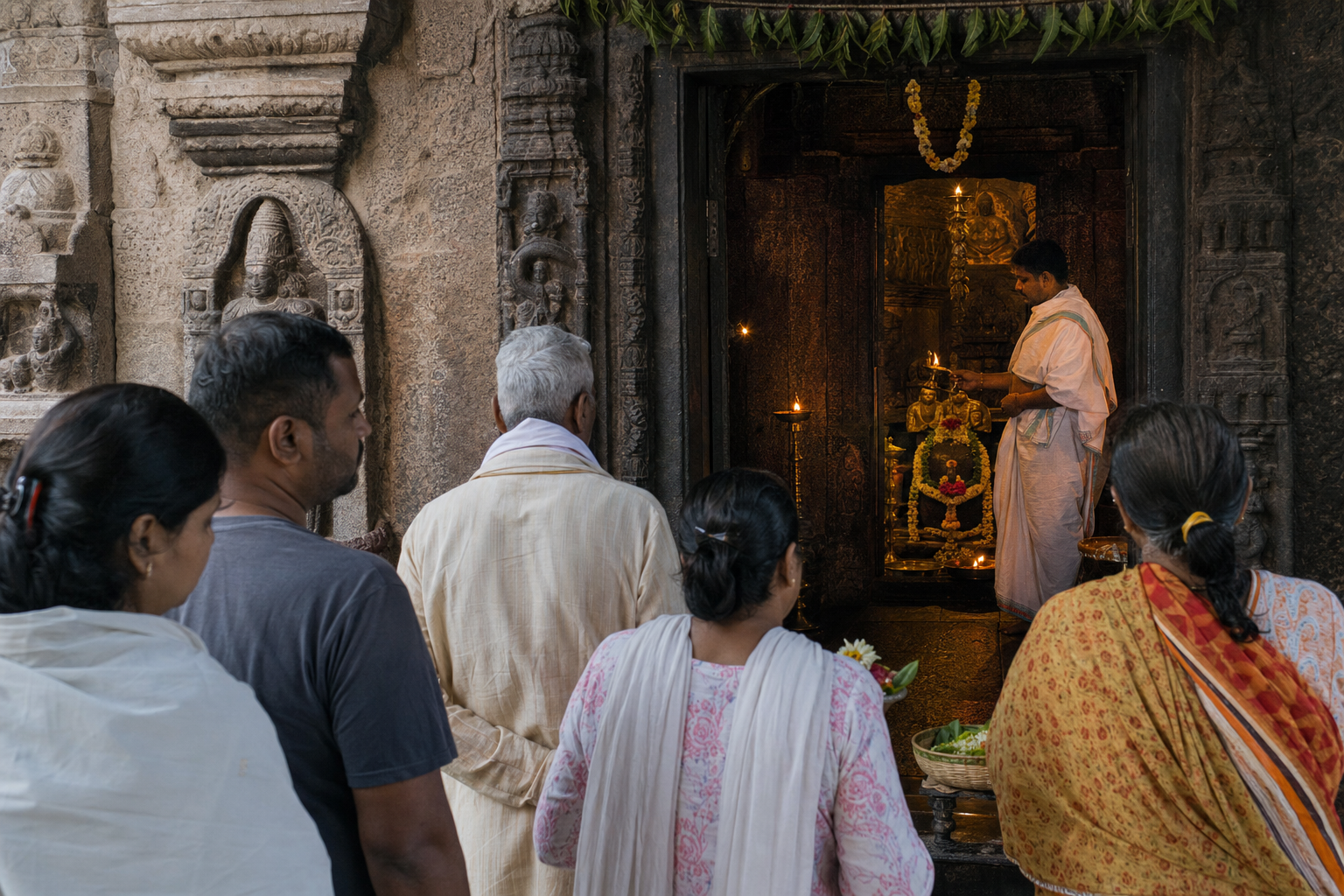
A careful visit can teach more than a rapid circuit with a camera. Singhanath remains a place of worship, so the quality of your attention matters as much as the number of details you record.
- Choose your purpose before you arrive. For architectural observation, early morning or late afternoon offers softer light on the reliefs. During Mahashivaratri, the influx of devotees makes communal worship and cultural continuity more prominent than quiet visual study.
- Read the whole building first. Pause outside long enough to distinguish the sanctum tower and assembly hall. Only then move closer to the sculpture.
- Locate the relationship that brought you there. Identify the Shaiva setting and the Narasimha image before assigning a broad message to them. If a detail is unclear, ask a local knowledge-bearer rather than guessing from a photograph.
- Follow the shrine’s ritual etiquette. Remove footwear where required, dress modestly, move quietly through devotional zones and follow on-site directions about access or photography.
- Protect what you came to understand. Do not touch the carvings, leave litter or treat worn stone as a surface for posing. Physical contact that seems harmless to one visitor becomes damaging when repeated.
- Support living knowledge. Give serious attention to local custodians, guides and devotees. Their vocabulary and ritual understanding can keep you from reducing the temple to an abstract symbol detached from its community.
A useful visit ends with two kinds of notes. Record what you directly observed—forms, positions, gestures and spatial relationships—separately from what you think those details mean. That small discipline produces better travel writing, better teaching and more honest cultural advocacy.
Key takeaways for carrying the lesson forward
- Singhanath is a Shiva temple where Narasimha is represented in devotion, making relationship—not mere coexistence—the central feature.
- Its Shaiva-Vaishnava synthesis preserves recognisable identities; it does not depend on declaring the traditions identical.
- The rekha deula, terraced jagamohana and integrated sculptural programme should be read as one architectural and devotional setting.
- The strongest interpretation stays proportionate to the evidence: mutual reverence is visible, while universal doctrinal agreement is not established.
- A respectful visitor observes slowly, follows ritual etiquette, avoids touching carvings and learns from local custodians.
- In present-day sectarian discussions, test every appeal to unity for accurate naming, freedom from forced erasure and a concrete form of shared conduct.
The next time a discussion reduces Shiva and Vishnu to rival banners, change the question. Ask what kind of devotion becomes possible when identity is secure enough to bow without disappearing. Then make that principle visible in your own conduct: describe other traditions accurately, mark interpretation as interpretation, and protect the sacred places through which these relationships have been handed down.
References
