

You may feel an immediate pull toward Dakshinamurthy’s silence and still wonder where Shakti belongs. Is wisdom complete in motionless awareness, or does it need a living power that carries insight into thought, character, and conduct?
The most useful way to contemplate Dakshinamurthy and Wisdom-Shakti is not to force another genealogy onto the sacred image. Treat their unity as a discipline: become quiet enough to see, receptive enough to be taught, and steady enough to let what you understand change how you live.
Hold the theological distinction before beginning your practice
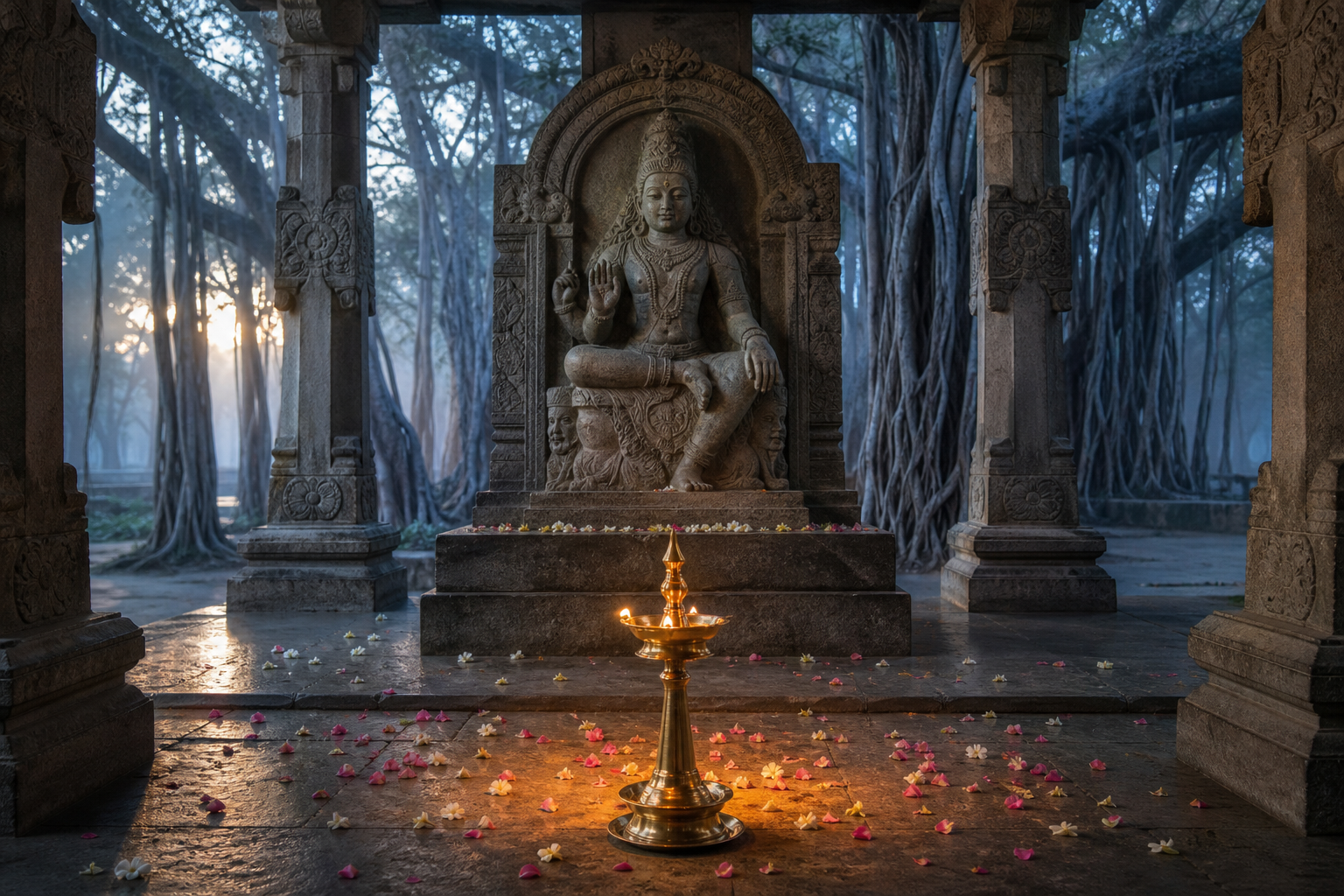
Dakshinamurthy is the south-facing form of Shiva revered as the Adi Guru. Seated beneath the banyan tree, he embodies pure knowledge, meditative stillness, and guidance that transforms the seeker. He teaches not only through words but through silence, gesture, and presence.
Dhara literally means a current or flow. In this contemplative interpretation, Mother Goddess Dhara personifies the jnana-dhara, the beneficent movement of wisdom from the Guru toward the seeker. She is the dynamic complement to Dakshinamurthy’s luminous stillness: not knowledge competing with power, but the power through which knowledge is received, absorbed, and lived.
That framing is meaningful, but it must be stated accurately. Dhara as the Wisdom-Shakti of Dakshinamurthy belongs to a less-discussed devotional and interpretive approach. It should not be presented as though every Shaiva lineage uses the name, depicts the relationship, or explains Dakshinamurthy in precisely this way.
| Level of contemplation | What you can affirm | What you should avoid claiming |
|---|---|---|
| Iconographic | Dakshinamurthy is Shiva as the silent Supreme Teacher, seated beneath the banyan tree. | That every detail of the image proves a private interpretation you have added to it. |
| Philosophical | Jnana and Shakti can be contemplated as inseparable: awareness is the ground, and its potency makes understanding living and effective. | That stillness and activity are two rival realities that must defeat one another. |
| Devotional | Dhara can personify the compassionate flow of wisdom that nourishes the seeker. | That this devotional name is compulsory or universal across Sanatana Dharma. |
The freedom of Ishta gives you room to approach the Divine through a form suited to your temperament. It does not require you to turn a fruitful personal form into a universal dogma. You can therefore pray to or contemplate Dhara as Dakshinamurthy’s Wisdom-Shakti while remaining honest about the interpretive character of that devotion.
Wisdom-Shakti joins the still center to the living current
Jnana is easily reduced to information. A person may collect verses, terminology, and arguments while remaining governed by the same fear, pride, or confusion. Shakti is just as easily reduced to activity. A person may remain constantly busy with ritual, discussion, or service without becoming clearer about what any of it is for.
The Dakshinamurthy-Dhara contemplation corrects both errors. Dakshinamurthy represents the still center in which ignorance can be seen and dispelled. Dhara represents the movement by which insight reaches the heart, matures through contemplation, and enters disciplined living. Stillness without this movement can become passivity. Movement without a still center can become agitation.
In the Advaita Vedanta frame, consciousness is the ground of being. Wisdom-Shakti does not add a second, independent reality to that ground. It names the living potency through which realization becomes present to the seeker and increasingly stable in life. The distinction is therefore useful in practice even when the underlying truth is understood as non-dual.
After study or meditation, ask three direct questions:
- What became clearer? Name the assumption, attachment, or confusion that you can now see more accurately.
- What must be contemplated further? Do not turn the first feeling of certainty into a final conclusion.
- What changes in conduct? Choose an ethical action through which the insight can become more than an attractive idea.
These questions do not reduce realization to a productivity exercise. They expose the gap between talking about wisdom and permitting wisdom to work on you. If nothing becomes clearer, nothing is examined, and nothing in your conduct changes, more accumulation may not be what you need. Return to silence and inquiry.
Read Dakshinamurthy’s image as a map, not decoration

A sacred image can become so familiar that you stop receiving its instruction. Dakshinamurthy’s seated stillness, the banyan tree, the teaching gesture, and the absence of rhetorical display direct attention away from spectacle and toward presence. Silence here is not the refusal to teach. It is itself a mode of teaching.
Use a three-layer reading whenever you sit before the image:
- Describe before interpreting. Notice what is actually present: the seated form, the tree, the gesture, the composure. This prevents imagination from immediately replacing attention.
- Recall the received meaning. Remember Dakshinamurthy as the Adi Guru whose presence reveals knowledge and dispels ignorance. Let tradition establish the frame before personal association enters it.
- Notice your response without canonizing it. A feeling, memory, or insight may be valuable, but it is not automatically a teaching for everyone. Hold it beside scripture, contemplation, ethical discipline, and the guidance of the lineage you follow.
This approach leaves room for genuine devotion without allowing private symbolism to outrun discernment. It also makes Dhara easier to understand. You do not need to force an additional figure into every depiction. Notice instead whether the silent teaching becomes a current within you: whether attention sharpens, inquiry deepens, and understanding begins to move toward compassionate action.
Build one complete cycle of study, silence, and action

A workable Dakshinamurthy practice should include both the stillness of the Guru and the flow of Wisdom-Shakti. You can build that balance without an elaborate new ritual.
- Select a small teaching. Take a short passage from a stotra or one Upanishadic idea. Working with a limited portion keeps study from becoming hurried consumption.
- Practice svadhyaya. Read attentively and restate the teaching in your own words. Mark what you do not understand instead of concealing uncertainty behind Sanskrit terminology.
- Enter silence. Sit quietly after reading. Do not rush to manufacture an experience or rehearse an explanation. Let the teaching remain present without continually adding commentary.
- Apply inquiry. Ask which assumption the teaching brings into question. Distinguish what the words actually mean from what you would prefer them to mean.
- Give insight a form. Choose one fitting expression in conduct: patience in a difficult exchange, restraint before a needless reaction, honest correction of an error, or sustained attention to a neglected duty.
- Remember the lineage. End with gratitude for the teachers through whom wisdom continues to flow. This shifts attention away from spiritual self-importance and back toward receptivity.
Test an insight before treating it as guidance
Not every thought that appears in silence is jnana-dhara. Silence can reveal a deeply rooted reaction just as readily as it can clarify one. Use practical safeguards before treating an inner impression as guidance:
- Clarity: Can you state the insight plainly, or does it depend on grand but evasive language?
- Continuity: Does it remain intelligible after you return to the teaching and contemplate it again?
- Character: Does following it strengthen patience, compassion, honesty, and disciplined living rather than vanity or impulsiveness?
- Correctability: Can the interpretation be questioned and refined, or does it demand immunity from scripture, reason, and a teacher formed in your lineage?
- Embodiment: Can you identify a dharmic action that expresses it without coercing someone else?
These filters do not prove that an impression is a divine communication. Their purpose is more modest and more dependable: they keep contemplation joined to humility, ethical responsibility, and the Guru-Shishya tradition.
Key takeaways
- Dakshinamurthy is the still, south-facing form of Shiva as Adi Guru; Dhara is an interpretive personification of wisdom’s living flow.
- Use the Dakshinamurthy-Dhara relationship as a contemplative lens, not as a universal claim about every Shaiva lineage.
- Jnana is not mere information, and Shakti is not mere activity. Their unity joins clear seeing to transformation.
- Let scripture, silence, inquiry, ethical action, and lineage gratitude form one cycle rather than unrelated practices.
- Judge an apparent insight by clarity, stability, character, correctability, and embodiment before acting on it.
Recognize Dharmic kinship without erasing differences
The movement from ignorance toward transformative knowledge appears across the Dharmic family, but it does not appear in identical doctrinal forms. Buddhist traditions speak of prajna. Jain traditions uphold kevala jnana. Sikh life is formed by the Guru and the teachings of the Guru Granth Sahib. Hindu traditions surrounding Dakshinamurthy emphasize the Supreme Teacher who reveals the ground of consciousness.
These terms should not be treated as interchangeable synonyms. Each belongs to a distinct account of reality, liberation, authority, and practice. The genuine family resemblance lies in the seriousness given to transformative wisdom and the disciplined relationship between teaching and seeker.
When you discuss Dakshinamurthy with Buddhists, Jains, or Sikhs, compare functions before equating doctrines. Ask how wisdom is cultivated, how ignorance is understood, what role the teacher holds, and how realization appears in conduct. Let each tradition define its own terms. That approach creates unity through respect rather than through compulsory sameness.
Your next contemplation does not require a larger ritual. Bring one short teaching, one honest question, and one change in conduct. Let Dakshinamurthy establish the still center; let Wisdom-Shakti carry what you see into the next thing you actually do.
References
