
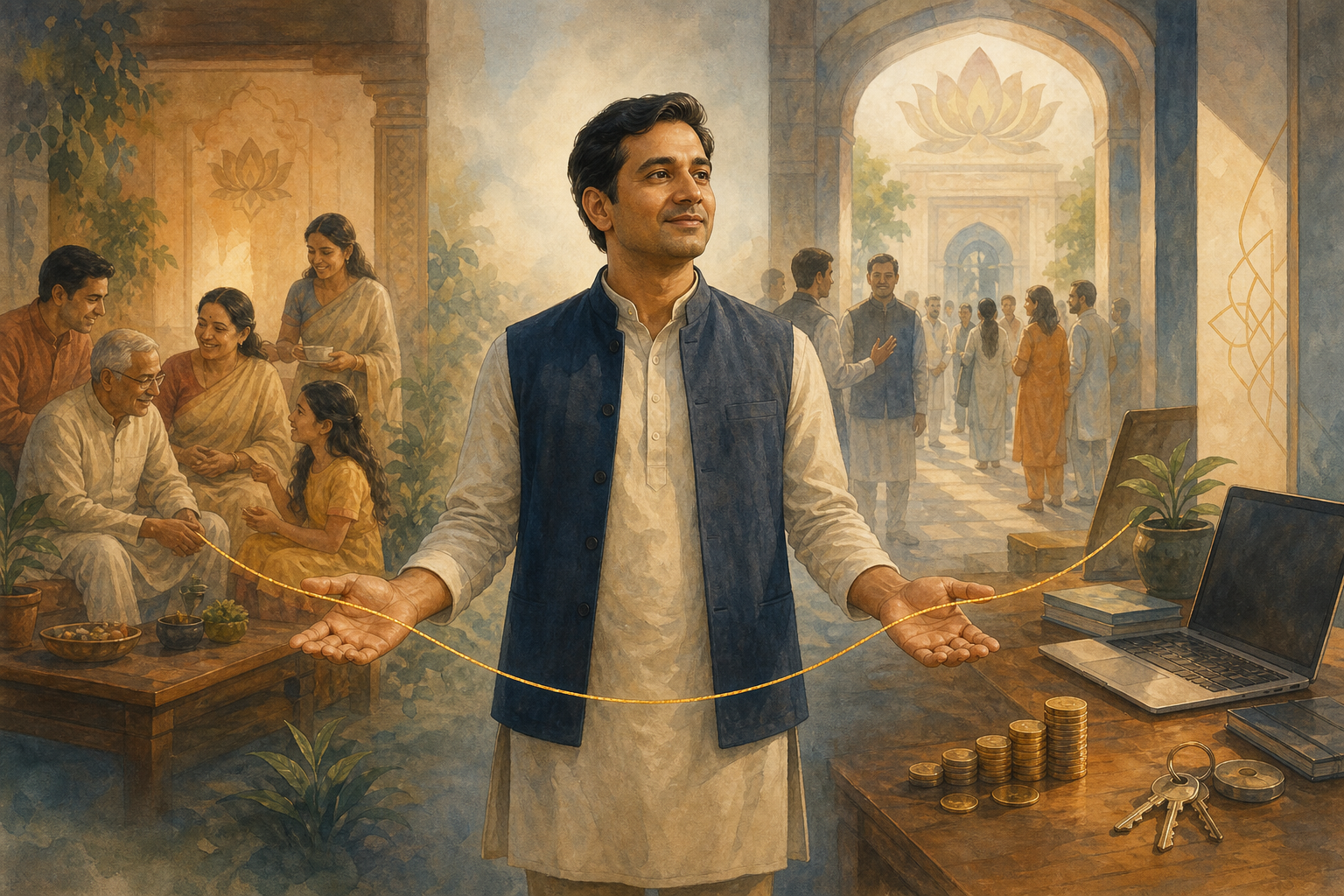
You may be caring for your family, building financial security, and doing work that earns public respect, yet still wonder whether spiritual non-attachment asks you to step away from all three. It does not. The more demanding question is whether you can perform those duties without making a particular outcome carry your identity.
Eshanatraya gives you a practical way to investigate that question. It separates attachment into three recurring pulls: continuity through family or legacy, security through wealth, and worth through recognition. Once you can see which pull is operating, you can loosen its grip without rejecting the people, resources, or responsibilities already in your hands.
The three attachments inside a respectable life

Eshanatraya names three desires that can obstruct inner freedom: Putraishana, Vittaishana, and Lokaishana. Their danger is easy to miss because each one grows within a legitimate part of life. Love for family can become ownership. Prudent provision can become endless accumulation. A good reputation can become dependence on approval.
| Desire | Its legitimate field | The binding turn | A revealing question |
|---|---|---|---|
| Putraishana | Children, family continuity, teaching, and legacy | Another person’s life or the survival of your name becomes proof of your worth | Am I serving this person’s welfare, or asking that person to complete my identity? |
| Vittaishana | Livelihood, provision, savings, and useful resources | Wealth ceases to serve a defined need and becomes the measure of safety or importance | What dharmic purpose will this additional acquisition actually serve? |
| Lokaishana | Trust, social respect, leadership, and community participation | Praise, visibility, status, or heavenly reward becomes the hidden reason for action | Would this remain worth doing if no one knew that I had done it? |
Putraishana historically referred to the desire for a son who would continue the lineage and its ritual obligations. Its modern reach is wider. It includes the need to live through a child’s achievements, control a family’s future, preserve one’s name, or make a project survive as a personal monument. You do not need biological children to be caught by it; any legacy can become a substitute for inner permanence.
Vittaishana is not the mere use of money. Artha has a valid place in a life governed by dharma. The attachment appears when acquisition no longer answers to a sufficient purpose, when the definition of enough keeps moving, or when possessions begin to carry self-worth. Lokaishana is subtler still. It can hide inside leadership, charity, teaching, religious observance, or cultural service because applause and prestige can imitate the satisfaction of having acted rightly.
A preference says that you will work sincerely for an outcome. Attachment adds that you will be diminished if the outcome does not arrive. That added identification feeds raga, or clinging, and ahamkara, the construction of self around role and result. It also weakens viveka because fear of loss and hunger for gain begin deciding what you call right.
This is why suppression is not the goal. Forcing yourself to feel nothing can leave the same desire in command, only concealed behind spiritual language. Freedom means seeing the desire clearly, choosing according to dharma, and surrendering the demand that the result confirm who you are.
Dharmic traditions preserve distinct teachings and should not be collapsed into one system, but they identify a closely related practical danger. Hindu thought examines raga and ahamkara while placing artha and kama under dharma in a life oriented toward moksha. Buddhism examines tanha and upadana, craving and the clinging built upon it. Jainism gives a central place to Aparigraha, non-possessiveness. Sikh teachings warn that maya and haumai can bind a person through wealth, status, and ego. The vocabulary and metaphysics differ; the instruction you can act on is similar: use what life gives you without building the self out of what cannot remain.
Find the attachment by testing what you cannot tolerate

You will not locate an eshana merely by listing everything you love or own. Look instead at what seems psychologically non-negotiable. The revealing point is often not what you want, but what you believe you could not bear to lose: control over a family outcome, a rising financial number, a title, an audience, or the reputation of being virtuous.
Use this decision audit on one live issue rather than judging your whole life at once:
- Name the decision in plain terms. State what you are considering doing and the result you want.
- Name the feared loss beneath it. Is it another person’s disapproval, reduced comfort, a broken image of family continuity, loss of status, or the possibility of being forgotten?
- Remove the identity reward in imagination. Suppose your family does not validate you, the gain does not increase your prestige, or nobody learns about your contribution. Ask whether the action still serves dharma.
- Restore the duty. Identify what remains yours to do even when praise, control, and certainty are unavailable. Let that duty govern the next step.
Then apply the question matched to the field:
- For Putraishana: Am I helping this person meet a real responsibility, or recruiting that person into my preferred story of family and legacy?
- For Vittaishana: Which rightful need will this money or possession meet, and what would sufficiency for that purpose look like before I continue pursuing more?
- For Lokaishana: Would I still perform this work if my name were absent, the response were modest, and no religious or social prestige followed?
Do not treat the first answer as a final verdict. Ahamkara is skilled at giving attachment a respectable explanation. Notice where you become defensive, where a simple question feels threatening, or where you repeatedly change the standard so that the desired outcome remains compulsory. That resistance deserves examination, not self-condemnation.
Emotional intensity by itself does not prove that an action is wrong. A genuine duty can be difficult, and love naturally makes loss painful. The sharper warning sign is that protecting the desired result starts to justify coercion, dishonesty, neglect of another duty, or refusal to see evident harm. At that point, the eshana is no longer accompanying the decision; it is governing it.
Meet each eshana without neglecting your dharma
The remedy is not one dramatic act of renunciation. It is a corrected relationship with family, resources, and regard. Each desire therefore requires a different form of practice.
Putraishana: turn ownership back into care
Putraishana becomes visible when another person’s choices feel like a verdict on you. A child’s vocation, conduct, marriage, achievements, or spiritual path may matter deeply, but that person cannot be reduced to the carrier of your unfinished ambitions. The same rule applies to students, institutions, creative work, and causes that you hope will preserve your influence.
Separate three things before you intervene:
- Duty: the care, guidance, provision, honesty, or boundary that is actually yours to provide.
- Preference: the outcome you regard as desirable but cannot rightly guarantee.
- Ownership: the belief that another person’s outcome must validate your identity, sacrifices, beliefs, or name.
Let duty govern your conduct. Express a preference without disguising it as an absolute moral command. Relinquish ownership altogether. Before offering advice or applying pressure, complete two sentences privately: this person’s welfare requires something from me; my identity wants something from this person. If the answers differ, choose the least controlling action that still fulfills your real responsibility.
Vairagya here does not mean emotional withdrawal. A parent cannot rename indifference as non-attachment, nor can a householder invoke spirituality to escape care. Keeping a promise, providing support, correcting harmful conduct, and maintaining a necessary boundary may all remain duties. The practice is to perform them without demanding that the other person become your monument.
Vittaishana: give every acquisition a dharmic purpose
Money can support a household, education, worship, generosity, resilience, and service. The trouble begins when a useful means becomes an unlimited answer to fear. Because an abstract desire for security has no natural finishing point, you need to define the purpose before pursuing the next gain.
Before a meaningful financial commitment, write down four answers:
- Which need, obligation, or constructive capacity will this serve?
- What would be sufficient for that stated purpose?
- Which ethical limit will I refuse to cross while pursuing it?
- Would I still want it if it carried no display value and nobody else knew I possessed it?
If you cannot state the purpose of a nonessential acquisition, delay the decision until its motive becomes clearer. The delay is not a verdict that the purchase is forbidden. It prevents urgency, comparison, and self-image from pretending to be necessity.
Aparigraha does not require reckless disposal of savings, refusal to earn, or abandonment of dependants. Sudden financial decisions made to prove spiritual seriousness can injure the very people whose care belongs to your dharma. For consequential questions involving investments, debt, taxes, or long-term provision, retain ordinary prudence and obtain qualified financial advice. The spiritual inquiry concerns your motive and attachment; it does not replace sound financial judgment.
A useful measure is whether you can steward wealth without worshipping it. Use resources deliberately, share where it is responsible to do so, and observe whether the loss of a possession feels like practical inconvenience or collapse of self. That distinction shows where further work is needed.
Lokaishana: do some worthy work beyond the audience
A good reputation can help people trust your work, and community honor can be received with gratitude. Lokaishana begins when image-management replaces the work itself. You then select actions for visibility, avoid necessary truths that may cost approval, or regard service as wasted when it produces no credit.
Use three practices to expose that bargain:
- Before a public action, write the value it is meant to serve. Return to that criterion after the response arrives.
- Keep at least one act of seva free from announcement. Do it because the help is needed, not because the act will decorate an identity.
- Separate correction from applause. Act on feedback that reveals an ethical or practical failure, but do not let praise counts decide whether the underlying duty was worthwhile.
Lokaishana can also wear sacred clothing. Worship, charity, austerity, or teaching may become transactions for heavenly reward or performances of a pious identity. Ask whether the practice would retain meaning if nobody on earth knew about it and no superior status could be claimed from it. If the answer is no, do not necessarily abandon the practice; purify the reason for doing it.
A daily discipline for loosening the grip

Insight becomes useful when it reaches the moment before speech, spending, control, or self-display. The following routine combines discernment with practices such as vairagya, Aparigraha, seva, dhyana, japa, breath regulation, and satsanga. Keep the routine attached to a real decision rather than turning it into another idealized image of yourself.
- Choose the live field. At the beginning of the day, name one family outcome, financial pursuit, or question of recognition that currently carries unusual emotional weight.
- State the dharmic action. Describe what is yours to do without including the result you hope to control. This separates conduct from outcome.
- Pause before the charged response. When urgency appears, use steady breathing, japa, or a brief period of dhyana to establish attention before acting. The aim is not to erase desire but to stop the first impulse from speaking as unquestioned duty.
- Perform one action without identity payment. Help without announcing it, provide care without demanding gratitude, or complete good work without making recognition its condition.
- Review the movement of motive. At the end of the day, write three short lines: what I wanted, what I feared, and what dharma required. If those led to different actions, name one repair you can make.
Bring persistent patterns into satsanga with people whose judgment you trust. You do not need to disclose every private family or financial detail. Name the pattern plainly: control disguised as care, accumulation disguised as prudence, or approval disguised as service. Good company matters because ego should not be the only judge of whether ego is operating.
Each discipline serves a distinct function. Dhyana helps you notice the desire before it becomes a command. Japa and regulated breathing steady attention. Vairagya loosens identification with the preferred result. Aparigraha challenges the reflex to accumulate. Seva directs energy toward another’s well-being. Satsanga keeps your reasoning answerable to something beyond private justification.
Do not grade the practice by the total disappearance of desire. Look for more honest indicators. Can you hear disagreement from a family member without withdrawing love or increasing control? Can you stop pursuing more when the stated financial purpose has been met? Can you continue worthy work when recognition is slight, while still accepting valid correction? These are signs that duty is becoming less dependent on identity reward.
Freedom is not numbness. Loss may still bring grief, criticism may still sting, and uncertainty may still create concern. The question is whether the emotion commandeers your ethics or whether you can feel it without handing it authority over the next action.
Key takeaways
- Eshanatraya does not condemn family, wealth, or social respect. It reveals the point where each becomes a support for ego-identification.
- Putraishana binds you through family control and legacy; Vittaishana through accumulation and financial self-worth; Lokaishana through approval, visibility, status, or heavenly reward.
- The clearest test is counterfactual: would the action still serve dharma if it brought no validation, display, control, or recognition?
- Non-attachment does not cancel responsibility. It removes the demand that the result prove your value.
- Work with one current decision at a time: identify the desire, name the feared loss, restore the duty, and release ownership of the outcome.
The next time a family plan, purchase, promotion, public contribution, donation, or religious act feels unusually charged, do not begin by asking whether you must give it up. Ask what part of you expects it to deliver permanence, safety, or importance. Keep the dharmic action, correct what is driven by fear or display, and stop asking a passing result to tell you who you are.
Begin with the decision already in front of you. That is where Eshanatraya becomes more than a teaching: you remain fully present in life, but life no longer has to obey your preferred script before you can act freely.
References
