
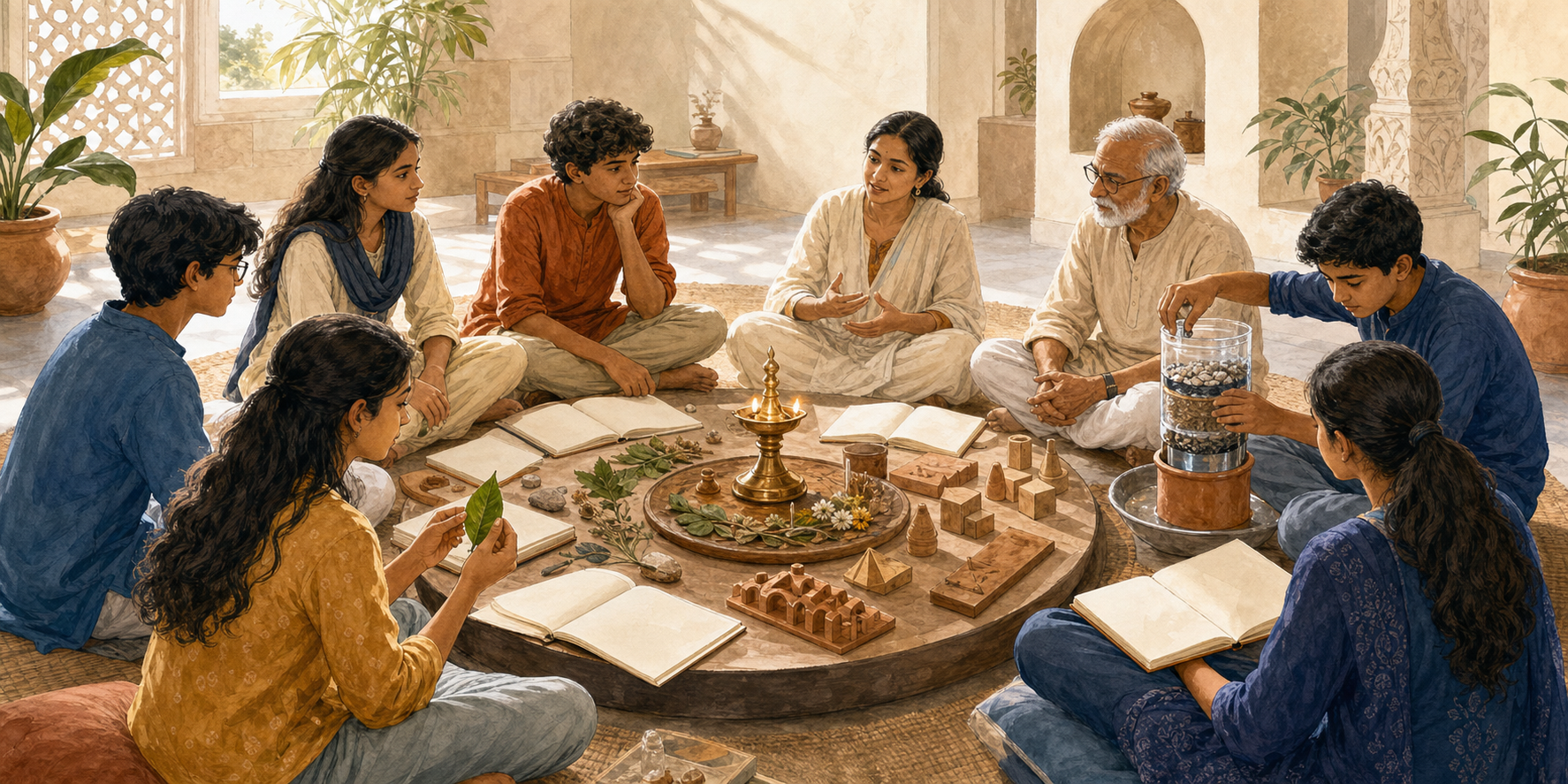
When a learner can recite the names of the darśanas but cannot ask what counts as evidence, education has preserved vocabulary without awakening intelligence. When the same learner completes a decorative heritage project but never confronts a real problem, creativity has been reduced to presentation.
If you are a parent, teacher, or study-circle facilitator, you do not have to choose between reverence and questioning. A stronger approach treats honest inquiry as part of Dharmic learning and turns understanding into work that benefits someone beyond the learner. The aim is not to make every lesson religious. It is to cultivate a disciplined mind, an ethical imagination, and the ability to carry knowledge into action.
Begin with a question that can change the learner
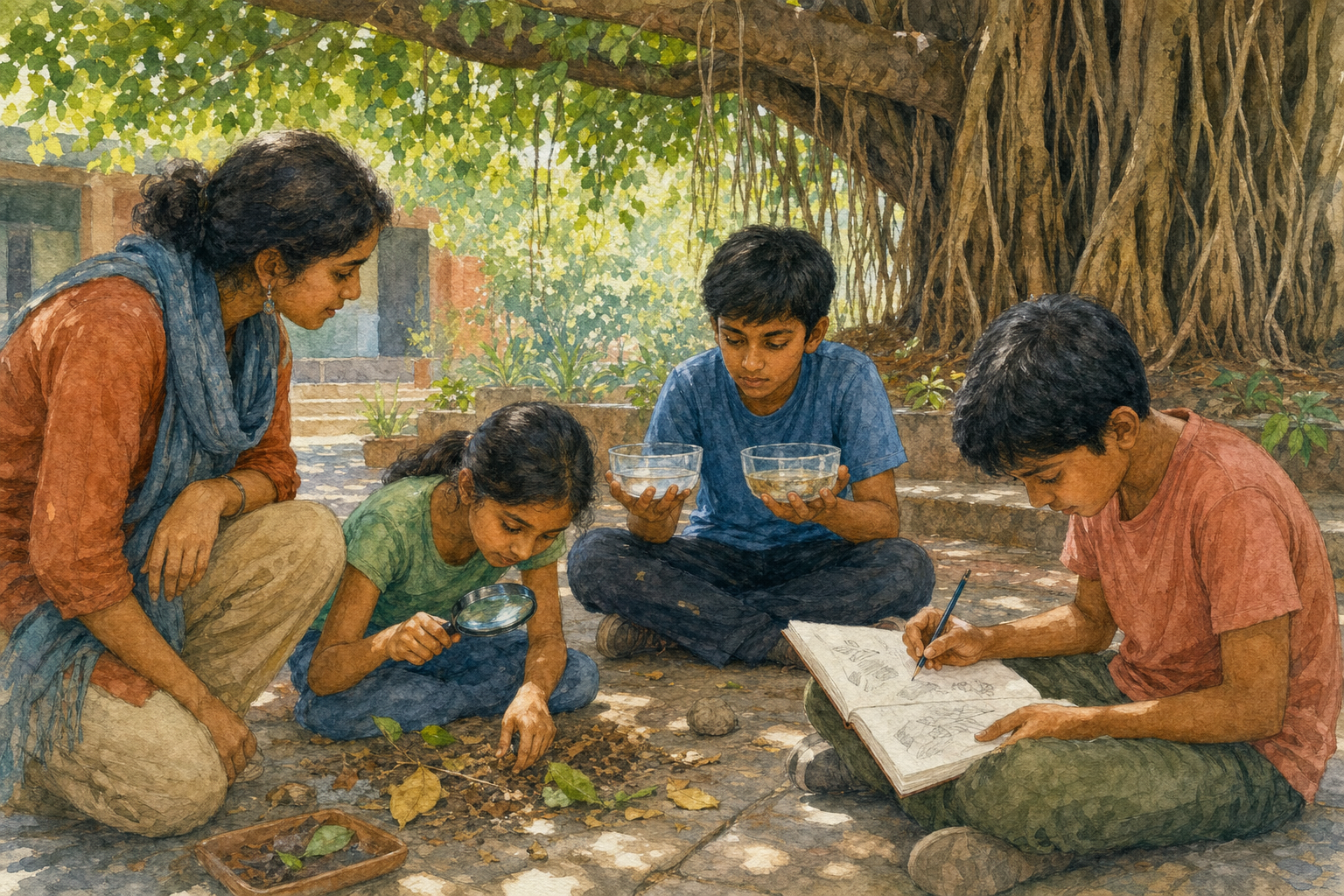
A weak lesson begins with information to remember: the definition of ahimsa, the branches of a philosophical school, or the life of a teacher. A strong lesson begins with a question that makes the information necessary. What does ahimsa require when every design choice causes some harm? How should conflicting testimony be judged? When does service help a community, and when does it merely make the volunteer feel useful?
This is close to the dialogical spirit found in Upanishadic learning. Questions about the self, reality, and valid knowledge are not interruptions to the tradition; they are part of its philosophical method. Nyāya examines logic and knowledge, Sāṃkhya distinguishes consciousness from matter, Mīmāṃsā develops disciplined interpretation, and Vedānta argues about the relationship among Brahman, self, and world. Even Cārvāka dissent was met through argument. A classroom that excludes difficult objections is therefore offering a thinner intellectual inheritance than the one it claims to protect.
Give each topic several kinds of question:
- A clarification question: What exactly is being claimed, and what do the key terms mean?
- An evidence question: How could we know whether the claim is sound?
- An interpretation question: Does another school, sect, or Dharmic tradition understand the matter differently?
- A consequence question: If we accepted this view, what would change in conduct?
- A self-examination question: What assumption did you bring to the subject before studying it?
Do not reward a learner merely for producing a provocative question. Require a provisional answer, the evidence supporting it, a serious alternative, and an explanation of what could cause the answer to be revised. That turns curiosity into accountable inquiry.
Questioning also needs a boundary: criticism must address a claim, interpretation, or action rather than caricaturing a community. Reverence cannot excuse weak reasoning, but intellectual freedom does not require contempt. The learner should be able to state a position fairly before challenging it.
Give inquiry a repeatable path from evidence to service
Use pramāṇa as a practical evidence toolkit
The classical vocabulary of pramāṇa gives learners more useful prompts than the vague instruction to do research. Different philosophical schools do not accept or classify every pramāṇa identically, so present these as a working menu and identify a school’s own commitments when precision matters. The purpose is to help a learner notice why a belief appears justified.
| Pramāṇa | Plain-language prompt | Classroom move |
|---|---|---|
| Pratyakṣa, perception | What was directly observed? | Separate the observation from the interpretation placed upon it. |
| Anumāna, inference | What conclusion follows, and through which reasoning? | Write the premises before accepting the conclusion. |
| Upamāna, comparison | What does the comparison clarify? | Name both the useful similarity and the point where the analogy fails. |
| Arthāpatti, postulation | What must be proposed to account for the known facts? | Compare the proposed explanation with plausible alternatives. |
| Anupalabdhi, non-cognition | What expected thing is not found? | Check whether the absence is meaningful or merely the result of an inadequate search. |
| Śabda, reliable testimony | Why should this text or speaker be trusted here? | Examine competence, context, transmission, and possible disagreement. |
This framework prevents two common mistakes. Śabda should not become a licence to end discussion by quotation alone; the learner still has to establish what the passage means and why that testimony is relevant. Anupalabdhi should not become the careless claim that something is false because the learner failed to find it. In both cases, the method demands more intellectual work, not less.
A simple evidence record can accompany every substantial assignment. Ask the learner to record the claim, the relevant pramāṇa, the evidence obtained, the strongest objection, and the resulting level of confidence. If the conclusion changes, keep the earlier version visible. Revision is evidence that inquiry occurred, not evidence of failure.
Move through study, reflection, creation, and offering
Śravaṇa, manana, and nididhyāsana can shape a practical learning cycle: attend carefully, reflect and test, then assimilate the learning until it affects perception and conduct. For creative education, extend that movement into making and service.
- Frame the problem. Start with a question tied to a text, practice, place, craft, or community need.
- Receive knowledge attentively. Read, listen, observe, or learn from a person who possesses relevant knowledge.
- Interrogate the material. Define terms, sort evidence through the pramāṇas, and identify a credible alternative view.
- Create something testable. Build a prototype, demonstration, archive, performance, teaching resource, or working process.
- Seek correction. Let peers, mentors, and intended users identify errors, omissions, and unintended effects.
- Revise the work. Preserve a record of what changed and which evidence justified the change.
- Offer the result. Return something useful to the people, place, or body of knowledge from which the learner benefited.
- Assimilate the lesson. Write what changed in understanding, skill, and responsibility.
The project should not be a craft attached to a lecture after the intellectual work is over. Making is itself a way to expose gaps in understanding. A learner who documents a heritage craft, for example, must distinguish what was observed from what was inferred, check terminology with an artisan, explain where an analogy fails, and decide how the record will be returned to the knowledge holder. The final exhibit matters, but so do the corrected captions, abandoned assumptions, and consent governing what may be shared.
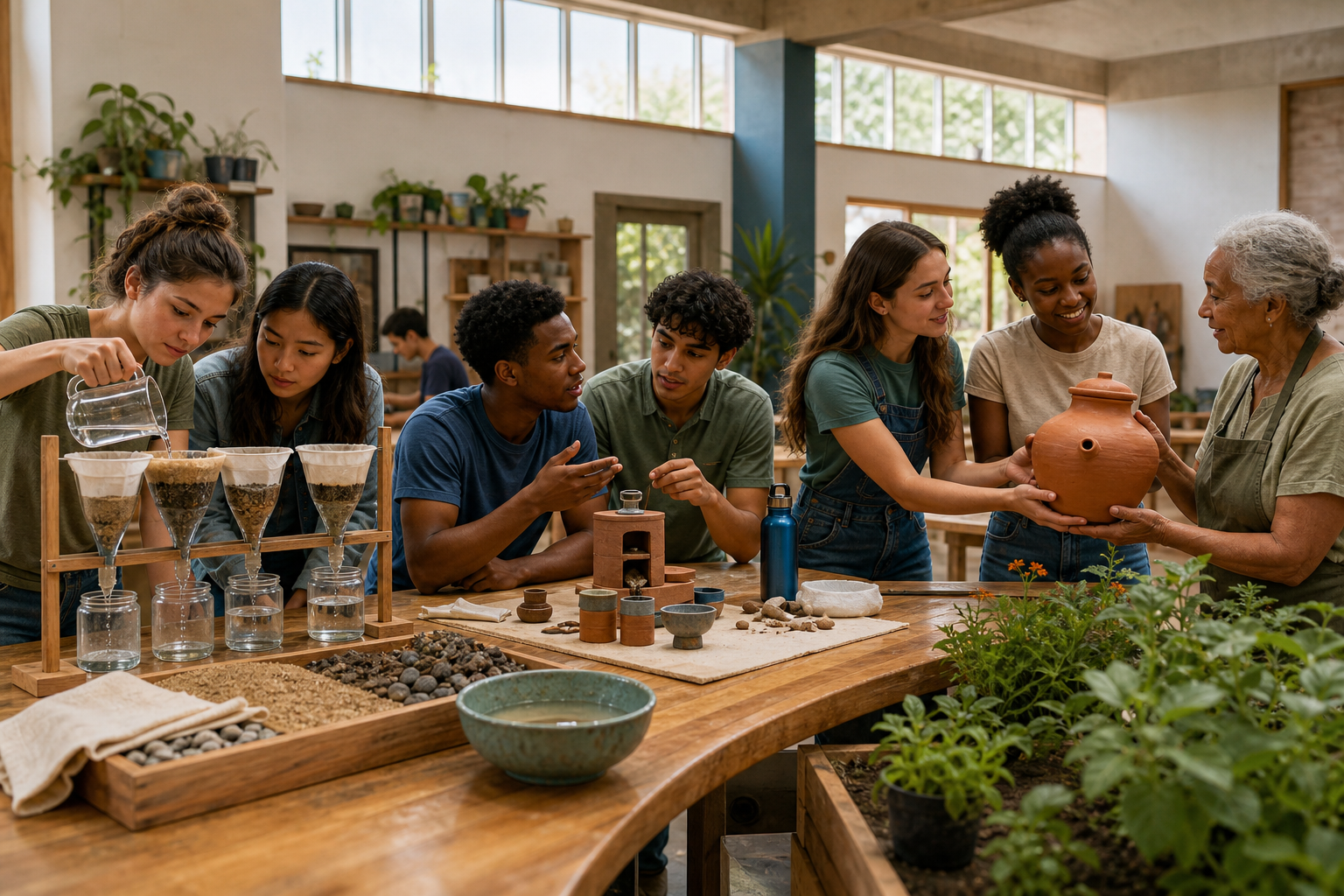
The same structure can support a water-filter prototype, a record of local craft knowledge, a waste-segregation solution, or a neighbourhood reading circle. Begin with the local problem rather than the preferred technology. A robotics project is worthwhile only if the machine addresses the actual waste process, can be used by the people responsible for that process, and improves after their feedback. Otherwise, the learner has demonstrated gadgetry rather than service.
Before approving a project, ask for a brief containing the guiding question, intended beneficiary, evidence needed, ethical constraint, proposed output, test method, and way the result will be returned. If the beneficiary exists only as an imagined audience, the project is not yet community-centred.
Teach pluralism through structured disagreement
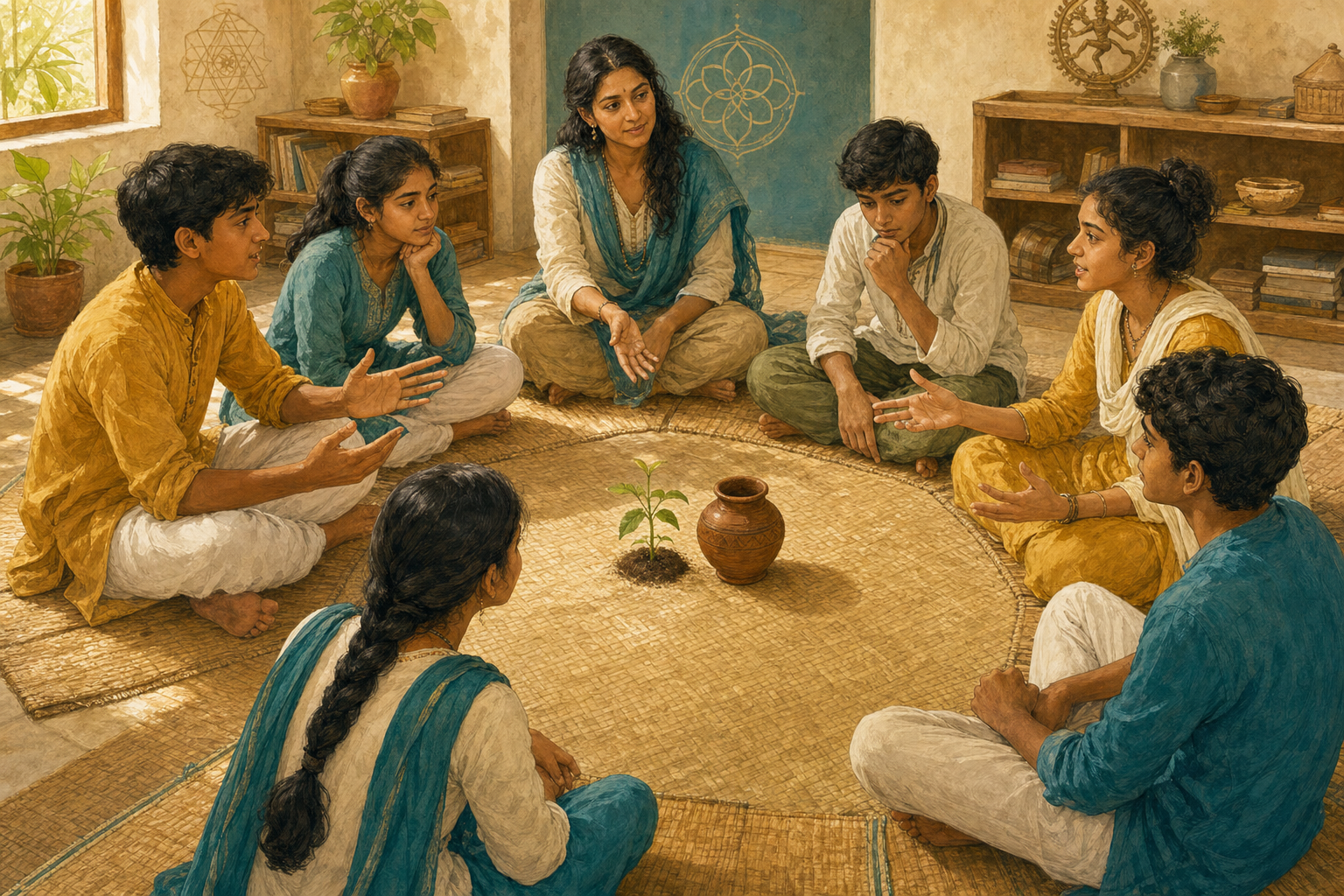
Dharmic plurality is not the claim that every statement is equally true. It is the discipline of approaching a difficult object without assuming that your first angle exhausts it. Jain Anekāntavāda offers a particularly useful reminder that reality can be many-sided, while the history of śāstrārtha shows the value of defined terms, evidence, inference, and sustained challenge. Humility and judgement belong together.
Use a debate protocol that makes understanding the price of participation:
- State the claim in language its defender would recognise.
- Define the disputed terms before arguing about them.
- Present the strongest available reason for the claim.
- Restate the opposing position fairly and obtain confirmation that it has been understood.
- Identify whether the disagreement concerns observation, inference, testimony, interpretation, or an ethical priority.
- Name the evidence that would weaken your own position.
- End with a revised claim that reflects whatever the exchange clarified.
This format is especially important when learners compare Hindu, Buddhist, Jain, and Sikh thought. Do not flatten these traditions into the claim that they all teach the same thing. They have real differences in doctrine, authority, practice, and philosophical vocabulary. Shared civilizational habits such as truth-seeking, disciplined attention, compassion, responsibility, and service can be studied without erasing those differences.
The traditions can also supply distinct ethical lenses for a project. Karma Yoga can press the learner to examine duty, attachment to recognition, and responsibility for action. Buddhist mindfulness can direct attention to mental habits and compassionate awareness. Jain ahimsa can widen the search for harm, including harm hidden in materials or processes. Sikh seva can test whether the work is genuinely oriented toward the community. These are starting questions, not interchangeable definitions of the traditions.
Build an ethical audit into the project before the final presentation. Ask who benefits, who bears inconvenience or risk, whose knowledge is being used, whether permission was obtained, which voices are missing, and whether the project would still appear successful from the beneficiary’s perspective. This is where philosophical plurality becomes a design discipline.
Assess the reasoning, then surround the learner with mentors
An examination can check whether a learner remembers a concept. It cannot, by itself, show how that learner responds when an assumption fails, a prototype breaks, testimony conflicts, or a community rejects the proposed solution. Keep appropriate checks of subject knowledge, but add evidence that captures inquiry and revision.
A useful portfolio contains:
- The original question and the reason it matters.
- An evidence map identifying perception, inference, comparison, postulation, non-cognition, and testimony where relevant.
- A problem log recording uncertainty, failed attempts, and unresolved constraints.
- Drafts or prototypes that make revision visible.
- Peer criticism and the learner’s response to it.
- Feedback from the intended user, knowledge holder, or community participant.
- An ethical audit based on responsibility, compassion, non-harm, and service.
- A final reflection distinguishing what was learned from what still needs to be tested.
Judge the work on question quality, accuracy, fit between claim and evidence, fairness to alternatives, quality of revision, effectiveness of the created result, and ethical responsibility. Do not let visual polish hide weak reasoning. A beautiful model based on a false premise is unfinished work. Likewise, do not let an inelegant early prototype obscure a learner’s strong diagnosis and thoughtful revision.
Feedback becomes more useful when it is specific. A reviewer should be able to complete these statements: I understand your claim to be; your strongest evidence is; the assumption that still needs testing is; the person whose perspective is missing is; and the revision most likely to improve the work is. This keeps peer review away from empty praise and personal attack.
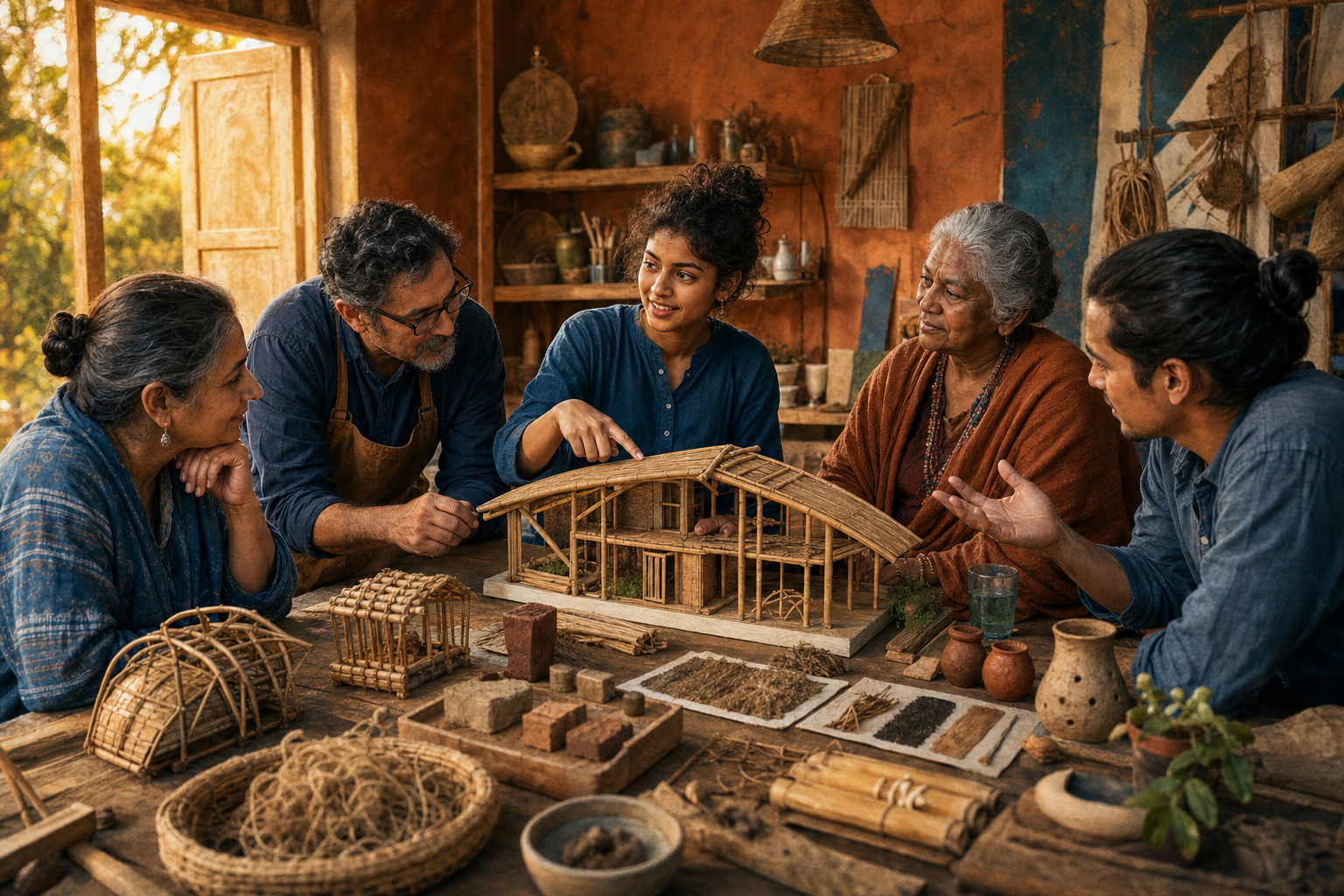
Creative inquiry also needs more than a single all-purpose instructor. A contemporary version of relational mentorship can connect teachers, artisans, entrepreneurs, researchers, monastics, and engineers. Give each mentor a bounded role. The teacher protects conceptual clarity; the craftsperson or practitioner corrects assumptions about lived technique; the technical mentor examines feasibility; the community participant tests usefulness; and the philosophical or spiritual mentor deepens the ethical questions. For minors, outside contact should remain under the ordinary safeguarding and supervision rules of the family or institution.
Attention must be trained alongside creativity. Use a brief opening pause in which learners settle, write the active question, and name the task they intend to complete. During work, let them mark a distraction in the problem log before switching attention. Close with a reflection on what was assumed, what was discovered, and what must be checked next. Breath-based focus, mindful attention, and reflective journaling can support ekāgratā, but participation in a graded project should assess attention and reflection rather than compel a particular act of religious observance.
Key takeaways
- Start with a live question that requires evidence, interpretation, and an ethical consequence.
- Use the pramāṇas to identify why a claim appears justified and where its support may fail.
- Move from attentive study through reflection, creation, testing, revision, service, and assimilation.
- Use Anekāntavāda to seek neglected perspectives, not to avoid deciding which claim is better supported.
- Assess the evidence trail, failed attempts, revisions, community response, and ethical judgement as well as the finished product.
- Build a bounded network of mentors so that conceptual, practical, technical, and community knowledge can correct one another.
For your next unit, do not begin by rewriting the entire syllabus. Choose a topic already being taught and place these questions at its centre: What is being claimed? How could we know? What would a fair opponent say? Whom should this knowledge serve? Require the learner to leave with an evidence record, a revised creation, and a responsible way of offering it. That small redesign is enough to turn inherited knowledge from something displayed into something examined, lived, and carried forward.
References
- DharmaRenaissance Blog — Hinduism’s Fearless Quest for Truth: Rational Inquiry, Pluralism, and Dharmic Unity
- DharmaRenaissance Blog — Beyond Classroom Walls: Unleashing Creative Minds with Dharmic Wisdom and Modern Innovation
