
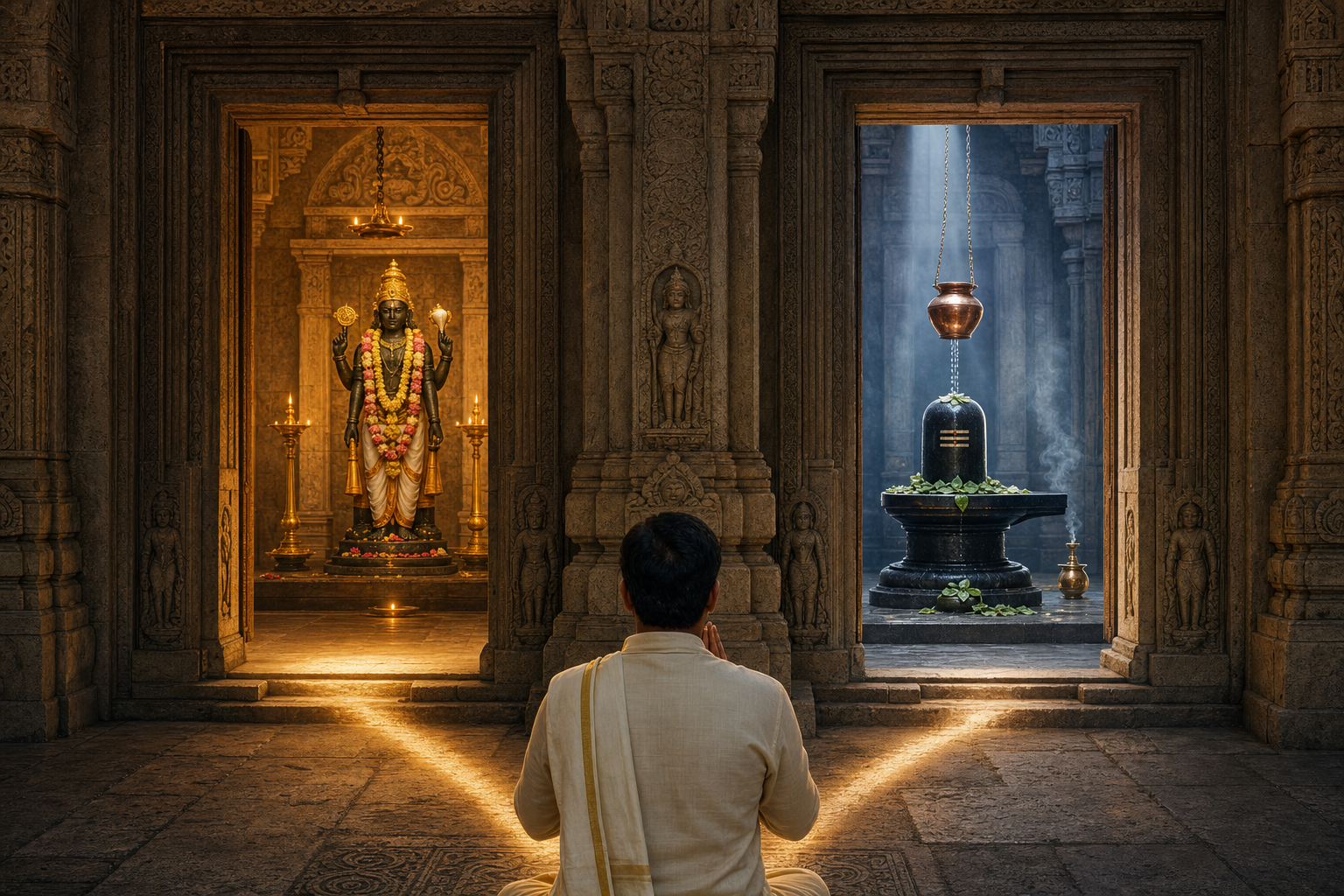
You may feel at home in both a Vishnu temple and a Shiva temple and still be unsure what changes once the central form has been consecrated. Is the murti or linga a symbol, a divine presence, or both? May you worship in the same way at either shrine?
Consecration asks you to shift from looking at sacred art to entering an inherited relationship. The form, ritual order, continuing service, offerings, and conduct around the sanctum belong together. Once you understand that pattern, you can participate confidently without pretending that every Vaishnava and Shaiva lineage follows the same devotional grammar.
Consecration changes an image into a focus of continuing service
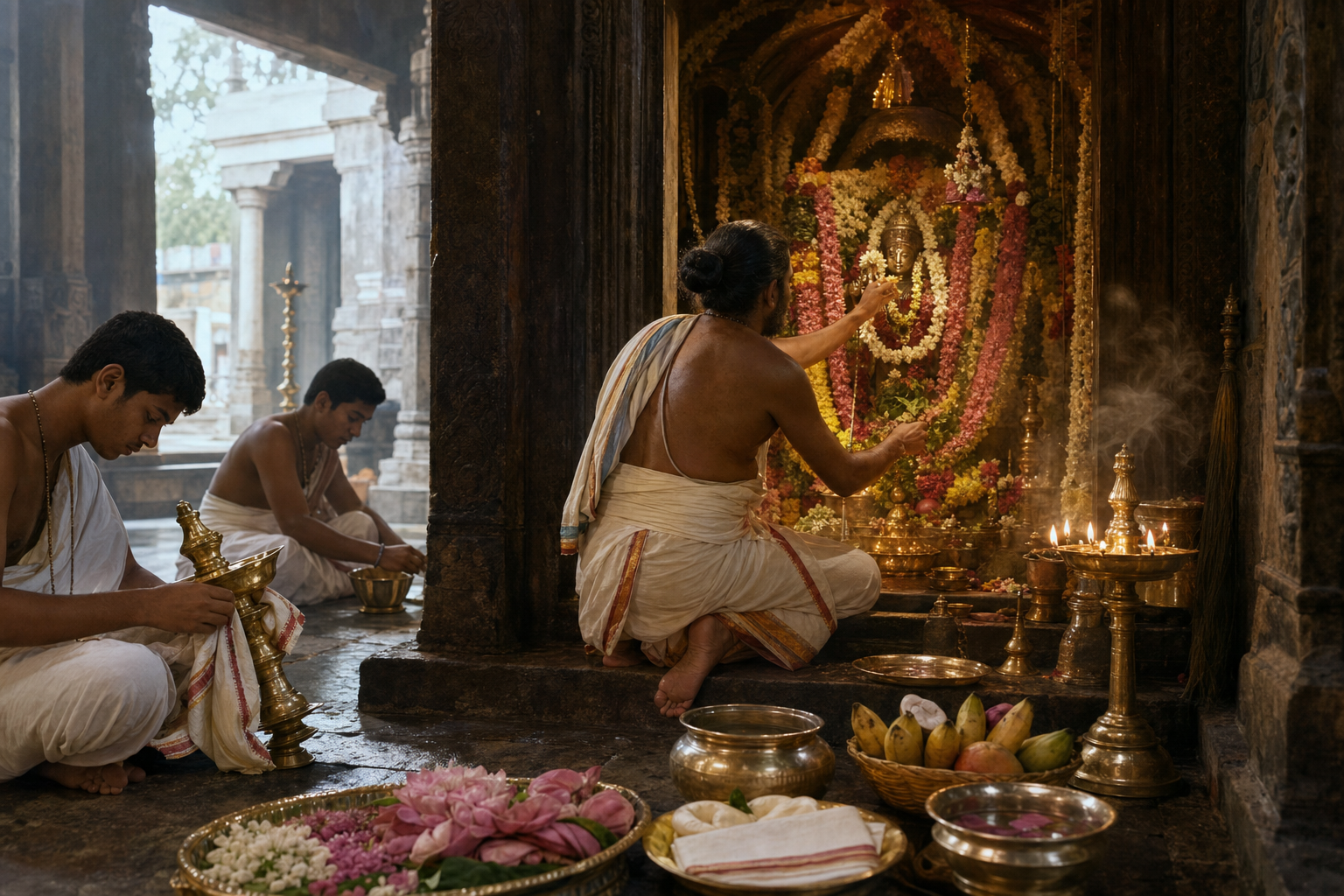
Prana-pratishtha is not merely a temple opening or a ceremonial blessing placed upon a finished object. It ritually establishes a form as a focus of divine presence and obligates the temple community to sustain worship. Within Pancharatra Vaishnavism, consecration belongs to a larger system that also encompasses archana, mantra, iconography, temple liturgy, and household observance. In Shaiva worship, the Daivatha Linga is similarly established through Agamic rites as the sacred center of the shrine.
This does not mean that the limitless Divine has been confined inside stone or metal. It means that a particular form, place, and ritual relationship have been accepted as dependable means of encounter. The physical form makes devotion concrete: worship happens somewhere, at particular times, through particular acts of attention and care.
The Shaiva distinction between chala and achala lingas makes the practical effect especially clear. A chala linga is movable and can be used in domestic worship or carried in a procession. An achala linga is fixed within the garbhagriha after consecration and remains the permanent center of the temple. Its immovability is not an incidental architectural fact. It binds sacred presence to a place, a community, and a continuing cycle of worship.
Three consequences follow for you as a visitor:
- Do not approach the sanctum as a display. You are entering a relationship already being maintained through daily worship.
- Do not separate darshan from ritual order. The bathing, adornment, mantra, offering, and periods when the sanctum is not accessible are parts of the sacred relationship, not distractions from it.
- Do not treat domestic simplicity as spiritual inferiority. A household practice need not reproduce the scale or technical detail of a consecrated temple. Its integrity comes from steadiness, reverence, and conduct suited to your circumstances.
Vaishnava worship trains relationship through ordered devotion
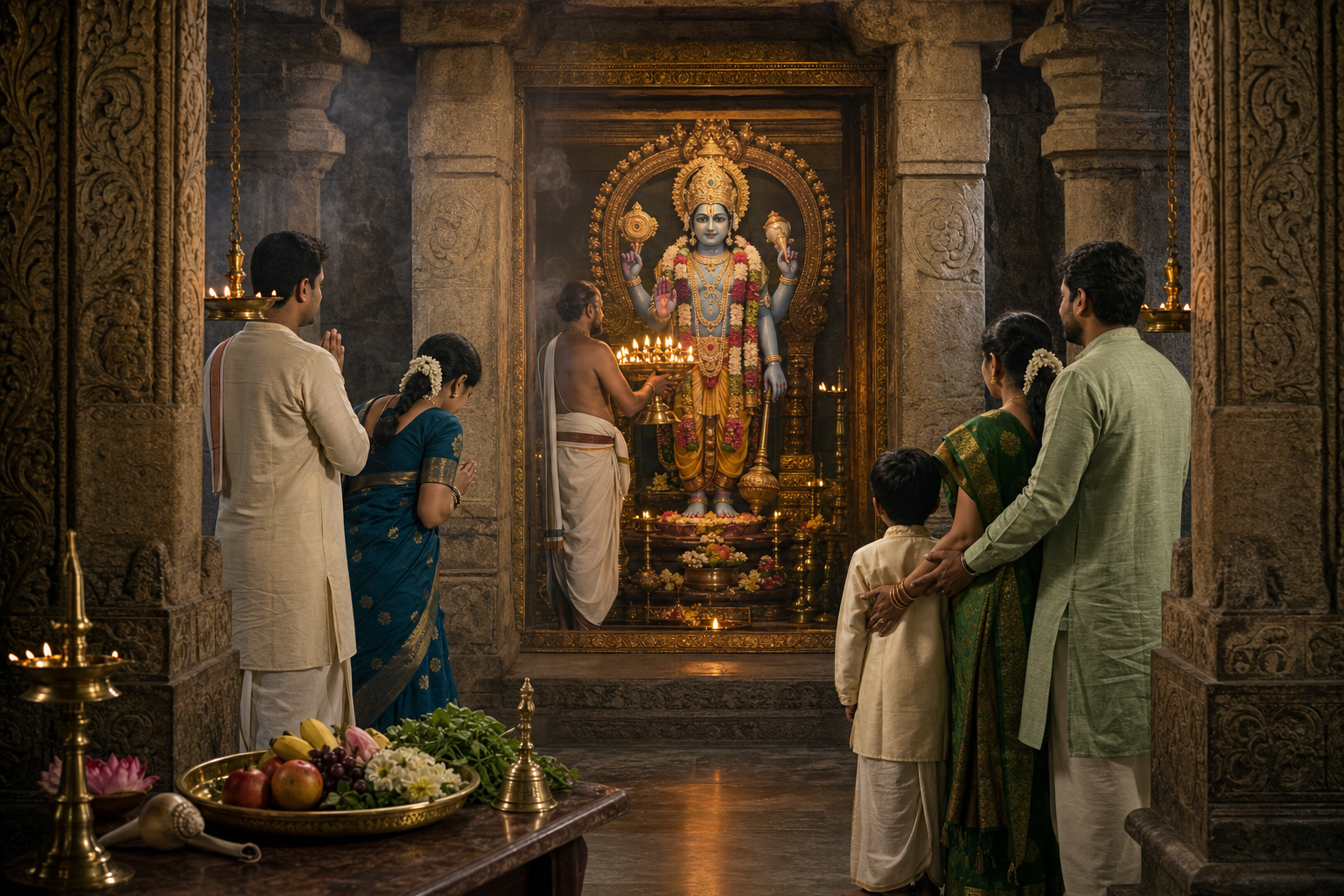
In a Vaishnava temple shaped by Pancharatra practice, the consecrated form is approached through bhakti expressed as service. Archana, mantra recitation, praise, offerings, and visual form work together. The rite is not an ornamental layer placed over theology; it is theology given a disciplined rhythm.
Pancharatra is a major Vaishnava stream, not a universal label for every Vishnu temple. Its theological world affirms Vishnu’s supremacy and includes the four vyuhas: Vasudeva, Sankarshana, Pradyumna, and Aniruddha. That emanational vision gives ordered plurality a place within divine unity. It also helps explain why a visible consecrated form need not be regarded as a limitation upon the Divine. Form can disclose divine reality rather than compete with it.
For the worshipper, however, the decisive point is not mastery of a theological chart. It is the quality of relationship cultivated through repeated attention. Bhakti is joined to truthfulness, compassion, self-restraint, and reverence for life. A temple visit that produces a strong emotion but leaves your conduct untouched has stopped before the practice is complete.
This corrects a common transactional misunderstanding. Naivedya is not a payment, mantra is not a device for forcing a result, and darshan is not a brief opportunity to present the Divine with a list of demands. Consecrated worship trains you to receive, serve, remember, and respond. A petition may be sincere, but it belongs inside that larger relationship.
If you are new to a Vaishnava temple
- Learn the name of the presiding form. Do not stop at the general label of Vishnu. The temple’s particular identity, devotional history, and local practice shape how the deity is approached.
- Let the liturgy teach before you imitate it. During archana or mantra recitation, attentive listening is better than guessing unfamiliar words or gestures. If you do not know the prescribed mantra, silently remembering a familiar divine name is enough for your personal attention.
- Use the temple’s channel for offerings. Present flowers, food, or other materials only in the manner the temple permits. A sincere offering does not become more devotional by interrupting the established service.
- Carry one ethical consequence home. Decide what the darshan requires from you that day: greater truthfulness in one conversation, compassion toward one person, restraint in one habit, or more careful regard for life.
Pancharatra’s recognition of different temperaments also matters. Not everyone experiences devotion through the same emotional expression. Praise, mantra, ritual service, contemplation, and simple household observance can engage different capacities. You do not need to manufacture visible intensity to prove bhakti. Disciplined attention is itself a serious form of devotion.
Shaiva worship holds visible presence and formless depth together
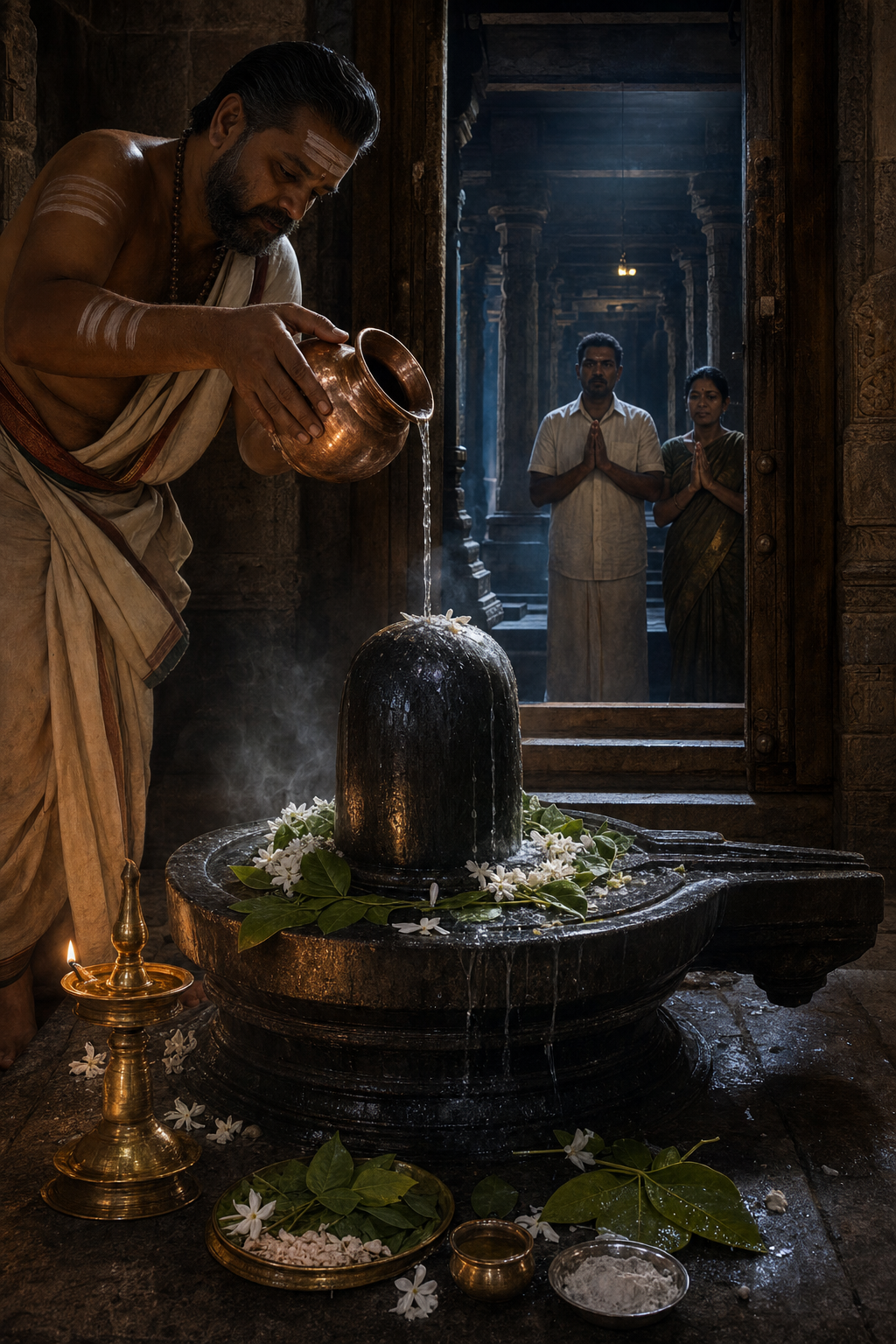
The linga is sometimes misunderstood in opposite directions. One reading treats it as merely an abstract symbol; another treats its material form as the whole meaning. Consecrated Shaiva worship refuses both reductions. The linga supports saguna worship of Shiva while directing contemplation toward the nirguna Absolute beyond every bounded description.
The traditional expression liyate asmin iti lingah points toward that into which creation ultimately resolves. The linga therefore speaks through form about what exceeds form. Its non-anthropomorphic shape does not indicate an absence of divine presence. It gives the worshipper a still center through which creation, sustenance, dissolution, and return can be contemplated.
This is why the Daivatha Linga functions as more than an emblem placed in a sanctum. It becomes the shrine’s living axis through consecration, recurring worship, festivals, and the memory of the kshetra. Stone, metal, crystal, and other materials may be used, while local Agamic lineages and sthala traditions determine the details of worship.
Abhisheka makes the relationship visible through ritual bathing. Alankara adorns the consecrated presence. Naivedya presents an offering. Bilva leaves, circumambulation, mantra, and silence can all direct the body and mind toward Shiva. None of these acts is a free-form performance. Their order, materials, availability to visitors, and ritual meaning depend on the temple.
If you are new to a Shiva temple
- Become quiet before trying to do something. A few attentive moments in the mandapa can prepare you to receive darshan without turning the visit into a sequence of hurried tasks.
- Ask before offering anything directly. Water, milk, or Bilva leaves may be accepted during an abhisheka in one shrine and handled only by designated worshippers or priests in another. Do not pour or place materials simply because you have seen the act elsewhere.
- Perform pradakshina only according to the local pattern. Follow the temple’s signs, customary flow, or direct guidance rather than assuming that every sanctum is circumambulated in precisely the same way.
- Use the linga’s form as instruction. Let attention settle on stillness, humility, and the return of scattered thought to a single center. The absence of an anthropomorphic face is not a gap that imagination must fill.
You need not choose between regarding the linga as sacred presence and understanding it as a metaphysical teaching. Consecrated worship depends upon their conjunction. The same form can be lovingly bathed and adorned while awakening reflection on the limitless ground from which existence arises and to which it returns.
Honor the shared discipline without collapsing the differences
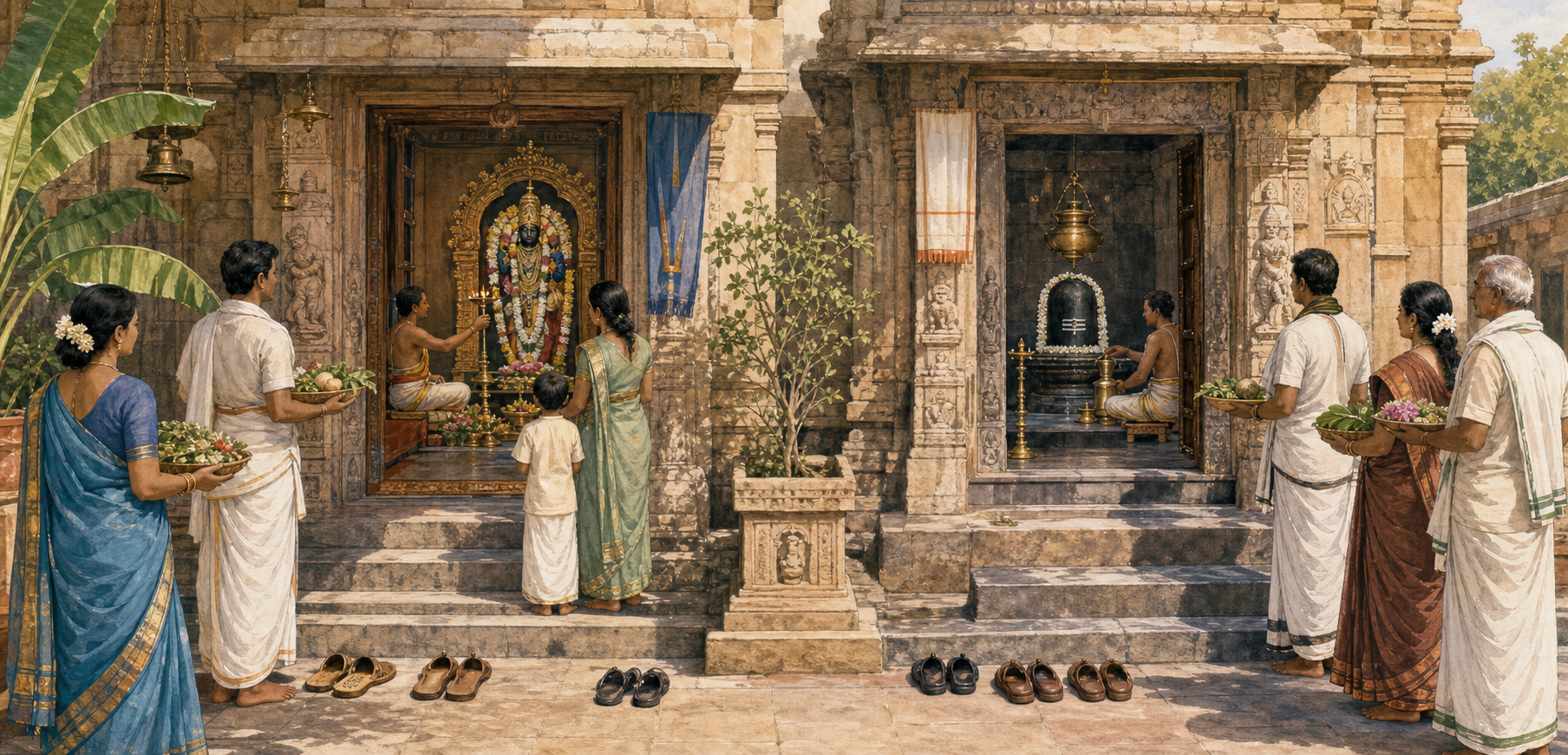
Vaishnava and Shaiva consecrated worship share a recognizable sacred grammar: Agamic discipline, established presence, mantra, offering, embodied gestures, recurring service, and a temple community organized around the sanctum. Both make devotion more than an inward opinion. Body, material, place, sound, schedule, and ethical response all participate.
Their emphases should still remain distinct. Pancharatra Vaishnava worship foregrounds loving relationship with Vishnu through structured bhakti and service. Shaiva linga worship foregrounds Shiva as both present to saguna devotion and suggestive of nirguna reality. Neither emphasis makes one path more personal, philosophical, concrete, or elevated than the other. Each trains attention through its own inherited forms.
If you come from another Dharmic path, you may recognize familiar concerns. Buddhist aniconic expression, Jain attention to stillness and inner realization, and the Sikh affirmation of the singular formless Divine can provide points of resonance with the linga’s movement between form and transcendence. Shared intuitions can open respect, but they do not erase the theological or ritual identity of a Shiva temple. The same principle applies when Vaishnava inclusiveness is mistaken for the claim that every mode of worship is interchangeable.
A five-step method for approaching either shrine
- Identify where you are. Learn the presiding devata, the temple’s lineage if it is readily available, and whether you are approaching the fixed sanctum form, a movable processional form, or an auxiliary shrine.
- Pause at the threshold. Set aside the urge to photograph, compare, rush, or immediately request something. Give the temple’s sacred order time to become perceptible.
- Let the temple lead. Observe the current worship, follow clear instructions, and ask a simple question when the offering procedure is uncertain. Respect for lineage is more important than displaying ritual familiarity.
- Choose one appropriate mode of attention. In Vaishnava worship, attend to divine name, form, relationship, and service. Before a Shiva linga, allow presence and formless depth to be contemplated together. Do not force one shrine to speak in the other’s vocabulary.
- Complete the visit outside the temple. Carry one quality into ordinary conduct: devotion expressed as service, self-restraint before an impulse, compassion in a difficult interaction, or stillness before a reactive decision.
This method also protects you from two avoidable extremes. Ritual tourism collects striking gestures without entering their discipline. Ritual anxiety assumes that an imperfect visitor has nothing meaningful to offer. Attentive presence, respect for the temple’s procedure, and a concrete ethical response provide a sound middle path.
Key takeaways
- Prana-pratishtha establishes a continuing relationship of divine presence and service; it is more than a ceremonial inauguration.
- Pancharatra Vaishnava worship integrates consecrated form, archana, mantra, bhakti, and ethical discipline.
- The consecrated Shiva linga joins saguna worship to contemplation of nirguna reality rather than forcing a choice between form and formlessness.
- Temple worship and household worship can both be genuine without being identical in scale, obligation, or ritual detail.
- Never improvise an offering, abhisheka, or circumambulation when the local procedure is unclear; ask or observe first.
- The most reliable sign that darshan has become practice is a specific change in how you serve, speak, restrain an impulse, or meet another being.
On your next visit, enter with one practical question: what relationship is this shrine training you to live? Let the temple answer through its own sequence, then carry one part of that answer into the next ordinary hour. That is where consecrated worship stops being something you merely observe and becomes part of your sadhana.
References
- DharmaRenaissance Blog — Narada Pancharatra: Timeless Vaishnava Wisdom and Inclusive Paths to Devotion
- DharmaRenaissance Blog — Daivatha Linga: Unveiling Shiva’s Sacred Emblem and the Universe’s Return to Source
