

If you are trying to turn devotion into useful service, the difficult question is not simply where to volunteer. It is how to keep the work from splitting in two: private piety on one side, public activism on the other.
You need a practice that does three things at once: meets a real need, disciplines the ego, and strengthens the shared world. Seva can do that, but the label alone guarantees nothing. The formation lies in how you choose the task, how you perform it, and what you do after the first burst of enthusiasm.
Seva forms you through the motive you practise

Many people postpone service because their motives do not feel pure enough. They want to help, but they also hope to feel peaceful, useful, connected, or spiritually assured. That mixture does not disqualify you. It gives you the raw material of practice.
The important question is not whether self-interest appears at the beginning. It is whether you keep feeding it. Disciplined service can gradually move attention from personal consolation toward contribution. Happiness may still arise, but it becomes a consequence of alignment rather than a payment demanded for doing good.
Dharmic traditions express this movement in distinct vocabularies. Hindu bhakti can treat action as service to the Divine, while karma yoga offers work without clinging to its fruits. Buddhist karuṇā turns attention toward suffering with compassion. Jain dayā and aparigraha join care with a loosening of possession. Sikh nishkām seva places service beyond calculation of personal gain. These are not identical doctrines, but they share a practical discipline: reduce grasping, attend closely, and act without making yourself the centre.
You can train that discipline at three moments:
- Before the work, identify the need. Ask who or what is being served, who understands the situation, and what would actually help. A sincere intention cannot compensate for an unwanted or poorly chosen intervention.
- During the work, return attention to the task. Notice when you start comparing effort, seeking recognition, avoiding an unglamorous role, or imagining how the service will appear to others. Then return to the person, place, or duty in front of you.
- After the work, examine the residue. Ask what genuinely improved, where you wanted credit, whether anyone carried an unfair burden, and what obligation remains. This review turns a completed activity into spiritual instruction.
Do not make purity of motive into another performance. If relief from anxiety or a desire for purpose brings you to seva, begin there. Just do not make the people you serve responsible for producing that relief. They are not instruments in your spiritual project.
Over time, the measure changes. You ask less often whether the activity made you feel good and more often whether you became attentive, dependable, less possessive, and more willing to do necessary work without applause. That is formation. Joy can accompany it, but joy is fruit, not an invoice.
Public devotion begins with the commons in front of you
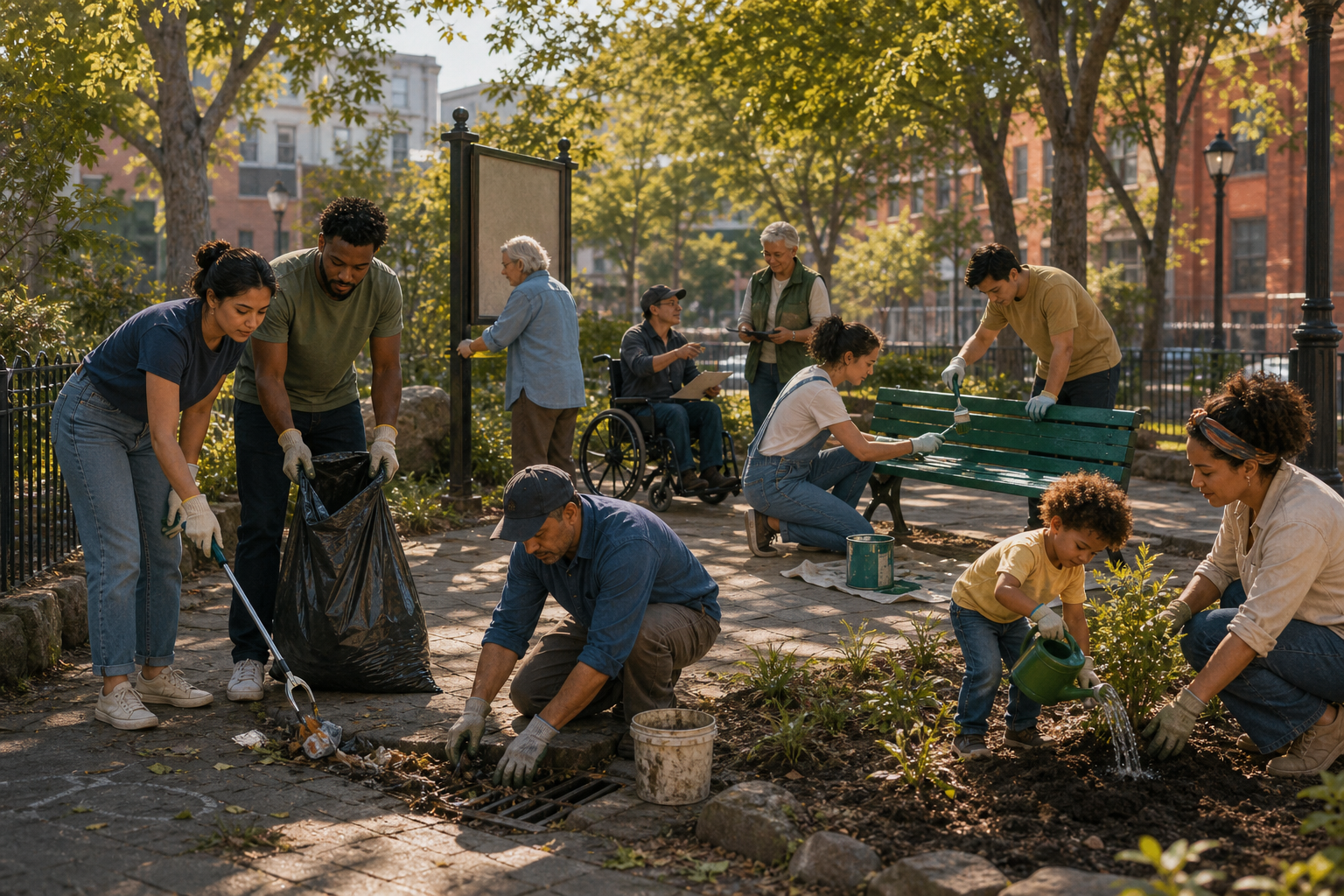
Spirituality becomes civic when it accepts responsibility for places and relationships that belong to the community rather than to one household. Streets, water points, places of worship, gardens, historic sites, and other shared spaces reveal whether reverence has acquired practical hands.
At Bhuikot Fort in Solapur, youths from Solapur, Akkalkot, and nearby rural areas combined worship and devotional chanting, guided heritage learning, a cleanliness drive, and discussion of social and national responsibilities. The usefulness of this pattern lies in the connection among its parts. Historical memory supplied a reason to care. Spiritual reflection set an ethical orientation. Physical work gave reverence a public consequence. Discussion connected one local responsibility to larger questions of citizenship.
A cleanliness drive by itself can improve a site. A heritage talk by itself can deepen knowledge. Devotion by itself can refine attention. Civic seva joins these without confusing them. It asks you to know what you are protecting, perform work the place actually needs, and leave behind something more substantial than a ceremonial photograph.
Use four tests before calling a project civic seva:
- There is a verified need. A responsible steward, regular user, resident, or community body can explain why the work matters.
- The benefit is genuinely shared. The activity improves access, dignity, cleanliness, continuity, safety, knowledge, or care beyond the organising group alone.
- The method respects the place. You have permission, suitable tools, a plan for materials or waste, and enough knowledge to avoid causing damage.
- Someone owns the handoff. The group knows what remains unfinished, who will communicate with the steward, and whether another visit is required.
Heritage service requires particular restraint. Removing obvious litter with permission is different from altering historic fabric. Do not scrape, paint, move objects, cut growth, or apply chemicals at a historic site unless the responsible authority has explicitly approved the work. Enthusiasm does not create competence.
The same principle applies elsewhere. Do not arrive at a community kitchen and redesign its system before asking what the regular team needs. Do not distribute items that create a disposal problem. Do not organise a public cleaning effort without deciding where collected waste will go. Seva begins with humility toward reality, not attachment to your preferred form of helping.
Build a seva cycle that can survive the first event

A single day can awaken interest and create fellowship. Formation, trust, and stewardship require return. If every gathering begins again from zero, the group may accumulate memorable events without becoming responsible for anything.
A repeatable seva cycle can be simple:
- Choose one bounded responsibility. Name the place, people, or function you intend to support. Prefer a task that can be completed or clearly advanced during one visit, such as caring for an authorised area, preparing a meal under an existing team, or helping with a defined community process.
- Listen before planning. Speak with the person responsible for the site or service. Ask what is useful, what is prohibited, what has already been tried, and what happens after your group leaves.
- Set a clear sankalpa. Before beginning, state the intention in one sentence. A prayer, chant, period of silence, or short reflection may support it, depending on the tradition and setting. The purpose is to direct attention toward the offering, not to stage a display.
- Assign roles around the work. Identify who holds permission, who brings approved materials, who handles safety and waste, who coordinates participants, and who communicates with the local steward. Rotate visible and invisible roles so status does not harden around the microphone or camera.
- Close the civic loop. Record what was completed, where materials or waste went, what remains, who is responsible for follow-up, and what the steward needs next. If the task revealed a larger problem, describe it accurately instead of claiming completion.
- Close the spiritual loop. Ask where impatience, possessiveness, avoidance, rivalry, or the desire for recognition appeared. Then choose one correction for the next visit. Set the next responsibility before the group disperses.
Keep the cadence honest. A modest responsibility performed reliably is better formation than a grand promise the group cannot maintain. If you cannot return, describe the effort as a one-time contribution and make a clean handoff to someone local. Do not present temporary activity as permanent stewardship.
You can also carry the same cycle into ordinary work. Preparing food, maintaining a temple approach, teaching a skill, caring for an elder, helping a neighbour navigate a process, or doing an overlooked workplace duty can become seva when the need is real, the action is competent, and attachment to praise is consciously reduced. Public scale is not the measure of spiritual seriousness.
Guard seva against performance, control, and exhaustion

Devotional language does not make every service project wise. Seva can reproduce ego, hierarchy, waste, or exclusion unless you examine how the work is organised. Watch for these failure modes:
- Applause replaces usefulness. Public communication may help recruit people or document stewardship, but the camera should not dictate the task. Obtain consent before identifying recipients, avoid turning vulnerable people into scenery, and report the work accurately.
- Service becomes control. Ask before acting. The people affected by a project retain knowledge and agency; they are not passive material for someone else’s virtue. If your plan cannot survive their disagreement, it was never truly centred on service.
- Selflessness becomes self-neglect. Service without expectation of reward does not require accepting unsafe work, abusive treatment, or limitless demands. Use appropriate training and equipment, define roles, and step back when a task exceeds your competence or capacity.
- Unity becomes erasure. Hinduism, Buddhism, Jainism, and Sikhism have distinct teachings and institutions. Cooperation does not require pretending otherwise. Dharma, self-discipline, compassion, courage, service, environmental care, and responsible citizenship can provide a shared field of action while each community speaks in its own authentic voice.
- An event substitutes for responsibility. A crowded launch, devotional programme, or cleanup may generate energy, but unresolved waste, damaged trust, or an absent handoff exposes the gap between appearance and stewardship. Judge the activity after everyone has gone home.
The right evaluation is therefore concrete. Did the person or place receive something needed? Were permission and dignity preserved? Did participants become more reliable and less attached to status? Is the next obligation named? If the answer to one of these is no, do not defend the project with spiritual language. Correct the design.
Key takeaways
- You do not need a perfectly selfless motive before beginning. You need a practice that notices self-interest and repeatedly redirects attention toward service.
- Seva becomes civic action when devotion accepts responsibility for a real public need, especially the care of shared places and community institutions.
- Permission, local knowledge, competent methods, and a clear handoff are part of the offering. Good intentions do not replace them.
- A bounded responsibility repeated reliably does more formative work than an impressive activity with no continuity.
- Joy may accompany seva, but the durable measure is whether the work served well and made you more attentive, humble, courageous, and dependable.
Choose one shared place or community responsibility already present in your weekly life. Find the person who knows it best and ask for one bounded task. Begin with a clear intention, complete the work competently, examine your motive afterward, and name the next responsibility before leaving. That is small enough to begin now and serious enough to form you.
References
- Hindu Janajagruti Samiti — Bhuikot Fort Awakens: A Day with Chhatrapati Shivaji Maharaj Inspires Youth and Seva
- Dandavats — From Self-Interest to Selfless Seva: Bhakti’s Path to Serving the Divine and Boundless Joy
