
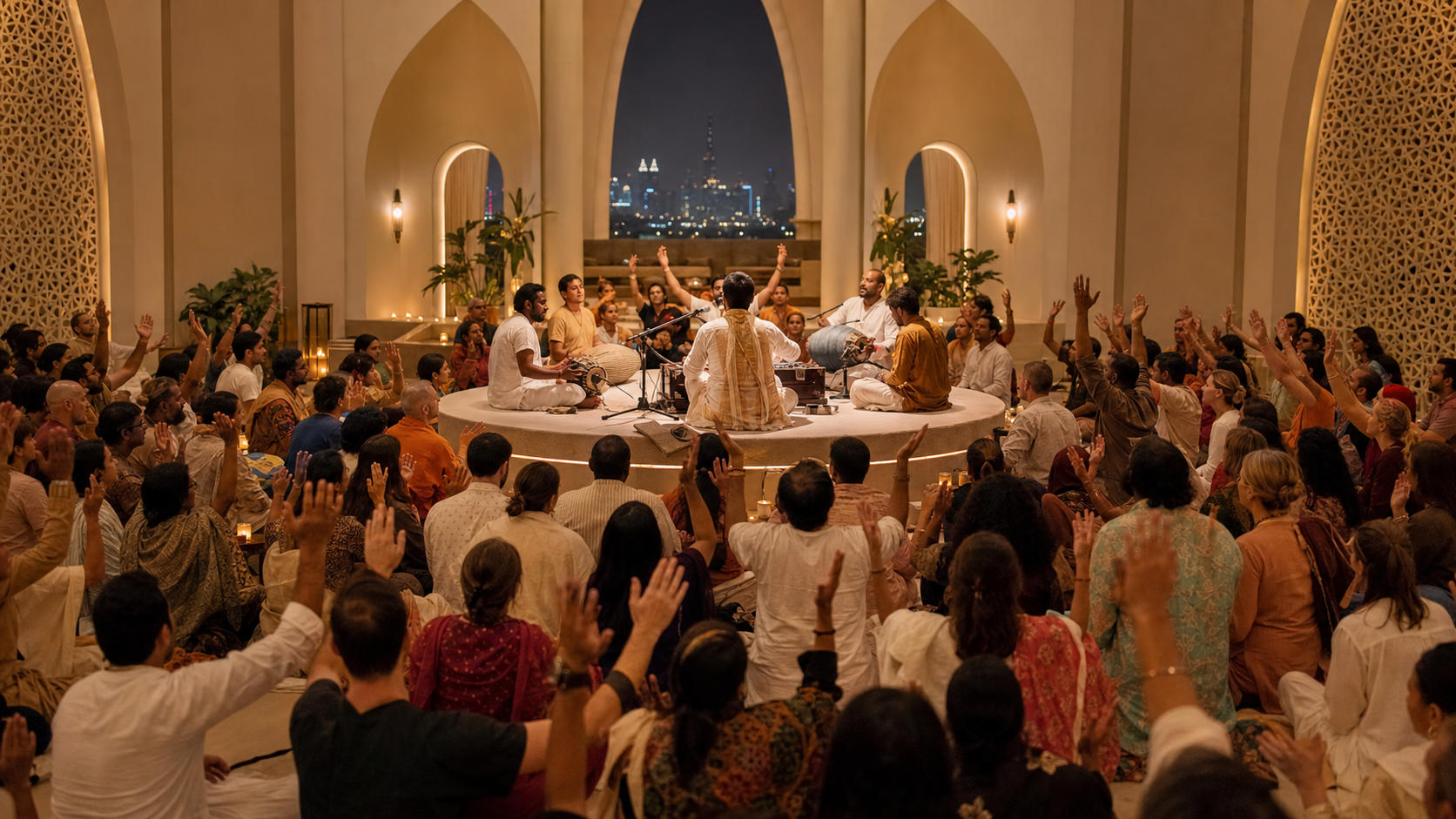
You may have opened Kirtan Rasa 2025 wondering how to approach it: as a concert, a meditation, or an act of worship. If you want to understand why the gathering matters, begin by noticing what repetition does to your attention and how call-and-response changes the relationship between the leader, the congregation, and you.
The Day 1 kirtan led by HH Sacinandana Swami at the Dubai Kirtan Mela centers on the Hare Krishna maha-mantra. Its 4K presentation brings the gathering to viewers far beyond the venue, but a screen creates a choice: you can consume the recording passively, or you can use it as an attentive encounter with bhakti. Here is how to choose the second path.
Know what kind of experience you are entering
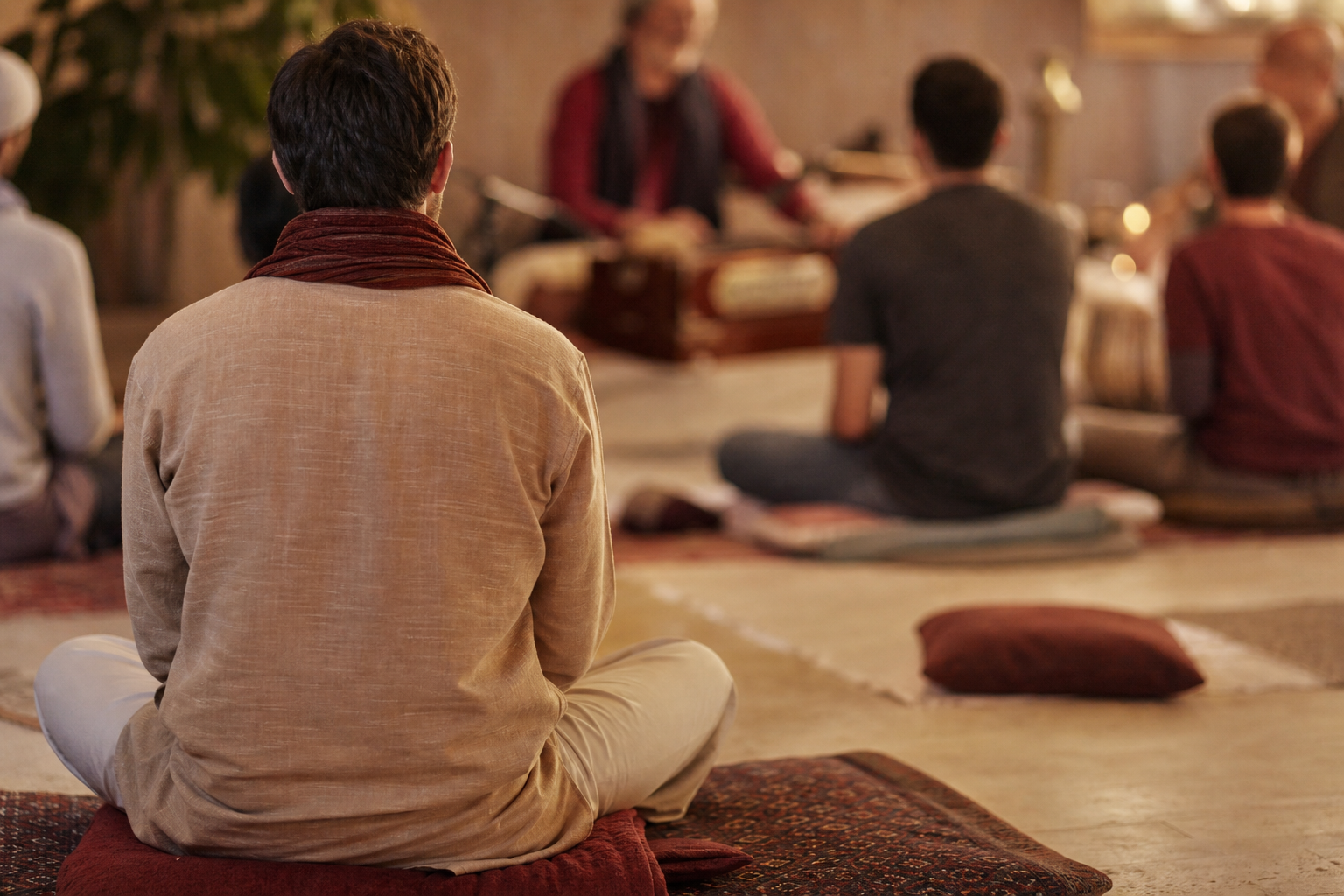
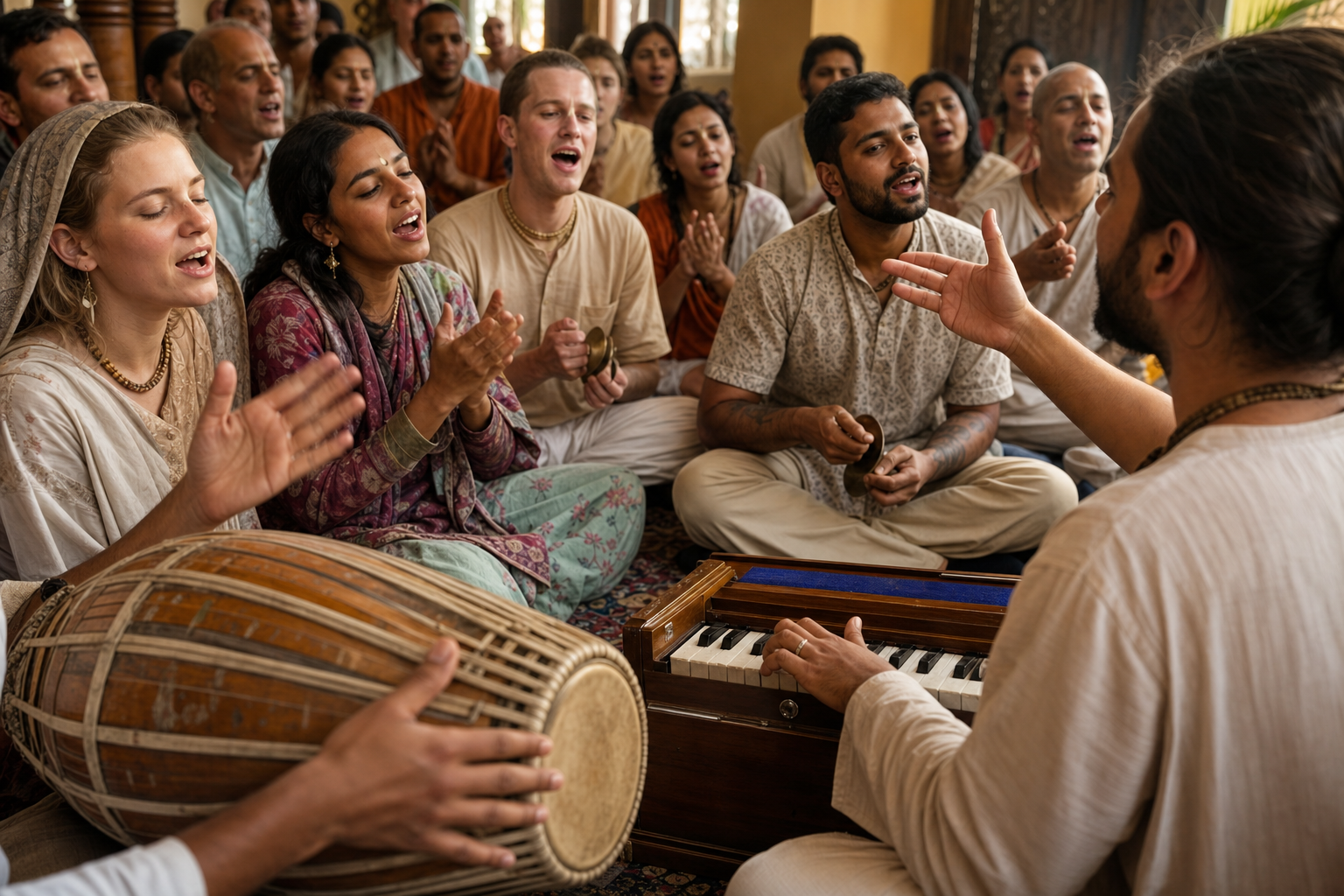
Kirtan in the Gaudiya Vaishnava tradition is sung devotion. The leader offers a phrase and the congregation answers, creating a shared act of hearing, remembering, and invoking the sacred names. The melody carries the mantra, but the melody is not the final object of attention.
Hare Krishna Hare Krishna Krishna Krishna Hare Hare
Hare Rama Hare Rama Rama Rama Hare Hare
This sustained repetition is not there because the practice has run out of ideas. Each return gives a distracted mind another point of entry. A response that initially feels unfamiliar can gradually become natural; a phrase you first hear as sound can become an intentional devotional address.
You do not need to imitate the visible emotion of experienced participants. You also do not need to know every theological detail before joining. Your immediate task is simpler: hear the offered line accurately, respond without rushing, and allow the mantra to receive more attention than your evaluation of the music.
Listen in a way that preserves the call-and-response
The easiest mistake is to treat a recorded kirtan as devotional background music. It may still create a pleasant atmosphere, but divided attention hides the form of the practice. Use the following sequence when you want to engage more fully.
- Give the session a boundary. Close conversations, silence avoidable alerts, and decide that the kirtan is the activity rather than the accompaniment to another task. No special posture is required, but choose one in which you can breathe and listen comfortably.
- Begin by receiving the line. Listen to the leader before trying to reproduce the melody. Let the words, pace, and melodic contour become clear. Joining a little later is better than anticipating the phrase and losing the response.
- Answer rather than compete. The congregation’s reply belongs after the leader’s offering. Keep your voice at a comfortable level and allow the collective rhythm to carry you. Vocal force is not the same thing as devotional concentration.
- Return when your mind wanders. Do not turn distraction into a verdict on your ability to chant. Notice it, hear the next phrase, and re-enter with the response. The repeated structure is precisely what makes repeated return possible.
- Respect both intensification and rest. The session moves through steady crescendos and gentler pauses. Do not assume that the loudest passage is automatically the deepest one. A quieter phrase may reveal whether you are still listening or merely riding the momentum.
- Use the 4K image to study participation. Notice how the leader gives space for an answer, how the congregation settles into a shared pulse, and how transitions are communicated. The visual detail is most useful when it teaches you how a community listens together.
- Let the ending remain an ending. Before opening another tab or starting another video, notice one concrete after-effect. Is your breathing less hurried? Is mental chatter still dominant? Do you feel more patient, more connected, or simply more aware of your distraction? Honest observation is more useful than declaring that you had the experience you were supposed to have.
If you cannot sing aloud, you can still follow the responses mentally or listen with full attention. Participation has degrees. What matters is that you stop treating the congregation as a spectacle and begin hearing the pattern from within it.
Measure the kirtan by what happens after the crescendo
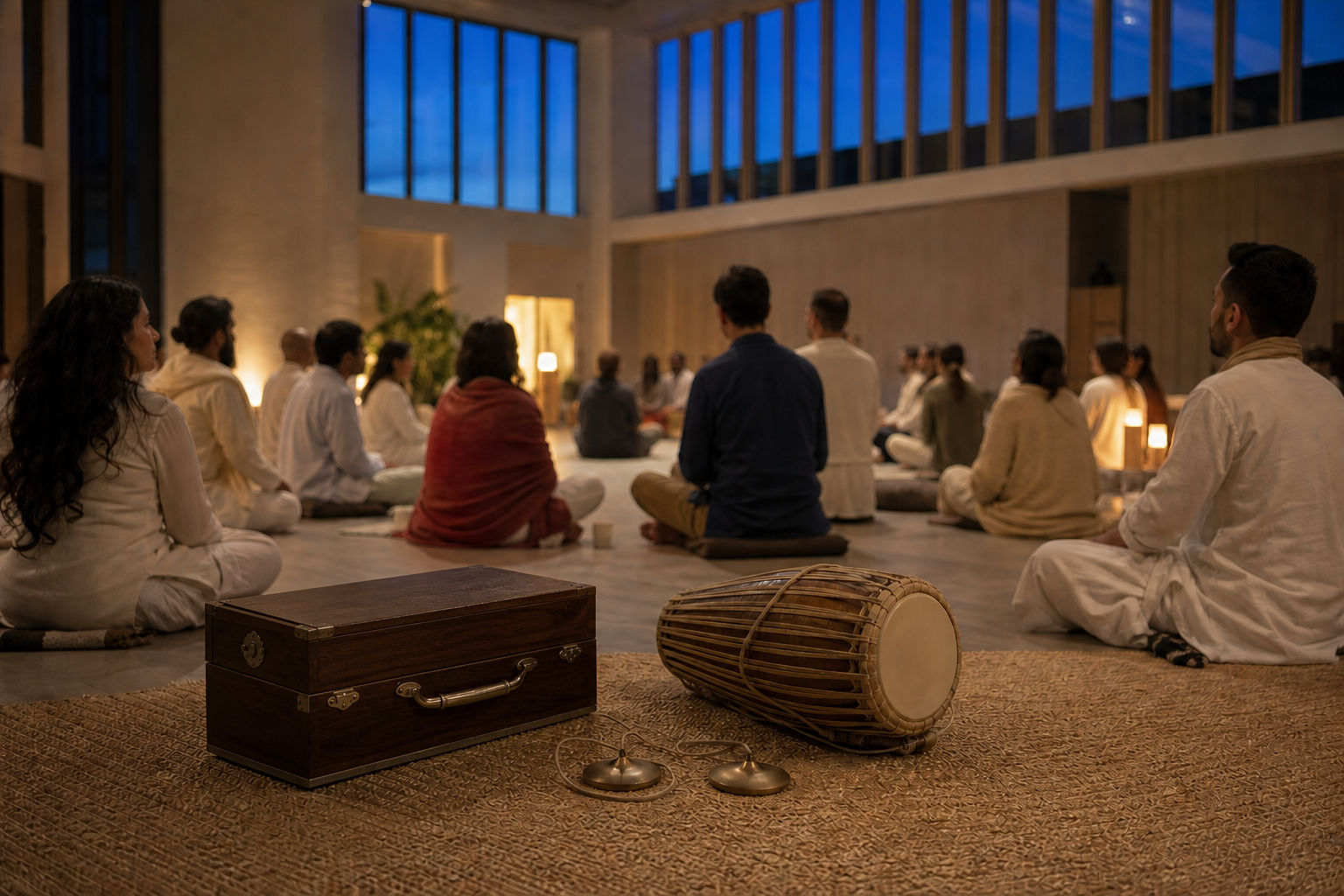
A rising melody, coordinated voices, and collective rhythm can be deeply moving. That emotional movement is real, but it is not a complete measure of spiritual depth. Neither tears nor calm prove advancement, and their absence does not prove failure.
In this setting, rasa points beyond entertainment toward devotional relationship and taste. You therefore need a better test than whether the session produced an intense feeling. Look at three practical signs:
- Attention: When your mind wandered, were you able to return to the mantra instead of following every distraction?
- Relationship: Did call-and-response make you listen more carefully to another voice and contribute without trying to dominate the sound?
- Conduct: Does the collected state show itself afterward as a little more patience, compassion, or steadiness in an ordinary interaction?
These are not scores, and one session cannot settle them. They are safeguards against confusing stimulation with transformation. Rhythm, repeated words, coordinated breathing, and attentive response can make mental clutter less commanding for the duration of the chant. Bhakti asks what you do with that clearer attention once the music stops.
If you feel uplifted, receive that without grasping at it. If you remain restless, use the next response as your place to begin again. Chasing a previous emotional high usually pulls attention away from the sacred name that gave the kirtan its center.
Honor shared dharmic resonance without flattening traditions
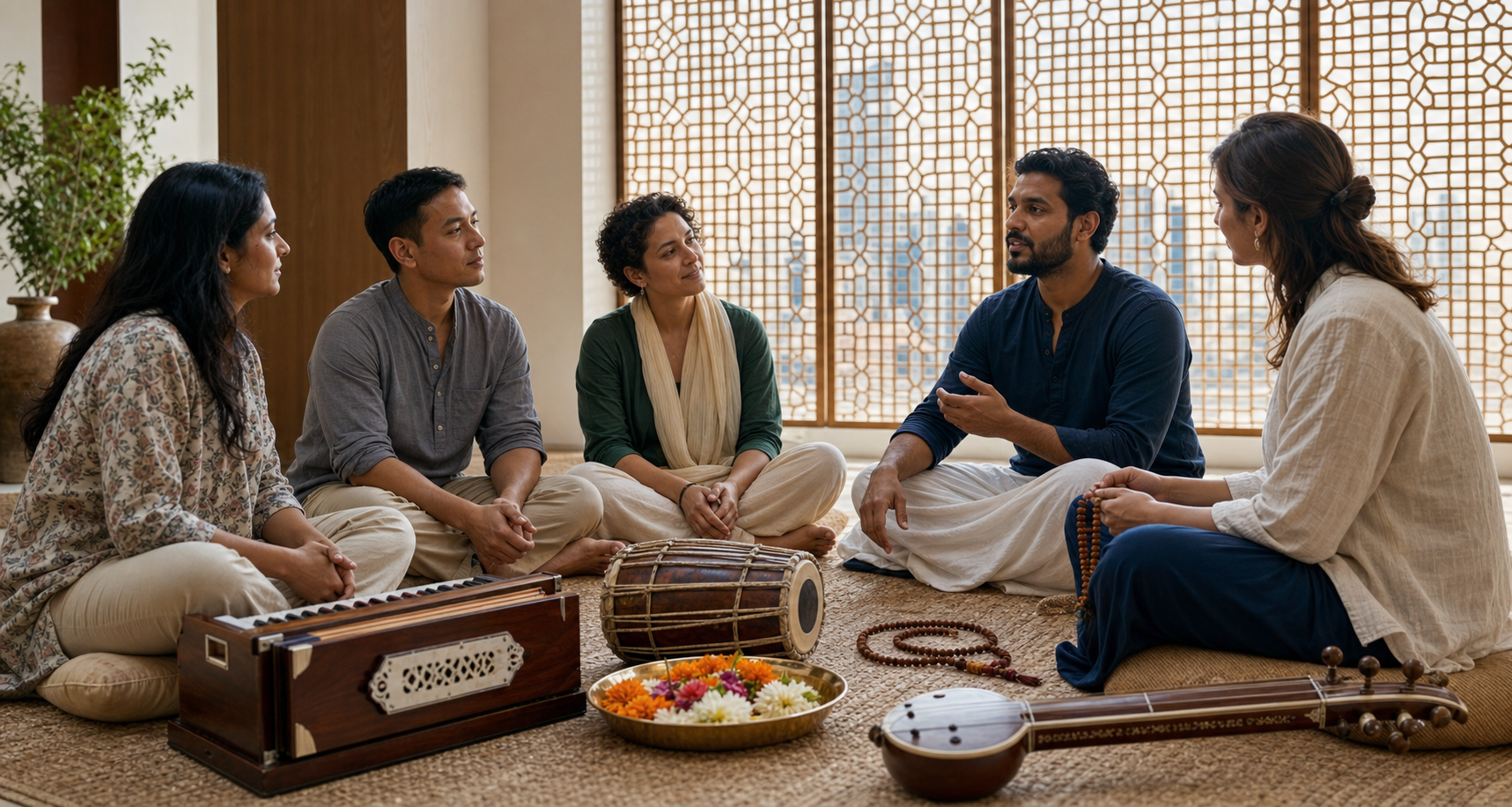
Kirtan Rasa in Dubai also gives you a way to think about dharmic continuity beyond Bharat. Sacred recitation does not become a museum object when it crosses an ocean or enters a modern city. A diaspora gathering can make inherited practice present through living voices, shared discipline, and participation across generations.
There are recognizable resonances across Hindu, Buddhist, Jain, and Sikh communities: reverence for sacred utterance, the use of repeated recitation or song, disciplined hearing, and the formation of community through sound. That resemblance should encourage respect, not careless equivalence. Gaudiya Vaishnava nama-kirtan has its own theology and lineage. Sikh kirtan, Jain stavan, and Buddhist forms of collective recitation retain their own teachings, languages, authorities, and purposes.
When you encounter another tradition’s sacred music, ask three questions before claiming that it is the same practice under a different name:
- What or whom is being invoked, praised, remembered, or contemplated?
- What role does the tradition give to sound, text, melody, silence, and congregational response?
- What change in understanding, devotion, or conduct is the practice intended to cultivate?
Those questions let you recognize a dharmic family resemblance while preserving real distinctions. They also improve the way you introduce this recording to someone unfamiliar with it. Describe it precisely: this is a Gaudiya Vaishnava Hare Krishna kirtan, led by HH Sacinandana Swami during Kirtan Rasa 2025 at the Dubai Kirtan Mela. Precision is a form of respect.
Key takeaways
- Approach the recording as participatory devotion, not merely as a musical performance.
- Listen to the leader’s complete phrase before answering; call-and-response depends on receiving as much as singing.
- Treat distraction as a cue to return at the next response, not as evidence that kirtan is beyond you.
- Use the 4K presentation to notice congregational timing, transitions, and attentive listening rather than turning participants into a spectacle.
- Judge the experience less by emotional intensity and more by the quality of attention and conduct that follows it.
- Recognize shared dharmic patterns while naming the distinct lineage, theology, and purpose of each tradition’s practice.
Your next step can be modest. Play the session from the beginning, put the phone aside, listen through the first responses, and join when the words and pace become clear. When it ends, carry one deliberate act of patience or attentive listening into the next part of your day.
If the practice draws you back, return for the mantra rather than for a particular crescendo. That shift – from chasing an experience to learning how to hear and respond – is where a digital recording can become a genuine doorway into bhakti.
References
