
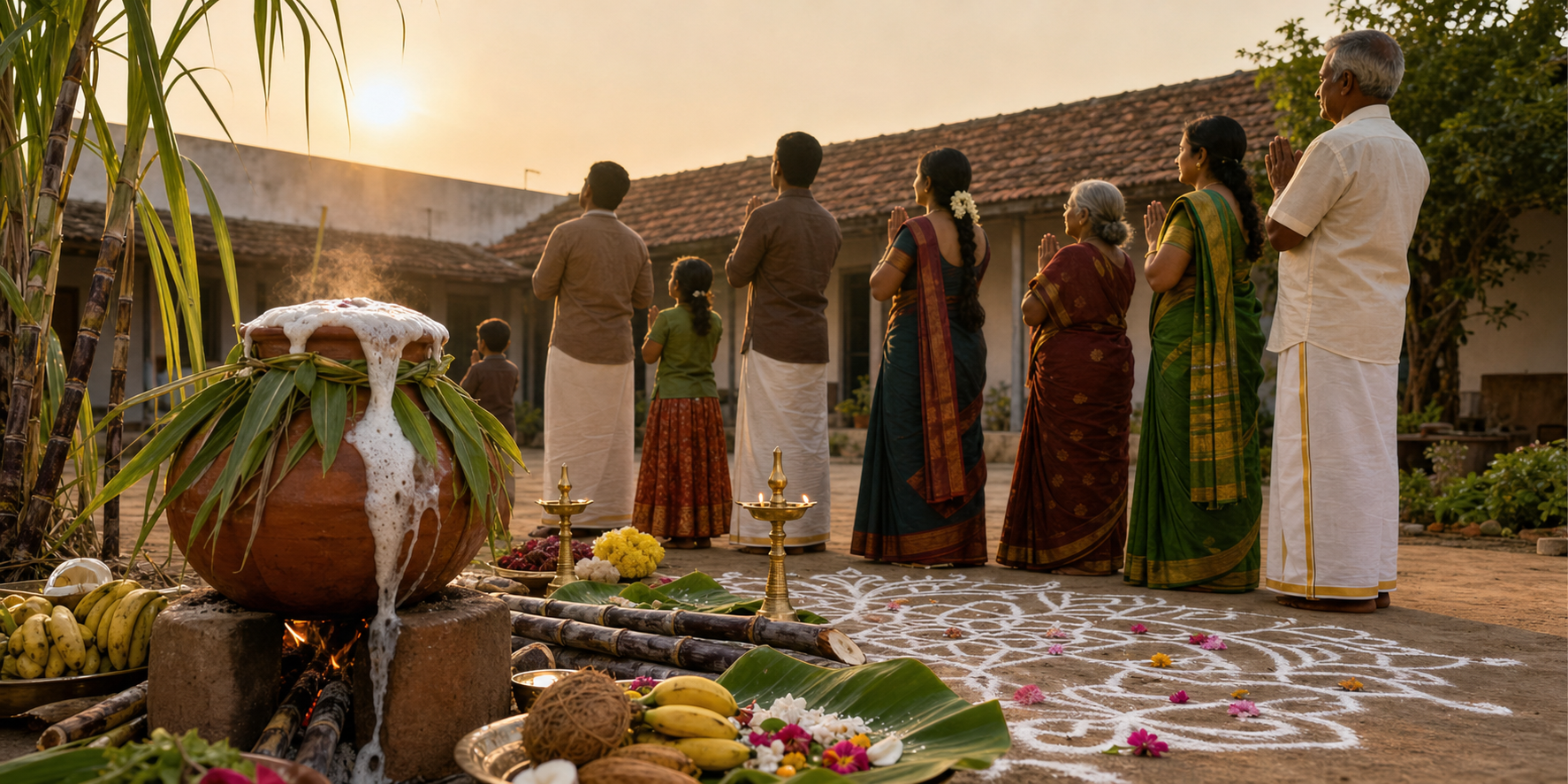
If you are arranging Pongal 2026, the difficult question is not what to cook. It is how to reconcile the 3:07 PM Surya Sankramana on 14 January with the household custom of performing Thai Pongal puja in the forenoon. Those two timings cannot describe the same morning ceremony in 2026, so do not force them into a single supposedly exact muhurtham.
The practical answer is to decide which ritual moment your family intends to time. You may prepare in the morning and reserve the central Surya offering for after Sankramana, or retain your family’s established forenoon observance and acknowledge the solar transition later. In either case, confirm the usable interval in a Tamil Panchang calculated for the place where you will actually celebrate.
What is fixed for Pongal 2026, and what must be local
The central astronomical reference for Tamil Nadu is the Sun’s entry into Makara, or Capricorn. In 2026, that transition is recorded as 3:07 PM on 14 January. This is the Surya Sankramana around which the principal Thai Pongal offering can be arranged.
That one reference time does not settle every household question. Sunrise, Rahu Kalam, Punya Kala and the practical puja window must be read for your location. Even within India, the almanac should be set to the city of observance. If you live outside India, do not copy 3:07 PM onto your local clock and assume that it remains correct. Use a reliable local Panchang that expresses the solar transition and associated intervals for your place of residence.
This distinction prevents the most common planning error: treating a solar event and an auspicious interval as though they were interchangeable. Sankramana is the transition itself. Punya Kala is an observance interval associated with it. Your household puja time is the usable period selected after considering those factors, local sunrise, Rahu Kalam and family tradition.
Key takeaways for your calendar
- Use 3:07 PM on 14 January 2026 as the stated Surya Sankramana reference for Tamil Nadu.
- Do not describe a forenoon ceremony as occurring after Sankramana when the transition itself is at 3:07 PM.
- If your family wants the central offering after the transition, complete the cleaning, kolam and most cooking preparations earlier, then make the Surya naivedya in the locally approved post-Sankramana interval.
- If your established custom requires a forenoon home puja, choose the window after sunrise, avoid the locally calculated Rahu Kalam and follow your family achara or priest’s direction.
- Expect the four-day sequence around 13-16 January, but confirm the dates and intervals in the Panchang for the city where you will observe them.
- Keep the offering sattvic and recognizably connected to the harvest: fresh rice, milk, sugarcane, turmeric and seasonal produce.
Resolve the morning-versus-afternoon question before the festival
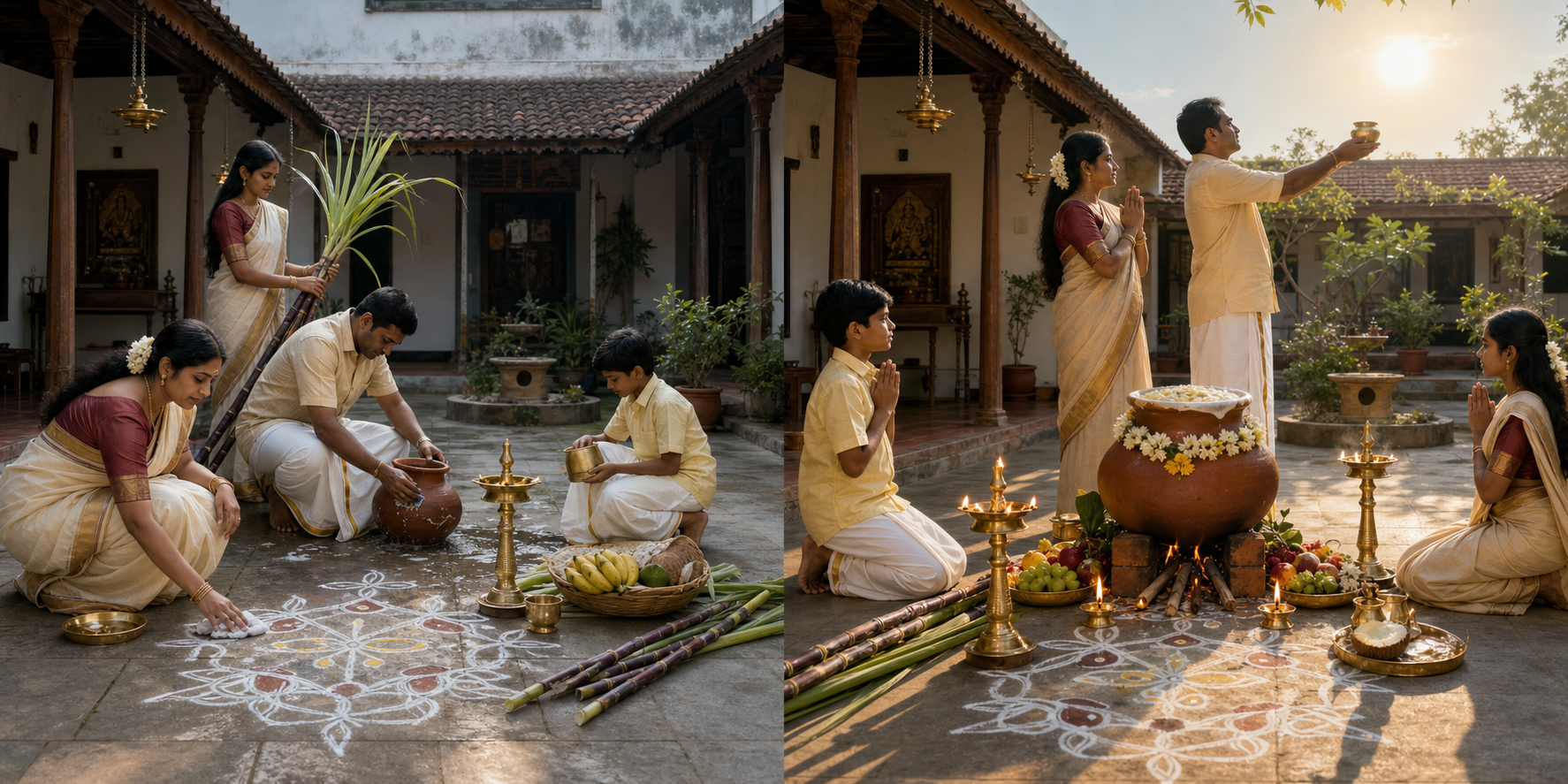
Families often inherit more than one timing rule. An elder may remember that the Pongal pot should rise in the morning, while a calendar entry may place special emphasis on the Makara transition. In 2026, the afternoon Sankramana makes that difference visible. The disagreement is easier to handle when you separate preparation, cooking and naivedya instead of treating them as one indivisible act.
If Sankramana governs the central offering
Draw the kolam, prepare the cooking area, arrange the produce and begin the household observance in the morning. Plan the principal Surya naivedya and arati after 3:07 PM, within the Punya Kala shown for your location. Do not invent an exact ending time from the transition alone; the available timing establishes the Sankramana reference but not a universal city-by-city Punya Kala.
If your family observes Thai Pongal in the forenoon
Select a local window after sunrise, while avoiding Rahu Kalam according to the Panchang you follow. Complete the customary pot, offering and family worship in that period. If your family wishes to acknowledge the later transition as well, a simple Surya arati or renewed offering after Sankramana provides a practical two-part observance. Present that arrangement honestly as a morning household puja followed by a post-Sankramana acknowledgement, not as one continuous muhurtham.
If a family priest, temple or hereditary custom gives a different sequence, follow that lineage-specific direction. A generic timing cannot account for every sampradaya or regional practice. The important planning step is to settle the choice before 14 January so the household is not debating the calendar while the pot is already on the stove.
A workable plan for all four days
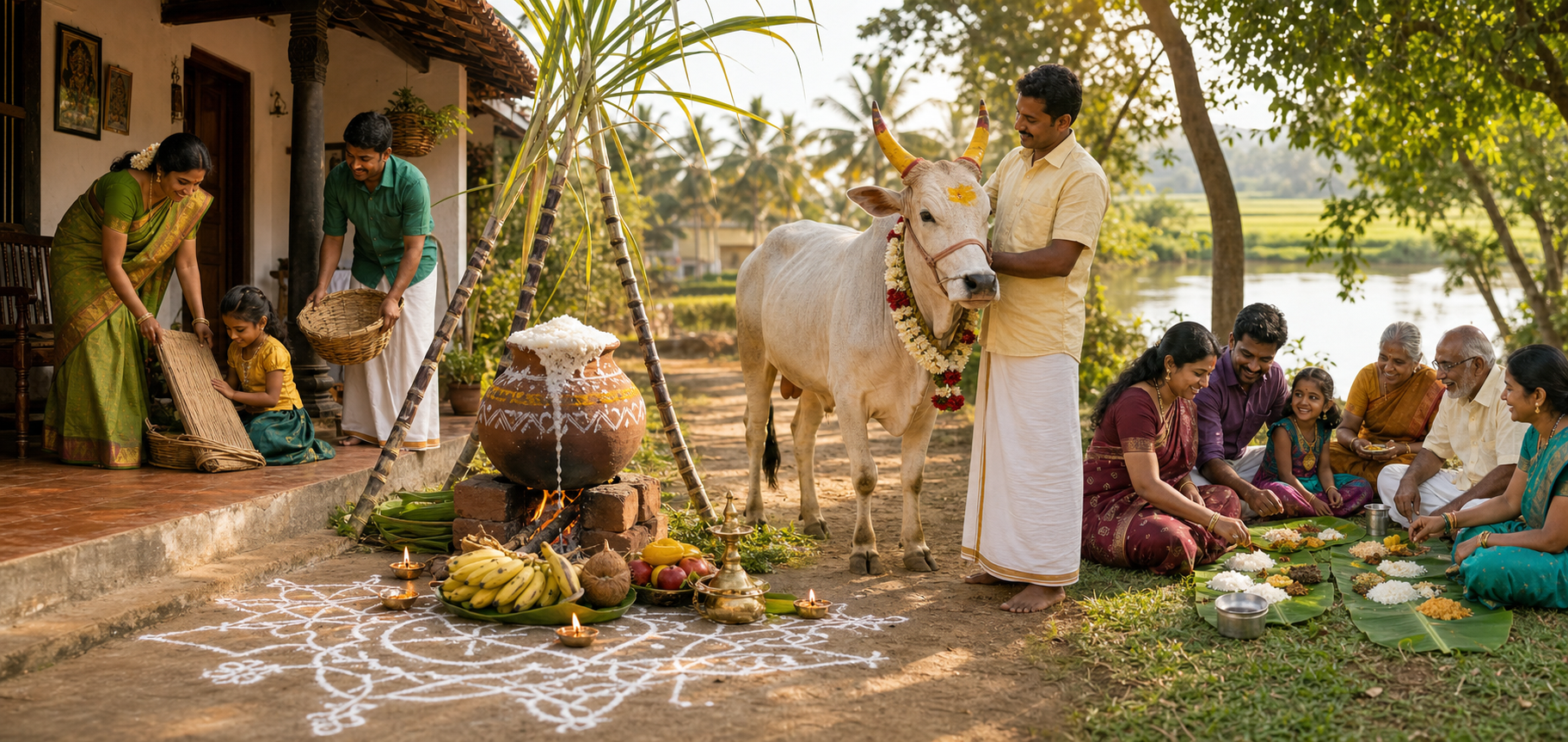
The four days form one movement of gratitude. Bhogi prepares the home, Thai Pongal turns toward Surya and the harvest, Mattu Pongal recognizes cattle, and Kaanum Pongal carries the celebration into kinship and community. Use the dates below as a 2026 planning sequence, then verify them locally before printing invitations or fixing travel.
| Observance | Expected 2026 planning date | What to arrange |
|---|---|---|
| Bhogi | Around 13 January | Clean and reset the home, prepare the consecrated cooking space, check the pot and gather the offering ingredients. |
| Thai Pongal | Around 14 January | Draw the kolam, prepare pongal, welcome the auspicious overflow and offer naivedya and arati to Surya in the timing your family has selected. |
| Mattu Pongal | Around 15 January | Honor cattle through care, garlands and gentle observance, recognizing their place in agrarian life. |
| Kaanum Pongal | Around 16 January | Make time for relatives, community visits or an open-air gathering that strengthens social bonds. |
Do not let uncertainty about a narrow muhurtham postpone the practical work. By Bhogi, the cooking vessel should be ready, the location decided and the local Panchang consulted. If family members will join remotely, tell them whether they are joining the morning household observance or the later Surya offering. Naming the event precisely is more useful than distributing a bare time without context.
Set up a simple Thai Pongal home puja
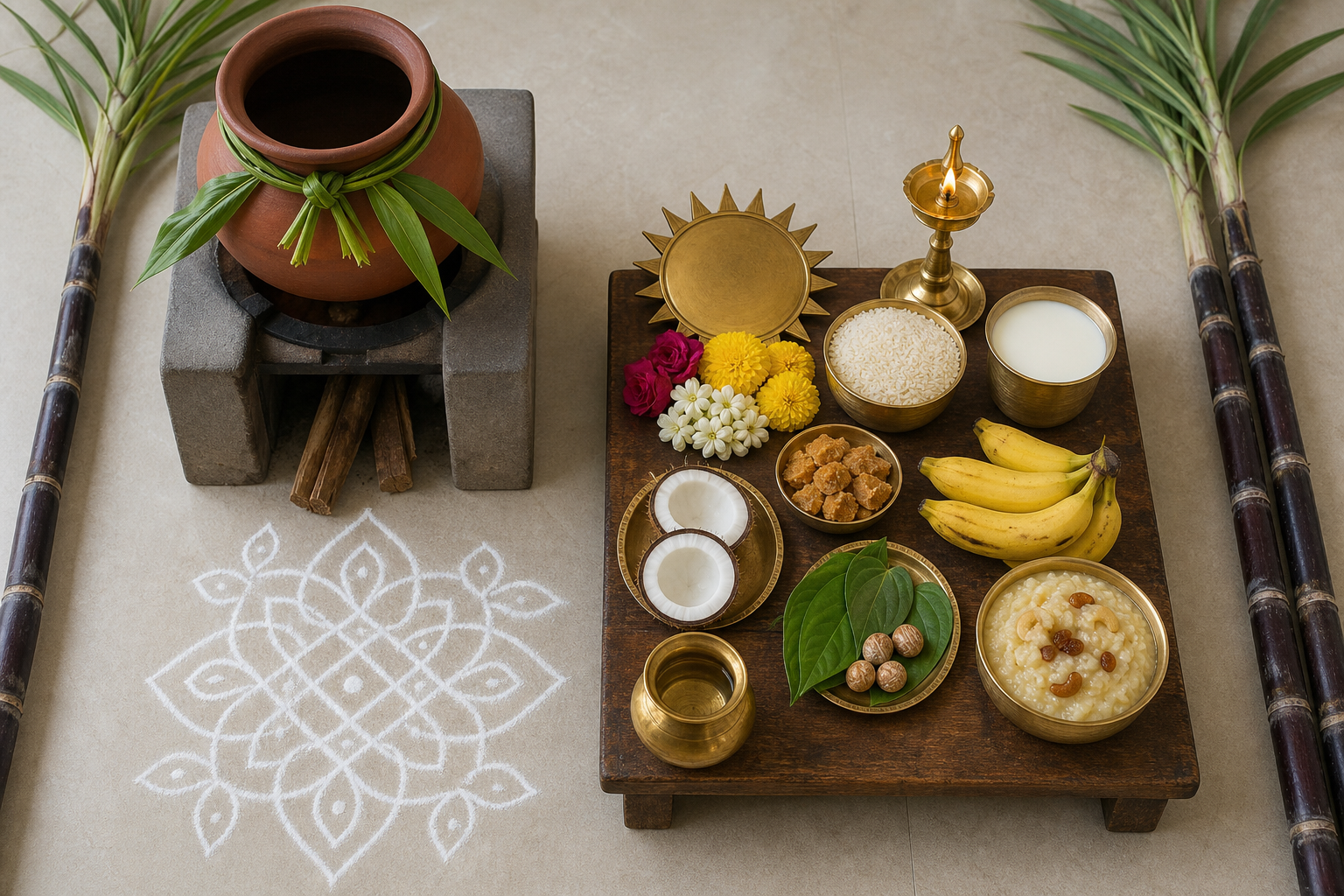
A good home observance does not need unnecessary complexity. The visible elements should express cleanliness, abundance and gratitude. Prepare only what your household can offer attentively and share respectfully.
- Check a trusted Tamil Panchang for your city. Write down the local Sankramana, Punya Kala, sunrise and Rahu Kalam information rather than relying on memory.
- Decide whether your central naivedya will follow the post-Sankramana timing or your family’s forenoon custom. Tell everyone involved which plan you are using.
- Clean the cooking and worship area. Face east where the home permits, but do not make an impractical room layout the centre of the ritual.
- Draw the threshold kolam and arrange the pot, fresh rice, milk, sugarcane, turmeric and seasonal produce before the chosen period begins.
- Use a clay or metal pot for the pongal. Leave enough space around it for the milk to rise safely.
- Welcome the overflow with the customary call of “Pongalo Pongal.” The rising pot is a sign of abundance, but it should be managed deliberately: use a stable vessel, keep children away from the hot surface and allow safe clearance around the flame or heating element.
- Prepare the sweet or salty pongal your family customarily offers. Simplicity is preferable to adding ingredients merely for display.
- Place the pongal with sugarcane, turmeric and seasonal produce as naivedya to Surya. Complete the focused arati according to your household tradition.
- Share the prasada and meal with the family. The offering reaches its social meaning when abundance is received with gratitude rather than treated only as a timed performance.
The pot does not have to overflow at the exact second of Sankramana unless your own tradition explicitly requires that. The more defensible timing focus is the central offering to Surya. Trying to make the milk rise at one predicted minute can turn the kitchen into a race and distract from the act of worship.
Keep the meaning of each day visible
If children or guests are joining, give them one clear meaning for each day. Bhogi clears space for a renewed cycle. Thai Pongal gives thanks to Surya and for the food that sustains life. Mattu Pongal recognizes the cattle whose work belongs to the agricultural order. Kaanum Pongal extends gratitude into family and community. This is more memorable than presenting the festival as four unrelated sets of customs.
The solar transition also places Thai Pongal within a wider Dharmic landscape. Makara Sankranti is observed in different forms across Bharat. Sikh communities mark Maghi, while generosity, prayer and reflection are important in Buddhist and Jain life during the Magha period. These observances should not be collapsed into one uniform festival. Their connection lies in a shared moral neighbourhood: gratitude, restraint, generosity, community and attention to the larger order that sustains life.
That distinction matters when you organize a school explanation, community programme or inter-Dharmic gathering. Name each tradition accurately, then point to the values that can be recognized together. Unity becomes stronger when it does not require anyone to surrender the particular form of their practice.
Avoid the timing mistakes that cause needless confusion
- Do not publish 3:07 PM as a worldwide local-clock time. It is the stated Tamil Nadu reference; a diaspora household needs a location-specific Panchang.
- Do not advertise an exact Punya Kala unless your chosen local almanac supplies its beginning and end. Sankramana alone does not provide the whole interval.
- Do not claim that a morning puja occurred after Sankramana in 2026. If you perform both, identify them as two parts of the observance.
- Do not confuse the festival date with the muhurtham. A date tells you the civil day; the muhurtham tells you the selected ritual window within the locally interpreted calendar.
- Do not let clock precision overwhelm the offering. Cleanliness, sattvic food, attention to Surya and gratitude for the harvest remain the substance of Thai Pongal.
- Do not reduce Mattu Pongal to decoration. Care for cattle is the ethical centre of that day; garlands and ritual gestures should express that care.
- Do not treat the 13-16 January sequence as a substitute for local verification. Confirm it before making travel, temple or community arrangements.
Before Bhogi arrives, put three things in writing: the Panchang location, the household’s chosen puja plan and the person responsible for preparing each offering. That small act will remove most last-minute uncertainty and leave your family free to greet the rising pot with attention, gratitude and the words that belong to the moment: “Pongalo Pongal.”
References
