
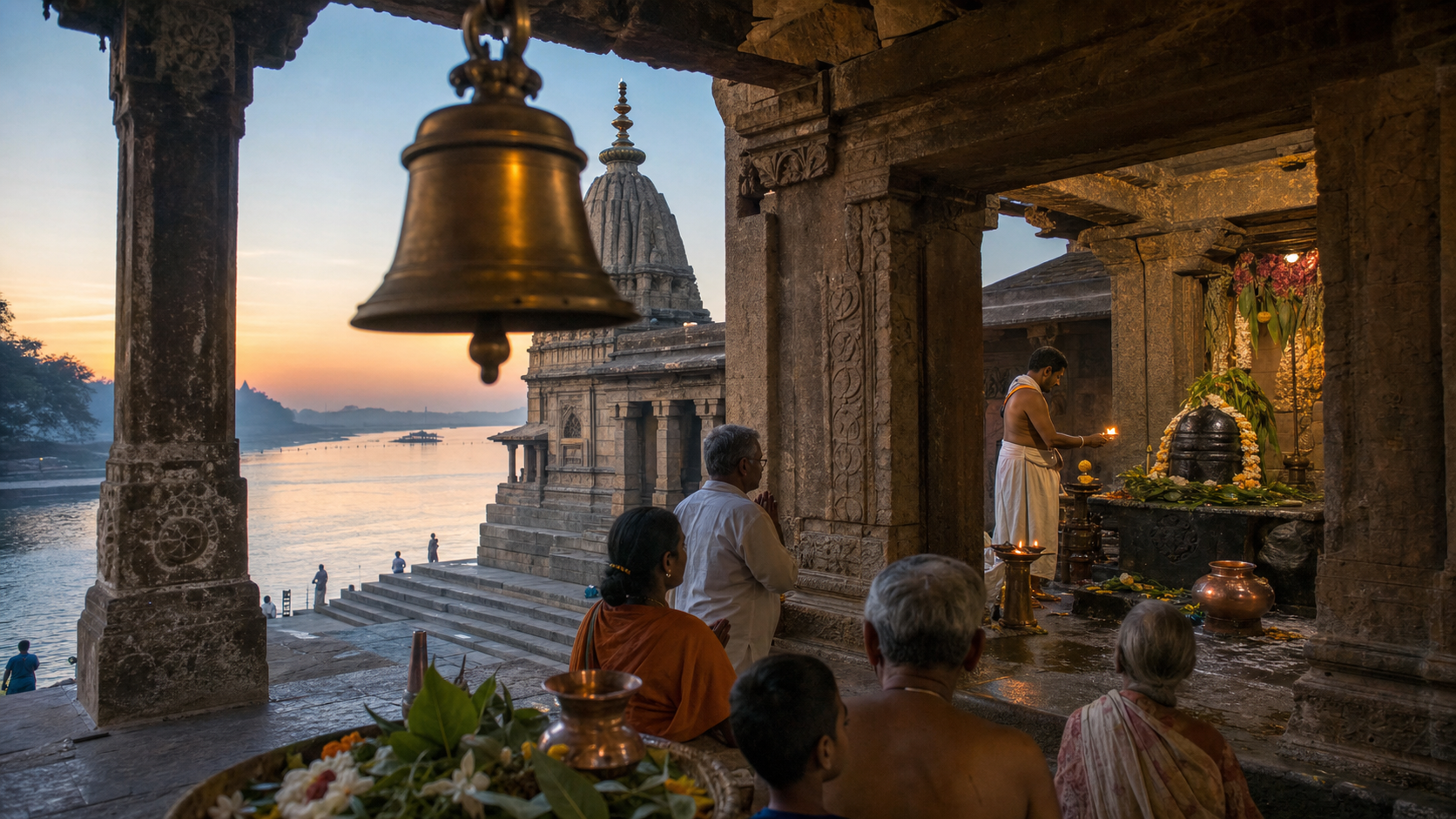
You enter a temple and encounter a Shivling, a kalasha, a riverbank, a flame, a bell or a trace of sacred ash. You sense that each matters, but a quick label such as Shiva, purity or protection doesn’t tell you how the symbol actually lives in that place.
You can read the space more responsibly by following five connections: form, location, ritual, community memory and conduct. This method lets you learn from sacred symbolism without reducing worship to a codebook, treating oral tradition as proven chronology or turning another community’s sanctuary into spiritual scenery.
Start with what makes the temple a living institution
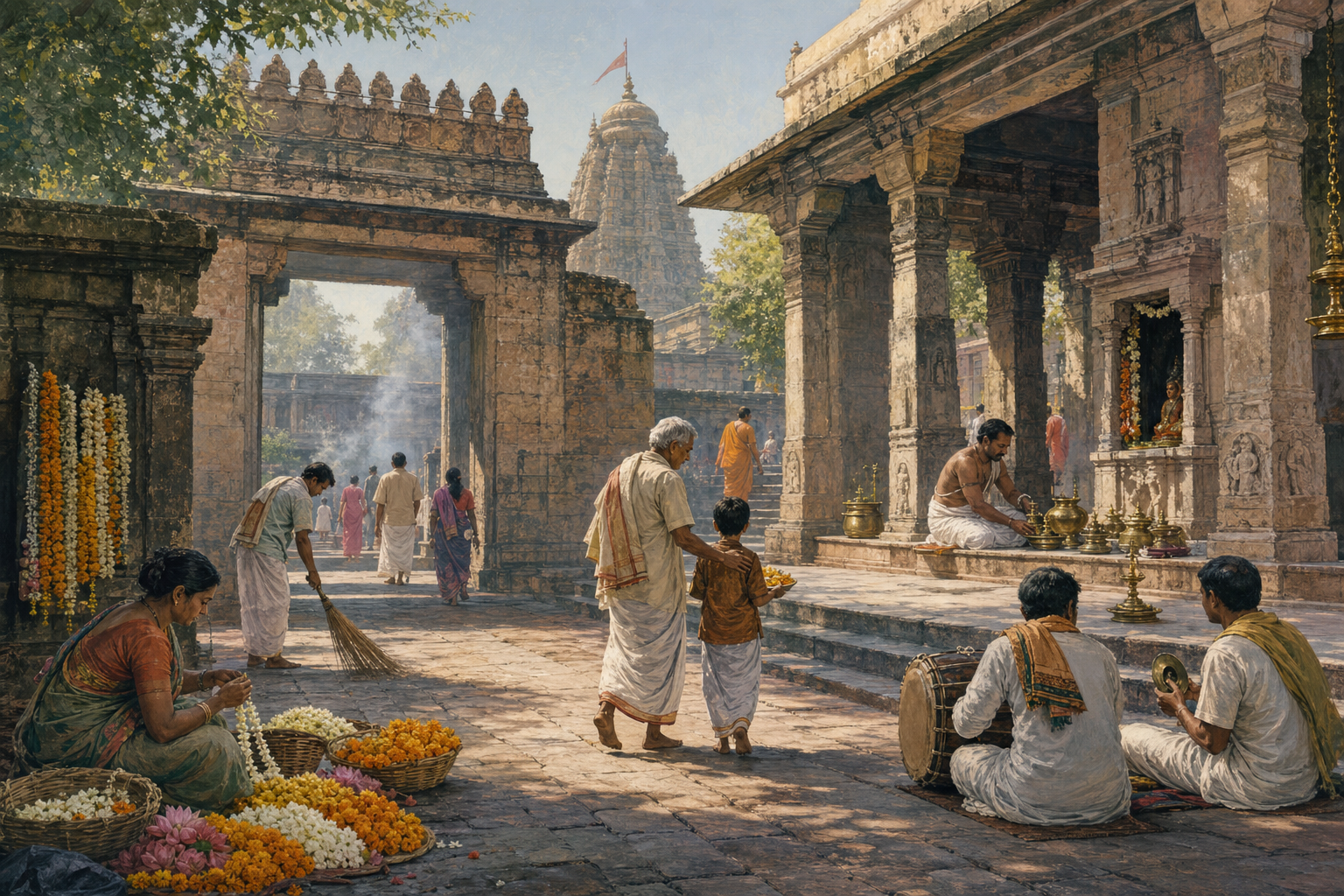
A monument can preserve architecture after its original ritual world has receded. A living temple does something more: people return, perform worship, maintain the sanctuary, remember its stories and adapt their daily lives to its calendar. Its meaning is therefore carried not only by stone or iconography, but also by aarti, mantra, offerings, vows, festivals and the people responsible for them.
This distinction matters when a temple’s remembered past exceeds what surviving records can establish. At Agra’s Kailash Mahadev Temple, local tradition places the shrine at more than ten thousand years old and attributes the consecration of its two Shivlings to Lord Parashurama. Chronological debate remains. You don’t have to choose between contempt and credulity: receive the account as sacred memory unless independent evidence supports a historical conclusion.
Sacred memory still tells you something important. The Parashurama association locates the shrine within a moral world of tapas, restraint, duty and transformation. That meaning remains available even when the date cannot be settled. Conversely, repeating a devotional chronology as archaeological fact weakens rather than protects the tradition, because it asks a form of community memory to prove something it was not designed to prove.
Agra Kalibari presents the same interpretive challenge in a different form. Its prominence is remembered across more than two centuries of local narrative, while exhaustive archival documentation is absent. Daily worship and neighborhood stewardship are not substitutes for missing records, but they are real evidence of another kind: evidence that the shrine has remained socially and spiritually consequential.
When you visit, begin with observation rather than explanation:
- Identify the kind of place. Is it an active sanctum, a river shrine, a festival pavilion, a memorial area or a cremation ground? The same object can carry different weight in each setting.
- Notice the ordinary rhythm. Watch what happens before, during and after worship: who prepares the space, what devotees repeat, and where silence is maintained.
- Ask what changes with the calendar. Kailash Mahadev draws larger gatherings for Pradosh and Mahashivaratri, while Agra Kalibari has particular intensity around Amavasya, Navaratri and Kali Puja. Everyday practice and festival practice reveal different layers of the same institution.
- Distinguish inherited memory from verifiable chronology. Use phrases such as local tradition holds when that is what the evidence supports.
- Look for custodianship. Priests, caretakers, devotees and nearby families often preserve different parts of the temple’s life. A respectful question asked outside an active ritual can teach you more than an isolated visual guess.
Read a constellation, not an isolated object
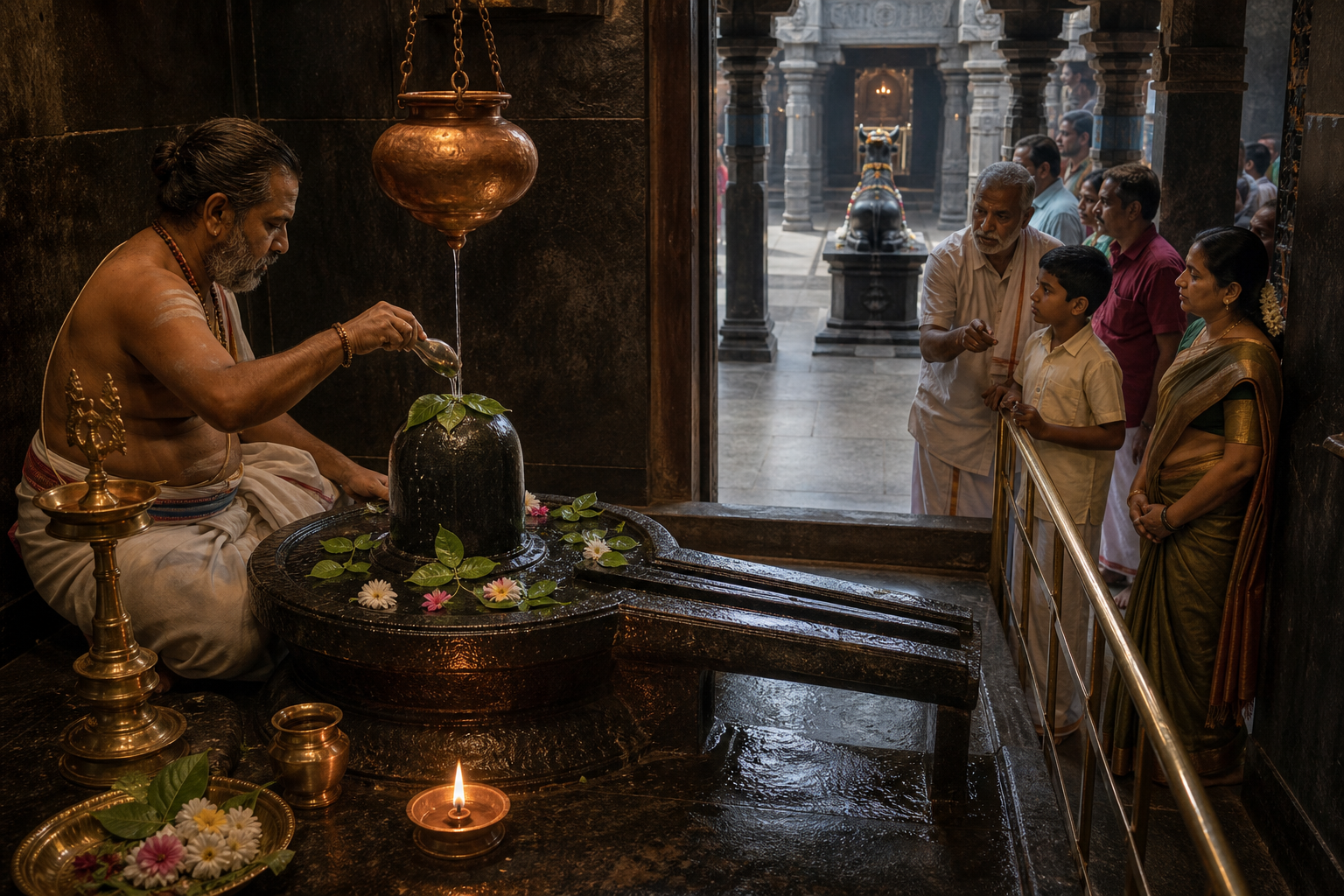
A sacred symbol rarely has one detachable meaning. Its form matters, but so do its placement, accompanying story, ritual use and relation to other forms. Before asking, What does this object mean?, ask, What relationships make it meaningful here?
Form and pairing
The Shivling is an aniconic form: it does not portray Shiva as a human figure. That absence of a human likeness directs attention beyond personality and appearance, toward the formless Absolute. Yet the Shivling is not floating in abstraction. It is installed, approached, worshipped and cared for within a community. Transcendence becomes part of embodied practice.
The two Shivlings at Kailash Mahadev can invite reflection on complementary dimensions of Shiva: stillness and movement, detachment and guardianship, dissolution and renewal. The careful word is can. A pairing does not automatically encode one mandatory interpretation, and it need not imply two competing realities. Its value may lie in teaching you to hold apparent opposites within a larger unity.
When you encounter a pair, cluster or repeated form, resist assigning a meaning immediately. First check whether the forms are approached together, whether they receive the same ritual attention, and whether a local narrative connects them. Repetition may signal complementarity, sequence, guardianship, lineage or simply the history of the site’s development.
Location and contrast
A river beside a temple is not merely a scenic background. At Kailash Mahadev, the Yamuna places worship within a landscape associated with purification, continuity and cyclical existence. The river’s movement also gives the stationary Shivling a powerful counterpart: change passes beside stillness. You can notice that relationship without pretending it has only one authorized explanation.
Tarapith offers a sharper contrast. The temple and adjacent Maha Smasan form a sacred landscape in which maternal protection stands beside the uncompromising fact of death. Tara is represented in a nurturing form, nursing the infant Shiva, while the cremation ground confronts impermanence, fear and attachment. Tenderness does not conceal mortality, and mortality does not cancel compassion.
That relationship is more instructive than either location considered alone. If you visit only to seek reassurance, you miss the discipline of impermanence. If you visit only for the cremation ground’s intensity, you miss Tara’s maternal grace. The complete teaching lies in moving between refuge and truthfulness.
Ritual use and community memory
At Agra Kalibari, a sanctified kalasha is associated with vows, gratitude and answered prayers. The responsible approach to this miracle-pot tradition is precise: its miraculous associations belong to faith and are not empirical verification. Its symbolic role – abundance, protection, hope and grace – remains intelligible without manufacturing proof or mocking devotion.
If a devotee calls an object miraculous, listen for the practice surrounding the claim. Was a vow made? Is gratitude expressed through an offering or service? Does the object gather family memory across generations? Those questions reveal how the symbol orders conduct. Demanding laboratory proof misses the nature of the claim; presenting the lore as demonstrated fact goes too far in the other direction.
Sound, scent and bodily movement also belong to the symbolic field. Bells mark ritual attention; chanting gives a group one cadence; incense changes the sensory character of the space; removing footwear changes how you cross the threshold. At Kailash Mahadev, the river breeze, conch calls, temple bells and the movement between stone and water help create a contemplative setting. These are not decorations around the real worship. They are among the means by which attention is gathered.
Let the symbol tell you how to behave
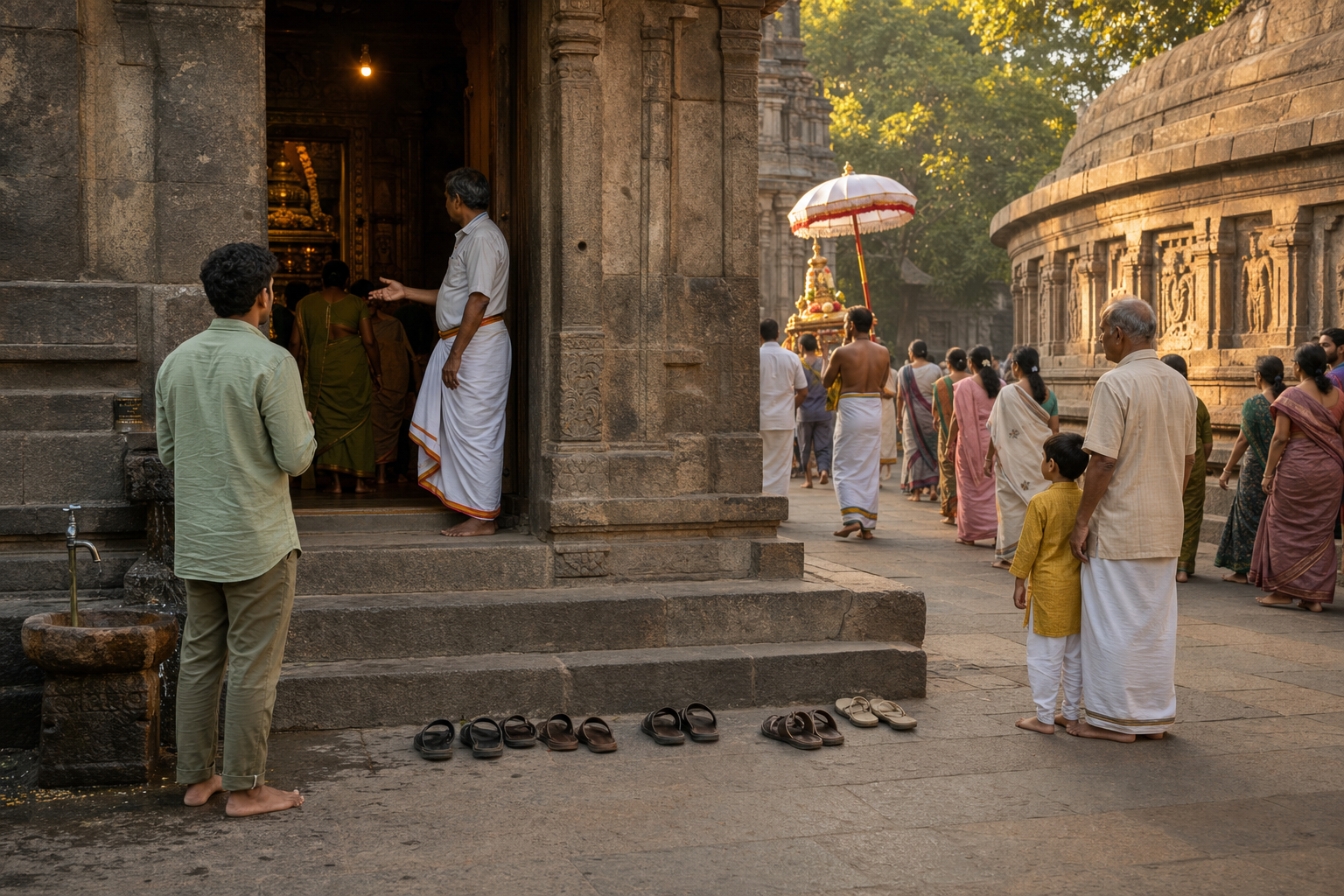
The surest test of your interpretation is conduct. If you say ash represents impermanence but handle a cremation ground as a photo opportunity, you have understood the concept and ignored the teaching. Sacred symbolism asks for a response from the observer.
Within Tarapith’s cremation-ground symbolism, ash points toward the end of clinging, the skull toward wisdom after pretension falls away, and flame toward the heat of transformation. Nocturnal animal calls place human anxiety within nature’s impartial rhythms. These signs are used within disciplined Tantric practice; they are not an invitation to collect souvenirs, stage dramatic images or imitate advanced rites.
Historically, practice at the Maha Smasan has included mantra, vigil and meditation near the funeral fires. Such disciplines require guidance, maturity, ethical restraint and responsibility toward the living and the deceased. Watching a ritual does not authorize you to reproduce it. If you don’t have a qualified guru and the permission required by the lineage and place, observation and silence are the appropriate limits.
A practical visitor protocol follows directly from that principle:
- Pause before entering. Check footwear rules, clothing expectations, signs and the behavior of regular devotees. Modest dress and a quiet manner are safe starting points.
- Follow local ritual direction. Don’t assume an offering is acceptable because you have seen it elsewhere. Ask a caretaker where to stand, what may be offered and whether participation is appropriate.
- Separate worship from documentation. Put the camera away when a rite is underway unless permission is explicit. At a cremation ground, photography and intrusive observation are inappropriate because families may be performing last rites.
- Choose the right time for the kind of visit. Early morning and twilight can provide quieter darshan at Kailash Mahadev. A visit to Tarapith’s cremation ground is better made in daylight with local guidance, both for propriety and safety.
- Don’t imitate restricted practice. Mantra, vigil and cremation-ground sadhana aren’t visitor activities merely because they are visible or described publicly.
- Leave less physical disturbance. Keep offerings simple, use environmentally responsible materials where local practice permits, and don’t leave packaging or personal objects behind.
- Allow silence to finish the encounter. Before reaching for an explanation, spend a few moments noticing which form, sound or action changed the quality of your attention.
This protocol is not etiquette added after spiritual understanding. It is spiritual understanding made visible. Restraint protects worshippers, mourners, the physical site and your own capacity to learn.
Recognize shared dharmic insights without flattening traditions
Living temple traditions can disclose values that resonate across the dharmic family: silence, compassion, self-discipline, nonattachment, service and courage before impermanence. Resonance, however, is not identity. Hindu, Buddhist, Jain and Sikh traditions don’t become interchangeable because they sometimes cultivate comparable virtues.
The cremation-ground disciplines of Hindu Tantra can be placed in conversation with Vajrayana charnel-ground contemplation, Jain anitya and ashubha bhavana, and Sikh acceptance of hukam. Each can train a person to face change with greater clarity, but their practices retain distinct religious settings and disciplines. A shared concern with mortality does not erase different teachings about the self, liberation, authority or ritual method.
The same care applies to familiar ethical practices. Seated meditation, ahimsa and langar may all cultivate forms of attention or self-transcendence, yet they are not alternate names for one generic exercise. Their meaning comes partly from the communities, teachings and obligations in which they are practiced.
You can make a sound cross-dharmic connection with three moves:
- Name the home tradition first. Identify the symbol or practice in its own setting before drawing a parallel.
- Compare a defined ethical or contemplative function. Compassion, restraint or reflection on impermanence is more precise than saying all religions teach the same thing.
- Preserve the difference. State that the practices may converge in a human insight while retaining different lineages, doctrines and ritual boundaries.
This approach allows a pro-dharmic understanding of unity without demanding uniformity. It also keeps the living community in view. A symbol isn’t universal merely because an outsider can assign it a broad meaning; it becomes a bridge when its particular inheritance is respected.
Key takeaways for your next temple visit
- A living temple is sustained by recurring worship, caretaking, community memory and a ritual calendar, not by age claims alone.
- Read every symbol through five connections: its form, location, ritual use, remembered story and the conduct it asks of you.
- Treat devotional chronology and miracle traditions honestly. Neither dismiss them nor present them as independently verified facts.
- Look for relationships rather than isolated definitions: two Shivlings, a river beside a sanctum, or a temple beside a cremation ground can create meaning through contrast and complementarity.
- Let etiquette test interpretation. Silence, permission, modest dress, appropriate offerings and respect for mourners are part of reading a sacred place correctly.
- Don’t imitate Tantric or restricted practices without qualified guidance, lineage permission and the maturity those disciplines require.
- Draw cross-dharmic parallels through specific shared values while keeping the traditions’ doctrines, authorities and practices distinct.
On your next visit, choose one symbol and make five mental notes: what it looks like, where it stands, what people do around it, which story accompanies it and how your own behavior should change in its presence. That small discipline will take you further than collecting ten disconnected meanings.
References
- DharmaRenaissance Blog – Agra’s Kailash Mahadev Temple: Timeless Shivlings, Yamuna Sanctity, and Living Symbolism
- DharmaRenaissance Blog – Tarapith’s Maha Smasan: Where Goddess Tara Dwells and Tantric Sadhana Transforms Fear
- DharmaRenaissance Blog – Agra Kalibari Temple: Living History, Miracle Pot Lore, and the Rhythm of Worship
