

You may have reached Sita Ram Goel because the history you learned leaves an obvious mismatch: imperial capitals occupy the centre, while Rajputs, Marathas, Jats and Sikhs enter the narrative mainly when they resist an empire. If the vocabulary feels wrong, the useful response is not to exchange one rehearsed story for another. It is to examine who possessed political agency, how power operated and what the surviving evidence can actually support.
Goel’s historiography offers a method for making that examination. Its value lies less in supplying a new list of heroes than in forcing neglected questions back into view: Is a rebel merely rebelling, or governing? Does an elite marriage transform the character of a state? Can violence be described honestly without assigning inherited guilt? And what distinguishes civilizational state-building from a temporary reaction against an enemy?
Begin with political agency, not the imperial capital
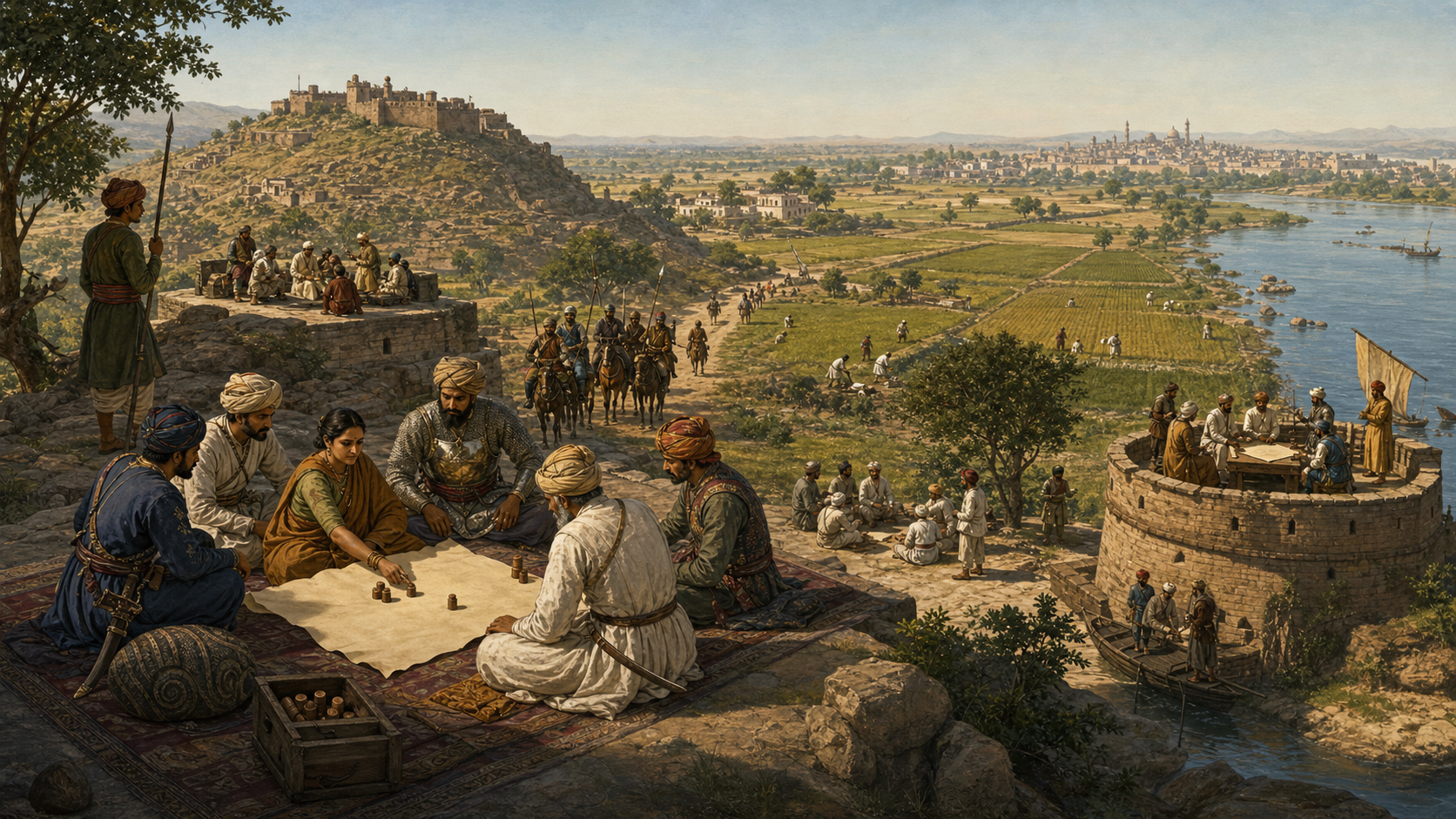
The word rebel quietly decides a historical argument before the evidence is considered. It assumes that one political order was legitimate and that everyone resisting it was a subordinate who had broken obedience. That may be accurate in a particular case, but it cannot be treated as the neutral starting point.
A Mughal-centred narrative can therefore reduce Rajputs, Marathas, Jats and Sikhs to interruptions in an imperial sequence. Goel reverses the angle of vision. He asks you to approach these powers as autonomous actors capable of territorial government, military strategy, institution-building and civilizational preservation. Their relationship to an imperial court remains important, but it no longer defines their entire historical identity.
The correction becomes especially clear in the transition from Mughal to British power. Early British expansion in India confronted the Marathas far more directly than the familiar British-versus-Mughal picture implies. Maratha power had already curtailed Mughal authority, contested European ambitions and appeared again in the resistance of 1857 through figures such as Nana Sahib and the Rani of Jhansi. Once you restore that continuity, the Marathas no longer look like a regional disturbance on the edge of somebody else’s empire.
Whenever you encounter the label rebel, apply three checks:
- Identify the political authority whose viewpoint the label reproduces. A court’s declaration of rebellion proves that it claimed sovereignty; it does not by itself prove that everyone accepted the claim.
- Ask whether the supposedly rebellious power governed territory, raised resources, protected communities or created durable institutions. Resistance and state-building are different categories, though one movement may do both.
- Retell the episode from the region in which it occurred. If the actors become intelligible only after you leave the imperial capital, the original narrative was probably too narrow.
This test does not turn every opponent of an empire into a righteous national liberator. Some resistance was opportunistic, fragmented or predatory. The point is methodological: rebel should be a conclusion established by political context, not a label inherited unexamined from the dominant power.
An alliance does not automatically change the character of rule
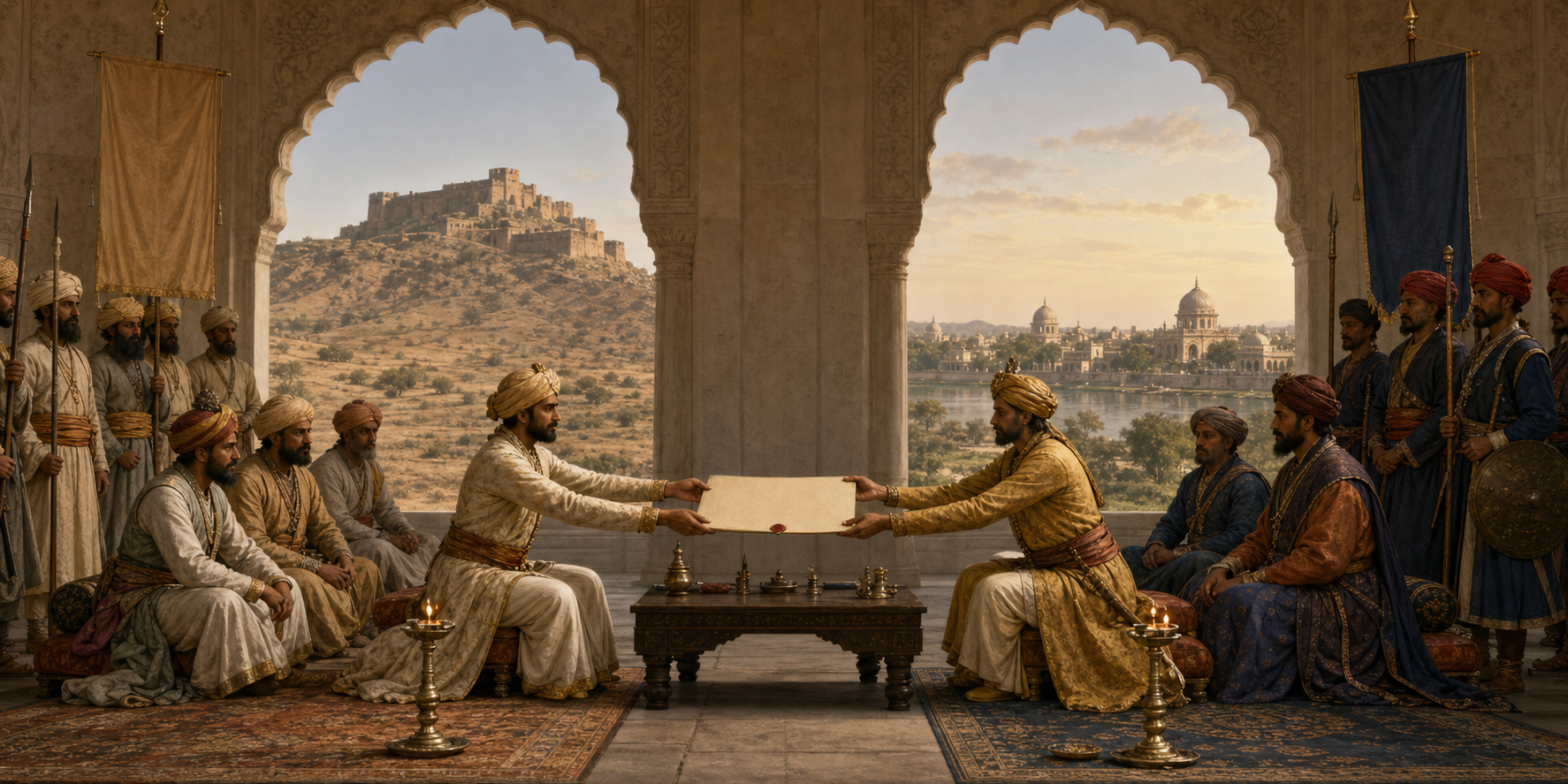
Jawaharlal Nehru offered an elegant account of gradual political assimilation in Glimpses of World History. He emphasized marriages between Muslim dynasties and Hindu lineages and connected them to a diminishing distinction between conqueror and conquered by the fifteenth century. Intermarriage certainly matters: it can reveal negotiation, accommodation and the formation of relationships among elites. Goel’s objection is that it cannot bear the full weight of a conclusion about the nature of the state.
To decide whether a ruling order had become indigenous, move from family relationships to institutions. Examine four areas:
- Revenue: Who assessed and collected it, under what authority, and with what consequences for the governed population?
- Administration: Which institutions exercised coercive power, and did elite alliances materially change their operation?
- Law: What legal order governed public life, and where did different communities stand within it?
- Religious policy: How did the state treat sacred places, religious communities and practices across time?
These questions do not predetermine the answer. They prevent a visible symbol of accommodation from substituting for an examination of power. A marriage can demonstrate an alliance without demonstrating equality. It can strengthen a dynasty without changing its fiscal or legal structure. It can also accompany genuine institutional adaptation. You have to establish which of those possibilities occurred rather than assume one.
Goel’s consistency test is sharp. If dynastic marriage were sufficient to erase the distinction between foreign and indigenous power, the same logic would have to be considered in other imperial settings, including British rule. Most readers would not describe an empire as indigenous merely because its ruling class formed relationships with local elites. The analogy does not prove that assimilation never occurred under earlier dynasties. It shows why intermarriage alone cannot settle the question.
This distinction is useful well beyond the Mughal debate. When a historian points to clothing, language, marriage or court custom as proof of political integration, ask what changed for the people governed by the state. Cultural adaptation and institutional transformation can coincide, but they are not synonyms.
Describe coercion precisely, then stop before collective blame

The hardest part of medieval historiography is not acknowledging that violence occurred. It is describing the action, motive, pattern and responsibility without either laundering the record or turning it into a charge against people living centuries later.
Goel challenges apologetic readings of Mahmud of Ghazni, Muhammad Ghori and Alauddin Khalji that explain destructive conduct only as political necessity. He insists that campaigns, temple desecrations, enslavement and punitive taxation recorded in the historical tradition be confronted rather than softened into harmless administrative episodes. That is an interpretive position, and it still requires case-by-case verification. It is not permission to assume that every event had one motive or that every ruler behaved identically.
A disciplined examination separates five questions that polemical arguments often collapse:
<!– wp:list {