

If you have wondered why Ganapathi was judged to have circled the world when he only walked around Shiva and Parvati, the answer is not that the rules were bent for him. His pradakshina revealed that he understood what the world meant at a level deeper than physical distance.
That distinction matters whenever you are being hurried into a race: finish first, travel farther, collect more, answer sooner. Ganapathi’s example asks you to pause before moving and identify the true center of the task. It is a lesson in devotion and discernment, not a license to avoid effort.
The race that turns on the meaning of the world

The cherished folk narrative begins when sage Narada presents a celestial mango to Shiva. Ganapathi, also known as Ganesha, and his brother Subrahmanya, or Skanda, both desire the rare fruit. The condition is simple: whoever first circles the world will receive it.
Subrahmanya responds immediately. Mounted on his peacock vahana, he races across the horizon. The imagery places him among mountains, oceans and the realms of the three worlds. His choice expresses courage, discipline and the youthful willingness to undertake an enormous task without hesitation.
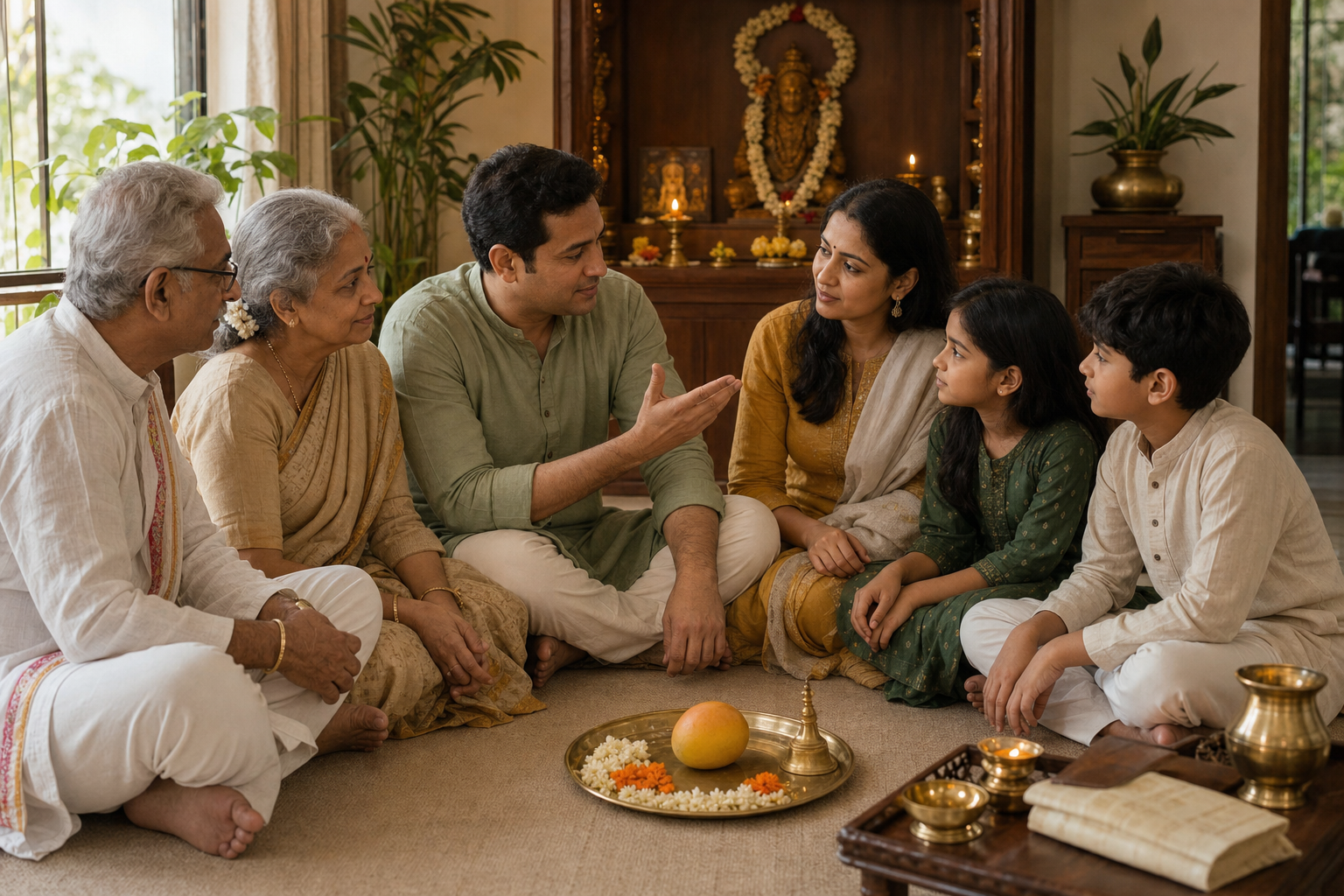
Ganapathi does something quieter. He pauses to consider what the world is. Shiva and Parvati are not merely two people standing conveniently nearby; they are his divine parents and, within the logic of the tale, the source and sustaining center of the cosmos. Ganapathi performs pradakshina around them. By circling the origin of the world, he fulfills the challenge through understanding rather than distance.
When Subrahmanya returns, Ganapathi’s act is accepted as the more insightful world tour, and the mango is awarded to him. The result is not meant to make honorable effort look foolish. It brings three qualities into focus: bhakti, or devotion; viveka, or discernment; and reverence for parents as one’s first gurus.
Pradakshina makes the sacred center visible

Pradakshina is circumambulation: moving reverentially around a sacred presence. Its meaning does not come from tracing a circle as a piece of geometry. It comes from what you place at the center. The movement gives bodily form to a spiritual correction: you are not the axis around which everything else must revolve.
Ganapathi’s circle is physically small, but its meaning is vast. He recognizes the whole through its sacred center. The immediate relationship with Shiva and Parvati becomes his doorway to the cosmic. Nearness does not make that relationship less profound; correctly understood, the near contains the meaning of the far.
This is why pradakshina is essential to the tale rather than an incidental gesture. Ganapathi does not merely announce that his parents represent the universe. He acts on that understanding. His body follows the conclusion reached by his intelligence, and his intelligence remains grounded in devotion.
You can use the same distinction to examine your own worship. A completed ritual may be outwardly correct while your attention remains centered on yourself: your schedule, your wishes, your reputation or your desire to be seen as devout. Pradakshina asks a more demanding question: what have you actually allowed to occupy the center?
The ethical meaning also reaches beyond one Hindu family story. Hinduism, Buddhism, Jainism and Sikhism are not interchangeable traditions, but reverence for parents, gratitude toward teachers and the preference for wisdom over rivalry can be recognized across Dharmic life. Shared values do not erase doctrinal differences. They give diverse communities a practical ground on which respect can grow.
Ganapathi’s victory is not an excuse for clever shortcuts
If the tale is reduced to a contest between a clever child and a hardworking child, its moral becomes shallow. Ganapathi does not win because effort is unnecessary. He wins because effort without an understanding of purpose can travel an immense distance in the wrong measure.
Subrahmanya answers the geographical sense of the challenge: the world is the expanse to be crossed. Ganapathi answers its metaphysical sense: the world proceeds from a sacred origin that can be honored directly. Both responses possess dignity. The tale gives precedence to insight without denying the valor of the journey.
This matters because people sometimes use spiritual language to decorate avoidance. Calling an easier option wise does not make it so. Ganapathi still performs the required action, offers reverence and gives a coherent account of how his action fulfills the challenge. He does not simply refuse to participate.
A genuine act of discernment passes three tests. It respects the words of the duty rather than escaping them. It reveals the deeper purpose of the duty rather than replacing that purpose with personal convenience. And it does not depend on mocking another person’s sincere labor.
Use those tests when you are tempted by an ingenious workaround. If your interpretation leaves the real responsibility undone, benefits only you and requires everyone else to pretend that the result is equivalent, it is probably evasion. Wisdom does not oppose effort. Wisdom decides which effort serves dharma.
Carry the mango lesson into decisions, worship and family life
The practical value of this story appears before action, during the short interval when speed is urging you to move but understanding has not yet caught up. You do not need prolonged hesitation. You need a disciplined pause long enough to separate the visible race from its real purpose.
Pause before entering the next race
- State the task plainly. Write or say what you have actually been asked to do, without adding the competitive story forming around it.
- Name the obvious measurement. It may be speed, distance, volume, status, marks, money or public recognition. This is the equivalent of the miles Subrahmanya could cover.
- Identify the center. Ask which person, principle or relationship gives the task its meaning. Look for service, learning, truth, gratitude, responsibility or care.
- Test your proposed action against both levels. It should meet the stated duty and preserve its purpose. Satisfying one while abandoning the other is not Ganapathi’s kind of wisdom.
- Act without contempt for the other path. A different person may reasonably choose the longer journey. Discernment becomes ego when it needs to call every other form of effort foolish.
Suppose you are studying. Finishing the largest number of pages is the visible distance; understanding what you can explain and apply is the center. Suppose you are serving a community. Winning an argument is the visible race; protecting truth without needlessly damaging trust may be the deeper duty. Suppose you want to honor your parents. A grand public gesture can be less meaningful than listening carefully, keeping a promise or making time for a responsibility they actually need you to carry.
The point is not that speed, completion and recognition are always false measures. Subrahmanya’s journey prevents that misreading. The point is that a measure becomes dangerous when it detaches from the good it was meant to serve.
Let pradakshina lead to one concrete duty
If pradakshina is already part of your worship, use it as an intentional checkpoint. Before beginning, recognize whom or what you are placing at the center. While moving, notice which personal demand keeps trying to reclaim that position. When the circle is complete, choose one duty that will carry the recognition into the rest of your day.
That duty need not be dramatic. You might thank a parent for a specific lesson, ask a teacher a sincere question and listen to the answer, complete an obligation you have delayed, or withdraw a needlessly competitive remark. The circle becomes spiritually useful when it changes the direction of the next action.
Revering parents as first gurus also requires precision. Gratitude for those who gave and formed your life is not the same as treating every parental preference as infallible. Ganapathi’s conduct joins reverence with viveka. If you preserve reverence by abandoning discernment, or claim discernment while discarding gratitude, you keep only half of the lesson.
Apply the teaching inwardly before using it to instruct someone else. It is easy to tell a younger person to respect elders. It is harder to ask whether your own speech, availability and fulfilled promises show respect to those who guided you. The most credible explanation of the mango story is a life in which gratitude can be seen.
Key takeaways
- Ganapathi fulfills the mango challenge by recognizing Shiva and Parvati as the sacred origin and sustaining center of the world.
- Pradakshina is meaningful because of what occupies the center, not because walking in a circle is valuable by itself.
- The tale honors Subrahmanya’s courage and effort while giving priority to Ganapathi’s devotion and discernment.
- Wise interpretation fulfills both the stated duty and its deeper purpose; it is not a spiritual name for avoiding work.
- You can apply the lesson by pausing before a race, identifying its real center and choosing one action that protects what matters most.
The next time urgency tells you to move before you understand, take a Ganapathi pause. Name the race, locate its sacred center and then act. Speed may still be necessary, but it will serve your purpose instead of deciding it.
References
