

You may feel drawn to Krishna or another form of the Divine as your beloved, yet remain unsure what to do with that attraction. Is it genuine sadhana, private emotion, poetic imagination, or a mixture of all three?
Madhura Bhava becomes workable when you stop trying to manufacture a devotional mood. Give your longing a disciplined form through remembrance, ethical restraint, and service. Then judge the practice by what happens to your conduct when the music ends.
Begin with relationship, not emotional intensity
Madhura means sweet, and Madhura Bhava approaches the Divine with the intimacy of a beloved. The word “beloved” is important, but so is the word “Divine.” This is not ordinary romance transferred unchanged into religious language. Human possessiveness says, “You must satisfy me.” Devotional love gradually learns to say, “Let my attention, action, and identity be offered to You.”
Bhava is therefore more than whatever feeling happens to be strongest today. It is a cultivated disposition: a stable way of remembering, addressing, and responding to the Divine. Rasa is the relishing of that relationship. Emotion may accompany both, but emotion alone does not establish either one.
Within Gaudiya Vaishnavism, madhurya-rasa is honoured as the summit of loving devotion to Krishna. That is a theological position within a particular tradition, not an instruction that every Hindu must imitate its devotional language. Jayadeva, Andal, and Mirabai each give beloved-centred devotion a distinctive voice, while the Srimad-Bhagavatam supplies a major scriptural current for Krishna bhakti. Their words can educate your devotional imagination, but borrowed poetry should not become borrowed emotion.
Start with the Ishta already rooted in your life. If you belong to a sampradaya, use the names, narratives, and forms of address it has given you. If your Ishta is not Krishna, do not import Krishna-lila imagery merely because Madhura Bhava sounds more elevated. Intimacy becomes authentic through fidelity, not novelty.
Before deepening the practice, ask yourself three plain questions:
- Do I remember my Ishta during ordinary hours, or only when I want emotional relief?
- Does this relationship make me more truthful, restrained, and considerate?
- Can I serve without turning my devotion into a display?
If these questions expose a gap, that is useful. Madhura Bhava does not require you to pretend the gap has already disappeared. It gives you a way to work on it.
Give devotion a practical rhythm through japa, kirtan, remembrance, and seva
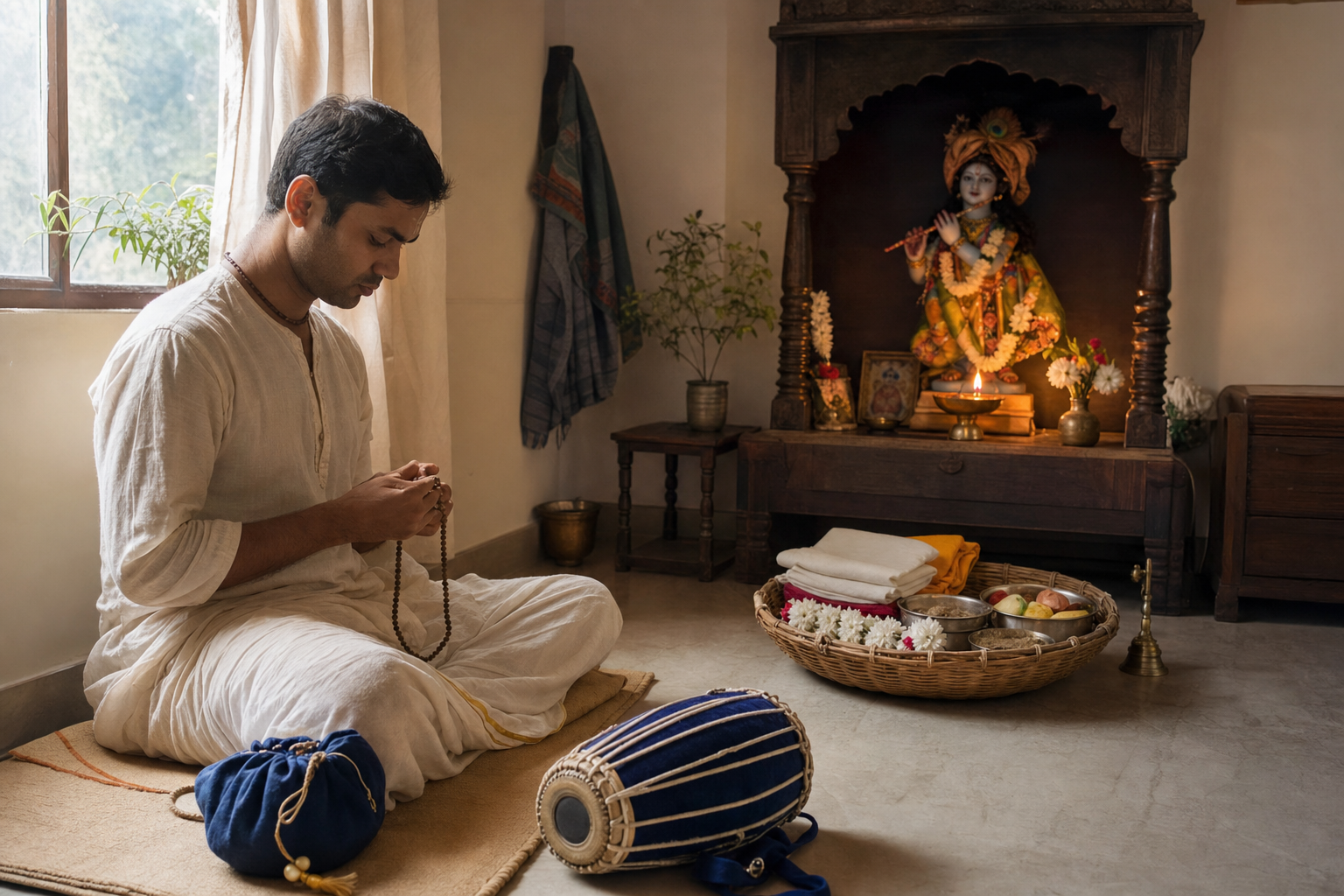
The essential disciplines are accessible: japa steadies attention, kirtan awakens the heart, lila-smarana directs the imagination, and seva turns love into action. They reinforce one another, but they do not perform the same job. Use each deliberately.
Let japa become the daily anchor
Use the Divine name or mantra already rooted in your practice. If you have received instructions from a guru, follow them rather than continually modifying the method. Repetition becomes abhyasa when you return faithfully, including on days when no sweetness appears.
Attach japa to an ordinary transition you can keep: the beginning of your morning practice, a safe portion of a commute, or a quiet interval between duties. Repeat attentively. When the mind wanders, return to the name without turning distraction into a moral drama. The return itself is part of surrender.
Do not assess a round of japa only by how concentrated or moved you felt. Notice what follows it. If someone interrupts you, can you answer without irritation? If not, the name has shown you where devotion still needs to enter your behaviour.
Use kirtan to warm attention, not stage a performance
Kirtan is especially helpful when japa has become mechanical or the heart feels closed. Choose a familiar name or composition, learn what its words mean, and sing toward the Divine rather than toward an imagined audience. Musical beauty can support bhakti, but technical display is not its measure.
In congregational kirtan, listen as carefully as you sing. The shared response can loosen self-consciousness and remind you that devotion is held by a community, not privately owned. In solitary kirtan, simplicity is an advantage. You do not need to sound impressive to address the One who already knows your voice.
Keep lila-smarana connected to received narratives
Lila-smarana means remembering divine pastimes. Begin with a scene you know from a trusted narration, scripture, teacher, or lineage. Recall what happens before trying to intensify what you feel. Attend to the Divine qualities revealed in the scene and to the devotional response it invites.
This order matters because imagination can either serve remembrance or make the practitioner the centre of a private fantasy. If your visualisation becomes elaborate while your understanding of the lila remains thin, return to the received account. Let scriptural and lineage guidance shape the imagination before personal embellishment does.
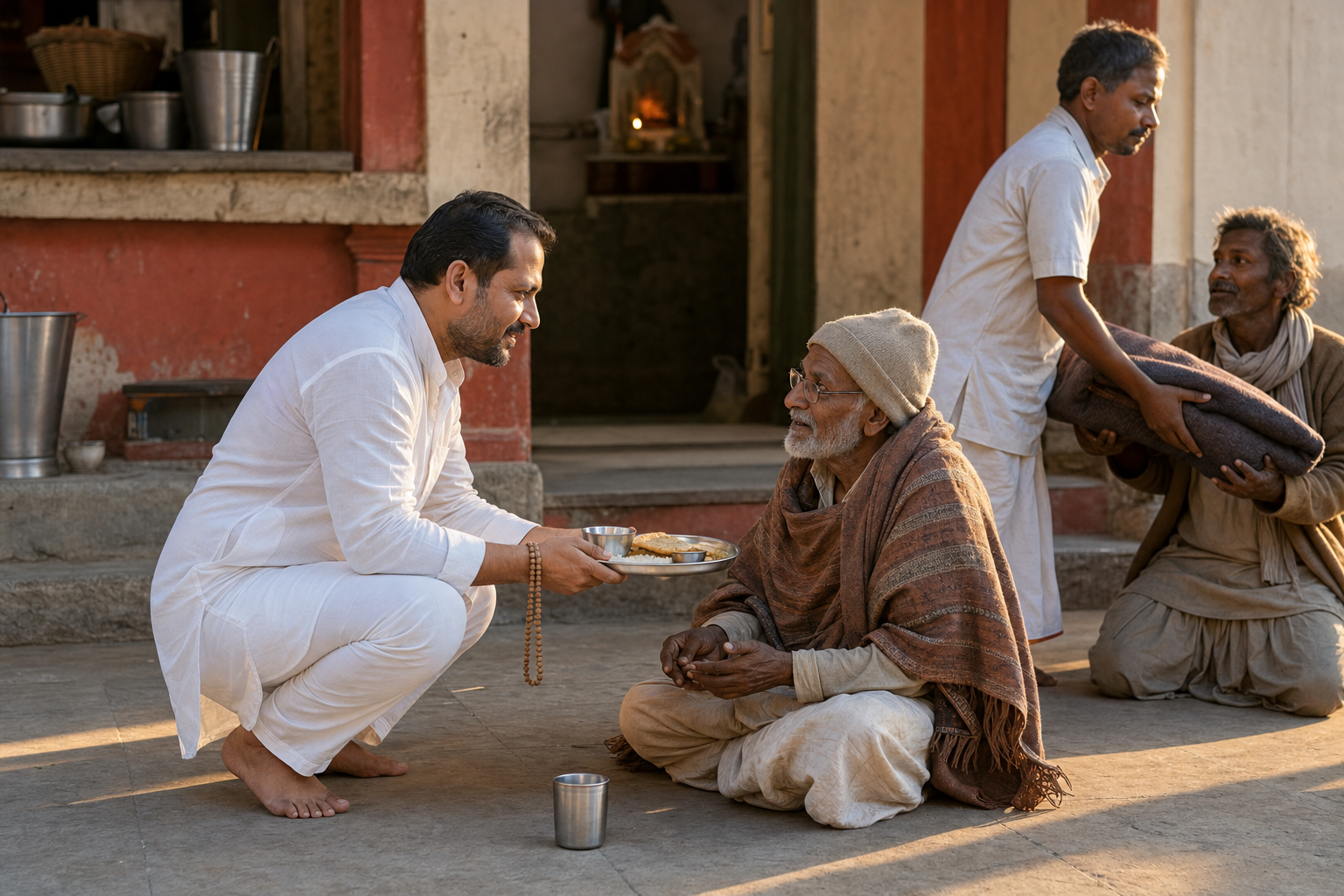
Use seva to discover whether love has become less self-centred
Choose a real need in your home, temple, satsang, or local community. Complete the task carefully. Do not advertise it. Then observe your reaction if nobody thanks you or if somebody else receives the credit.
That reaction is spiritually informative. Resentment does not mean the seva was worthless; it reveals where ahamkara still seeks payment. Offer the reaction as honestly as you offered the task, and continue refining the motive.
A workable practice can follow this sequence:
- Begin by inwardly offering your attention to your Ishta.
- Repeat the Divine name with care, returning whenever the mind wanders.
- Add a familiar kirtan when the heart needs help becoming attentive.
- Recall a trusted lila without forcing yourself into an imagined role.
- Carry the remembrance into a definite act of seva.
You do not need to perform every element at every sitting. On a crowded day, keep the thread through japa and one quiet act of service. When you have more space, add kirtan and lila-smarana. Regularity matters more than constructing an impressive session you cannot sustain.
Let conduct judge the emotion
Devotional softness, tears, absorption, or longing may arise. Receive them without contempt and without making them your certificate of advancement. A feeling can be sincere and still be temporary. Madhura Bhava matures when tenderness begins to change how you speak, choose, serve, and recover from provocation.
| Experience during practice | A better test after practice |
|---|---|
| Softness during kirtan | Are you gentler when someone interrupts or disagrees with you? |
| Intense longing for the Divine | Does the longing strengthen your duties rather than provide an excuse to neglect them? |
| Vivid lila imagery | Does imagination remain guided by discernment, scripture, and your tradition? |
| Strong attachment to your Ishta | Can you honour other Ishtas without contempt or insecurity? |
| Pleasure in seva | Will you still serve when the work is unnoticed and inconvenient? |
The traditional guardrails of yama and niyama are not preliminary rules to be discarded once devotion feels intimate. They prevent sacred language from becoming a cover for dishonesty, possessiveness, indulgence, or neglect. If an apparent divine prompting asks you to violate clear ethical duties, do not treat emotional intensity as proof of authority. Pause, examine it, and seek guidance.
A qualified guru can help distinguish devotional sentiment from projection. Satsang and temple life provide further correction because other practitioners can see patterns that private enthusiasm hides. Guidance should strengthen discernment and dharmic conduct, not demand that you surrender moral judgement to another human being.
Watch especially for these distortions:
- Chasing a devotional high: changing chants, teachers, or practices whenever sweetness fades.
- Making yourself the protagonist: using lila-smarana chiefly to elaborate a special identity for yourself.
- Neglecting dharma in the name of longing: treating unfinished duties or careless speech as signs of transcendence.
- Displaying private states: using tears, visions, or devotional language to claim status in a community.
- Ranking people by devotional style: assuming that someone whose relationship with the Divine is different must be spiritually inferior.
The more reliable signs are quieter: fewer reactive impulses, gentler speech, humility, gratitude, compassion, and more purposeful action. These changes may be gradual. Look for direction and consistency, not a flawless personality produced overnight.
Madhura Bhava may support emotional balance, but it is not a substitute for mental-health care. If devotional imagery becomes involuntary or frightening, or if practice interferes with your ability to function, pause intensive visualisation and seek appropriate professional help. You can also discuss the practice with a trustworthy teacher who understands your tradition.
Recognise Dharmic resonance without erasing differences

Madhura Bhava belongs to a specifically Hindu devotional vocabulary, yet its central intuition is recognisable across the Dharmic family: heartfelt devotion can educate attention, restrain ego, and give ethical action a deeper motive. Shared resonance is real. Sameness is not.
Sikh kirtan and the prem-centred language of Gurbani cultivate tender orientation toward the Divine Naam. Buddhist traditions can join trust, maitri, and reverence for the Buddha or Bodhisattvas with disciplined conduct and insight. Jain devotees honour the Tirthankaras through stotra, vandana, and stavan. Each form deserves to be understood through its own account of the Divine or the liberated being, the self, bondage, and liberation.
Do not rename every tender Dharmic practice “Madhura Bhava.” That would create unity by removing precisely the differences that make dialogue worthwhile. Instead, describe the practical resonance accurately: song gathers attention, remembrance shapes desire, reverence humbles the ego, and devotion becomes credible through conduct.
This distinction gives you a sound way to speak across traditions:
- Name your own practice and lineage precisely.
- Describe what the practice does without claiming that another tradition teaches the same theology.
- Receive Sikh, Buddhist, and Jain devotional forms in their own vocabulary.
- Let shared virtues such as humility, compassion, disciplined remembrance, and service become the ground of Dharmic solidarity.
Respect for other paths also tests your Madhura Bhava. Love of your Ishta should concentrate fidelity, not produce hostility toward someone else’s sacred form. Intimacy with the Divine becomes narrower, not deeper, when it needs contempt to protect itself.
Key takeaways
- Madhura Bhava is a cultivated relationship with the Divine as beloved, not a demand to generate intense emotion.
- Begin with the Ishta, mantra, narratives, and discipline already rooted in your tradition.
- Use japa to steady attention, kirtan to awaken participation, lila-smarana to refine imagination, and seva to test motive.
- Keep yama, niyama, guru guidance, satsang, and moral discernment active as devotion deepens.
- Judge progress by reduced reactivity, gentler speech, humility, gratitude, compassion, and dependable service.
- Recognise devotional kinship across Dharmic traditions without collapsing their distinct teachings into one vocabulary.
Begin with the Divine name that is already yours. At your next ordinary pause, repeat it attentively, carry the remembrance into one unadvertised act of service, and observe how you handle the next difficult interaction. Let sweetness become visible as dharma before asking it to become ecstasy.
References
