

Someone has told you that a dosha is blocking your marriage, career, health, finances, or family peace. The dangerous part is often not the Sanskrit label. It is the leap from a symbolic reading to a frightening certainty. You do not have to choose between dismissing the tradition and surrendering your judgment.
A Dharmic response begins with responsibility. A dosha can be approached as a prompt for conscious correction rather than a sentence of fixed destiny. The useful question is not, “What terrible event has been guaranteed?” It is, “What pattern should I examine, and what right action is available to me now?”
Separate the astrological warning from a verdict

Begin by asking what has actually been claimed. “This period may require greater discipline” is not the same claim as “You cannot succeed until an expensive ritual is performed.” The first leaves room for effort, context, and uncertainty. The second turns an interpretive tradition into coercion.
Do not allow one placement, tithi, or symbolic association to carry the weight of an entire life. An Amavasya birth offers a useful example. Amavasya is the fifteenth tithi of Krishna Paksha, but being born on that tithi is not inherently inauspicious. A chart-based interpretation also considers the Moon’s sign, house, strength, aspects, and the rest of the horoscope. The same principle applies when someone identifies a dosha: the label needs context before it deserves influence over a decision.
Ask the astrologer or family adviser four direct questions:
- Which exact chart factors support this interpretation?
- Which factors in the same chart moderate or contradict it?
- Is the claim about a tendency, a difficult period, or a fixed outcome?
- What remedy would still improve my conduct or community even if the interpretation proved incomplete?
The fourth question is especially valuable. Truthful speech, care for elders, charity, ecological responsibility, and disciplined practice do not become wasted effort because an astrological judgment was uncertain. A remedy grounded in dharma retains value beyond the prediction.
Identify the responsibility behind the dosha label

Navagraha, Pitru, and Sarpa Dosha point toward different symbolic fields. They should not be used as interchangeable explanations for every setback. Use the distinction to decide what part of life deserves honest examination.
| Dosha | Traditional lens | What you can examine | Proportionate response |
|---|---|---|---|
| Navagraha Dosha | Perceived disharmony among the nine planetary forces, traditionally associated with timing and fluctuations in health, work, or relationships | Irregular habits, neglected duties, impulsive decisions, poor timing, or conduct that is adding instability to an already difficult period | Navagraha Shanti if appropriate to your tradition, mantra, a stable routine, truthful conduct, attention to duty, and consistent seva |
| Pitru Dosha | An unsettled relationship with lineage or neglected ancestral obligations, sometimes associated with recurring family discord or delayed milestones | Care of elders, unresolved family duties, inherited patterns of speech or conflict, and whether remembrance has become detached from responsibility | Pitru Tarpana where customary, care for elders, charitable giving in an ancestor’s name, and support for education or public welfare |
| Sarpa Dosha | Serpent symbolism connected with transformation, protection, land, and water; sometimes associated with prolonged delays or property obstacles | Your treatment of animals, land, water, and shared natural resources, as well as the practical facts behind any delayed plan or property matter | Naga Puja where customary, non-harm toward living beings, protection of water sources, tree planting, and responsible stewardship of land |
This is not a symptom checker. A delayed marriage does not prove Pitru Dosha. A property dispute does not prove Sarpa Dosha. Low mood, exhaustion, or recurring pain does not prove planetary affliction. Ordinary causes still require ordinary investigation.
If the concern involves persistent physical symptoms or serious emotional distress, seek a qualified health professional while continuing any safe spiritual practice you value. If it involves debt, employment, a contract, inheritance, or title to property, obtain appropriate financial or legal guidance. Ritual can accompany competent help; it should not replace it.
Build a remedy that changes more than the ritual calendar

A strong remedy has more than one layer. Ceremony can mark intention, but daily conduct determines whether that intention enters your life. Use the following sequence to turn a general prescription into a practice you can understand and sustain.
- Name the correction. Complete the sentence, “This dosha reading is asking me to become more responsible about…” Your answer might concern speech, family duty, consistency, generosity, or care for the natural world. If neither you nor the adviser can name a correction, the proposed remedy may be too vague to guide you.
- Choose one daily discipline. Select a practice you can perform without spectacle: mantra, meditation, truthful speech, non-harm, regular sleep and waking, or careful completion of your duties. Ethical discipline and a balanced routine are not lesser remedies. They are the part that follows you beyond a temple visit.
- Match service to the symbolic concern. For an ancestral concern, care for an elder or give in an ancestor’s name. For Sarpa symbolism, protect living beings, water, or trees. For a Navagraha concern, make seva and steadiness part of the response rather than waiting passively for a favorable period.
- Add ritual with clear intention. Navagraha Shanti, Pitru Tarpana, and Naga Puja belong to distinct contexts. Ask what the rite means, who should conduct it, what preparation is appropriate, and whether your family or sampradaya observes it differently. A rite should deepen reverence and responsibility, not create panic.
- Review conduct rather than demanding a miracle. Notice whether you are more dependable, less reactive, more respectful toward family, more careful with resources, and more willing to serve. These changes are available to your agency. A promised marriage date, promotion, pregnancy, or financial windfall is not.
If you undertake a vrata, keep it within your health and capacity. Fasting is not a test of sincerity when illness, pregnancy, age, medication, or another condition makes it unsafe. Choose prayer, charity, restraint in speech, or another suitable observance instead, and consult a qualified clinician when health is in question.
Do not treat daana as a fee paid to escape karma. Give where there is genuine benefit and without humiliating the recipient. Likewise, do not reduce ahiṃsā to avoiding one prohibited act on one ritual day. Let it shape speech, consumption, treatment of animals, family conduct, and the way you respond when afraid.
Choose guidance without handing over your agency
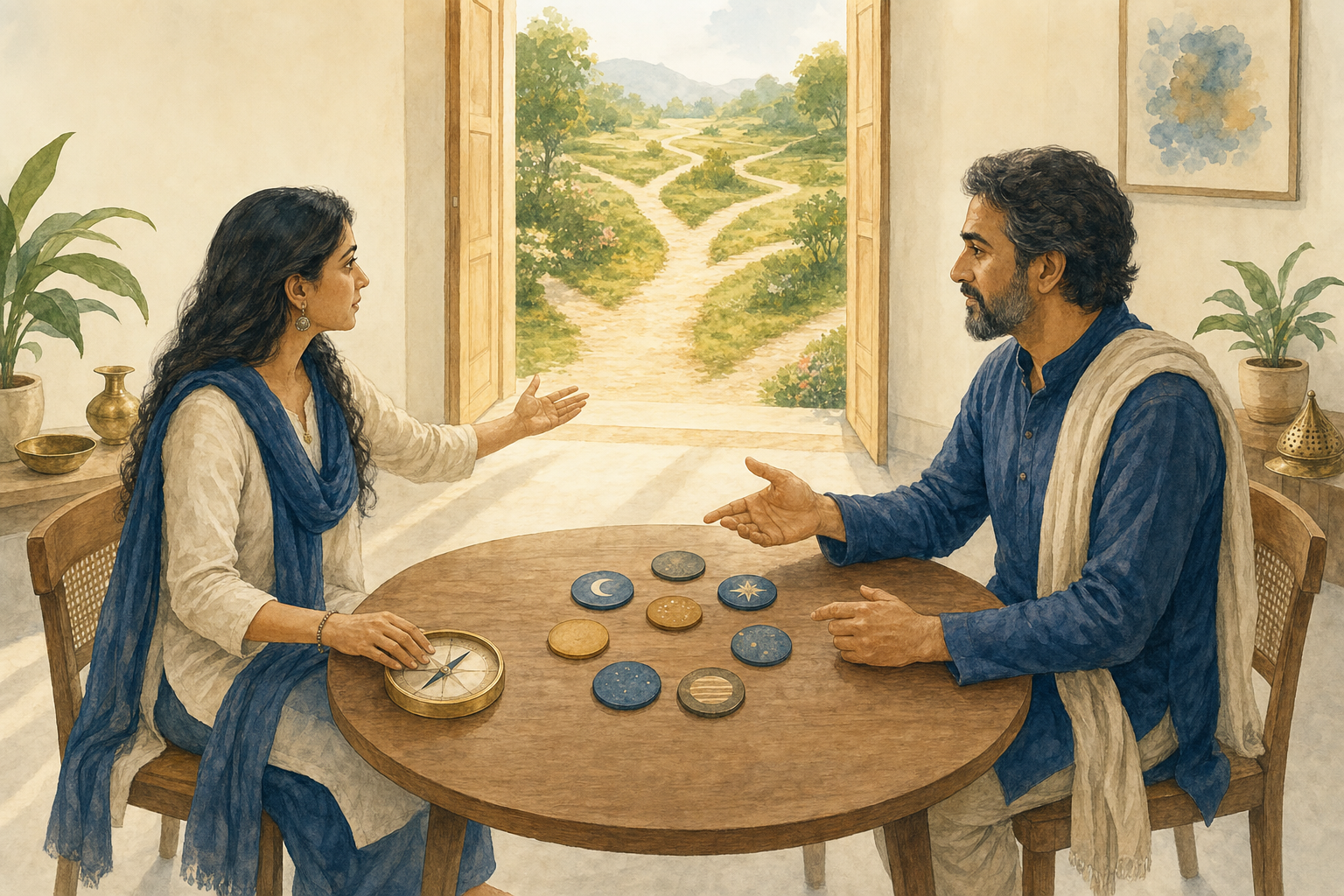
A competent and compassionate guide should help you see proportion, context, and choice. The consultation should leave you clearer about your responsibilities, not dependent on repeated warnings.
Look for someone who:
- examines the whole chart rather than isolating one frightening feature;
- distinguishes symbolic interpretation from guaranteed prediction;
- explains why a remedy corresponds to the claimed imbalance;
- respects differences of family custom, region, and sampradaya;
- offers remedies proportionate to your means and circumstances;
- does not ask you to abandon medical, psychological, legal, or financial help; and
- accepts careful questions or a second opinion without treating them as spiritual disobedience.
Step back if fear becomes the main instrument of persuasion. Warning signs include a guaranteed catastrophe, pressure to pay immediately, an insistence that only one costly remedy can help, or an accusation that a particular relative is the hidden cause of your suffering. Such claims can damage finances and family relationships before any supposed astrological outcome occurs.
Be especially careful when a reading concerns a child. Do not turn Amavasya, a planetary placement, or a dosha label into the child’s identity. A reflective temperament can be supported through predictable routines, gentle encouragement, creative work, and thoughtful mentorship. Tendencies toward inwardness or solitude are not fixed forecasts for education, career, marriage, health, or finances.
The language adults use matters. “You may need to cultivate steadiness” offers a practice. “Your birth is unlucky” imposes a burden. Preserve the child’s room to develop character, competence, devotion, and independent judgment.
Key takeaways
- A dosha is most constructive when treated as an interpretive lens for responsibility, not a verdict of unavoidable misfortune.
- Ask for the full chart basis, counterbalancing factors, degree of uncertainty, and purpose of every proposed remedy.
- Match the response to the concern: steadiness and seva for Navagraha, ancestral responsibility for Pitru, and non-harm and ecological care for Sarpa.
- Combine any ritual with an observable change in conduct. Prayer without responsibility leaves the central work untouched.
- Keep medical, psychological, legal, and financial problems within the care of qualified professionals; spiritual observance can accompany that care.
- Reject advice that relies on doom, family blame, financial pressure, or the promise of a guaranteed result.
Before you spend money, frighten your family, or postpone an important decision, write down the exact astrological claim and the chart factors said to support it. Then choose one safe action that strengthens dharma regardless of the prediction: repair a neglected duty, serve someone, care for an elder, protect a living being, or establish a disciplined practice. That is where a dosha reading stops controlling you and begins asking something worthwhile of you.
References
- DharmaRenaissance Blog — Doshams Decoded: Navagraha, Pitru, and Sarpa Causes, Signs, Remedies for Karmic Harmony
- DharmaRenaissance Blog — Child Born on No-Moon (Amavasya) Day: Cultural Meanings, Life Paths, and Hopeful Remedies
