

You may be able to recite a verse, recognize several roots, and still lose the sentence when sounds merge or endings change. At that point, a dictionary is no longer enough. You need to see how each Sanskrit form is produced.
Panini gives you the rule system; Patanjali teaches you how to reason within it. Once you separate those two jobs, Sanskrit grammar stops looking like a wall of aphorisms. It becomes a repeatable practice: identify the conditions, apply the relevant operation, test competing rules, and explain why the resulting form is correct.
One grammatical tradition, two different jobs
Panini’s Ashtadhyayi is the compact engine of the system. It is generally dated to the fifth century BCE and organized into eight chapters containing 3,996 sutras. Those rules address Sanskrit phonology, morphology, and syntax with an economy that still commands attention.
That economy creates the first difficulty for a learner. A sutra is not a self-contained textbook paragraph. It operates within a network of technical terms, metarules, conditions, exceptions, and ordered operations. Reading one rule in isolation may tell you its wording while leaving you unable to derive a single form correctly.
Patanjali’s Mahabhashya performs a different task. Traditionally placed around the second century BCE, it examines Panini’s sutras together with Katyayana’s varttikas, or supplementary observations. It asks why a rule should be understood in a particular way, what objection could be raised, whether an alternative interpretation works, and which conclusion survives examination.
| The learner’s question | Panini’s role | Patanjali’s role |
|---|---|---|
| What operation does the grammatical system permit? | States the rule in a highly compressed form. | Clarifies how the rule should be interpreted and applied. |
| How do several rules interact? | Provides an ordered, condition-sensitive system. | Examines conflicts, context, exceptions, and competing readings. |
| Why is one result preferable to another? | Supplies the formal basis of the derivation. | Tests the reasoning through objections, examples, and established usage. |
| What should the student learn? | How a valid Sanskrit form is generated. | How to defend the derivation and reject a plausible alternative. |
Key takeaways
- Use the Ashtadhyayi to determine what operation the grammatical system licenses.
- Use the Mahabhashya to understand why a particular interpretation withstands objection.
- Treat a Sanskrit form as the result of an ordered derivation, not as an isolated item to memorize.
- Check a formally possible result against examples and established usage before accepting it.
Learn derivations, not disconnected sutras
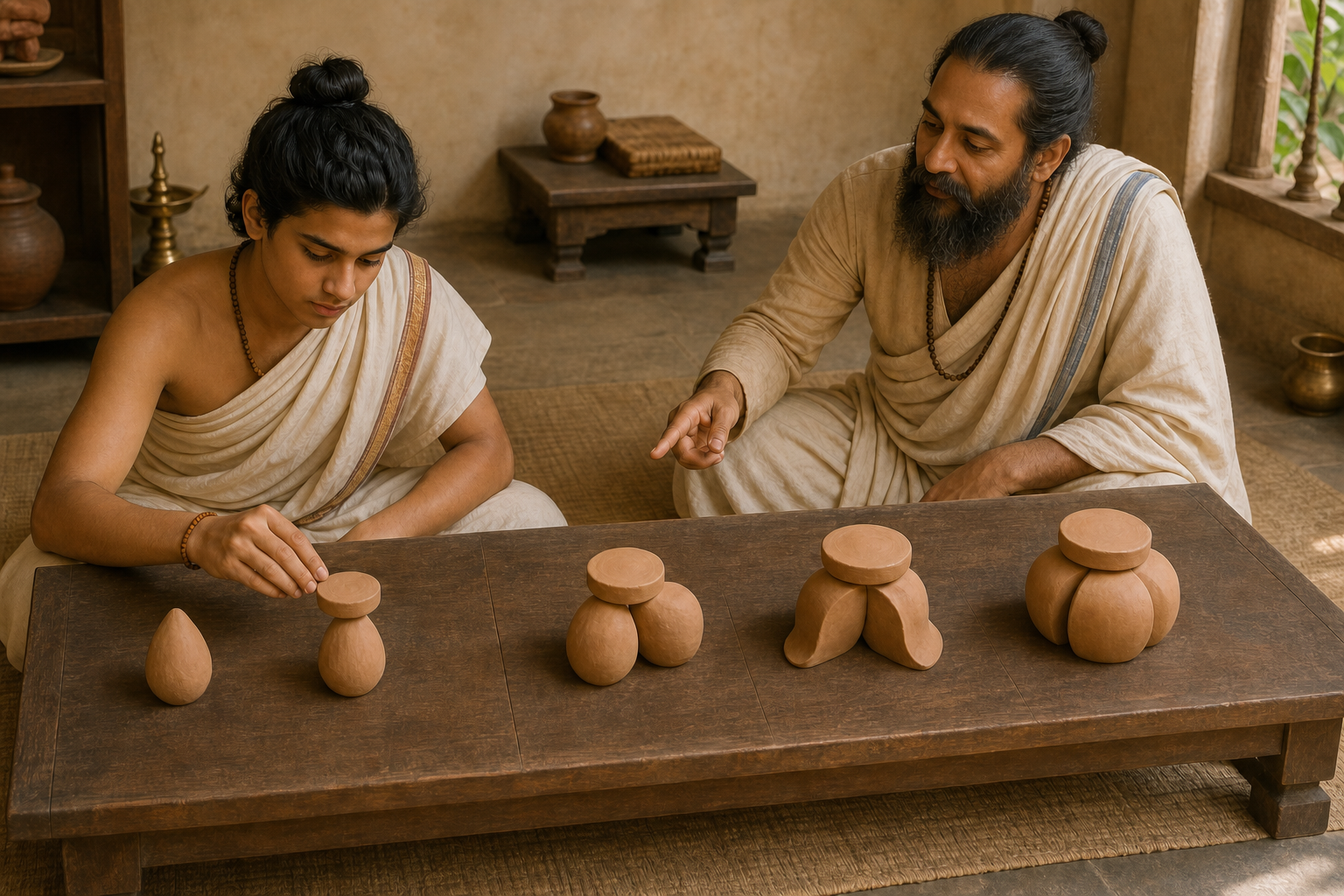
The most useful question in Paninian grammar is not simply, “What does this sutra mean?” It is, “What work does this sutra perform at this point in the derivation?” The change in question forces you to connect a rule to an input, a set of conditions, an operation, and an output.
Use the following sequence whenever you study a form:
- Begin with the form in context. Record the complete word, expression, or sound junction rather than extracting a fragment too early.
- Identify the grammatical problem. Decide whether you are dealing chiefly with sandhi, derivational morphology, a syntactic relation, or an interaction among them.
- Recover the relevant input. Mark the root, base, affix, or adjoining sounds that existed before the observed change.
- State the rule and its conditions. Do not write only the rule number or final substitution. Record why the rule becomes eligible here.
- Show the intermediate result. If several operations occur, place each stage on a separate line. This makes the location of an error visible.
- Test competing rules. Ask whether another rule appears to fit and identify the condition, context, or ordering principle that decides between them.
- Verify the output. Compare the result with accepted examples and usage rather than assuming that formal manipulation alone guarantees a living Sanskrit form.
A simple notebook layout makes this discipline easier. Use three main columns labeled input, rule or operation, and output. Reserve a margin for one additional question: Why did the nearest competing rule not apply? That margin is where memorization begins to become understanding.
The common mistake is to memorize only the finished word. That may help you recognize the same form again, but it gives you little help with an unfamiliar form. A derivation is transferable: it lets you recognize the same grammatical mechanism when the vocabulary changes.
Do not begin by trying to memorize all 3,996 sutras. First build a map of the Ashtadhyayi’s divisions, terminology, and core processes. Then study a selected group of rules through complete derivations. The map tells you where a rule belongs; repeated derivation teaches you what it actually does.
When two rules seem possible, use Patanjali’s method

The Mahabhashya is especially valuable when a rule’s wording looks simple but its application is not. Its characteristic method moves through objection, examination, and established conclusion: purvapaksha presents a serious opposing position, the discussion tests it, and siddhanta states the conclusion that the reasoning supports.
You can use that method even before you are able to read long passages of the Mahabhashya independently:
- State your proposed derivation. Name the rule you think applies and the form you expect it to produce.
- Construct the strongest objection. Identify another rule, interpretation, or contextual reading that could produce a different result.
- Find the deciding evidence. Look at the wording of the rule, its place in the ordered process, the grammatical context, relevant examples, and established usage.
- Resolve the conflict explicitly. State which condition admits one rule or excludes the other.
- Write the conclusion in full. Explain both why the accepted result works and why the nearby alternative fails.
This prevents circular explanations. “The form is correct because the rule produces it” is not enough if the applicability of the rule is precisely what is disputed. A sound explanation must identify the condition that makes the rule operative in this case.
While reading a Mahabhashya passage, mark changes in argumentative position. Use P for purvapaksha, E for the examination of evidence, and S for siddhanta. Otherwise, you may mistake a carefully framed objection for Patanjali’s final view.
This approach also works well in a study group. One learner presents the derivation, another raises the strongest grammatical objection, and a third identifies the rule, condition, or usage that settles the issue. The exercise succeeds only when the group can explain the rejected alternative as clearly as the accepted result.
Grammar protects the first layer of Dharmic interpretation

Grammar is not merely a concern for specialists. A sandhi decision can determine where words divide. A derivational analysis can reveal how a form relates to its root and affix. Syntax can show which word qualifies another or which action belongs to which agent. If those first decisions are wrong, a polished philosophical interpretation may rest on a faulty parse.
For a mantra, verse, or philosophical passage, use this order:
- Preserve the received wording and recitation before breaking the expression apart.
- Resolve relevant sandhi and establish defensible word boundaries.
- Identify the important derived forms and their grammatical components.
- Determine the syntactic relations within the complete sentence.
- Only then compare possible translations or philosophical interpretations.
This order does not pretend that grammar alone settles every theological or philosophical dispute. Context, genre, commentary, and the teachings of a lineage still matter. Grammar performs a narrower but indispensable service: it tells you which readings the language can reasonably bear and which ones require the Sanskrit to do something it does not do.
The discipline served recitation, textual interpretation, debate, and commentary across Hindu, Buddhist, Jain, and later scholastic communities. That shared intellectual inheritance should not be used to flatten the real differences among Hindu, Buddhist, Jain, and Sikh traditions. It offers something more useful than forced sameness: a respect for exact language, reasoned disagreement, and conclusions that can be examined by others.
You can notice the benefit directly when a rule resolves a difficult sound combination or exposes the structure of a poetic form. Precision need not diminish reverence or beauty. It can remove the confusion that prevents you from hearing how carefully the language has been formed.
A six-stage path from recognition to grammatical judgment

A workable course of study should increase your independence in stages. Use the following progression rather than measuring progress by the number of sutras you have encountered.
- Map the system. Learn the broad architecture of the Ashtadhyayi, its terminology, and the main grammatical processes. Your goal is orientation, not total memorization.
- Work with selected sutras. Choose rules that participate in visible processes such as sandhi and derivational morphology. Study each rule through examples rather than as an isolated aphorism.
- Record complete derivations. Show inputs, conditions, intermediate forms, applicable rules, and outputs. Correct the exact stage where your derivation departs from the accepted result.
- Add Patanjali’s reasoning. Read the Mahabhashya on the topics you are already deriving. Mark purvapaksha and siddhanta, then restate the decisive argument in your own words.
- Cross-reference the traditional supports. Consult the Dhatu-patha when the identity or behavior of a verbal root matters and the Gana-patha when membership in a specified group affects a rule’s application.
- Defend the result. Explain the derivation without looking at your notes, then answer the most plausible objection. Move forward when you can justify the choice of rule, not merely reproduce the final form.
If your interest extends to formal linguistics or computational work, preserve the same derivational habits. Mark the input features, the conditions that trigger an operation, the order in which operations occur, and the resulting output. Paninian economy, feature sensitivity, and rule ordering remain relevant to formal grammar design and computational approaches to language.
Begin your next session with one form that you can recognize but cannot yet explain. Write its input, conditions, rule, intermediate stages, and output. Then ask why the closest competing analysis fails. That single completed derivation will bring you closer to Panini and Patanjali than another page of rules remembered without their work.
References
