

If you are organizing support for Sikh applicants, the hardest part is not persuading people to care. It is turning goodwill into a process that a student can use before a deadline, during an interview, while requesting an accommodation, and after receiving an offer.
Many applicants carry two workloads at once: meeting academic or professional standards and explaining Sikh identity in rooms that may not understand the dastar, unshorn hair, kirpan, kara, or the significance of seva. An equitable program removes that avoidable burden without coaching applicants to conceal, simplify, or perform their identity for approval.
Build around the decisions an applicant must make

A directory of successful professionals is not yet a mentorship program. The applicant needs the right person at the point where a consequential decision is due. Start by mapping the applicant journey, then recruit mentors against the needs revealed by that map.
- Direction: The applicant identifies suitable courses, institutions, research areas, professions, or early-career roles. The mentor tests the reasoning behind those choices and points out missing prerequisites or unrealistic assumptions.
- Evidence: The applicant gathers academic work, employment, seva, leadership, language preservation, kirtan, gatka, and other relevant experience. The mentor helps separate meaningful evidence from material that is merely descriptive.
- Presentation: Essays, resumes, recommendations, and application forms are developed around a consistent account of ability, purpose, and contribution. Every claim should be supportable.
- Rehearsal: The applicant practices interviews, difficult identity-related questions, and concise explanations of community work. The purpose is not to memorize a performance but to respond without losing the thread of the interview.
- Access: The applicant finds the correct institutional policy, contact, and procedure for any religious accommodation. A mentor can help prepare the request, but the institution must own the decision and its implementation.
- Decision and transition: Offers, scholarships, financial-aid options, accommodation responses, and practical conditions are reviewed together. Support should continue into enrolment or the beginning of employment, where a poorly managed handoff can undo earlier progress.
Your intake form should therefore ask what the applicant is applying for, which deadlines govern the process, what help is needed, what community experience may be relevant, and whether funding information is required. Questions about religious practice or accommodations should be optional, private, and limited to what is necessary for support.
Match mentors first to the decision the applicant faces, then to the relevant sector, and then to lived or cultural context. A Sikh applicant pursuing medicine may need professional guidance from a healthcare mentor and identity-specific guidance from someone familiar with Sikh practice. Those roles may be filled by the same person, but the program should not assume that they will be.
Every match also needs a simple agreement covering scope, confidentiality, response expectations, boundaries, and escalation. Mentors should know where their role ends. They can review a statement or rehearse an interview; they should not impersonate the applicant, guarantee admission, invent achievements, or offer legal advice outside their competence.
Key takeaways
- Design the applicant journey before building the mentor roster.
- Make each mentoring session produce a usable artifact, decision, or next action.
- Provide both sector knowledge and Sikh cultural understanding when the applicant needs both.
- Treat mentorship as support for navigating institutions, not as a substitute for institutional responsibility.
Translate Sikh experience into evidence without self-exoticizing
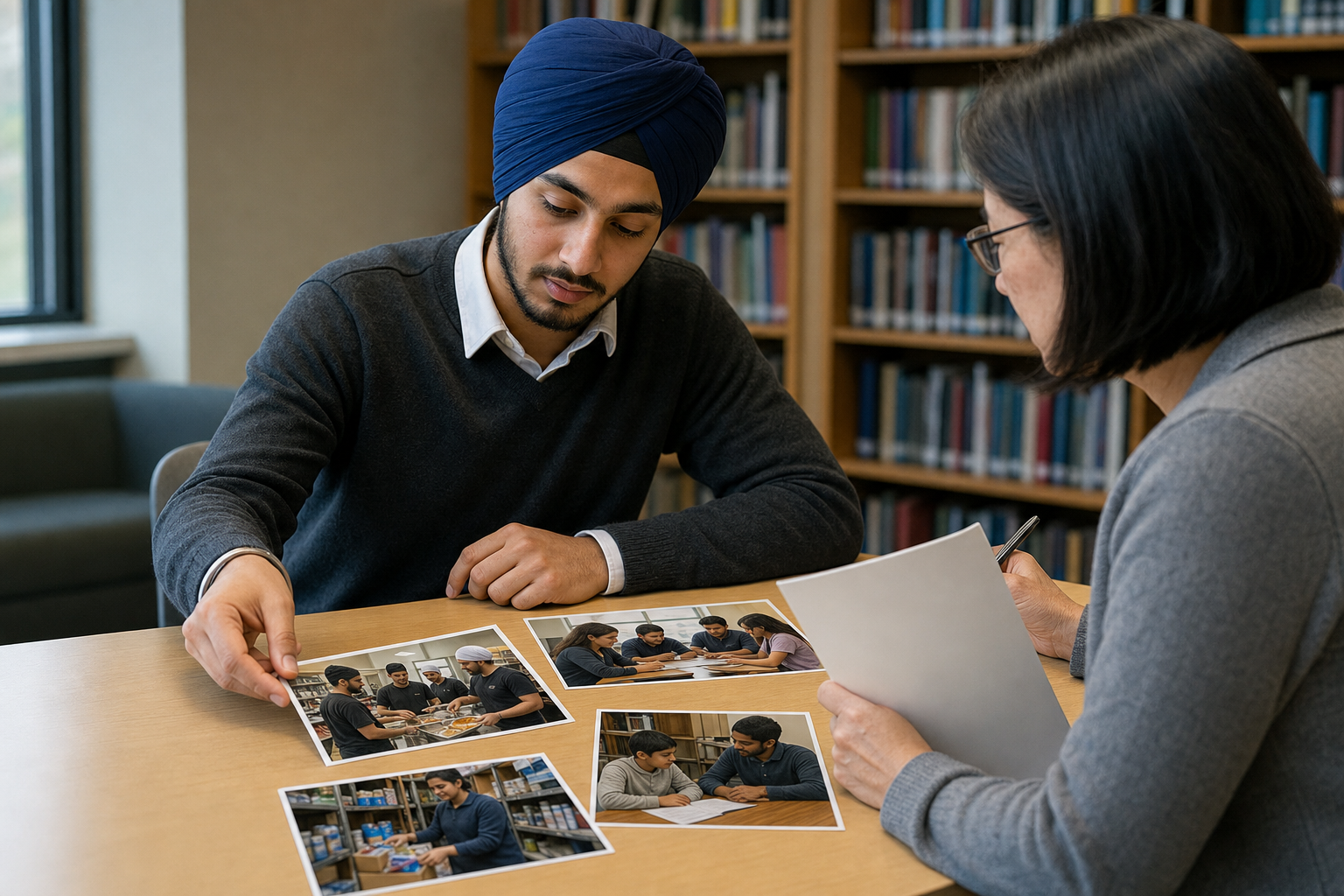
Sikh applicants are often told to discuss what makes them distinctive. That instruction can produce two bad outcomes: a generic identity statement with no evidence, or an intimate explanation of faith written mainly for an unfamiliar evaluator. Neither is necessary. The stronger approach is to show what the applicant did, why it mattered, and what capacity it demonstrates.
Seva, Punjabi-language preservation, kirtan, gatka, and youth leadership can belong in a competitive portfolio when they are presented with the same discipline applied to research, employment, or formal extracurricular work. For each experience, ask:
- What responsibility did the applicant personally hold?
- Who depended on the work, and what need was being met?
- What planning, judgment, teaching, coordination, or problem-solving did the work require?
- What changed because of it?
- What evidence could verify the scope or outcome?
- How does the experience connect to the course, profession, or responsibility being pursued?
A useful drafting pattern is: context, responsibility, method, verifiable result, and relevance. Instead of writing only, “I participated in seva,” an applicant can build a sentence such as: “I coordinated [activity] for [community served], addressed [specific problem] by [method], and produced [verifiable outcome].” The brackets must be replaced with facts. If a number was never recorded, do not manufacture one; describe the scope and result in accurate terms.
The same evidence should remain consistent across the resume, essay, recommendation, and interview. A referee can be given a brief evidence sheet listing the applicant’s responsibilities and confirmed outcomes. That is more useful than asking the referee to repeat broad praise or to explain Sikh identity on the applicant’s behalf.
Interview preparation should include a calm bridge back to merit when an identity-related question arises. The applicant can correct a misunderstanding, state the relevant need, and return to the qualification being assessed. For example: “My kirpan is an article of faith. I would like to understand the written policy for this setting and the process for requesting an accommodation.” The applicant does not need to apologize for asking, speculate about policy, or turn faith into a hardship narrative merely to appear compelling.
This is also where a disciplined application lab earns its value. Reviewers should check whether a draft demonstrates academic readiness, professional judgment, service, leadership, or resilience rather than merely naming those qualities. The goal is not to make every application sound alike. It is to make the evidence legible without stripping it of its Sikh context.
Make religious accommodation an institutional workflow

Equity begins where mentorship stops. A mentor may help an applicant frame a question, but the institution must publish the route for answering it. If applicants have to depend on private contacts or repeatedly educate each interviewer, the system is transferring its own responsibility to the person seeking entry.
| Moment | What the applicant needs | What the institution should own | Evidence that the process works |
|---|---|---|---|
| Before applying | A visible way to ask about the dastar, unshorn hair, kirpan, kara, prayer breaks, or another practice | A published policy, named contact, and confidential request route | The applicant can find the route without relying on an informal introduction |
| Assessment or interview | Questions tied to academic or role requirements | Reviewer guidance and a procedure for separating merit assessment from accommodation decisions | The request reaches the responsible office without derailing the interview |
| Offer or enrolment | A clear response and practical implementation | A documented handoff among admissions, student services, security, human resources, or other responsible teams | The agreed arrangement is confirmed before the applicant enters the setting where it is needed |
| Early study or employment | A safe route for correcting a failure or misunderstanding | A known escalation contact and a record of the agreed arrangement | The applicant does not have to restart the explanation with every new office or supervisor |
Cultural-competence training should be equally practical. Staff need to recognize Sikh articles of faith without assuming that every Sikh observes the same practices. They should ask questions relevant to the course or role, protect private information, and route accommodation questions to a trained decision-maker. They should also know that curiosity is not a reason to make the applicant conduct an impromptu lesson during an assessment.
An applicant can use a concise written request: “I observe [practice]. I am requesting [specific adjustment] for [process or setting]. Please identify the applicable policy, the person responsible for the decision, and any information required from me.” Specificity helps everyone distinguish the actual request from assumptions about it.
A general template cannot determine a person’s legal entitlement. Policies and legal duties vary by institution and jurisdiction. If a request is denied, delayed past a consequential deadline, or made conditional on abandoning a religious practice, ask for the decision and its basis in writing. Then use the institution’s equity, student-services, union, or human-resources process as applicable, and obtain qualified local legal advice when the consequences warrant it.
Turn community goodwill into an accountable program

No single gurdwara, university office, or professional association has to carry the entire program. The work becomes sustainable when each partner owns a defined part of it. Gurdwaras can reach applicants and families. Universities can provide policy contacts and admissions literacy. Professional associations can recruit sector mentors. Community and Dharmic organizations can run application labs, peer cohorts, and scholarship directories.
The scholarship directory needs an owner, not merely a shared document. Each entry should identify eligibility, required materials, deadline information, and when the information was last checked. Applicants should still verify the terms before acting, but visible maintenance prevents an outdated opportunity from being mistaken for current guidance.
Peer cohorts should have a similarly clear purpose. They can provide deadline accountability, practice audiences, and moral support without becoming spaces for comparison or disclosure pressure. Set confidentiality expectations at the start. Reflection or mindfulness drawn from Dharmic traditions can help applicants recover focus and ethical clarity, but participation should not be compulsory or treated as a replacement for professional mental-health support when that is needed.
Cooperation across Hindu, Buddhist, Jain, and Sikh communities can expand the pool of mentors, scholarship knowledge, and institutional relationships. Shared commitments such as seva, satya, and ahimsa can support common work, but unity must not blur Sikh-specific questions. An allied mentor may be the right person for research strategy or interview practice; a Sikh mentor or informed policy specialist may still be needed for the religious and institutional context. Unity is credible when it adds capacity while preserving identity.
Accountability requires more than testimonials. Track applications completed, offers received, scholarships or financial aid secured, retention, applicant satisfaction, and whether requested accommodations were adopted. Keep participation and identity data voluntary, collect only what the program needs, and protect confidentiality. Read the measures as a pathway: strong essay feedback means little if applicants still cannot find the accommodation process, while admission alone is incomplete if the student leaves because promised support never materializes.
Review the pathway after every application cycle. Look for the stage where applicants stalled, the guidance mentors could not provide, the policies institutions failed to explain, and the directory entries that had gone stale. Then assign each repair to a named owner before recruiting the next cohort.
You can begin with two working documents: an applicant journey showing each decision and handoff, and an accommodation contact sheet naming the responsible institutional office. Take them to a gurdwara and an institutional or professional partner, and ask each organization to own a specific line. That division of responsibility is how goodwill becomes mentorship, and how mentorship begins to produce institutional equity.
References
