
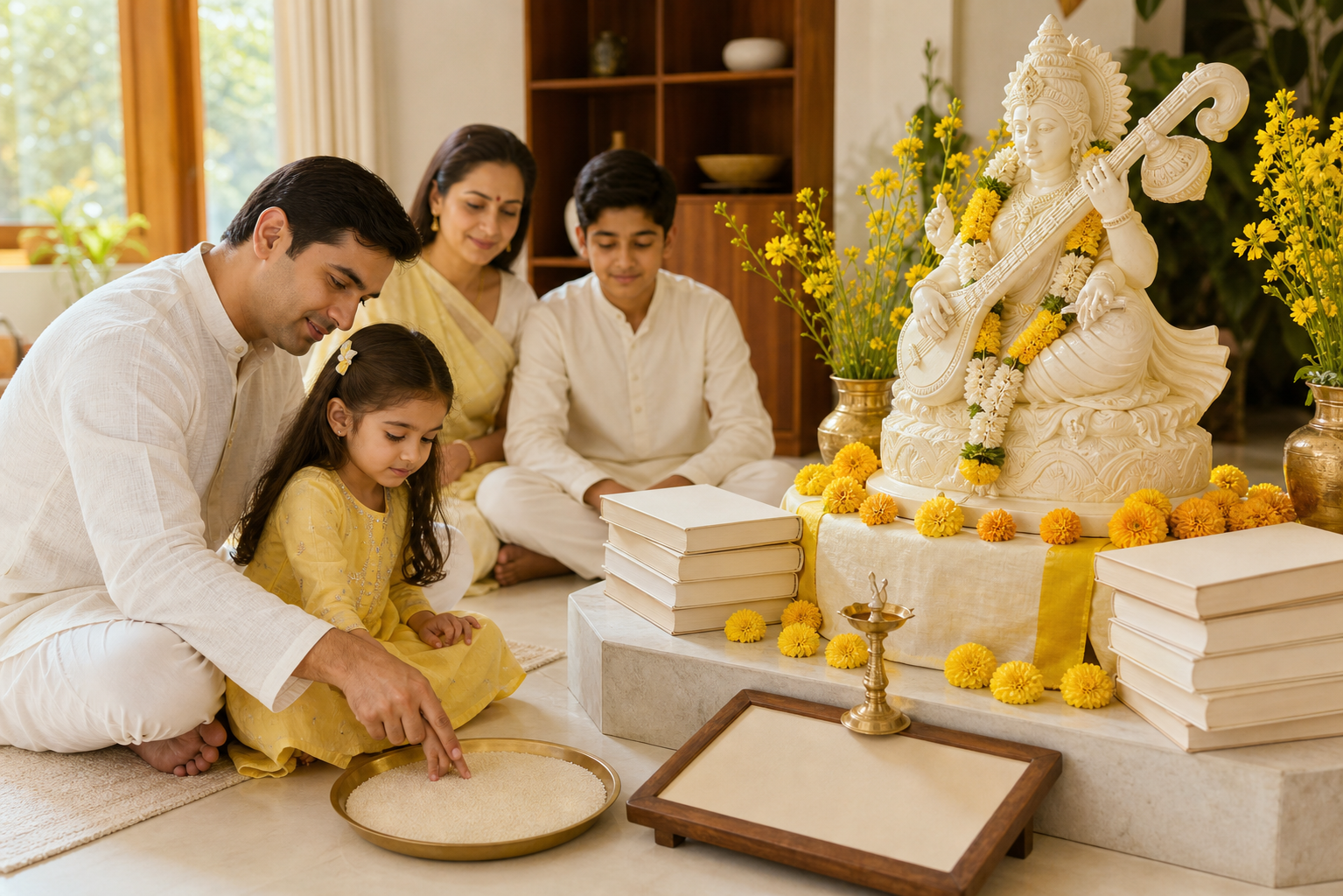
If you are arranging Vasant Panchami for your family, you probably need two answers: when should the puja happen, and can the same occasion be used for a child’s Vidyarambham? In 2026, Vasant Panchami falls on 23 January. The local worship time still needs to be checked, because a lunar Tithi does not follow a midnight-to-midnight civil calendar.
You can combine Saraswati Puja with a first-learning rite when that agrees with your family tradition. If your parampara reserves formal Vidyarambham for Vijayadashami, keep that custom and use Vasant Panchami to bless books, renew studies, or begin a new discipline. The purpose is not to manufacture a uniform ceremony. It is to place learning under dharmic discipline and divine grace.
Set the date first, then obtain a local muhurat
Vasant Panchami is Magha Shukla Panchami, the fifth lunar day of the bright fortnight in Magha. Saraswati Puja is generally performed while Panchami Tithi prevails during Purvahna, or the forenoon. The exact clock time depends on the local sunrise and the Tithi’s beginning and ending times. That is why the Panchami Tithi and local place of observance matter more than a time copied from another city.
Use the Panchang for the place where the ceremony will actually occur. This is especially important for families outside Bharat: a muhurat circulated from Delhi, Kolkata, Chennai, or Hyderabad should not automatically be converted as though it were an ordinary appointment. Ask a local temple, priest, or trusted regional Panchang to confirm:
- whether Panchami Tithi prevails during the local forenoon;
- the recommended Saraswati Puja window for your city;
- whether your tradition applies Rahu Kalam or Yamagandam restrictions to the proposed Vidyarambham;
- whether the child’s nakshatra or a family observance changes the preferred initiation time.
A household Saraswati Puja does not always require the same degree of individual timing as a formal samskara. If you are initiating a child, regional custom, family lineage, and child-specific guidance deserve greater attention. Once a trusted local authority confirms a suitable window, stop collecting conflicting forwarded timings and plan around that decision.
Prepare an altar that keeps learning at the centre
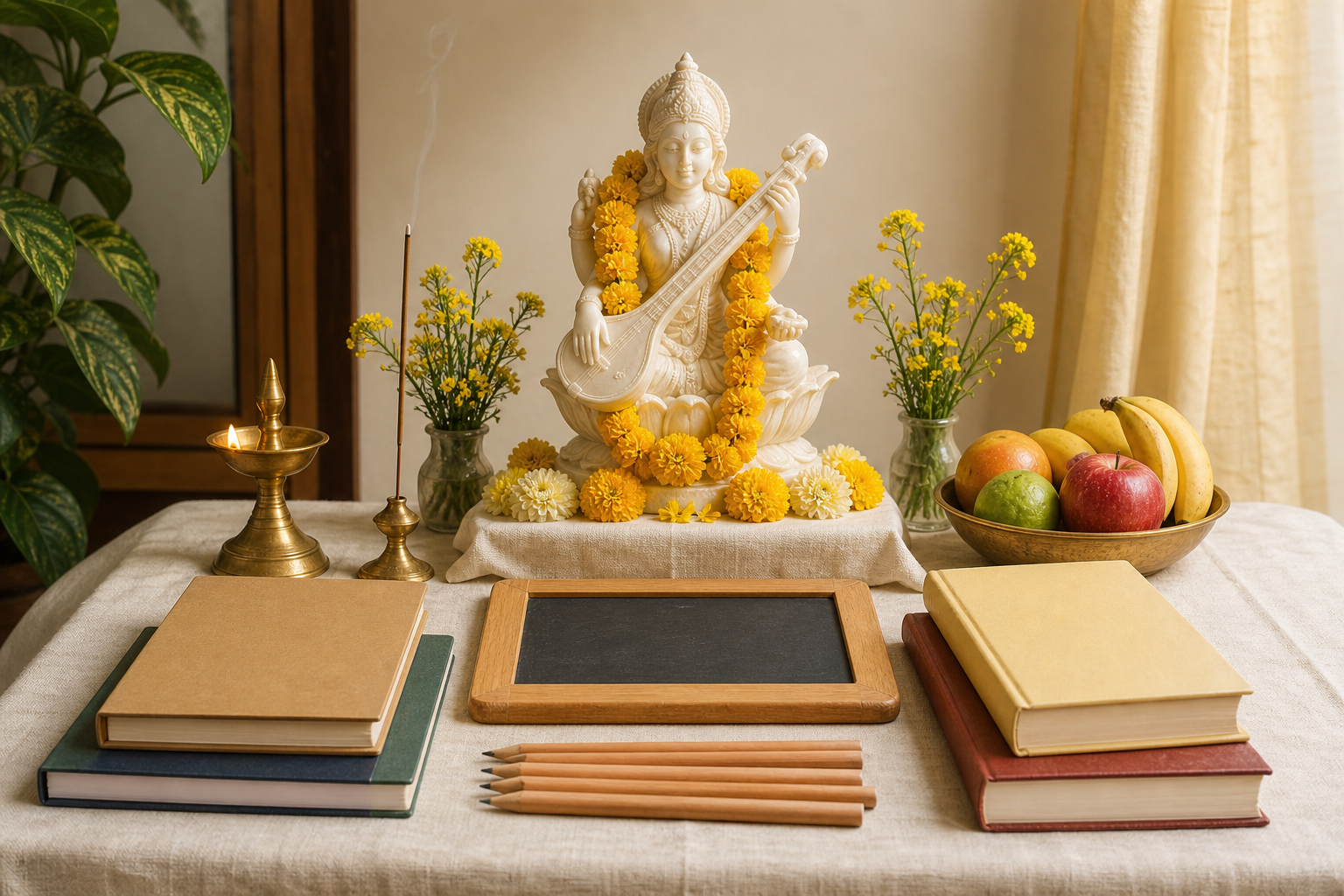
You do not need an elaborate arrangement. Clean the worship area and the study space the previous evening. Choose a calm place where the child, books, lamp, and offerings can be handled without haste. Yellow garments and flowers evoke the basanti colour of spring, but books, instruments, tools, and the act of learning are the heart of the observance.
Set aside the following before the muhurat begins:
- a murti or image of Devi Saraswati, according to your household practice;
- a diya, incense if used in your home, and supplies for aarti;
- yellow or white flowers, turmeric, kumkum, and akshata;
- a simple sattvic naivedyam and water;
- a current textbook, notebook, pen, musical instrument, art material, or professional tool;
- a shallow tray of clean rice or fine sand if Vidyarambham will be performed;
- a clearly printed prayer sheet so nobody has to search for a mantra during worship.
Choose representative objects instead of crowding the altar with everything the family owns. A student might place the book currently being studied. A musician can place the instrument used in daily practice. A writer, craftsperson, teacher, or professional can offer the tool through which knowledge becomes useful work. This makes the ritual personal without turning the altar into a display.
If a young child is participating, complete the setup before bringing the child to the worship space. Keep the child rested, comfortable, and free from pressure to perform for photographs. A peaceful first encounter with letters is more faithful to Vidyarambham than a perfectly staged but exhausting event.
Follow a simple Saraswati Puja sequence
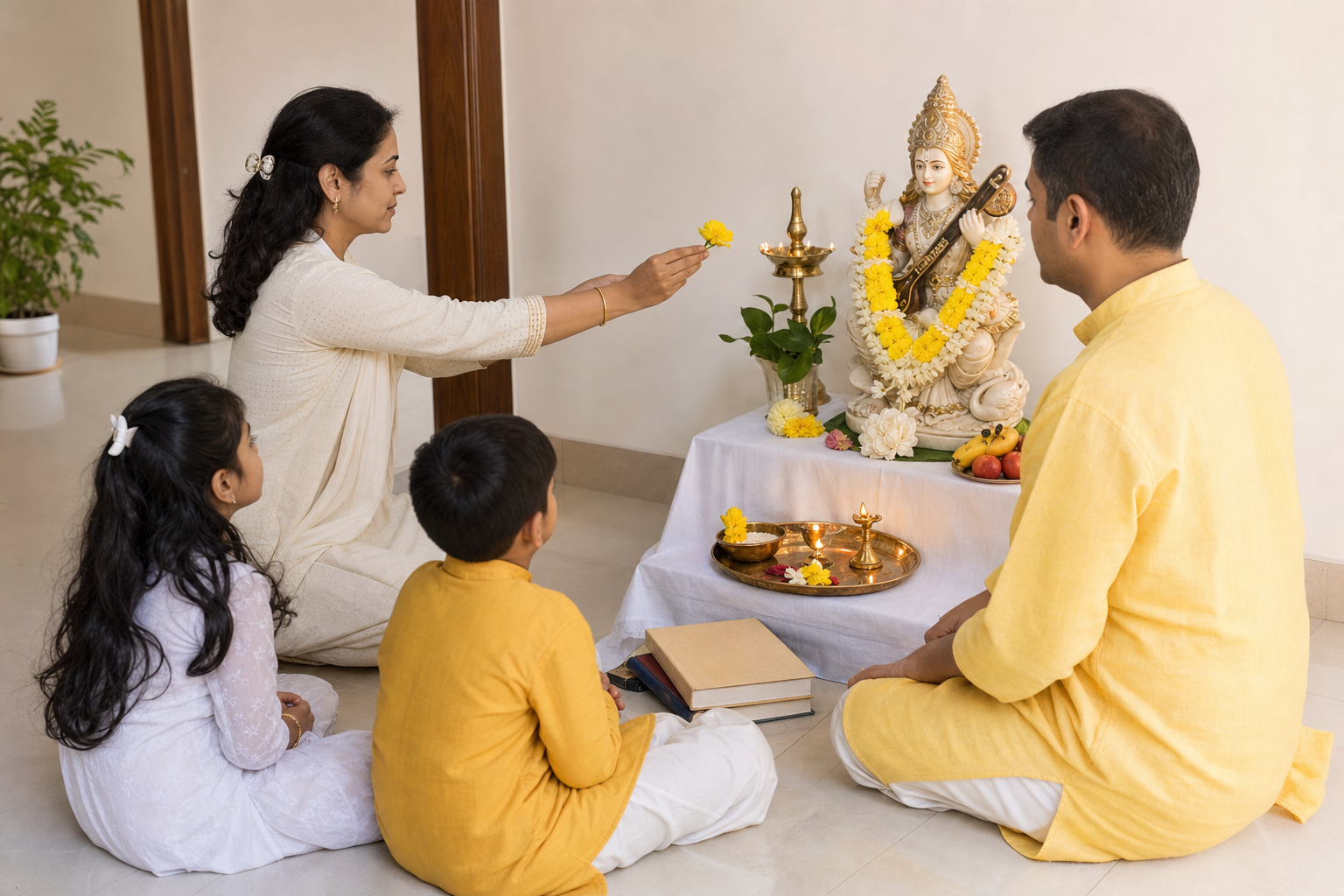
Your family’s paddhati takes precedence when one has been handed down. Where no detailed household procedure is available, the following sequence keeps the worship coherent and manageable:
- Settle everyone before the altar, light the diya, and take a clear sankalpa. State who is worshipping and whether the intention concerns study, teaching, music, writing, speech, research, craft, or a child’s initiation.
- Invoke Ganesha according to your custom, especially when beginning Vidyarambham, and then turn your attention to Devi Saraswati.
- Offer flowers, akshata, and naivedyam. Place the selected books, writing tools, instruments, or work implements respectfully near the altar.
- Recite a Saraswati dhyana shloka, stotra, or mantra that your family knows. Correct, steady recitation is preferable to attempting a long unfamiliar text.
- Sit quietly for a short period after chanting. Let the worship include silence as well as sound.
- Perform aarti, seek the blessings of elders and teachers, distribute prasadam, and proceed to Vidyarambham if it forms part of the plan.
- After the worship, complete one real act of learning: read a passage, write a few careful lines, practise a musical exercise, or organize the next study session.
A widely used simple invocation is Om Aim Saraswatyai Namah. Another familiar prayer is Saraswati Namastubhyam, Varade Kamarupini; Vidyarambham Karishyami, Siddhir Bhavatu Me Sada. It asks for Saraswati’s grace as learning begins. Devotees may choose a manageable repetition count such as 9, 11, 27, or 108, but a count should support attention rather than become a hurried target.
Pronunciation and parampara matter. If your family uses a longer stotra, Saraswati Gayatri, or a particular mantra recension, learn it from a knowledgeable teacher or elder. Sincerity is essential, but sincerity also includes the humility to learn a sacred formulation correctly. Mantra can gather the mind around a noble intention; it does not replace study, sleep, practice, or ethical conduct.
Make Vidyarambham gentle, brief, and meaningful
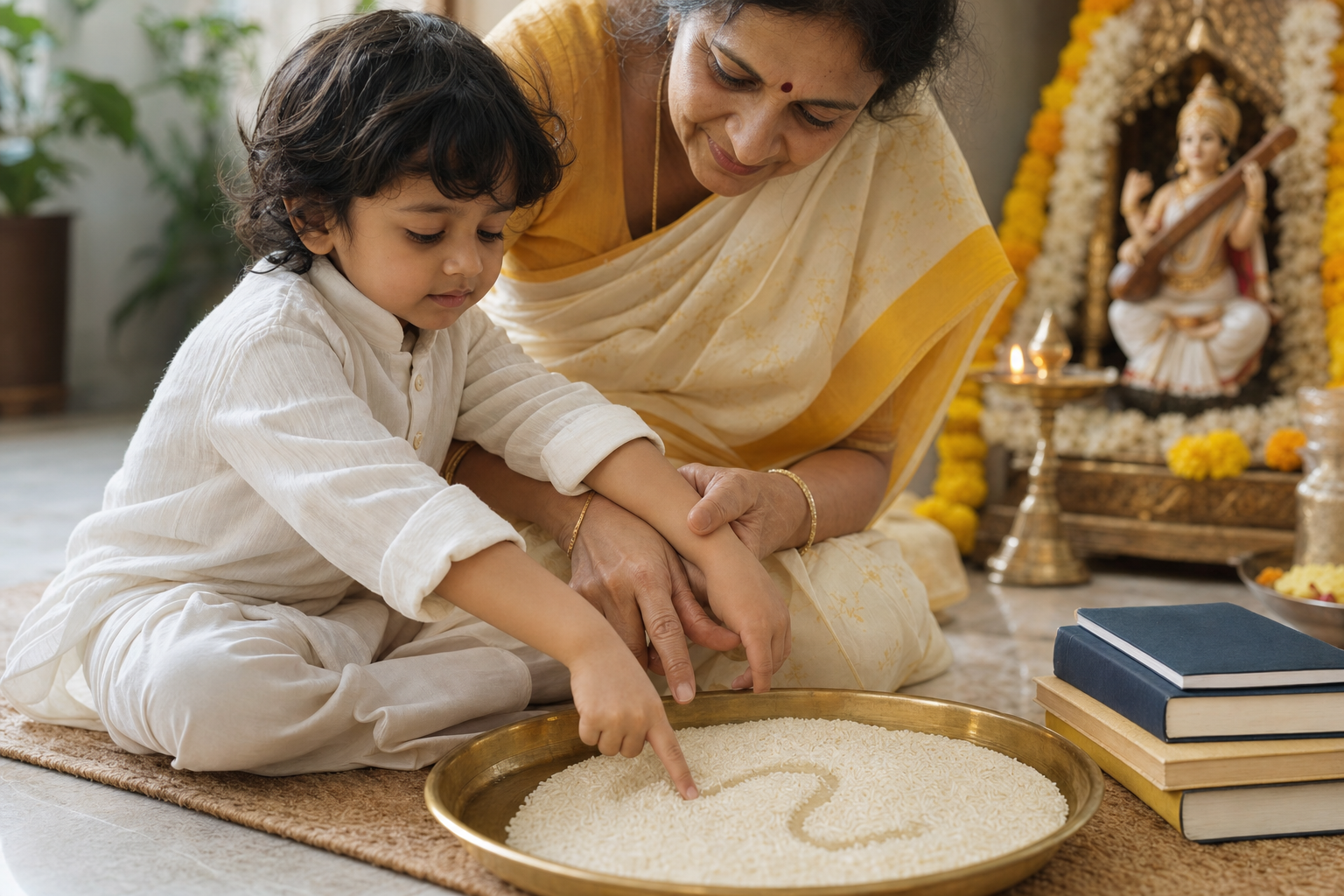
Saraswati Puja and Vidyarambham are related but not identical. Saraswati Puja venerates the source and disciplines of knowledge. Vidyarambham, also called Aksharabhyasam, Akshara Sweekaram, or Ezhuthiniruthu in different regional settings, marks a child’s formal entry into letters and purposeful learning.
Use this child-centred sequence after the main invocation:
- Seat the child comfortably beside a parent, grandparent, guru, or teacher. Position the rice or sand tray where the child’s hand can move without strain.
- Offer brief prayers to Ganesha and Saraswati according to family custom.
- Let the elder gently guide the child’s hand. A commonly used opening is Om Hari Sri Ganapathaye Namah.
- Continue with the child’s name or the first letters used in the family’s language and learning tradition.
- Offer akshata, receive blessings from elders, perform aarti if it was not already completed, and give prasadam.
- End while the child is still comfortable. The first lesson should leave room for curiosity, not become a handwriting examination.
The rice tray is symbolic, so the first strokes do not need to be neat. If the child hesitates, the elder can demonstrate and invite participation without forcing the hand. Readiness, regional custom, and the child’s comfort should guide the experience more than the desire for a particular photograph or performance.
Many traditions strongly associate formal Vidyarambham with Vijayadashami and the closing Saraswati observances of Navaratri. If that is your family’s established practice, Vasant Panchami need not replace it. On 23 January, the child can offer a book, hear the Saraswati prayer, trace a familiar letter, or renew an existing course of study without treating the occasion as the full samskara.
Key takeaways for 23 January 2026
- Date: Vasant Panchami and Saraswati Jayanti fall on 23 January 2026, during Magha Shukla Panchami.
- Time: Use a local Panchang or temple-confirmed muhurat. Do not assume that one city’s clock time applies everywhere.
- Puja: Keep the altar clean and focused, with a lamp, flowers, simple naivedyam, and representative books, instruments, or tools.
- Chanting: Choose a prayer you can recite steadily and respectfully. Follow your parampara for longer mantras and regional variations.
- Vidyarambham: Combine it with Vasant Panchami only when this suits your family custom. Keep the child comfortable and the first writing brief.
- Follow-through: Complete one act of study, teaching, reading, writing, or artistic practice after worship so that the sankalpa enters daily life.
The wider dharmic family expresses reverence for knowledge through distinct traditions: Saraswati worship, right knowledge, disciplined inquiry, literacy, shabad, insight, and compassionate understanding. These forms should not be collapsed into one ritual. Their shared civilizational lesson is that learning carries an ethical responsibility. Knowledge should refine speech, deepen humility, and become service.
Your next step is straightforward. Mark 23 January, obtain the muhurat for your location, decide whether you are performing Saraswati Puja alone or adding Vidyarambham, and prepare the representative book or tool the night before. Once the timing is settled, give your attention to the atmosphere: a calm child, a steady prayer, and a real return to learning.
References
- DharmaRenaissance Blog — Saraswati Puja Stotras for Basant Panchami and Navratri: Powerful Mantras, Meaning, and Practice
- DharmaRenaissance Blog — Vasant Panchami Wishes and Saraswati Puja Quotes: Heartfelt Greetings and WhatsApp Status Ideas
- DharmaRenaissance Blog — Auspicious Saraswati Jayanti 2026 (Vasant Panchami): Date, Meaning, and Puja Guide for Magh
- DharmaRenaissance Blog — Vasant Panchami 2026 Muhurat: Auspicious Saraswati Puja Date, Meaning, and Traditions
- DharmaRenaissance Blog — Aksharabhyasam 2026 Muhurthams: Auspicious Vidyarambham Days, Steps, and Parental Guide
