

If you are trying to place nine nights of Shyamala worship, a near-midnight tithi change, and Ratha Saptami on one family calendar, the dates can look more complicated than the observance needs to be. The key is to keep two things separate: the civil date tells you when to prepare, while the local tithi tells you how to make the ritual sankalpa.
In 2026, Shyamala Navaratri extends from January 19 through January 27, covering Magha Shukla Pratipada through Navami. Ratha Saptami falls within that nine-day cycle on January 25. You can therefore follow one steady Shyamala practice across the festival while giving Sashti and Saptami their own appropriate emphasis.
The 2026 dates that actually affect your observance
Do not treat every Gregorian date as though its tithi begins at midnight. A tithi is a lunar division calculated from the changing angular relationship of the Sun and Moon, so it can begin or end at any clock time. That distinction matters especially on January 24.
| Date | Magha Shukla marker | What to plan |
|---|---|---|
| January 19, 2026 | Shukla Pratipada | Begin Shyamala Navaratri with sankalpa, a clean altar, and a realistic nine-day discipline. |
| January 24, 2026 | Panchami changes to Sashti | One local calculation places the change at 12:08 AM, leaving almost the entire civil day under Sashti. Verify the time for your city. |
| January 25, 2026 | Shukla Saptami | Observe Ratha Saptami at local sunrise while continuing the regular Shyamala Navaratri practice. |
| January 27, 2026 | Shukla Navami | Conclude the nine-day vrata or household discipline with prayer, gratitude, study, and an act of giving or service. |
For January 24, the available calculation keeps Panchami until 12:08 AM and places the remainder of the day in Sashti. This is useful for planning, but it is not a universal clock time. Your longitude, latitude, time zone, and chosen Panchang method can change the displayed transition. If you live outside India, copying an Indian city’s time is particularly likely to produce an incorrect local sankalpa.
Build the nine days around one sustainable daily practice
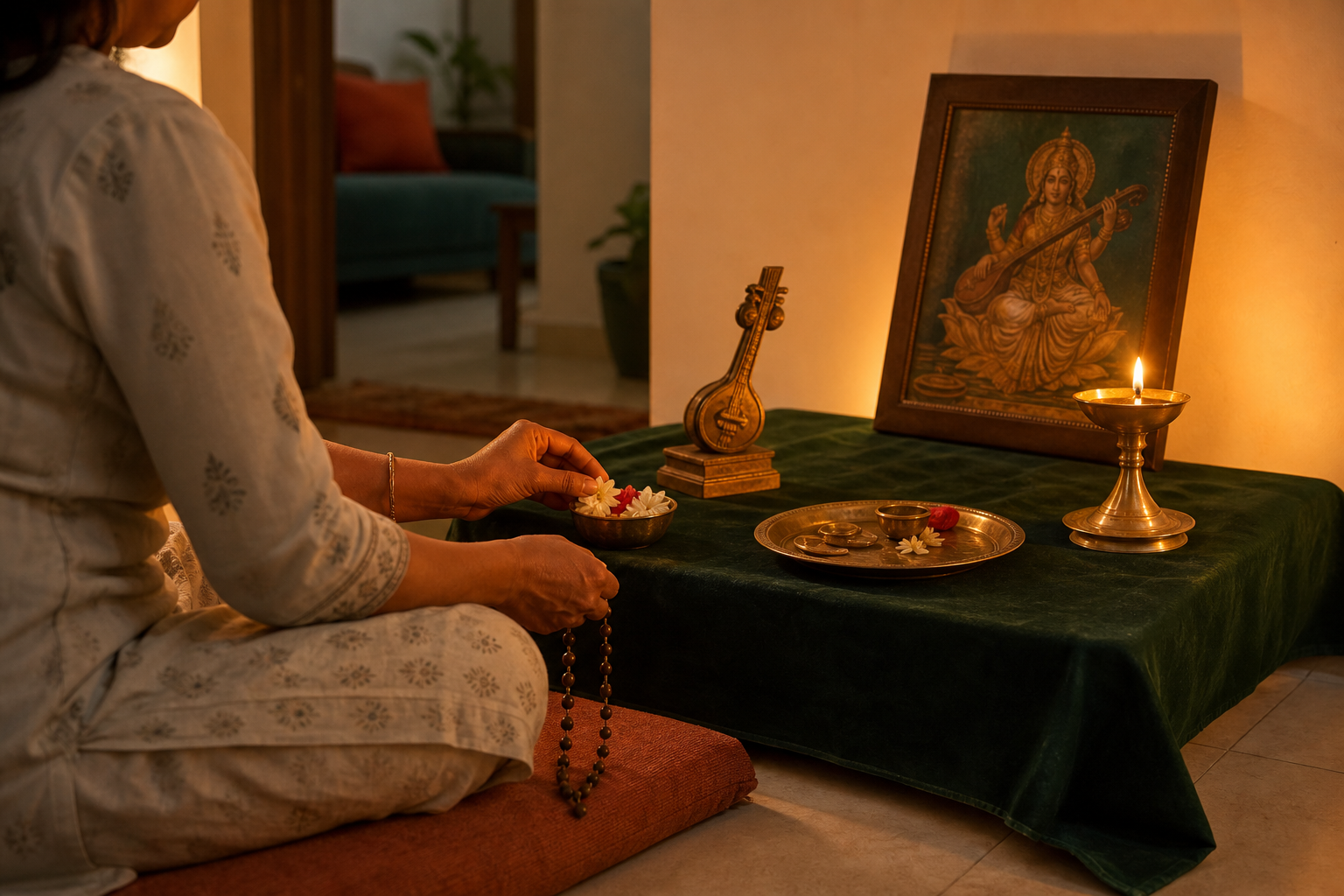
Shyamala is revered in Shakta traditions as a form of the Divine Mother associated with vak, refined speech; buddhi, discerning intelligence; vidya, knowledge; music; and creative expression. That gives the festival a practical center. Your observance should make your speech more truthful, your study more attentive, and your work less scattered. More ritual activity without those changes misses the discipline at the heart of the festival.
A household practice can remain simple without becoming casual. Use the same basic order each day:
- Prepare the place. Clean the altar and arrange a deepa, flowers, water, and a modest sattvic naivedya. Consistency matters more than adding new items every night.
- Make sankalpa and sit for dhyana. State the observance, the day, and your intention in the form used by your family or temple. If you do not know a formal Sanskrit sankalpa, do not fabricate one; make a clear devotional resolve in language you understand.
- Offer the puja you have received. Perform Panchopachara or Shodashopachara Puja if that is your customary form. Otherwise, offer the lamp, flowers, prayer, and naivedya with care.
- Recite within your tradition. Shyamala Dandakam, an established Saraswati or Shakta stotra, or nama-japa received through your parampara can form the recitation. Do not improvise with a mantra presented as initiation-bound.
- Keep a daily study commitment. Read a manageable portion of a respected text, learn a hymn, or give undistracted attention to music or another art. Choose an amount you can complete on all nine days.
- Practice restraint in speech. Before repeating criticism, ask whether it is true, necessary, and appropriately expressed. Shyamala worship becomes concrete when vak, thought, and action begin to agree.
- Close with archana or aarti. Offer naivedya, sit quietly for a moment, and dedicate the benefit of the practice beyond yourself through kindness or seva.
If your lineage does not prescribe a separate form for each night, you can use a nine-quality reflective arc: humility, clarity, learning, creativity, discipline, harmony, courage, devotion, and fulfillment. Treat this as a household aid, not as a replacement for a lineage’s ritual sequence.
- Humility: begin as a student rather than as someone seeking spiritual display.
- Clarity: identify the one habit of confused thought or careless speech you most need to correct.
- Learning: study a passage closely enough to explain its meaning in your own words.
- Creativity: offer music, writing, drawing, recitation, or another disciplined art rather than passive entertainment.
- Discipline: keep the commitment even when the initial enthusiasm has faded.
- Harmony: notice where your words, intentions, and actions contradict one another.
- Courage: speak a needed truth without using truth as permission for cruelty.
- Devotion: offer the work itself, not merely its visible result.
- Fulfillment: close the cycle with gratitude, sharing, and a decision about what practice will continue.
Although Shyamala Navaratri is a Hindu Shakta observance, its disciplines of learning, ethical speech, self-examination, compassion, and service are intelligible across the wider Dharmic family. That shared moral ground should not be used to make Hindu, Buddhist, Jain, and Sikh rites interchangeable. Unity is strongest when common values are recognized without erasing distinct teachings and practices.
Give Sashti and Ratha Saptami distinct roles
January 24: let Sashti test your steadiness
Shukla Sashti is associated with disciplined practice and steady progress. Because the January 24 transition occurs just after midnight in the timing available here, a daytime household observance will fall in Sashti under that calculation. Use the day to strengthen continuity rather than enlarge the ritual.
This is the point in a nine-day discipline when novelty often gives way to repetition. That is not a defect. Light the same lamp, recite the practice you selected, finish the study you promised, and pay particular attention to speech. If the first five days produced several ambitious resolutions, Sashti is the day to retain the one you can actually sustain.
January 25: place Ratha Saptami inside the Navaratri rhythm
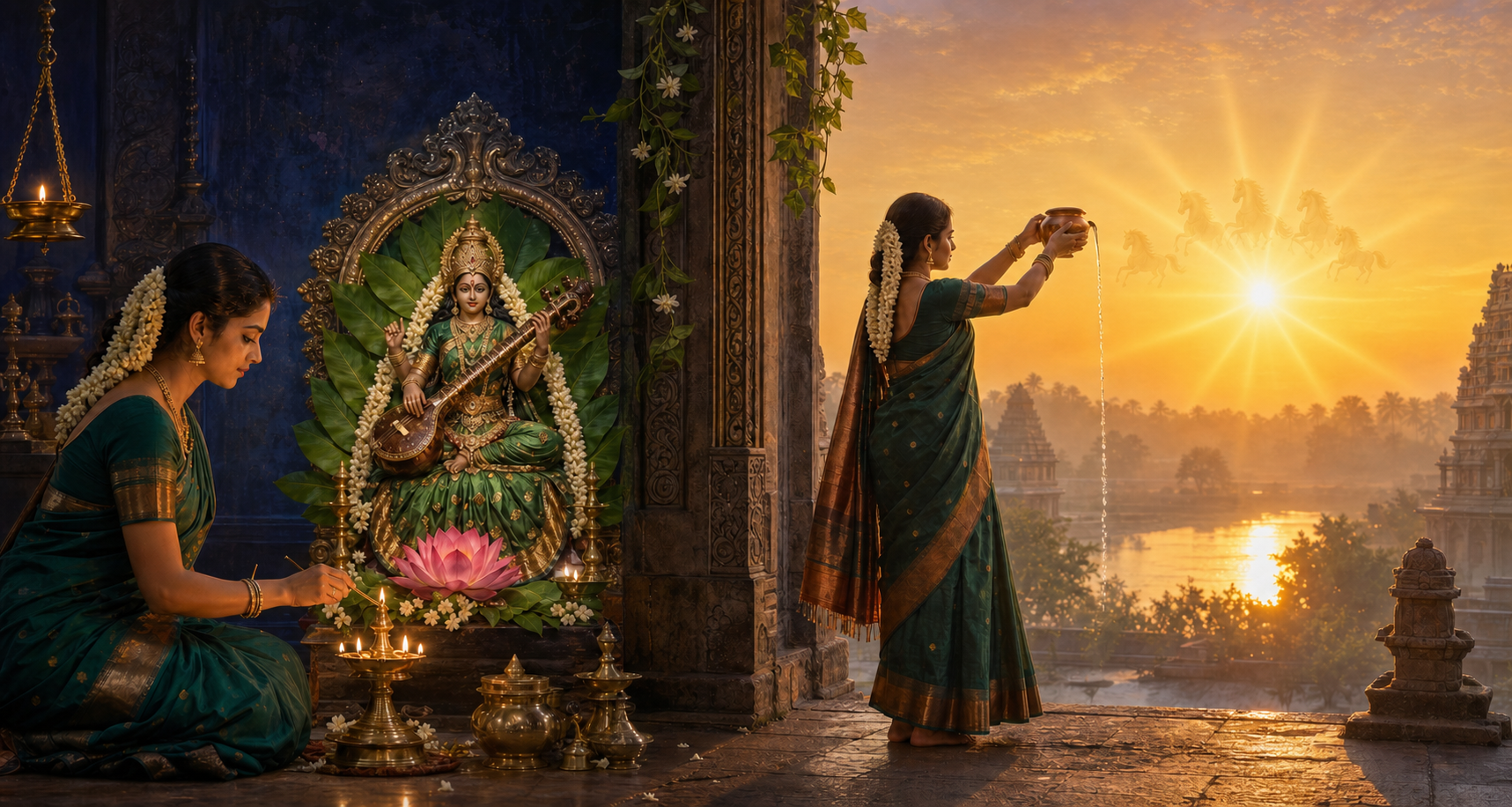
Magha Shukla Saptami is observed as Surya Jayanti, Ratha Saptami, Saur Saptami, or Achala Saptami. In 2026 it falls on January 25 and is centered on local sunrise. You do not have to choose between the solar observance and Shyamala Navaratri. Keep their intentions distinct and place both within the same day.
- Before sunrise: bathe and prepare the arghya vessel, lamp, and prayer space. The bath should remain consistent with practical safety and your household custom; austerity is not measured by making it hazardous.
- At local sunrise: face the rising Sun and offer arghya to Surya Bhagwan with gratitude for light, order, time, and life-sustaining energy.
- After arghya: perform Surya Namaskar according to your ability and customary practice. Treat it as embodied reverence, not as a test of athletic performance.
- For recitation: use Aditya Hridayam or the Surya prayers established in your family tradition.
- For the Navaratri observance: perform the regular Shyamala puja at its usual time. The solar worship need not displace the daily discipline of study, careful speech, and devotion.
Some regional customs place arka leaves on the head, shoulders, and torso during the ritual bath, while some households draw a rangoli or kolam representing Surya’s ratha. Follow these only where they belong to your known family or regional practice. A simple sunrise arghya offered attentively is better than assembling unfamiliar customs from disconnected calendars.
Check four local details before making your sankalpa
A Panchang is not merely a festival list. Tithi, nakshatra, rashi, sunrise, and muhurta arise from related astronomical calculations, but they are not interchangeable labels. A date carrying Sashti or Saptami does not mean every hour on that date is automatically a general-purpose shubh muhurta.
- Tithi beginning and ending: verify the Magha Shukla tithi times for the city where you will actually perform the observance.
- Local sunrise: this is essential for Ratha Saptami. Use January 25 sunrise for your location, not a time copied from another region.
- Local sunset and temple schedule: check these if your evening puja, community recitation, or conclusion depends on a fixed window.
- The rule used by your family or temple: when a tithi crosses sunrise or ends during the day, different observances may apply different calendrical conventions. Follow the convention of the temple, priest, or parampara guiding the ritual.
For a simple daily home puja, a repeatable time is usually more workable than searching for a new muhurta every day. Use the city-specific Panchang for date-sensitive elements, especially the January 24 tithi change and January 25 sunrise. If you are also planning a samskara or another formal ceremony, obtain its muhurta separately; the Navaratri date alone does not settle that question.
Key takeaways for a limited schedule
- If you can observe all nine days: begin January 19, keep one modest daily puja and study discipline, and conclude January 27.
- If work or family duties are heavy: preserve daily continuity with a lamp, prayer, recitation, and a small study commitment instead of making only the first and last days elaborate.
- If you can protect only one morning: reserve local sunrise on January 25 for Ratha Saptami, then continue Shyamala worship later that day.
- If you need ritual precision: verify your city’s tithi and sunrise rather than treating 12:08 AM or another region’s calendar as universal.
- If you do not have a prescribed Shyamala mantra: use a familiar public stotra, devotional name-recitation, or prayer already accepted in your tradition; do not invent an esoteric practice.
Before January 19, choose the local Panchang you will follow, select one recitation, write down one attainable study goal, and gather the few altar items you genuinely need. When January 27 arrives, keep the discipline that improved your speech or learning instead of packing it away with the festival materials.
References
- DharmaRenaissance Blog – January 24, 2026 Panchang Guide: Exact Tithi Change, Shukla Sashti Meaning, and Dharmic Harmony
- DharmaRenaissance Blog – Surya Jayanti 2026 (Magh Saptami): Auspicious Date, Rituals, and the Radiance of Unity
- DharmaRenaissance Blog – Shyamala Navaratri 2026: Dates, Pooja Guide, and the 9 Nights of Knowledge & Harmony
