

You may be trying to reconcile two features of Hindu life that seem to point in opposite directions. The Upanishadic vision speaks of one ultimate reality, yet a temple presents you with distinct deities, stories, mantras, powers, duties, and forms of worship. If Brahman is one, where does this immense plurality come from?
The contradiction eases once you stop treating Brahman as one object among other objects. Brahman names the ground of reality; Shakti names its power of manifestation. The many do not have to be fragments cut from the One. They can be real expressions of a reality that never ceases to be undivided.
Brahman is not one object, and Shakti is not a second God

Ordinary oneness is numerical. One lamp stands beside a second lamp, and both occupy a world larger than themselves. Brahman cannot be understood that way. In a nondual account, Brahman is not the first member of a cosmic collection. It is that outside which no independent reality can stand.
Shakti therefore does not need to be imagined as a second, competing substance. Within nondual Shakta and Advaita interpretations, Brahman and Shakti distinguish two aspects of one reality for the sake of understanding: the Absolute as unconditioned reality and the same Absolute as power, expression, movement, and transformation.
This is why the name Vikarini is so helpful. Derived from vikāra, or transformation, it presents Devi as the power through which subtle possibility unfolds into experienced form. Through Shakti, the unmanifest becomes intelligible as time, space, causality, name, and form. Shakti is not merely a force operating inside an already completed universe. She is the dynamic principle by which a universe can appear at all.
The expression that the One becomes many must therefore be handled carefully. It does not require a moment at which Brahman broke apart. Time itself belongs to manifestation, so the relation cannot be reduced to an ordinary before-and-after event. The language points instead to an undivided ground encountered through countless distinctions.
A practical map keeps the terms clear:
- Brahman answers the question of what is ultimately real.
- Shakti names the power by which reality manifests, sustains, moves, and transforms.
- Nāma-rūpa, name and form, describes the differentiated patterns through which you encounter a world.
- Jīva is the individual standpoint from which separation, limitation, desire, and action are experienced.
- Moksha, in the nondual map, is not the manufacture of unity but the recognition that the deepest Self was never separate from Brahman.
These are not necessarily five chronological stages. They answer different questions about the same field of experience. Remembering that distinction prevents two common mistakes: turning Shakti into a rival to Brahman, or calling the living cosmos meaningless because Brahman alone is ultimate.
Why many divine forms do not contradict the formless
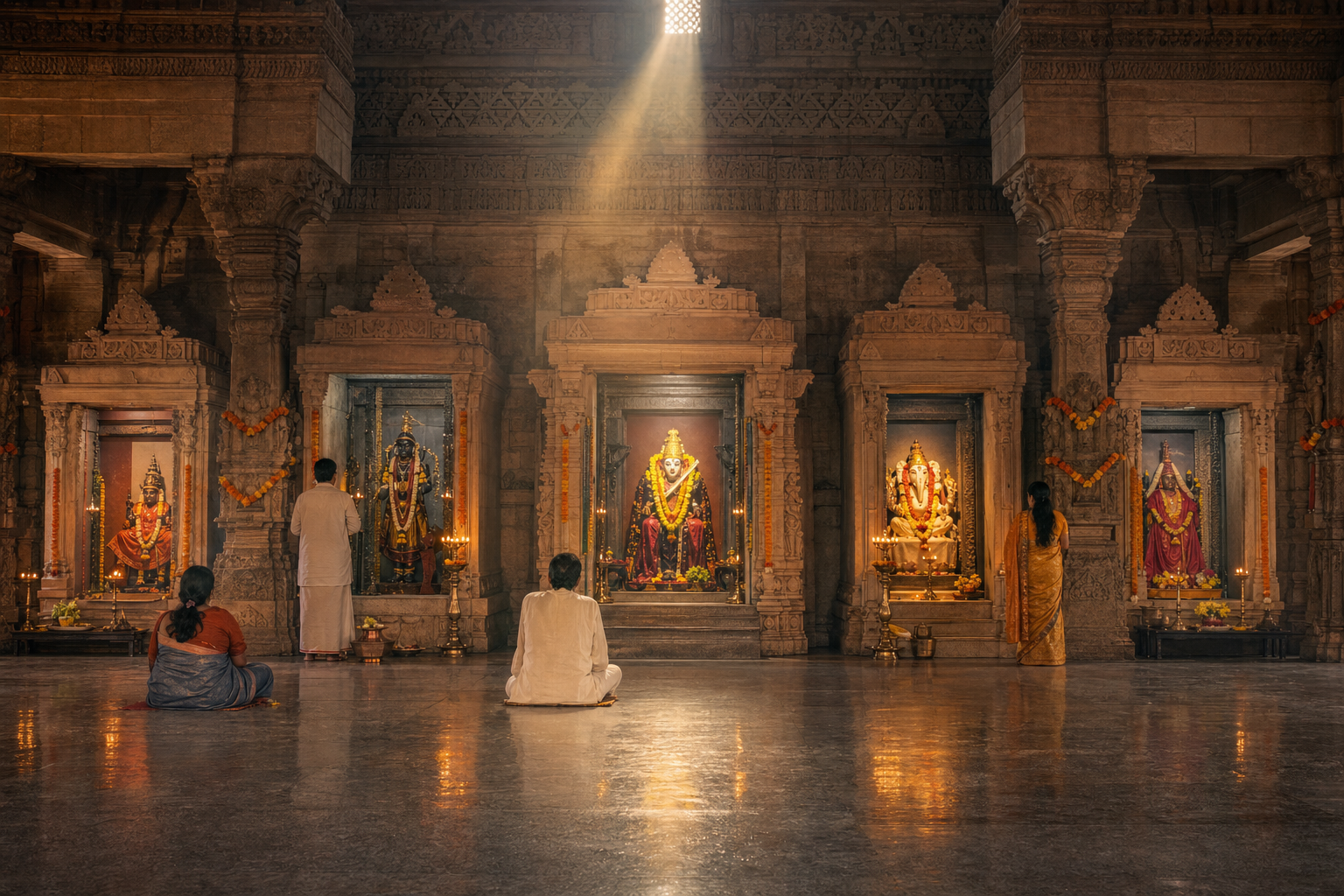
A form can be dependent without being worthless. Your name does not contain the whole of your being, but it allows another person to address you. A mantra, image, or divine name similarly gives attention a definite relationship through which it can approach what exceeds every definition.
This makes the Hindu principle of Ishta more than a concession to personal taste. A chosen form gives devotion a centre. It lets you love, serve, remember, and surrender without claiming that the limitless Divine is imprisoned inside that one form. Your chosen deity can be a complete focus of worship without becoming grounds for contempt toward another devotee’s path.
Māyā is also easily mishandled here. If you use it as a synonym for a worthless hallucination, you miss the role that manifestation plays in spiritual life. Māyā names the ordering through which the undivided is encountered through distinction. Those distinctions may not be ultimate or independent, but hunger, grief, responsibility, beauty, and harm still matter within lived experience.
The formless and the formed can therefore correct different errors. Contemplation of the formless stops you from treating one image, concept, or identity as an exclusive possession of the Divine. Worship through form stops metaphysics from becoming emotionally sterile. One loosens fixation; the other trains attention, love, gratitude, and discipline.
Choose your immediate practice according to the obstacle actually in front of you:
- If your understanding is clear but your heart remains distant, approach a chosen form through bhakti, mantra, pūjā, or remembrance.
- If you are trapped in the belief that you are only a separate personality, contemplate Tat tvam asi and examine what you mean when you say I.
- If spiritual ideas disappear during work and conflict, practise karma yoga by performing the necessary action without making personal reward the sole measure of its value.
- If change itself is creating resistance, contemplate Shakti as Vikarini. Observe transformation in breath, thought, emotion, and circumstance without assuming that every event is therefore morally good.
That last qualification matters. Calling transformation sacred does not place every choice beyond ethical judgment. Shakti explains how becoming is possible; the language must not be used to excuse cruelty, negligence, or avoidable harm.
The school matters: keep real differences visible

Brahman, Shakti, Prakriti, māyā, and spanda do not function identically in every Hindu darśana. You will understand a teaching more accurately if you first ask which school is speaking and what problem its vocabulary is meant to solve.
- Advaita Vedānta directs attention to the undivided Absolute and treats liberation as knowledge that dispels avidyā. In its nondual reading, manifestation does not divide Brahman, and Shakti cannot possess an independent reality outside Brahman.
- Sāṃkhya explains cosmic evolution through the Purusha-Prakriti framework and the unfolding of tattvas. Its categories should not be silently replaced with Advaita language, even when the frameworks illuminate related questions about consciousness and manifestation.
- Shakta Tantra places Devi and sacred power at the centre. Manifestation is not a disposable side issue; the same Shakti who brings forth the cosmos becomes the focus of ritual, mantra, devotion, and realization.
- Kashmir Shaivism uses the language of spanda, primordial vibration or pulsation, to direct attention toward the dynamism of consciousness. Here movement need not imply a departure from nonduality.
Before repeating a philosophical formula, ask four questions: Is it describing ultimate reality, cosmic evolution, divine agency, or contemplative experience? Does it treat Shakti as explanatory language, as ontological power, or as Devi worthy of worship? What does it mean by the world being dependent? What kind of realization does it call liberation? These questions expose apparent contradictions that are often differences of framework.
The same discipline is needed when noticing resonances across the broader dharmic family. Buddhist dependent origination and śūnyatā illuminate the conditioned and interdependent character of form, but śūnyatā should not simply be renamed Brahman. Jain Anekāntavāda and the idea of modal change cultivate attention to the many-sided, changing character of reality, but they retain a Jain philosophical setting. Sikh proclamations of Ik Onkar, together with Kudrat and Hukam, affirm the One and a meaningful creative order without becoming a restatement of Advaita.
Resonance is a bridge, not an eraser. You can recognize a shared civilizational concern with unity, transformation, interdependence, and ethical life while allowing each tradition to define its own terms. This is a stronger form of respect than declaring every doctrine identical.
A daily way to see the One without ignoring the many

The one-to-many teaching becomes useful when it changes how you attend, worship, and act. You can use the following sequence at a home shrine, after mantra practice, or in a quiet place.
- Begin with what is actually present. Notice breath, sensation, sound, memory, and emotion. Do not reject multiplicity in order to imitate spiritual stillness.
- Notice transformation. See how each thought and sensation arises, changes, and passes. Treat this movement as a contemplative clue to Shakti, not as a proof that your preferred interpretation is the only valid one.
- Turn toward the ground of experience. Ask what is aware of these changes. In an Advaita practice, let Tat tvam asi challenge the assumption that awareness is merely one more passing object.
- Give the insight a form. Address your Ishta, repeat a mantra, offer a prayer, or rest in silent attention. Let the chosen method gather the scattered mind without turning the method into a boundary around the Divine.
- Carry it into one concrete action. Repair a needless conflict, restrain a harmful impulse, care for a living being, reduce a careless burden on the natural world, or complete a duty without demanding recognition.
- Review the result honestly. Ask whether the idea of unity made you more attentive to the person before you. If it made you dismiss difference, pain, or responsibility, you used an absolute truth to avoid a relative duty.
The ethical test is indispensable. If one light is present through living beings, compassion and ahimsa are not decorative additions to metaphysics. They are ways of refusing to treat another life as spiritually disposable. At the same time, unity does not require you to pretend that all conduct is equally dharmic. You can oppose a harmful action without denying the deeper dignity of the person who performs it.
Watch for four warning signs in your own practice:
- If nonduality makes you inattentive to suffering, it has become abstraction.
- If devotion produces contempt for other forms of worship, the chosen form has become an identity weapon.
- If reverence for transformation makes you passive toward wrongdoing, sacred process has been confused with moral approval.
- If meditation makes ordinary duties seem beneath you, insight has been separated from the conduct meant to embody it.
The movement back to One is not a flight from names and forms. It is a change in how you inhabit them. A role can be fulfilled without being mistaken for your whole identity. A deity can be loved without making the Infinite exclusive. A disagreement can remain real without turning the other person into an absolute other.
Key takeaways
- Brahman is not one cosmic object; in nondual thought, it is the undivided ground of reality.
- Shakti names the power through which the unmanifest is expressed as movement, transformation, time, space, causality, name, and form.
- The many are not necessarily pieces broken off from the One. They are differentiated expressions whose dependence does not make them meaningless.
- Ishta, mantra, pūjā, meditation, and karma yoga address different obstacles and can lead attention from form toward its limitless ground.
- Advaita, Sāṃkhya, Shakta Tantra, and Kashmir Shaivism use related terms differently; identify the framework before combining their claims.
- A sound understanding of unity should deepen ahimsa, responsibility, and respect for genuine difference rather than erase them.
At your next act of worship or contemplation, make one deliberate shift: see the form fully, then refuse to confine the Divine to it. Carry that same discipline into your next human encounter. Honour the distinct person before you while remembering that separateness is not the final truth.
References
- DharmaRenaissance Blog – From One to Many, Back to One: Profound Hindu Wisdom on Unity, Diversity, and Moksha
- DharmaRenaissance Blog – Vikarini, Divine Transformer: Shakti’s Creative Power and Cosmic Architecture in Hindu Thought
