
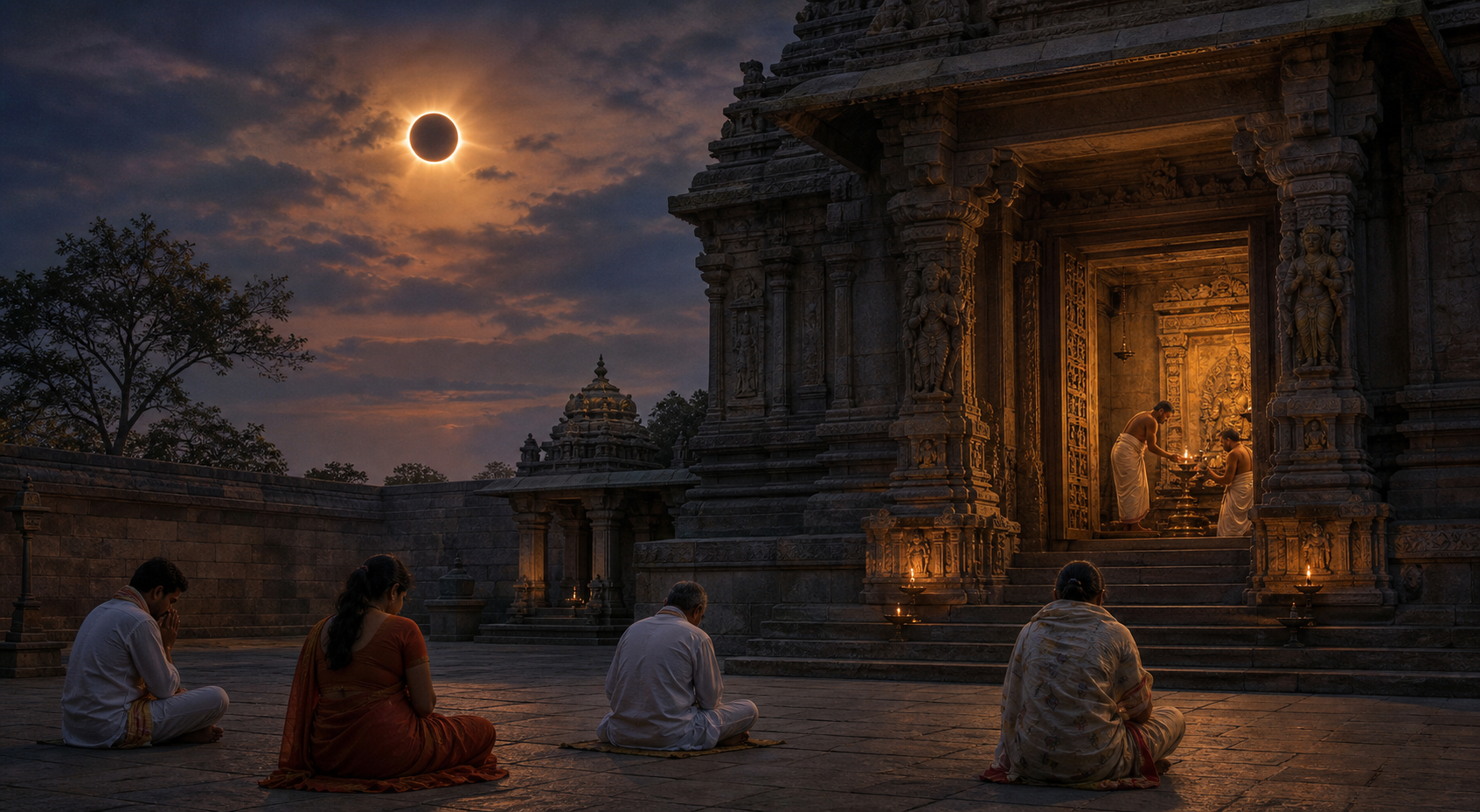
An eclipse is approaching, and the messages around your temple do not agree. One person says the doors must close. Another says worship must continue. A third insists that everything depends on family custom. Each may be answering a different question.
The practical way through is to separate three matters that are often confused: the deity’s regular seva, the public’s access to the temple, and your personal observance at home. Once those decisions are handled separately, a temple can preserve its discipline without dismissing local sentiment, and you can observe the eclipse without turning uncertainty into argument.
Separate the three decisions before giving an answer
When someone asks, “Is the temple closed during the eclipse?” the word “closed” is too vague to be useful. It might mean that visitors cannot enter, that public programs are paused, or that worship in the sanctum has stopped. Those are not the same condition.
- Determine the rule for deity seva. The temple’s authorized spiritual and ritual leadership must decide which scheduled services remain obligatory. Volunteers and social-media messages should not improvise a different rule.
- Determine the rule for public access. A temple may restrict entry because local devotees expect it, even while pujaris continue the established worship schedule inside.
- Determine what devotees can do elsewhere. Families may use the eclipse period for japa, kirtan, scriptural recitation, meditation, or another practice recognized within their own tradition.
This distinction prevents the most common misunderstanding: a pause in public darshan does not necessarily mean that the deity has been left without service. Temple notices should name the exact change instead of using an unexplained phrase such as “closed for eclipse.”
In ISKCON, seva continues even when public entry pauses
Within ISKCON, the Deity Worship Ministry’s position is that regular daily deity worship continues during an eclipse. Arati, bhoga, alankara, and related scheduled seva are therefore maintained rather than suspended merely because an eclipse is occurring.
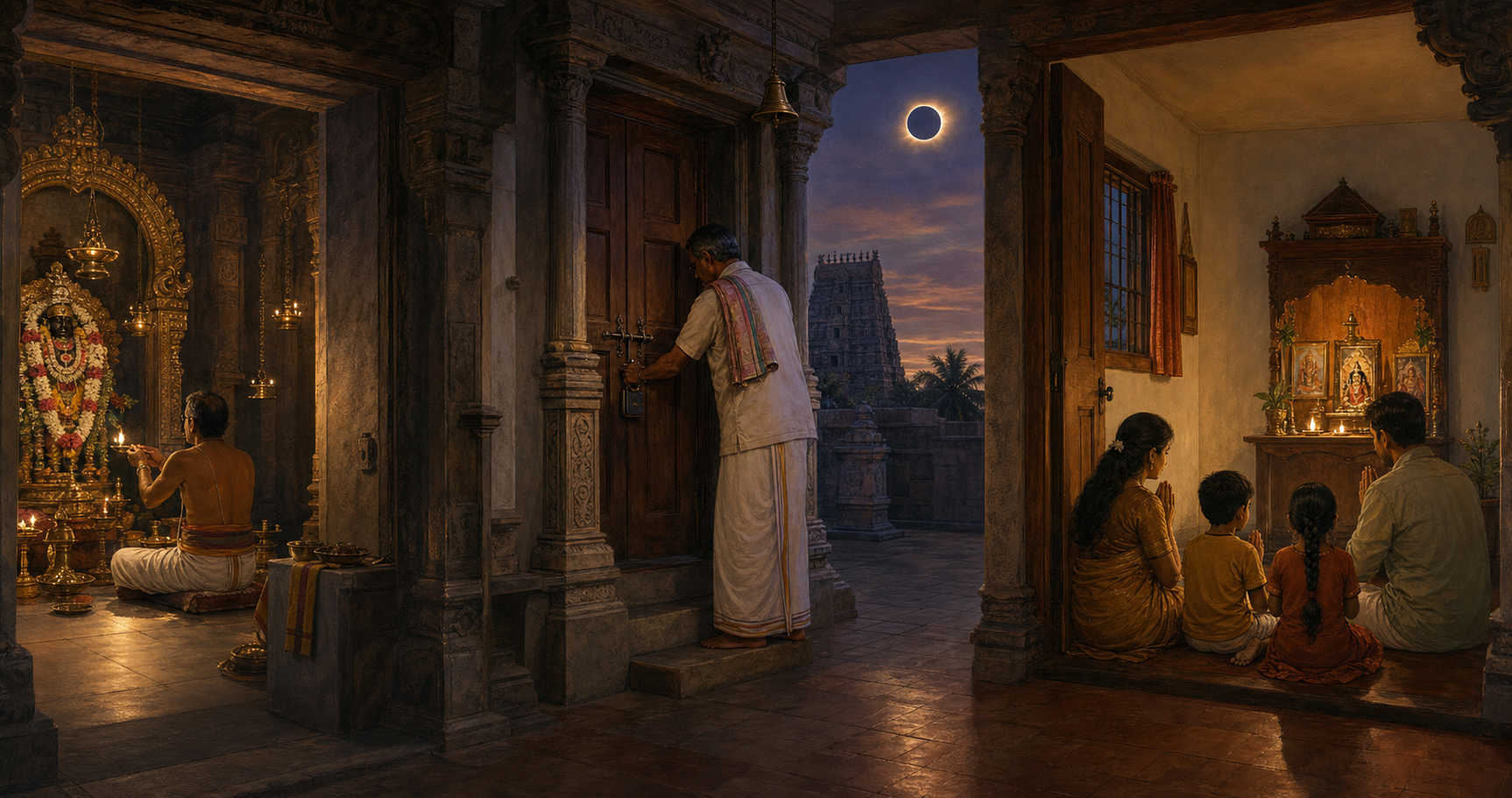
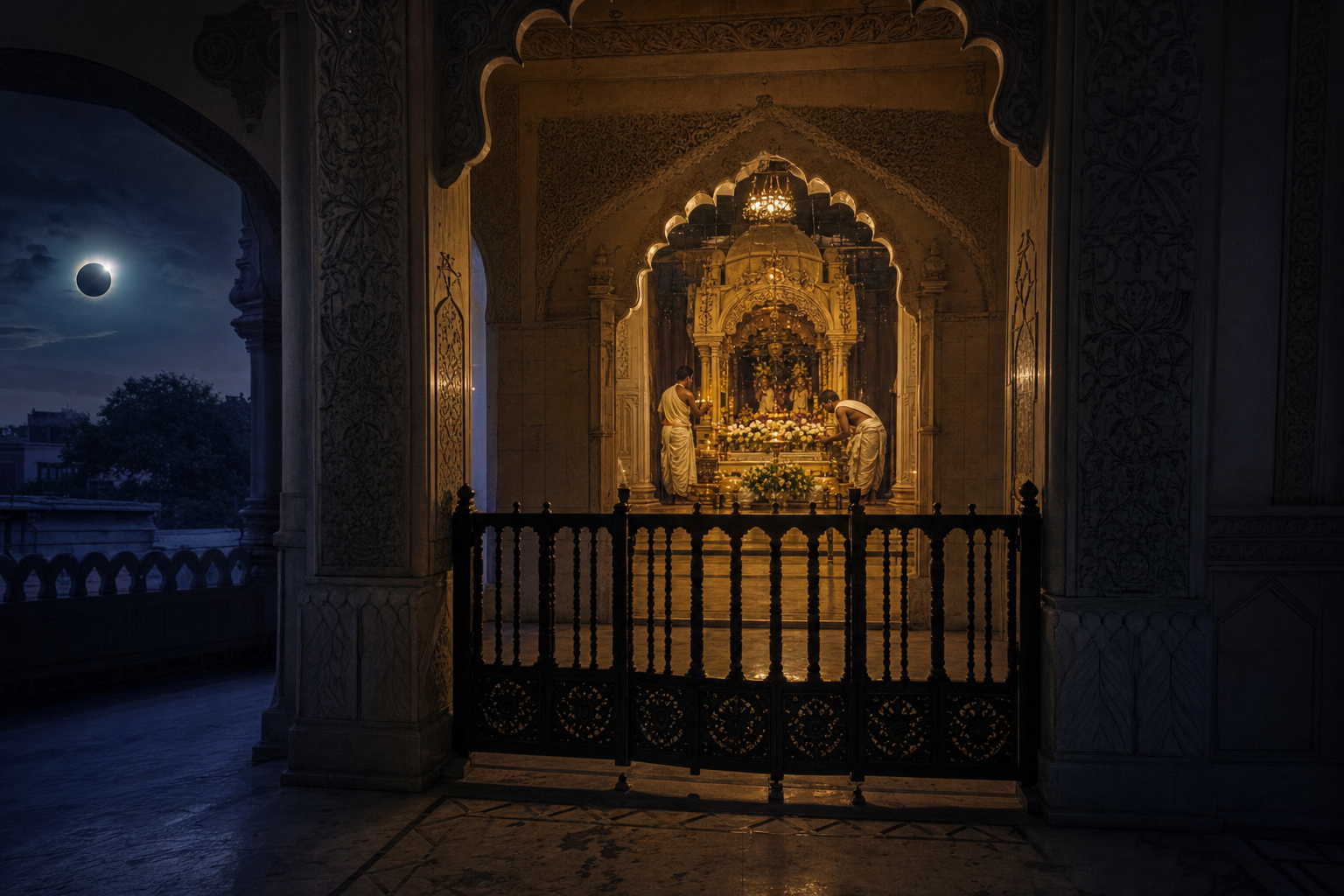
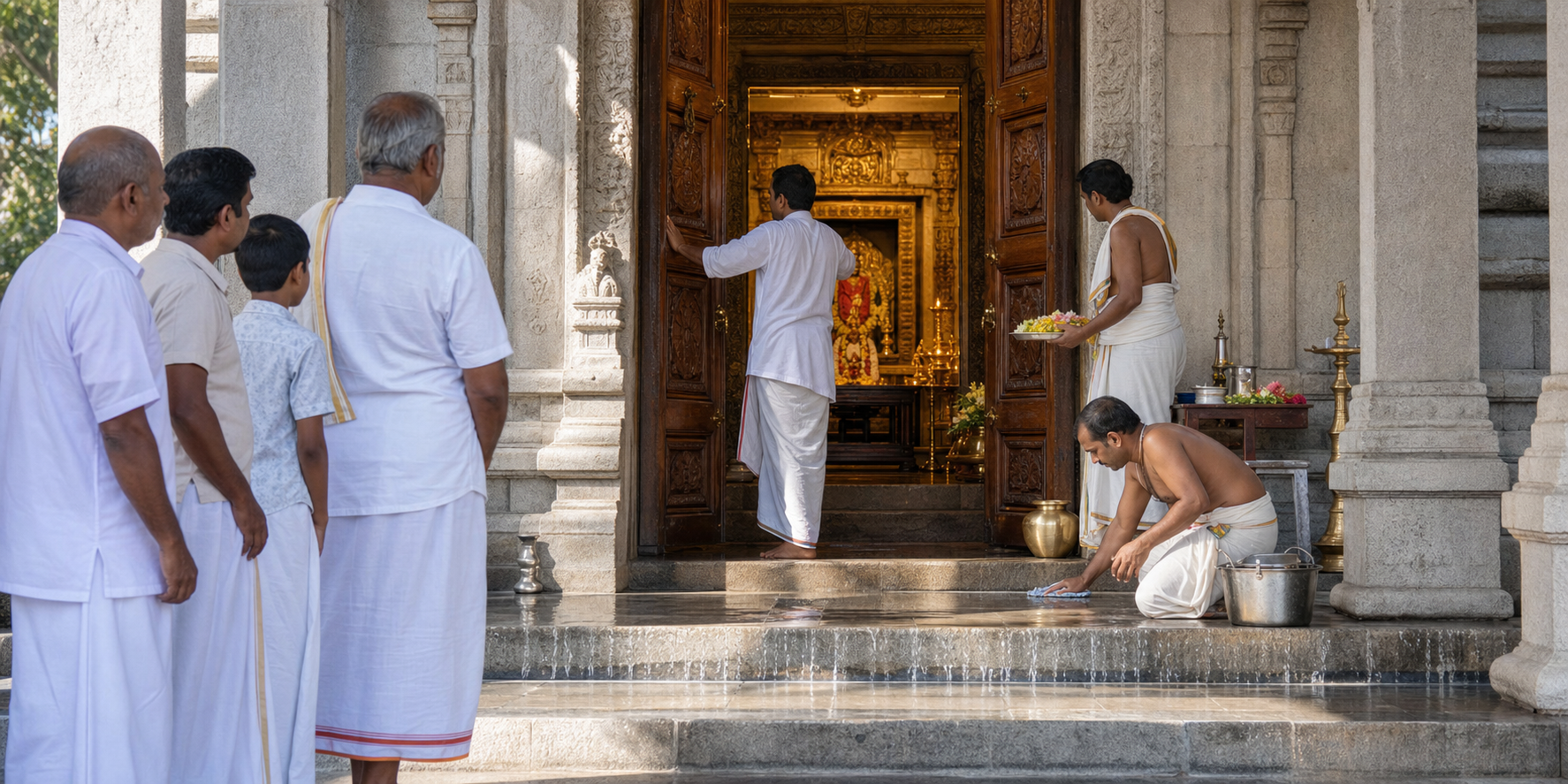
Public access is a separate administrative decision. Where local feeling about solar or lunar eclipses makes an open temple likely to cause distress or conflict, an ISKCON centre may temporarily close to visitors while the full worship schedule continues privately. That arrangement protects both devotional continuity and community harmony.
If you are preparing the announcement, use precise language: “Public darshan will pause during the eclipse; scheduled deity seva will continue in the sanctum.” Add the access period and the planned reopening information recognized by your centre. This tells pujaris what remains required and tells devotees what the closure actually means.
If your temple does not belong to ISKCON, do not turn this institutional rule into a universal rule for every mandir. Confirm the procedure with the authority responsible for your temple’s parampara. Dharmic traditions share reverence and discipline, but they do not erase differences in ritual jurisdiction.
Build a temple protocol for before, during, and after the eclipse
A reliable eclipse plan should fit on one page. Its purpose is not to settle every theological question. It is to ensure that the people responsible for worship, access, communication, and reopening know what they must do.
Before the eclipse
- Record the eclipse period recognized by the temple and identify who has authority to approve the final procedure.
- List each scheduled seva that overlaps that period, including arati, bhoga, alankara, and any related service maintained by the temple.
- Assign the authorized pujaris and supporting volunteers. A public closure should not create confusion about who may enter to perform seva.
- Decide whether darshan and other public activity will continue, be limited, or pause temporarily.
- Publish one consistent notice stating the access arrangement, whether scheduled worship continues privately, what devotees may do at home, and when the next update or reopening will occur.
Give volunteers the same wording used in the public notice. Contradictory answers at the gate or on community messaging groups can make an orderly accommodation look like a dispute over worship.
During the eclipse
- Maintain the approved seva roster rather than asking each pujari to decide independently.
- If visitors are not admitted, describe the restriction as a pause in public access, not as a suspension of deity worship.
- Direct devotees to the home practices already named in the temple notice. Avoid circulating new instructions midway through the observance unless the authorized leadership changes the plan.
- Keep the atmosphere devotional and orderly. The eclipse should not become an occasion for volunteers to debate competing customs with visitors.
After the eclipse
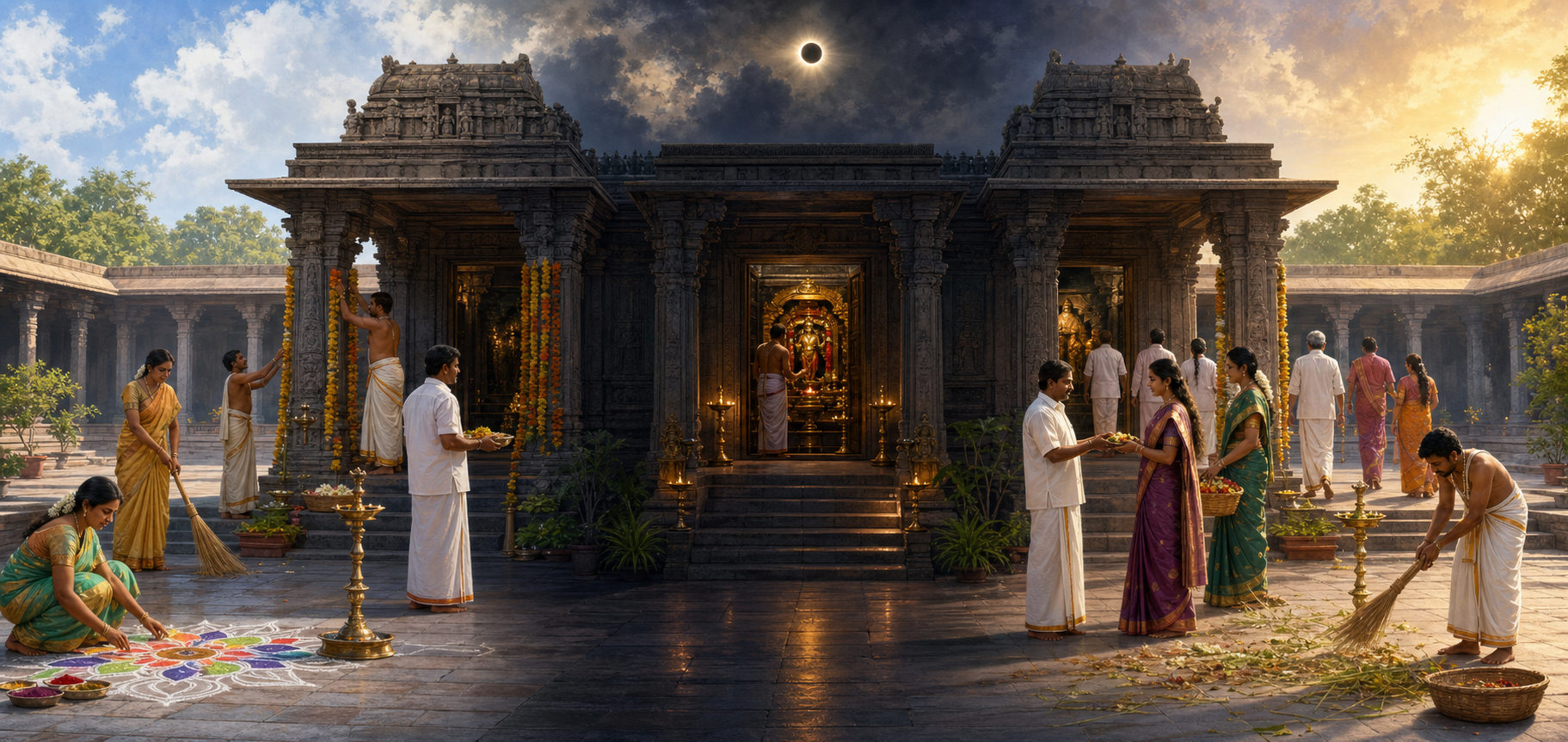
- Perform post-eclipse purification only as prescribed by the temple’s custom. Where customary, this may include snana, mantra, or another shuddhi-vidhi.
- Record that the scheduled seva and any prescribed purification were completed. This gives administrators a clear account if devotees later ask what occurred.
- Reopen or restore the normal program in accordance with the published notice, and communicate promptly if the timing has changed.
- Afterward, correct any unclear language in the written protocol so the next eclipse does not reproduce the same confusion.
Post-eclipse purification should not be invented by committee. Some communities observe it and others frame the period differently. The correct procedure is the one entrusted to the temple through its own authorized tradition.
Choose a home observance that belongs to your tradition
If public darshan is unavailable, you still have a meaningful way to use the eclipse hours. The safest starting point is a familiar practice already accepted by your guru, family tradition, sangat, sangha, or local religious community. An eclipse is not a reason to assemble an improvised ritual from unrelated traditions.
- In Hindu practice, devotees may emphasize japa, kirtan, scriptural recitation, or attentive support for the temple’s continuing seva. Some temple traditions also observe purification afterward.
- In Buddhist communities, the emphasis may fall on sustained meditation or chanting.
- In Jain practice, vrata, pratikraman, and careful attention to ahimsa may shape the observance.
- In Sikh practice, simran, kirtan, and seva offer a disciplined way to direct the period toward remembrance and service.
These are family resemblances, not interchangeable instructions. Meditation, vrata, simran, japa, and temple puja arise within distinct religious frameworks. Shared values such as self-discipline, reverence, ethical conduct, and service allow mutual respect without pretending that every community follows one eclipse ritual.
For a simple home plan, choose one recognized practice, prepare the text or mala you need in advance, and remove ordinary distractions for the period you intend to observe. If your temple recommends a particular mantra or reading, follow that direction. If it recommends charitable service, decide beforehand what service you can actually complete rather than leaving it as a vague intention.
When instructions conflict, ask a narrower question: “What does our temple or tradition ask its own members to do?” That is more useful than trying to discover a single rule that governs Hindu, Buddhist, Jain, and Sikh communities alike.
Key takeaways
- Deity seva, public temple access, and personal observance are three separate decisions.
- ISKCON centres maintain regular daily deity worship during an eclipse, although public entry may pause where local sentiment warrants it.
- A useful temple notice states what worship continues, whether visitors may enter, what devotees can do at home, and when normal access resumes.
- Post-eclipse snana, mantra, or shuddhi-vidhi should follow the local parampara rather than an improvised universal procedure.
- Buddhist, Jain, Sikh, and Hindu observances can share an orientation toward discipline and devotion without becoming one uniform practice.
Before the next eclipse, ask your temple to place its approved procedure in writing. If you are observing from home, save that notice and choose your practice before the eclipse begins. Clarity in advance leaves the eclipse hours for worship, reflection, and service rather than last-minute dispute.
References
