
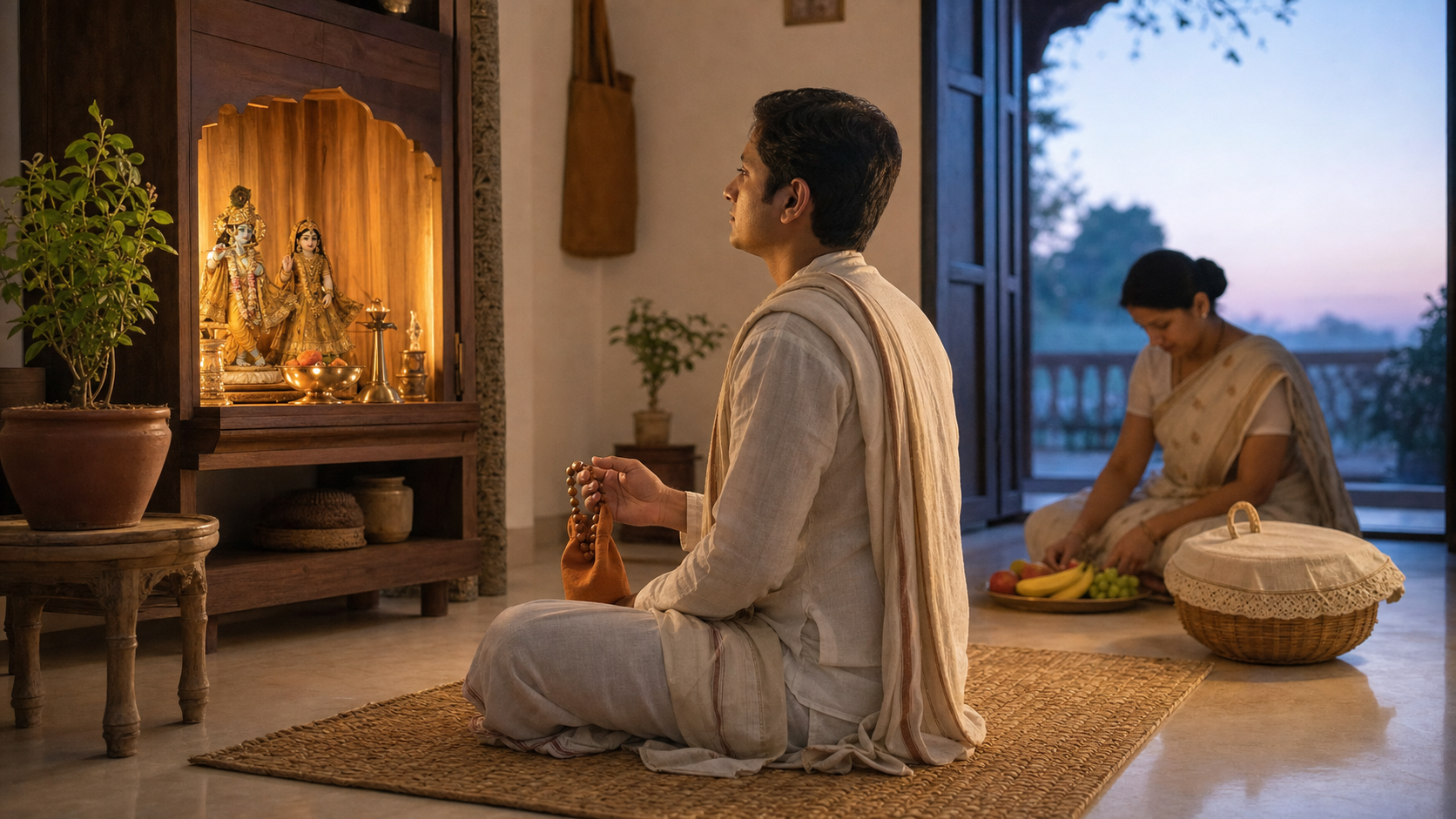
You may know what devotion feels like during kirtan, darshan, or a temple festival, yet struggle to carry that clarity into an ordinary morning. Work begins, messages arrive, the mind scatters, and yesterday’s spiritual resolve starts to feel remote.
You do not need to wait for a stronger mood. A workable Gaudiya Vaishnava life has a repeatable movement: take shelter of Krishna, return your attention through sadhana, and carry that remembrance into seva. Each movement corrects the others, so devotion becomes more than an occasional experience.
Keep refuge, sadhana, and seva in their proper relationship
Divine refuge answers the question, Whom do I trust when my control reaches its limit? Sadhana answers, How do I train my attention to remember that relationship? Seva answers, Where does that remembrance go once I stand up from practice?
These are not stages from which you graduate. They form a cycle. Refuge gives sadhana its devotional direction. Sadhana keeps service connected to remembrance. Seva prevents inward practice from becoming preoccupation with your own spiritual condition. Service then exposes impatience, pride, distraction, and fear, sending you back to shelter with greater honesty.
The balance matters. Sadhana without refuge can become a self-improvement project. Seva without sadhana can become restless activity, exhaustion, or a search for recognition. Refuge without either practice or responsible action can become a religious name for avoidance. The aim is not to choose among them, but to let each do its proper work.
Key takeaways
- Refuge is an orientation of trust, not an excuse to abandon effort or duty.
- Sadhana is the repeated return of attention to Krishna, especially when spiritual feeling is absent.
- Seva turns remembrance into conduct that benefits another person, the community, or the sacred environment.
- Kirtan, study, festivals, and sangha should strengthen ordinary practice rather than replace it.
- Humility, attentive hearing, reliability, and compassionate action reveal more than the intensity of a passing devotional mood.
Begin from shelter rather than spiritual mood
Srimad Bhagavatam 3.23.42 presents the lotus feet of the Divine as tirtha: a sacred place and a ford by which one crosses dangerous waters. The image is especially concrete because sanctifying rivers such as Ganga are understood to flow from those feet. A ford does not pretend that the river is absent. It gives the traveller a place to cross.
This distinction protects you from two common misreadings of surrender. The first treats refuge as a promise that every desired outcome will arrive. The second treats it as passive resignation. The verse instead joins determined shelter with divine grace. Difficulty may remain real, but you no longer have to meet it as an isolated controller whose peace depends on mastering every result.
Determination in this setting is not hardness. It is the decision to return to Krishna after distraction, disappointment, embarrassment, or delay. Surrender makes that determination supple: you still act, but you stop treating the outcome as proof of your worth or of Krishna’s care.
When you feel overwhelmed, translate refuge into a sequence you can actually perform:
- Name what is outside your control. Be specific instead of saying only that everything is difficult.
- Identify the next duty that remains within your control: a truthful conversation, attentive japa, an apology, a promised task, or a request for qualified help.
- Offer both the action and its uncertain result to Krishna in your own words.
- Begin the duty before the mind turns surrender into further rumination.
This is kriya aligned with saranagati: effort placed inside shelter. You can pray simply that the next action become service and that its result rest with Krishna. The exact wording matters less than the movement from fear, to offering, to responsible action.
Refuge never requires you to neglect practical protection. If a situation involves danger, illness, abuse, debt, or legal exposure, obtaining appropriate professional help can be part of your duty. Chanting may steady the heart while you act; it should not be used to postpone necessary action or keep you in harm’s way.
Build sadhana that survives an ordinary weekday
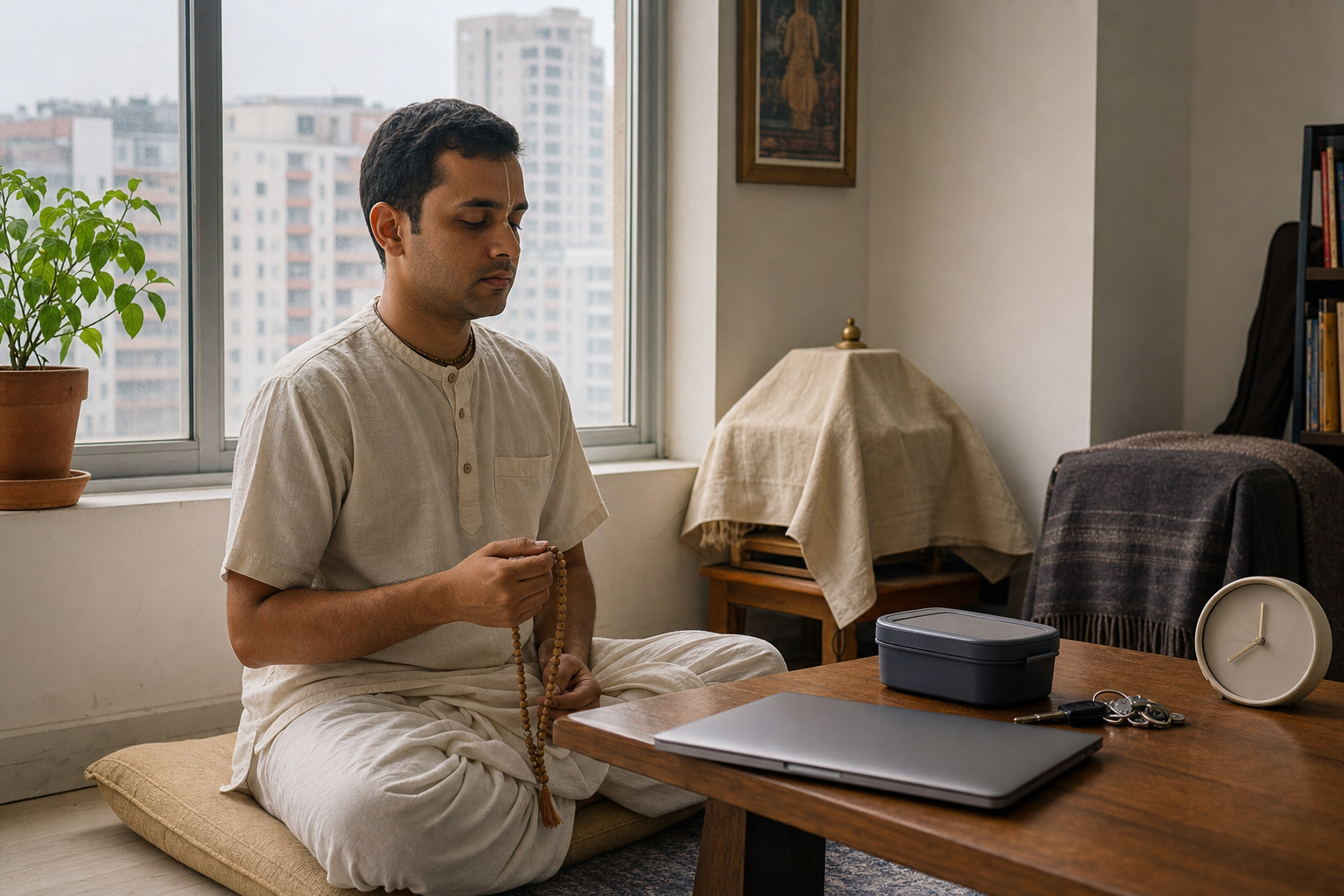
Abhyasa means returning through practice. Its real test is not what you can do while inspired, but what remains available when the day is crowded and the mind is unimpressed. Steady nama-japa, attentive listening, reflective teaching, and service belong together because each moves devotion from sentiment into formation.
If you have received a particular commitment from your guru or established spiritual community, preserve that commitment rather than substituting a casual routine. If you have not taken such a commitment, begin with an amount you can repeat honestly and seek mature guidance before taking vows. Ambitious promises made during a devotional high are less useful than a stable practice you can deepen responsibly.
A durable home practice can follow this order:
- Attach practice to a dependable cue, such as waking and washing, rather than to the hope that free time will appear later.
- Prepare the seat, beads, and text in advance. Removing small decisions protects attention when motivation is weak.
- Begin by remembering whose shelter you are seeking. Do not approach japa merely as a concentration test.
- Chant while listening to the names. When the mind leaves, return to hearing without turning distraction into a second argument inside the mind.
- Read a manageable passage and draw out one instruction: something to remember, begin, stop, or repair.
- Carry that instruction into the next part of the day as a specific act of seva.
It helps to distinguish the floor of your practice from its fuller expression. The floor is what keeps the relationship active under pressure. The fuller expression may include extended japa, study, kirtan, temple participation, and additional service when circumstances allow. The floor is a bridge through difficult periods, not a target to which you quietly reduce every day.
Do not redesign your sadhana whenever enthusiasm changes. A dry session is not automatically a failed session. If you noticed distraction and returned to hearing, abhyasa was already taking place. Spiritual feeling can be welcomed, but it cannot be made the condition for showing up.
- If japa is scattered, remove competing input and bring attention back to the sound you are presently chanting.
- If practice feels rushed, simplify optional preparation instead of treating attentive hearing as expendable.
- If you miss your regular cue, resume at the next available one. Do not add self-punishment and call it discipline.
- If study remains abstract, finish with one sentence describing what the teaching changes in your conduct that day.
The point is not to manufacture an impressive private routine. It is to make remembrance dependable enough that it can govern speech, choices, and service after the practice period ends.
Let seva carry remembrance into another person’s life

Seva begins with the understanding that your abilities, time, learning, and relationships can be offered rather than merely possessed. It may be public or almost invisible. Its devotional quality does not depend on an audience, but on the spirit, care, and truthfulness with which it is performed.
Book distribution offers a clear example. At Bhaktivedanta Manor, the National Sankirtan Festival honours the year-round service of sharing Srila Prabhupada’s books, along with kirtan, scriptural discussion, and accounts of encounters at homes, marketplaces, and community gatherings. The underlying pattern is larger than a festival: receive knowledge through study, approach another person with compassion, and make spiritual wisdom accessible without reducing the person to a result.
If you undertake book seva, the quality of the encounter matters. Read what you distribute, ask questions before recommending a text, obtain permission to make the offer, and describe it honestly. Do not promise that a book will instantly solve grief, anxiety, family conflict, or material hardship. Accept a refusal without argument. Sankirtan loses its compassionate purpose when the other person feels cornered.
The same discipline applies beyond book distribution:
- At a temple, take a necessary task that receives little attention and complete it reliably.
- In your household, perform a duty without using religious activity to leave the burden to someone else.
- With a newcomer, listen before instructing and explain unfamiliar customs without making embarrassment part of initiation.
- In community outreach, give people room to ask difficult questions without treating curiosity as hostility.
- In ecological or practical service, care for the place in which worship, food, learning, and community life occur.
A good test is to examine what your service produces in you and around you. Does it increase remembrance, humility, reliability, and care? Does it meet a real need, or only the need you wanted to meet? Can the service continue without chronic neglect of dependants, health, or existing duties? Does the recipient retain dignity and freedom?
Saying that the outcome belongs to Krishna does not excuse careless methods. You still owe preparation, consent, truthfulness, and follow-through. If service repeatedly produces resentment or exhaustion, reduce its scope, seek guidance from a mature practitioner, and reconnect the task to prayer. Sometimes perseverance is required; sometimes the form of service is simply unsustainable. Discernment is part of seva.
Use festivals and sangha as a bridge back to daily practice

A devotional gathering can concentrate attention in ways that private effort often cannot. At Govardhan Eco Village, the Madan Mohan Brahmotsavam brought darshan, kirtan, reflective teaching, nama-japa, seva, and ecological care into one setting. Ritual beauty became practical when participants were directed back toward steady practice and care for living beings.
The danger is not the intensity of a festival. It is leaving the intensity unintegrated. If you return home with many impressions but no changed practice, inspiration remains dependent on the next event. Give every gathering a path back into the weekday:
- Before attending, carry one real question about your sadhana or service. This gives your hearing a direction.
- During the event, protect a period of attention from photography, messaging, and commentary. Participate in at least one act of service rather than remaining only a spectator.
- At your next home practice, choose one teaching to apply. Put it into your existing routine instead of building an entirely new programme around the emotion of the day.
- Reconnect with someone from the sangha when you need accountability, clarification, or a service opportunity. Community should continue as relationship, not merely as a crowd.
You can also evaluate sangha by its fruit. Does participation help you chant more attentively and meet your duties more faithfully? Can people admit difficulty without having to perform spiritual success? Are learning and correction joined with humility? Does service produce care rather than factional contempt? A healthy community does more than create belonging; it helps its members remember Krishna and behave accordingly.
That grounding also makes wider dharmic respect possible. Buddhist mindfulness and metta, Jain ahimsa and aparigraha, and Sikh seva and simran offer recognisable ethical resonances with the Gaudiya concern for remembrance, purification, and compassionate action. You do not need to flatten distinct doctrines into sameness in order to honour this shared moral vocabulary. Respect is strongest when kinship and difference can both be spoken truthfully.
When practice becomes difficult again, return to the image of the ford. Refuge does not mean that the river of responsibility, distraction, grief, or uncertainty has vanished. It means you have a place from which to cross. If shelter feels abstract, name the burden before japa and identify the next duty. If japa feels mechanical, return to hearing. If seva feels draining, reduce its scope and renew the offering. If festival joy fades, carry one instruction into your ordinary cue.
At your next dependable practice time, sit down, place one real concern at Krishna’s feet, chant while listening, read until one practical instruction becomes clear, and perform one service shaped by that instruction. Keep the sequence when the heart feels luminous, and keep it when it does not. That is how divine refuge becomes a lived path.
References
- Dandavats – Bhaktivedanta Manor’s National Sankirtan Festival: Honouring Book Seva, Unity, and Joy
- Dandavats – Madan Mohan Brahmotsavam at GEV: Profound Insights by H.G. Shrutkirti Prabhu (17 Jan 2026)
- Dandavats – Srimad Bhagavatam 3.23.42: The Life-Changing Refuge at the Lotus Feet of the Divine
