
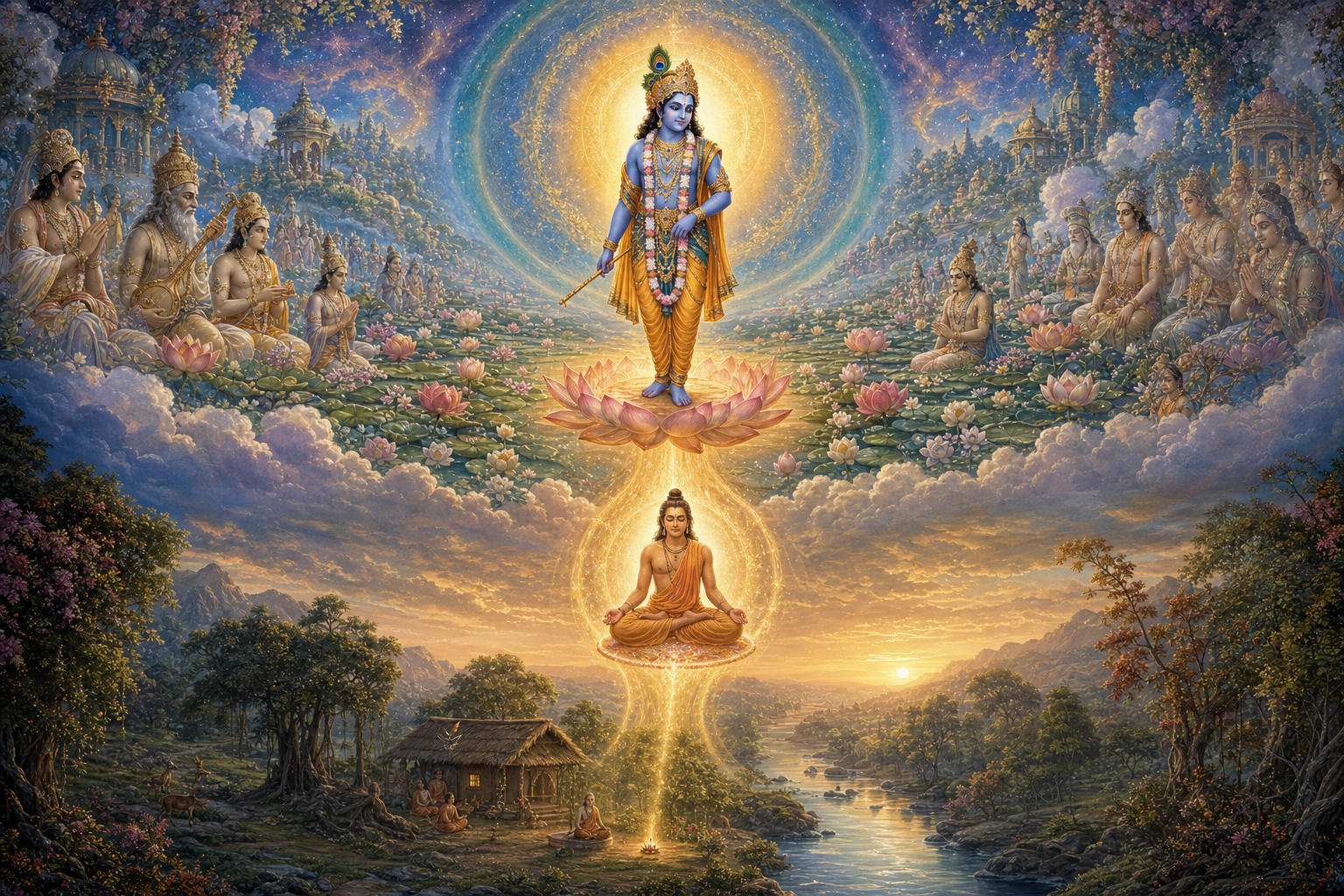
You can accept Kapila as an avatar and Krishna as the fountainhead of avatars without forcing the two claims into a contradiction. The difficulty begins when every divine name is placed on one flat ladder, as though Hindu theology must choose between a single name for God and several unrelated gods competing for rank.
A more precise Vaishnava approach distinguishes source, expansion, descent, and mission. That distinction shows why Kapila’s analytical Sāṁkhya belongs within a theology of divine compassion: the Divine does not descend only to perform extraordinary deeds, but also to teach you how to recognize consciousness, understand nature, and loosen the misidentification that sustains bondage.
The apparent contradiction disappears when you separate source from mission
Your first question may be straightforward: if Kapila is an avatar of Vishnu, how can Krishna be the source of all avatars? Within the Krishna-centered Vaishnava framework, the two statements answer different questions. Krishna as fountainhead identifies the ultimate source; Kapila as avatar identifies a particular descent and its purpose.
Avatāra is commonly understood as divine descent. It is not the involuntary rebirth of a conditioned being under karma. A jīva takes birth within material causation; an avatar appears through divine freedom. The form is therefore not evidence that the Divine has become trapped in matter. It is a way the transcendent becomes personally, morally, and intellectually accessible without ceasing to be transcendent.
In the twenty-four-avatar enumeration used here, Kapila is counted as Vishnu’s fifth avatar. That does not turn Krishna into another numbered item on the same roster. “Fountainhead” concerns origin. “Avatar” concerns manifestation. “Kapila” identifies the form, relationship, and teaching mission through which the Divine is encountered.
This answer is specifically Krishna-centered and Vaishnava. Hindu traditions do not all arrange the relationship between Krishna and Vishnu in identical language. Precision requires you to identify the theological framework instead of presenting one lineage’s formulation as the only vocabulary permitted within Sanātana Dharma.
Key takeaways
- Krishna’s status as fountainhead describes the source of divine manifestations; Kapila’s status as avatar describes a descent with a particular mission.
- An avatar is not a conditioned soul undergoing karmic rebirth. Divine descent is intentional and does not cancel transcendence.
- Divine forms can be nondifferent in essence while remaining distinct in name, relationship, appearance, and function.
- Kapila’s mission is especially instructive: he makes discriminative knowledge, devotion, and liberation available through teaching.
- The sacred identity of Kapila and the historical development of classical Sāṁkhya are related questions, but they are not the same question.
Read the divine family as a map, not a material genealogy

Material objects become smaller when divided. Avatar theology does not describe the Divine in that way. The Supreme does not lose a portion of divinity whenever a form or expansion becomes manifest. The Krishna-centered account instead presents plenary expansions as complete, nondifferent in essence yet distinct in form and function.
| Figure or form | Place in the Krishna-centered map | What the distinction helps you understand |
|---|---|---|
| Krishna | The fountainhead from whom avatars and expansions proceed | The source remains transcendent and complete while becoming accessible through many manifestations. |
| Balarama | Krishna’s first expansion, described as his second body and brother | Unity of divinity can coexist with a distinct personal relationship and role in līlā. |
| Vishnu and plenary manifestations | Complete divine forms through which the Supreme engages created realms | Manifestation is not fragmentation; distinction of function does not require rivalry between divine forms. |
| Kapila | An avatar of Vishnu appearing as a sage and teacher | Divine descent can disclose liberating knowledge as well as accomplish a cosmic or public act. |
Balarama makes the logic particularly clear. He is both the first expansion and Krishna’s brother within līlā. If identity of divine essence erased every distinction, that relationship would become meaningless. If distinction meant complete separation, the unity of the Divine would be lost. Vaishnava theology preserves both sides: real unity and real relational distinction.
Readers familiar with Acintya-bheda-abheda will recognize the theological concern. Unity need not abolish difference, and difference need not divide the ultimate source. You do not have to reduce Krishna, Balarama, Vishnu, and Kapila to interchangeable labels in order to affirm divine unity. Their names tell you how the Divine is revealed and how the devotee is invited to relate.
Three common mistakes disappear once you use this map:
- Material arithmetic: imagining each expansion as a fraction removed from a diminishing whole.
- Category confusion: treating “source,” “expansion,” “avatar,” and “sage” as competing answers to one question.
- Functional ranking: assuming that different missions necessarily indicate competing or unequal deities.
When you meet an unfamiliar avatar claim, first ask what kind of relationship is being described. Is the claim about ultimate source, divine manifestation, narrative kinship, devotional relationship, or the work accomplished by a particular descent? That one question prevents much of the confusion created by flattened lists of divine names.
Kapila descends to correct a mistake you make every day

Kapila’s mission centers on a persistent error: confusing the movements of nature with the conscious self that knows them. The Bhāgavata Purāṇa presents him as the son of Kardama Muni and Devahūti. His instruction to Devahūti, often called the Kapila Gītā, appears in Cantos 3.25–33 and brings metaphysical analysis into an intimate exchange between teacher and mother.
The central Sāṁkhya distinction is between Purusha and Prakriti. Purusha is pure consciousness, the witness that does not undergo the modifications it knows. Prakriti is primordial nature, the field from which mind, embodiment, sensory activity, and the experienced world develop. Classical Sāṁkhya speaks of many Purushas rather than treating consciousness as one more material product.
From Prakriti unfold the principles used to map experience: mahat, or cosmic intelligence; ahaṁkāra, the principle of individuation; the tanmātras, or subtle elements; the indriyas, including the faculties of perception and action; and the mahābhūtas, the gross elements. The purpose of this enumeration is not to reward memorization. It trains you to see that the body, senses, thoughts, impulses, and personal narratives belong to an unfolding field. They are known; they are not the knower itself.
The three guṇas make that analysis practical. Sattva brings clarity, balance, and harmony. Rajas produces movement, agitation, and restless pursuit. Tamas weighs experience down through inertia and obscurity. All three belong to Prakriti. That means “I am tamasic” is less precise than “tamas is strong in this state.” The first sentence turns a passing configuration into an identity. The second creates room for discernment and a different action.
You can apply Kapila’s distinction whenever a reaction begins to take command:
- Name what is changing. Is it a bodily sensation, an agitated thought, an urge to win, a remembered injury, or a social role under threat? Place the changing event within Prakriti instead of calling it your entire self.
- Notice the dominant guṇa. Rajas may appear as the compulsion to answer immediately. Tamas may appear as avoidance or refusal to look. Sattva is the capacity to see the situation without being driven by either impulse.
- Turn toward the witness. Ask what is aware of the thought, impulse, and bodily state. Sāṁkhya uses this distinction to cultivate viveka, not to invent a more flattering personality.
- Choose the dharmic response. Non-harming, truthful speech, restraint, contentment, and steadfastness support sattva because they reduce the conditions that feed agitation and obscurity.
This practice should not become an excuse for passivity. Calling anger a movement of Prakriti does not erase responsibility for angry speech. Detachment means freedom from compulsive identification, not indifference to consequences. Once you can see the movement clearly, you become more responsible for the action that follows.
Kapila’s avatarhood matters here because analysis is not presented as cold abstraction. The Bhāgavata presentation joins discriminative knowledge with devotion. Clear seeing loosens attachment, while bhakti directs the liberated attention toward the Highest. Reason and devotion perform different work, but they need not compete.
Keep sacred identity and textual history in their proper places

Calling Kapila an avatar answers a theological question: who appears, and why does that appearance matter? Dating an extant Sāṁkhya text answers a historical question: when did a particular formulation enter the surviving textual record? Confusion follows when either answer is forced to perform the other’s work.
The Purāṇic Kapila is the divine sage who teaches Devahūti. The history of classical Sāṁkhya is more layered. Īśvarakṛṣṇa’s Sāṁkhya-kārikā, dated to around the fourth century CE, is the earliest extant systematic treatise of the school. The Sāṁkhya Sūtras attributed to Kapila are generally treated in modern textual history as a later compilation.
Neither observation requires you to dismiss Kapila’s sacred role. A lineage can remember a founding sage while its technical vocabulary, arguments, and surviving texts develop across centuries. Conversely, reverence for a founder does not require you to claim that every later text bearing the tradition’s name was personally written by that founder.
Use four labels when you read or teach this material:
- Sacred identity: Kapila is received as an avatar of Vishnu within the Purāṇic and Vaishnava setting.
- Narrative setting: Kapila teaches Devahūti as son, sage, and compassionate spiritual guide.
- Doctrinal content: Sāṁkhya analyzes consciousness, nature, the guṇas, the tattvas, bondage, and liberating discernment.
- Textual history: the surviving classical corpus took systematic form through later works and commentaries.
These labels also stop you from speaking of “Sāṁkhya” as though every use of the word were identical. Patañjali’s Yoga draws on Sāṁkhya metaphysics while emphasizing disciplined method. The Bhagavad Gītā integrates Sāṁkhya-like analysis with action, Yoga, and devotion. Vedānta engages many of the same categories even where its conclusions differ. Specify whether you mean the Bhāgavata’s Kapila teaching, classical Sāṁkhya, a Yogic adaptation, or a later theological interpretation.
This precision serves faith rather than threatening it. It prevents an avoidable choice between uncritical literalism and reflexive dismissal. You can receive the Purāṇic narrative as sacred theology, study the philosophical system rigorously, and remain honest about the history of the texts available to us.
Make avatar theology a discipline of reading and living

An avatar claim becomes useful when it changes how you read, relate, and act. Before accepting, rejecting, or debating such a claim, work through five questions:
- Which tradition is speaking? A Krishna-centered Vaishnava formulation should be identified as such, not silently expanded into a claim that every Hindu school uses the same hierarchy.
- What kind of claim is being made? Separate statements about divine identity, narrative relationship, philosophical doctrine, devotional practice, and textual history.
- What is the mission of this form? Kapila’s distinguishing work is instruction: he exposes misidentification and provides a path joining discernment with devotion.
- Has distinction been mistaken for division? Different forms and functions need not imply separate ultimate sources or competing centers of divinity.
- What response does the teaching require? If the doctrine produces only a ranking chart of divine names, you have missed its demand for clearer perception, steadier conduct, and deeper devotion.
Then read the Kapila teaching in sequence rather than collecting detached sayings. In Bhāgavata Purāṇa 3.25–33, mark where the dialogue moves among the nature of the self, material causation, attachment, devotion, and liberation. Keeping those themes together protects you from reducing Kapila either to a dry metaphysician or to a devotional figure without analytical force.
Carry one distinction into ordinary life: what changes belongs to the field of nature; awareness is not exhausted by the change it witnesses. When rajas demands an immediate reaction or tamas urges avoidance, do not build an identity around the state. Notice it, take responsibility for it, and choose the response that increases clarity.
The same care is needed when speaking across the Dharmic family. Avatar is especially explicit in Vaishnava theology. Buddhism, Jainism, and Sikhism articulate ultimate reality, liberation, moral discipline, teachers, and compassion through their own categories. Respect does not require renaming every Buddha, Jina, or Guru as an avatar. A stronger unity acknowledges shared commitments such as wisdom, non-harming, truthful living, discipline, compassion, and freedom from egoic attachment while allowing doctrinal differences to remain real.
Begin with the Kapila Gītā and keep two notes beside each passage: what it teaches you to discern, and what it asks you to do. That pairing turns divine descent from a debate about celestial rank into a living encounter with wisdom. Kapila’s appearance then directs you back to the point of avatar theology itself: the transcendent source becomes accessible so that you can see more truthfully and live more dharmically.
References
- DharmaRenaissance Blog — Sage Kapila: Vishnu’s Fifth Avatar and the Transformative Power of Sāṁkhya Wisdom
- Dandavats — Krishna, Fountainhead of All Avatars: Profound, Unifying Wisdom for Dharmic Paths
