

You may be earning responsibly and still feel that devotion is being pushed to the edge of the day. Or your worship may be regular while money, work, and family decisions remain sources of unease. The problem is usually not that spiritual life and household life are incompatible. It is that they are being governed by different standards.
Grihastha dharma offers a more demanding and more workable answer: let one moral order govern prayer, income, pleasure, speech, and care for dependants. Prosperity then becomes more than accumulation. It becomes the capacity to fulfil duties without selling your conscience or surrendering command of your desires.
Let dharma govern both prosperity and pleasure
A balanced household does not give dharma, artha, and kama equal authority. Dharma supplies the boundary. Artha, the pursuit and management of material resources, must operate within it. Kama, the enjoyment of legitimate pleasures, must also remain within it. Bhakti gives the household its inward direction, so that success does not quietly replace the sacred as the object of life.
This order matters because many apparently practical decisions are really decisions about allegiance. A better-paid role may help you support parents, educate children, give in charity, and serve the community. The same role becomes difficult to justify if it requires habitual deceit, exploitation, or the abandonment of responsibilities you have already accepted. More income does not purify the means by which it is obtained.
Apply three tests before a major career, spending, or lifestyle decision:
- Test the means. Can you pursue this without deception, coercion, needless harm, or concealment?
- Test the duties. Will it strengthen your ability to care for the people and commitments legitimately entrusted to you, or will someone else carry the hidden cost?
- Test the mind. Is the decision likely to leave you more capable of prayer, restraint, gratitude, and truthful self-examination, or more agitated and dependent on the next acquisition?
A failure on the first test is a warning about the decision itself. A failure on the second may call for a different arrangement, a delayed move, or an honest renegotiation of duties. A failure on the third does not automatically make a choice wrong, but it reveals the spiritual discipline that the choice will require. This is more useful than asking whether wealth is good or bad in the abstract.
In the Dvaraka setting associated with Srimad Bhagavatam 10.90.28, Sri Krishna’s domestic life functions as a model of spiritual engagement within society. The implication for you is direct: withdrawal is not the only proof of seriousness. Paying what you owe, keeping your word, caring for family, receiving guests, and handling resources cleanly can all become parts of practice.
Build a daily practice that survives an ordinary weekday

A household practice fails when it is designed only for calm mornings, festival days, or periods of enthusiasm. Work deadlines, illness, travel, school demands, and family tensions are not interruptions to grihastha life. They are the conditions in which its steadiness is tested.
Create both a floor and a fuller form for your sadhana. The floor is the form you can honestly maintain on a difficult day. The fuller form is what you follow when time and energy permit. Japa, kirtan, scriptural study, prayer, and service can be arranged differently according to your sampradaya, initiation, vows, and stage of life. The essential point is that the minimum must be definite enough to perform, not merely an intention to be spiritual when convenient.
- Attach practice to a stable daily event. Waking, bathing, the lighting of the household lamp, or the period before devices and work enter the day can serve as the anchor.
- Define the minimum in observable terms. Name the practice you will actually complete. Avoid a vague promise to spend some time in devotion.
- Prepare the environment beforehand. Keep the mala, text, prayer space, and other necessities ready. Friction that looks trivial at night becomes an excuse in a hurried morning.
- Establish a recovery rule. If a practice is missed, resume at the next proper opportunity. Do not let guilt turn one lapse into a new habit.
- Give the household a shared sacred rhythm. A prayer before food, a regular kirtan, shared reading, seva, or observance can join family life to devotion without forcing every member into an identical personal routine.
Sadhana is not complete merely because it has been checked off. Its fruit should enter conduct. Notice whether worship is making speech more truthful, work more conscientious, consumption more restrained, and your treatment of family more patient. If ritual precision coexists with manipulated accounts, broken promises, contempt at home, or indifference to harm, the missing element is not another appearance of religiosity. It is ethical integration.
This is why a small practice kept with sincerity can be more formative than an impressive routine that repeatedly collapses. Abhyasa, steady repetition, reduces the number of spiritual decisions you must remake every day. The practice becomes part of the household’s structure rather than a competitor fighting for whatever time remains.
Manage money as entrusted capacity, not personal permission
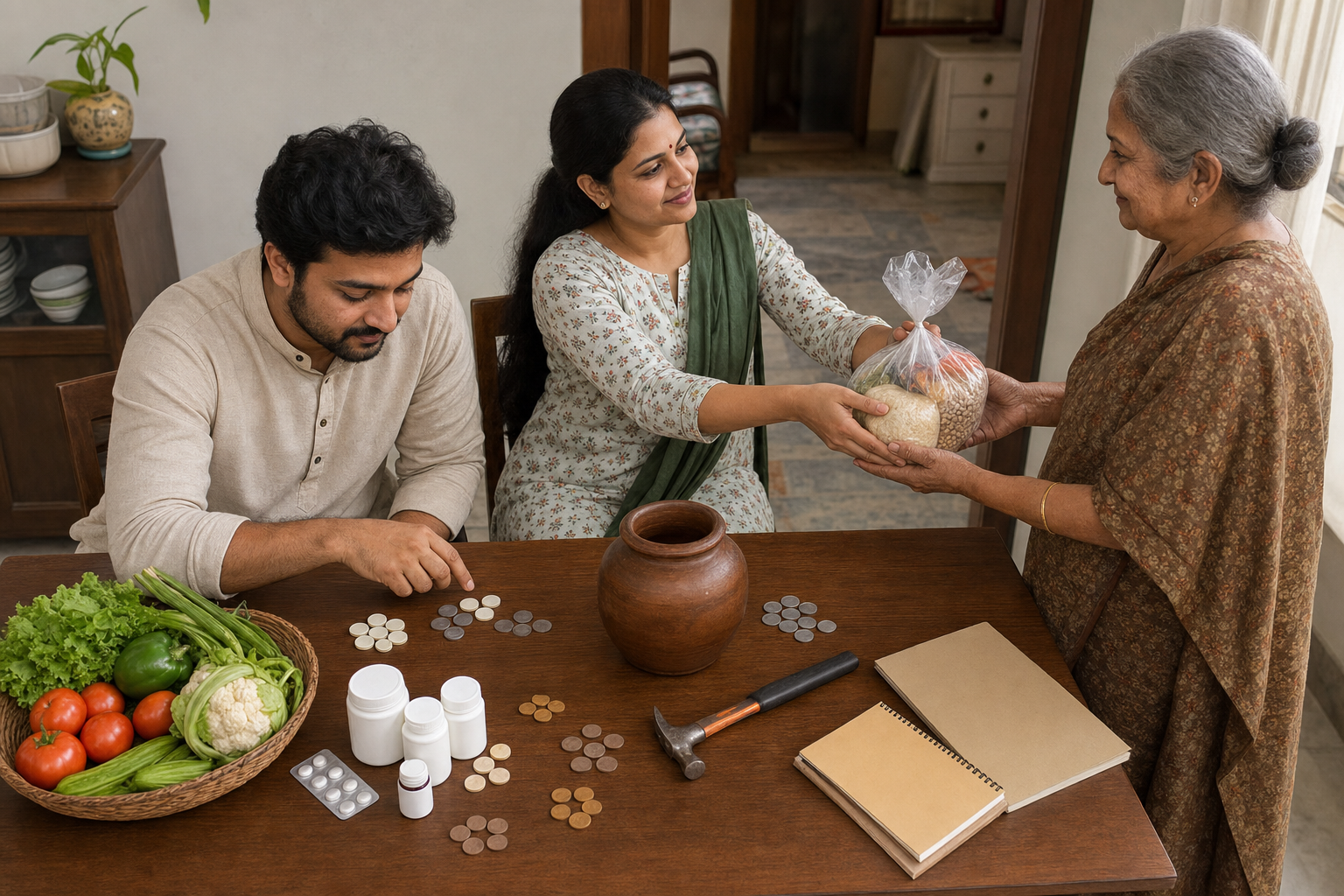
Artha is necessary. Food, shelter, education, healthcare, care for elders, hospitality, worship, charity, and community institutions all require material support. Treating money as inherently impure does not remove these duties; it can simply make the household less prepared to meet them.
The more useful question is what your resources are for. A dharmic household can think of income as entrusted capacity: something earned through right means, accounted for honestly, and directed with awareness. That attitude changes both earning and spending. You no longer ask only, “Can we afford this?” You also ask, “What duty or desire will this serve, and what will it displace?”
Review household money through five purposes:
- Present care: the genuine needs of the household and its dependants.
- Existing obligations: debts, taxes, wages, promises, and other commitments that should not be hidden behind pious language.
- Resilience: prudent preparation for foreseeable disruption, according to your circumstances.
- Service and generosity: support for people, temples, sanghas, and worthy work without display or neglect of prior duties.
- Legitimate enjoyment: recreation, beauty, celebration, travel, food, and gifts enjoyed within limits rather than treated as forbidden or limitless.
No universal percentage can settle the balance for every household. Income, debt, health, age, dependants, and religious commitments differ. What can be universal is transparency. Responsible adults making shared financial decisions should know the household’s real obligations, major commitments, and material risks. Secrecy about debt, recurring spending, or promised donations is not detachment. It prevents other people from giving informed consent to burdens they may have to carry.
Do not give away money required for essential care merely to appear devout, and do not call reckless borrowing faith. If debt, taxes, contracts, investments, or family ownership are materially at stake, use an appropriate financial or legal professional. Spiritual principles can clarify your purpose and conduct, but they do not replace competent advice about consequences you may not be able to reverse.
When income rises, pause before converting the whole increase into a new standard of consumption. Decide consciously what should strengthen care, resilience, generosity, and enjoyment. Otherwise, every gain creates a larger appetite, and prosperity reduces freedom instead of enlarging your capacity to serve.
Regulate enjoyment before enjoyment begins regulating you
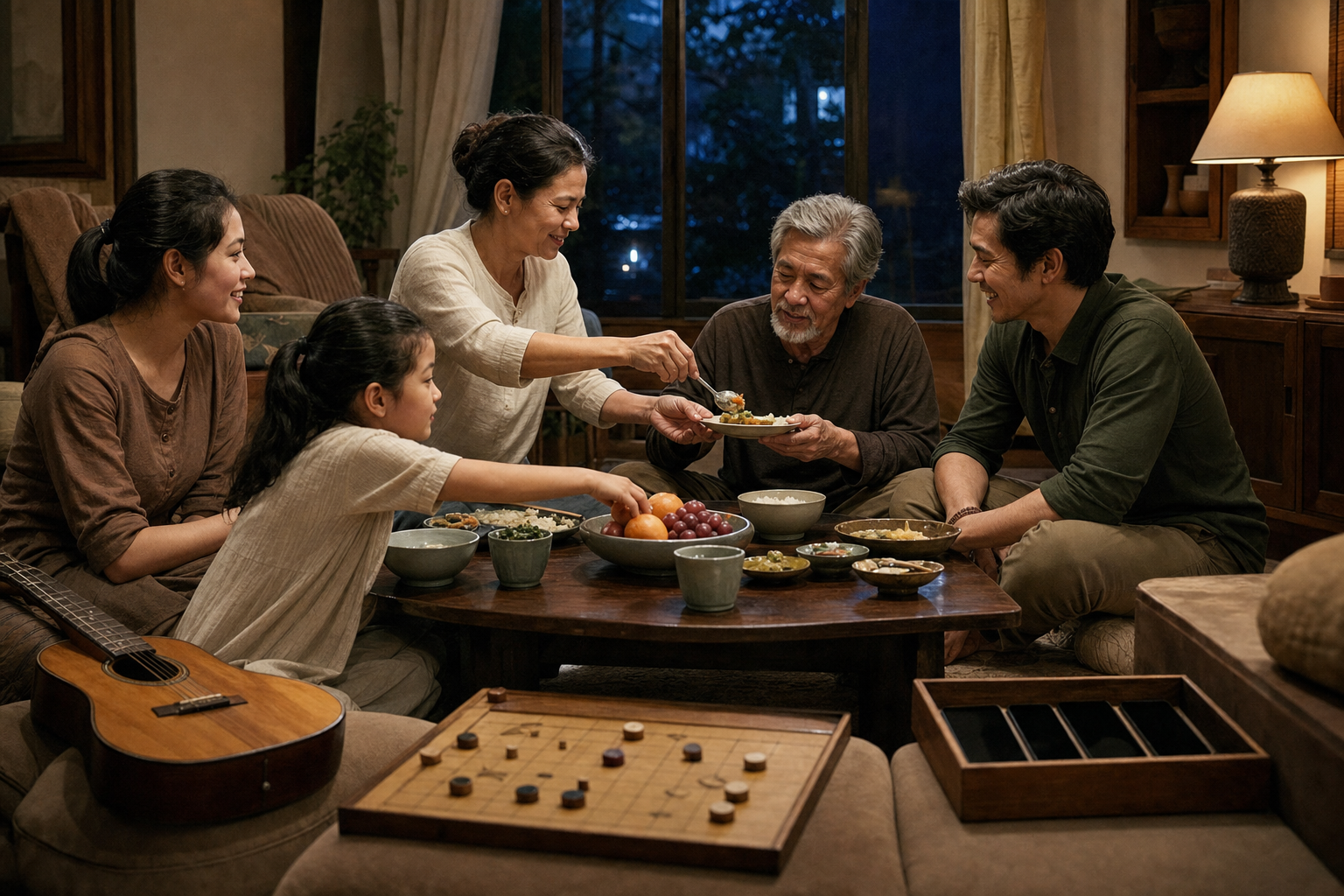
Householder dharma does not require suspicion toward every pleasure. Food shared gratefully, festivals observed with reverence, music, hospitality, marriage, affection, rest, beauty, and celebration can nourish a household. Regulation is what keeps enjoyment from becoming compulsion.
Limits are easiest to choose before desire is active. Decide in a calm state what fits your values, budget, health, vows, and duties. If you wait until the purchase, feast, screen, or social occasion has already captured your attention, the mind becomes both advocate and judge.
Use these questions to distinguish restorative enjoyment from attachment:
- Do you need to conceal, minimise, or misdescribe it to someone affected by it?
- Does it repeatedly weaken the next period of prayer, work, caregiving, or study?
- Can you enjoy it with gratitude and stop at the boundary chosen beforehand?
- Is it being financed by a broken promise or an obligation left for someone else?
- Does it leave the mind settled, or does it immediately demand repetition, novelty, or greater intensity?
One indulgence does not answer every question. Look for repetition. When the same pleasure repeatedly produces concealment, agitation, neglect, or loss of control, introduce tapas: a voluntary and clearly defined restraint. Choose the object of restraint, state when the discipline begins and ends, and name what will replace the habit. The replacement matters. Time removed from compulsive consumption can be given to japa, walking, study, seva, family attention, or simple rest; otherwise, one appetite often recruits another.
Tapas is not punishment for having a body or enjoying the world. It is a way to discover whether you still possess the freedom to say no. When you resume an enjoyment, do so deliberately and observe whether moderation has become easier. If the old pattern returns immediately, the restraint exposed a deeper attachment that needs continued accountability.
Families drawing from different dharmic traditions need not pretend that all doctrines are identical. They can still cooperate around shared disciplines. Buddhist attention to right intention and right livelihood, Jain commitments to ahimsa and aparigraha, Sikh seva, and Bhakti’s devotional offering all challenge the isolated ego’s claim that income and pleasure are purely private matters. Agree on the conduct the home will protect: honest livelihood, non-harm, restraint, gratitude, care, and service.
Use evidence to escape the spiritual gray zone

The most deceptive condition is not open rejection of dharma. It is the gray zone in which devotion and attachment borrow each other’s language. Ritual becomes a defence against ethical scrutiny. Spiritual feeling substitutes for regular practice. Generosity excuses financial disorder. Family duty becomes a respectable name for endless acquisition. Renunciation becomes an excuse to neglect people who depend on you.
Intentions alone will not reveal this condition because the gray zone is built from good explanations. Examine evidence instead. Keep a brief weekly household audit and choose one correction at a time.
| Area | Question | Evidence to inspect | Possible correction |
|---|---|---|---|
| Time | Did devotion and service receive protected attention? | Actual calendar, missed practices, unplanned screen or leisure time | Move the anchor, simplify the minimum, or remove a recurring distraction |
| Money | Were earning and spending transparent and aligned with duties? | Statements, receipts, debts, donations, and concealed purchases | Disclose the fact, correct the record, repay what is owed, or revise the plan |
| Speech and work | Did truthfulness survive pressure? | Promises, reports, sales claims, apologies avoided, and commitments missed | Make the necessary correction and change the process that invited dishonesty |
| Family care | Were burdens and attention distributed justly? | Repeated complaints, invisible labour, neglected dependants, and kept promises | Reassign a duty, schedule care, or have the conversation being postponed |
| Enjoyment | Did pleasure remain moderate and grateful? | After-effects on the mind, budget, sadhana, health, and relationships | Set a boundary, practise tapas, or choose a more sattvic alternative |
Record facts without turning the audit into a weapon against your spouse or family. The purpose is correction, not surveillance. Each responsible person should first name their own lapse and the action they will take. Where a pattern remains invisible from inside the household, satsanga can provide accountability. Choose a trusted teacher, elder, or spiritually mature friend who is willing to ask about conduct, not merely offer reassurance.
Track vows in the same concrete way. Mark whether a commitment was kept, missed, or consciously revised for a legitimate reason. If the same vow is repeatedly broken, do not keep making it theatrically. Reduce it to an honest discipline, seek guidance where required, and rebuild steadiness. A smaller truthful commitment is a firmer base than a grand promise maintained mainly in speech.
Key takeaways
- Dharma sets the limits within which artha and kama may be pursued; prosperity does not excuse wrongful means.
- Define a minimum daily sadhana that can survive a difficult weekday, then let its fruit appear in speech, work, and family conduct.
- Make major obligations and financial risks transparent to the people who will bear their consequences.
- Judge enjoyment by its after-effects: gratitude and clarity point toward regulation, while concealment and repeated agitation point toward attachment.
- Audit time, money, vows, speech, care, and pleasure using observable evidence rather than spiritual self-description.
- Use satsanga and periodic tapas when private intention is no longer strong enough to correct a recurring pattern.
Begin with one visible alignment this week. Define your sadhana floor, disclose one financial fact that should be shared, or place one recurring desire under a written boundary. Then keep the correction long enough for the household to feel its effect. That is how prosperity becomes serviceable, pleasure remains human, and the home itself becomes a place of spiritual formation.
References
