

You can finish a luminous passage from the Caitanya-caritamrta, feel genuine admiration, and still be unsure what should change when you close the book. That gap matters. Admiring Śrī Caitanya’s līlā is not yet the same as allowing it to shape your attention, relationships, and service.
Two compact locations in Ādi-līlā offer a disciplined way forward. One belongs to childhood-līlā; the other stands within the account of Caitanya’s devotees as branches of a living spiritual tree. Read them differently, then bring them together: receive the Lord’s self-revelation, recognise the devotees through whom bhakti travels, and answer both with a concrete act of sādhana.
Start by asking what kind of truth the passage carries

Ādi-līlā does not speak in a single literary mode. It moves through theology, sacred biography, līlā, praise, genealogy, and descriptions of devotional relationships. Trouble begins when you demand the same kind of lesson from every mode.
Begin with Ādi-līlā 14.52-55 as a childhood-līlā unit. Your first question should not be, “What behaviour am I supposed to copy?” Ask what the scene discloses about Śrī Caitanya, how the people around Him are drawn into relationship, and what response the narration awakens in a hearer.
Approach Ādi-līlā 10.105 within the architecture of Caitanya’s devotional tree. Here the names and placement of devotees are part of the teaching. The question becomes relational: how does divine grace take social form through particular people, services, loyalties, and lines of remembrance?
Use these prompts while reading:
- What actually occurs or is named? State it plainly before interpreting it.
- What does this disclose about Bhagavān, rather than merely about human conduct?
- Which relationship carries the meaning: Lord and devotee, teacher and student, household and guest, root and branch, or devotee and community?
- What resistance appears in you: embarrassment, scepticism, sentimentality, envy, impatience, or the desire to control the conclusion?
- What response fits the passage: remembrance, praise, correction, gratitude, chanting, study, or service?
This method protects you from opposite errors. You will not flatten līlā into a children’s moral tale, and you will not admire it as sacred entertainment with no claim on your life.
Childhood-līlā is received before it is applied
A modern reader often approaches a childhood scene looking for an approved behaviour and a tidy moral. That instinct is understandable, but it is too narrow for Caitanya-līlā. In Gaudiya Vaiṣṇava understanding, Śrī Caitanya is Bhagavān. His appearance as a child does not suspend His divine identity, even when the narrative places Him amid ordinary household concerns, affection, surprise, and play.
The apparent smallness of the child and the Lord’s spiritual sovereignty must therefore be held together. If you keep only the human scale, the līlā becomes charming folklore. If you keep only divine majesty, you lose the intimacy through which the Lord allows Himself to be loved.
That changes how you apply a childhood passage. You do not imitate every action performed within a divine līlā. Imitation asks, “May I behave like this?” Following asks, “What devotional disposition is being awakened in those who hear, remember, and serve?” The proper human response may be wonder, surrender, patient attention, affectionate service, or renewed attraction to the holy name. It is not permission to disregard dharma, courtesy, or responsibility.
When a scene resists your expectations, do not rush to defend it, dismiss it, or force it into a slogan. Pause over the resistance. A useful reading note can be as simple as: “I wanted the Lord to fit my idea of seriousness.” That sentence may reveal more about your spiritual obstacle than a page of abstract commentary.
Then ask a sharper question: what would it mean to let the Lord remain a person rather than an idea under your control? In practice, it may mean chanting to address someone rather than merely completing a quota, hearing līlā without demanding immediate usefulness, or allowing affection and reverence to coexist.
The branches of Caitanya’s tree correct solitary bhakti
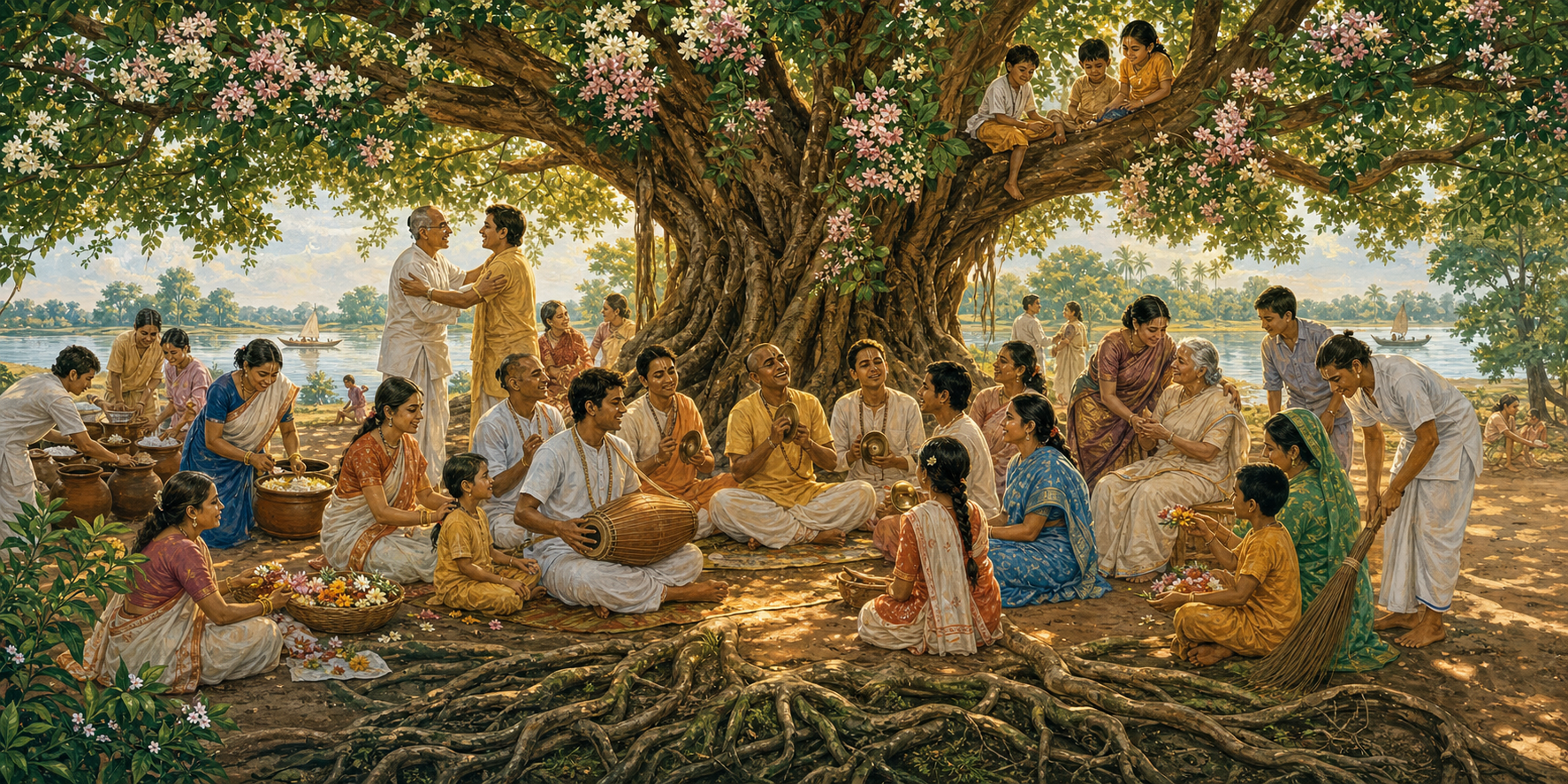
Lists of devotees are easy to skim. A familiar name receives attention; an unfamiliar one becomes background. Ādi-līlā’s tree imagery corrects that habit. A branch is distinct, yet it does not nourish itself. Its life comes through connection with the root, and its fruit appears through its particular place in the whole.
A verse situated among Caitanya’s associates therefore teaches through remembrance and placement. The devotee is not decorative material surrounding the “main” spiritual story. The network of devotees is one of the ways the story enters the world. Kīrtana needs voices. Teaching needs faithful hearers. Deity worship, prasāda, pilgrimage, hospitality, preservation of memory, and care for a community all require particular people accepting particular forms of service.
Acintya-bheda-abheda offers a useful doctrinal guardrail here. Connection does not erase distinction, and distinction does not require isolation. The Lord remains the Lord; the devotee remains the devotee. A branch does not become the root, yet separation from the root is not spiritual independence. You need not force every verse into a doctrinal proof. Let the doctrine prevent two practical mistakes: imagining intimacy to mean equality with Bhagavān, or imagining humility to mean that an individual devotee has no meaningful contribution.
You can apply this teaching by making your dependence visible. Write down the people whose service makes your practice possible: the person who introduced you to the text, leads kīrtana, prepares prasāda, keeps the temple clean, answers questions, preserves books, or makes space at home for worship. Include the quiet services you usually consume without noticing.
Then respond in a way that costs something more than a pleasant thought. Thank someone whose work has become invisible to you. Learn the name of a devotee you habitually overlook. Take an unglamorous task without announcing it. If you teach, credit the line through which the teaching reached you. These acts turn the tree from a metaphor into a correction of self-importance.
Community, however, is not an excuse to abandon discrimination or healthy boundaries. Honouring devotees does not make every personal opinion infallible. Genuine saṅga joins humility to scriptural judgment, responsible conduct, and service centred on Bhagavān. The tree has order and nourishment; it is not a demand for blind conformity.
Turn each reading into a repeatable act of sādhana
A passage changes you more reliably when reading, reflection, and response remain connected. Use the following sequence with a small unit of text rather than rushing through pages for the satisfaction of completion.
- Locate the passage. Identify whether you are reading līlā, theology, praise, instruction, or remembrance of devotees. Let that determine your first question.
- Read for the plain movement. Notice who acts, who receives, what relationship is present, and what changes within the scene or sequence.
- Complete three sentences: “This shows me…,” “This challenges my tendency to…,” and “My fitting response is….” Keep the answers tied to the passage.
- Select one feasible act. Choose attentive chanting, gratitude to a devotee, an unnoticed service, restraint from fault-finding, further study, or deliberate remembrance.
- Carry one phrase, image, relationship, or name into the rest of your day. Return to it when your attention becomes mechanical or self-centred.
The selected action should match the teaching. If the passage exposes your demand to control Bhagavān, do not answer by collecting more information. Practise receptive hearing. If it exposes neglect of devotees, do not keep the response entirely private. Offer service or gratitude. If it awakens attraction to Śrī Caitanya, bring that attraction into nāma-saṅkīrtana rather than leaving it as literary appreciation.
Watch for four common breakdowns:
- Moralising: you reduce the Lord’s līlā to a rule that could have been stated without Him. Correct it by asking what the scene uniquely reveals about His person and relationships.
- Spectacle-seeking: you chase the extraordinary element but ignore the devotional response it invites. Correct it by naming the quality of attention, surrender, or service being awakened.
- Name-skipping: you treat unfamiliar devotees as expendable details. Correct it by noticing how remembrance itself honours the channels through which bhakti is carried.
- Insight-collecting: you produce an impressive interpretation but change nothing. Correct it by choosing an action small enough to perform before your next reading.
This is also a useful test of interpretation. If your conclusion consistently makes you more important, more independent, or more interested in judging other practitioners, return to the passage. Caitanya-bhakti should deepen attraction to the Lord, gratitude toward devotees, seriousness about one’s own sādhana, and willingness to serve.
Key takeaways
- Read childhood-līlā first as divine self-revelation, not as conduct to imitate mechanically.
- Hold intimacy and reverence together: Śrī Caitanya’s child form invites affection without cancelling His identity as Bhagavān.
- Treat the devotees named in Ādi-līlā as part of the theology of transmission, not as background to a solitary spiritual hero.
- Use acintya-bheda-abheda to preserve both connection and distinction: dependence on the root does not erase the branch’s particular service.
- End each reading with a response suited to the passage, such as remembrance, attentive chanting, gratitude, restraint from criticism, or concrete seva.
At your next sitting, take one scene or one remembered devotee instead of measuring success by pages covered. Write down the revelation, the relationship, and the response. Perform the response before opening the next passage. That is how Ādi-līlā moves from the bookshelf into the habits of bhakti.

References
- Dandavats — Caitanya Caritamrita Adi Lila 14.52-55 Class by HG Dayal Mora Das – Sunday 2nd August 2026
- Dandavats — His Holiness Bhakti Dhira Damodara Swami Maharaj || CC Ādi-līlā-10.105 || 03-08-2026
