

You have found the name Vihagendra Samhita and want to know what kind of scripture it is. Is it a philosophical treatise, a ritual manual, or a work of devotion? Treating it as only one of these will give you a distorted reading.
The Vihagendra Samhita belongs to the Pancharatra stream of Vaishnava sacred literature. It is organized into twenty-four chapters and brings devotional practice, ritual worship, and spiritual discipline into a single framework. That combination is the key to understanding both its importance and its intended use.
Place the text correctly before interpreting it

Pancharatra, also written Pāñcarātra, is a Vaishnava Agamic tradition concerned with the worship of Narayana or Vishnu. Its sacred compendia are commonly called Samhitas. In this setting, a Samhita is not simply a collection of ideas to be admired from a distance. It organizes knowledge for religious understanding and practice.
This tells you how to approach the Vihagendra Samhita. Do not read it as though it were a modern essay in which every paragraph exists to prove one abstract thesis. Nor should you approach it as a miscellaneous catalogue of ceremonies. Its practical and spiritual elements belong to the same religious vision.
That distinction matters because modern readers often separate theology from worship. They ask what a tradition believes, then treat ritual as an optional cultural addition. An Agamic text works differently. Understanding shapes worship; worship gives embodied form to devotion; discipline makes that worship sustainable. When you encounter an instruction, therefore, ask what religious understanding the action expresses. When you encounter a theological statement, ask what manner of worship or spiritual orientation it is meant to support.
Searching for the text also requires attention to spelling. Catalogues and discussions may use forms such as Pancharatra or Pāñcarātra, and Samhita or Saṃhitā. Search both plain and diacritical spellings before concluding that an edition, catalogue entry, or discussion is unavailable.
Keep devotion, ritual, and discipline together
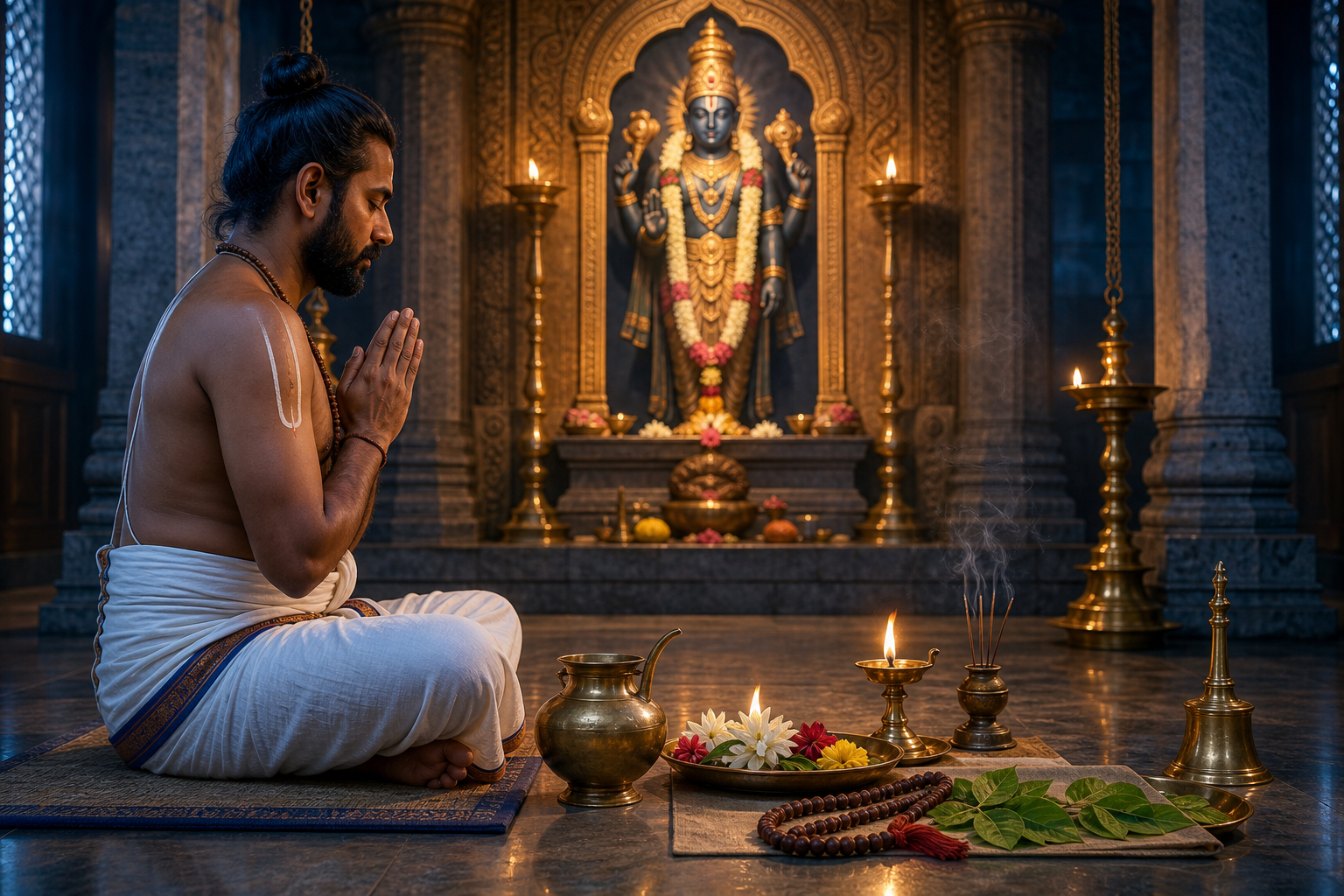
The Vihagendra Samhita is most intelligible when you follow three connected strands. Separating them may make individual passages easier to label, but it obscures the purpose of the whole.
Devotion supplies the inner orientation
Devotion is more than an emotion that happens to accompany worship. It establishes the relationship within which worship has meaning. As you read, notice what the passage asks the worshipper to recognize, remember, revere, or offer. This prevents you from reducing an act of worship to a sequence of movements.
A useful margin question is: “What disposition is this passage trying to form?” The answer might concern reverence, concentration, surrender, steadiness, or another devotional quality. Do not supply an answer that the passage itself does not support. The point is to notice the inner work performed by the instruction.
Ritual gives devotion a definite form
Ritual prevents devotion from remaining merely private or vague. It gives intention a sequence, a place, and an embodied expression. This is why ritual detail should not be dismissed as decorative material surrounding the “real” philosophy.
At the same time, seeing a procedure in a sacred text does not automatically authorize you to perform it. Ritual instructions may presuppose a particular setting, qualification, initiation, lineage, or role. Before turning a passage into practice, identify who is being instructed, what conditions are stated, and whether the act belongs to personal worship or an established temple context. If those details remain unclear, consult a qualified Pancharatra acharya or a priest trained in the relevant tradition.
Discipline carries worship beyond one ceremony
Spiritual discipline concerns continuity. A carefully performed rite has limited formative value if attention, conduct, and regularity disappear as soon as it ends. While reading, mark passages that concern sustained practice rather than a single ritual moment. This will help you see how the text joins formal worship to the cultivation of a worshipper.
You can track the three strands with a simple notation: write “D” beside devotional orientation, “R” beside ritual action, and “S” beside continuing discipline. Use more than one letter when a passage does more than one job. Repeated combinations will show you where the text refuses the divisions that a modern reader might impose on it.
Let the twenty-four chapters provide structure, not shortcuts
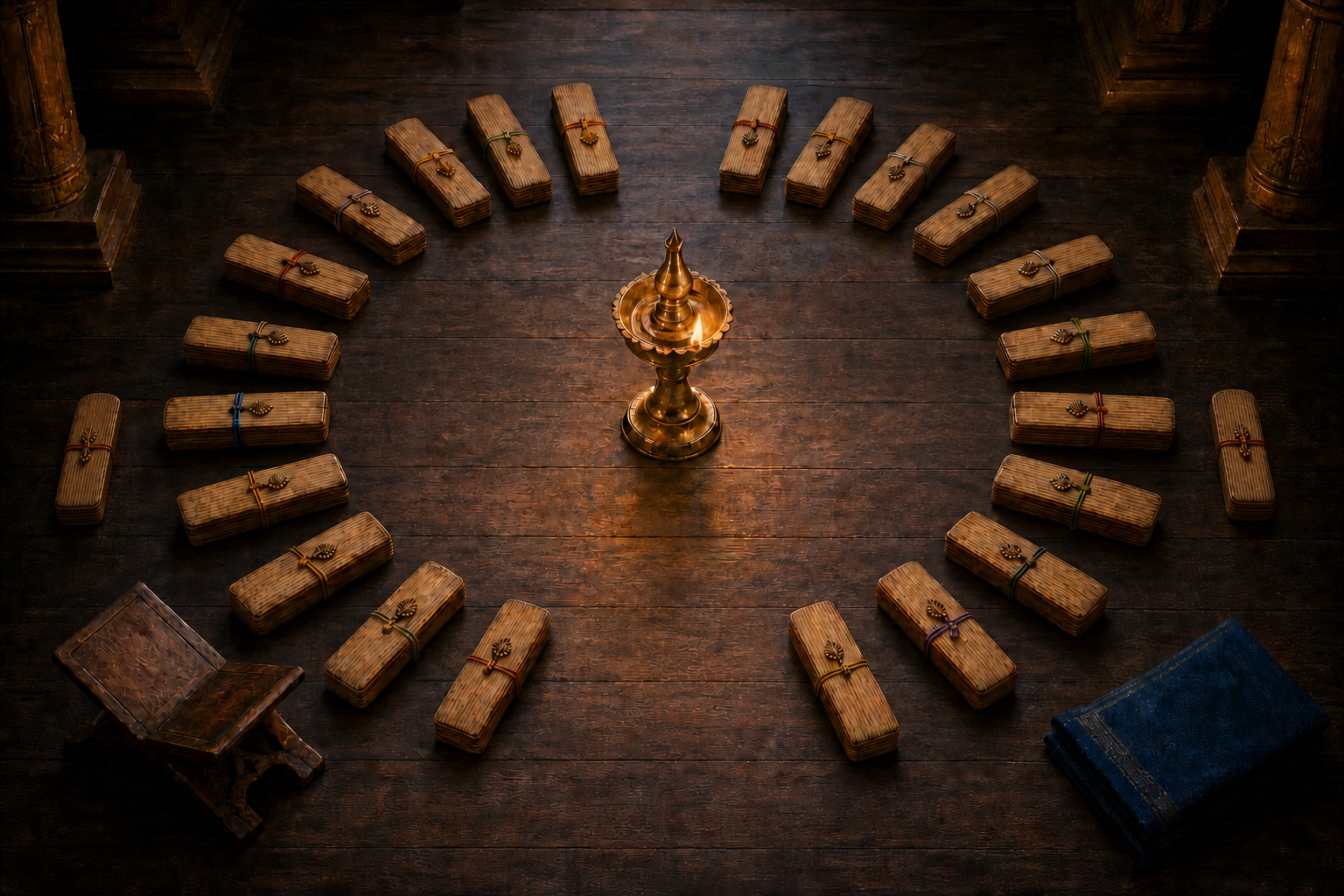
A twenty-four-chapter work invites systematic study. The chapter count, however, does not reveal the subject of each chapter, prove that every chapter has equal weight, or guarantee that the argument proceeds in a straight line. Do not invent a chapter-by-chapter scheme from the number alone.
Use the structure to control your reading instead. This six-step method works whether you have the Sanskrit text, a translation, or both:
- Identify the exact edition. Record the editor or translator, publication details, language, and the form of the title printed in the volume. Chapter and verse references are not useful if another reader cannot tell which edition you used.
- Survey the contents before studying a passage. Read the entire table of contents and note the stated beginning and end of each chapter. This gives you a map without assuming that the map explains the territory.
- Read each passage in its immediate neighbourhood. Include the preceding question, transition, or instruction and the material that follows. An isolated line can look universal even when its context limits its audience or purpose.
- Classify what the passage is doing. Distinguish explanation, praise, promise, prohibition, ritual direction, and spiritual counsel. A statement praising the fruit of a practice should not automatically be read in the same way as a procedural command.
- Track devotion, ritual, and discipline. Use the D-R-S notation or a three-column notebook. Record the words in the passage that justify your classification rather than relying on a general impression.
- Separate comprehension from performance. You may study an instruction to understand Pancharatra practice without attempting it. Move from reading to ritual performance only when the passage, your role, and the relevant lineage requirements are clear.
If you are working from a translation, keep technical Sanskrit terms visible in your notes whenever the edition supplies them. A smooth English rendering may use one familiar word for several distinct terms, or several English words for one repeated technical term. You do not need advanced Sanskrit to notice that pattern; you only need to record the term consistently and resist premature paraphrase.
For serious citation, quote the primary text from the edition in front of you. A modern synopsis can help you locate a subject, but it cannot establish the exact wording of a verse or instruction. Include chapter and verse numbers when the edition provides them, followed by the edition or translator in your note.
Avoid the mistakes that flatten Pancharatra scripture
Several reading habits repeatedly produce more confidence than understanding. You can avoid them by applying a few firm distinctions.
- Do not treat every Pancharatra Samhita as interchangeable. Membership in one textual tradition does not make separate works identical. Attribute a teaching to the Vihagendra Samhita only when you can locate it there.
- Do not turn the title into a table of contents. A title identifies the work; it does not tell you what every chapter contains. Verify chapter subjects from the edition itself.
- Do not isolate ritual from its devotional purpose. Ask what relation to Narayana or Vishnu the prescribed act expresses, not merely how the act is performed.
- Do not convert description into permission. Understanding a rite and being qualified to conduct it are different matters. This is especially important when a passage appears to concern consecration, mantra, or temple service.
- Do not assume that every instruction addresses every reader. Look for the speaker, recipient, setting, prerequisites, and stated result. If the translation hides those distinctions, compare the Sanskrit where possible or seek informed guidance.
- Do not use a secondary summary as the wording of scripture. Paraphrase it as background, then verify quotations and technical claims in a named edition of the primary text.
There is an equal and opposite error: treating ritual precision as if it exhausted the spiritual meaning of the work. Accurate sequence matters, but sequence alone does not explain why a practice is undertaken or what sort of worshipper it is intended to form. Your notes should preserve both the outward act and the inward orientation.
Key takeaways and a sound next step
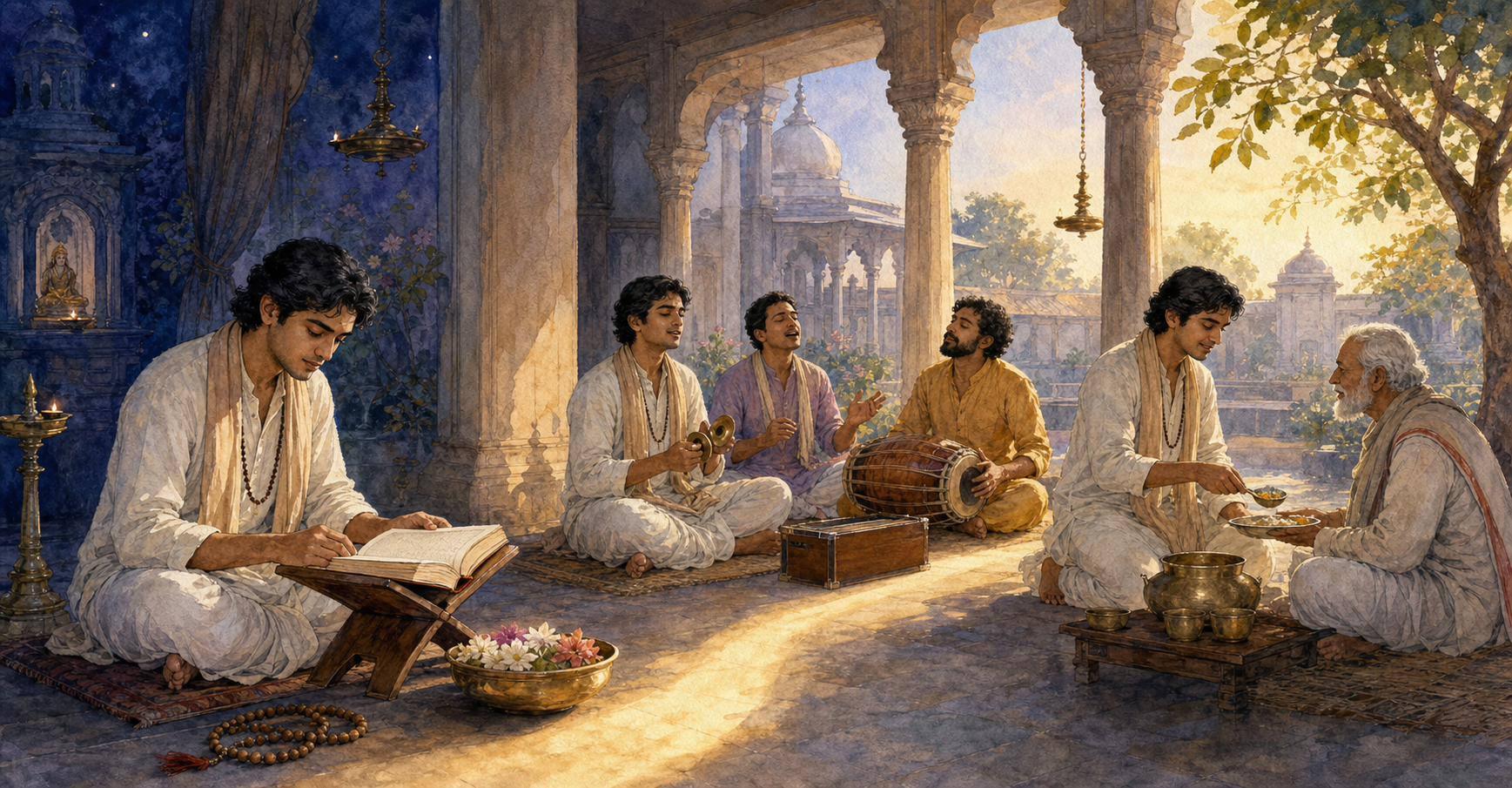
- The Vihagendra Samhita belongs within Pancharatra Vaishnava sacred literature, so read it as an Agamic work joining understanding and practice.
- Its twenty-four chapters integrate three concerns: devotion, ritual worship, and sustained spiritual discipline.
- The chapter count provides a study framework, but it does not justify guesses about individual chapter contents.
- A ritual passage must be read for audience, setting, qualifications, purpose, and devotional meaning before anyone treats it as a practical instruction.
- Exact claims and quotations should come from an identified edition of the primary text, not from an unattributed online summary.
Your next move is concrete: locate a named edition, copy its complete table of contents into your notes, and study one chapter together with the chapters immediately around it. Mark devotion, ritual, and discipline separately, then note where they meet. If your aim is performance rather than study, take the relevant passage and edition to a qualified Pancharatra teacher before acting on it. That small discipline will keep your reading faithful to both the words and the living tradition they serve.
References
