
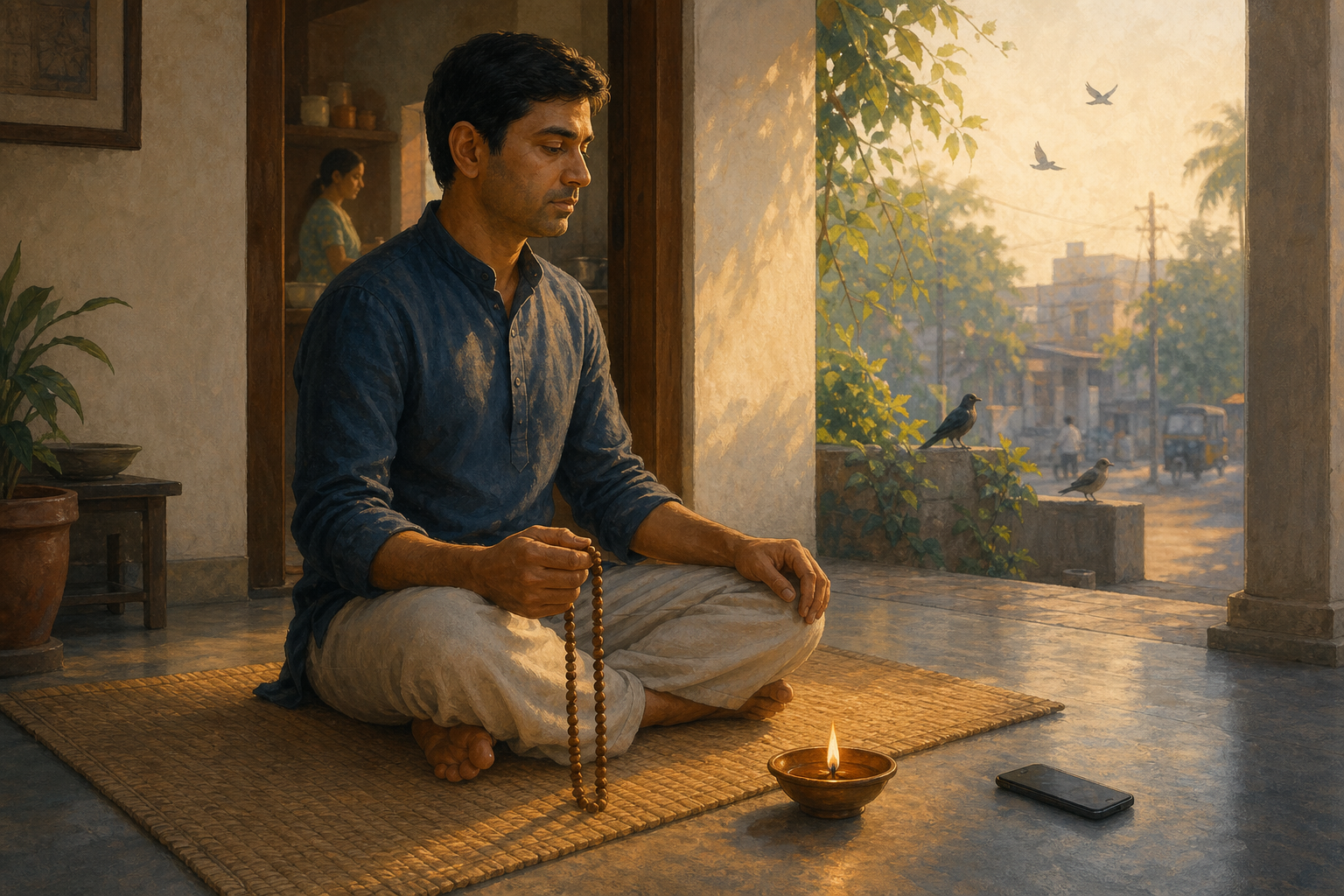
You sit down for japa, meditation, svadhyaya, or quiet prayer. A notification appears. A remembered argument follows. Soon the body is still but attention is moving from object to object, obeying every invitation it receives. The difficulty is not a lack of spiritual intention. It is that intention has not yet been supported by disciplined intake.
Dharmic restraint gives you a practical answer. You do not have to hate the senses, silence every thought, or withdraw from ordinary responsibilities. You train yourself to notice an impression without automatically pursuing it, to hear another person without preparing an attack, and to pause before turning an impulse into action. That small interval is where attention becomes freedom and restraint becomes dharma.
Key takeaways for daily practice
- Govern sensory intake before demanding greater concentration from yourself. Notifications, media, conversation, and visual clutter all compete for the same attention you bring to sadhana.
- Restraint is not suppression. Its purpose is to separate contact from compulsion so that you can choose whether, when, and how to respond.
- Use breath-led pratyahara to collect attention, then direct that attention toward japa, contemplation, study, work, or careful listening.
- Carry inward restraint into speech. Truth should be joined with benefit, gentleness, patience, and non-harm.
- Judge the practice by conduct after the session: whether you recover attention more readily, listen more accurately, and act with less haste.
Restraint is freedom from compulsion, not rejection of life

Pratyahara is the fifth limb of Patanjali’s Ashtanga Yoga. It stands between the outward-facing disciplines of yama, niyama, asana, and pranayama and the inward disciplines of dharana, dhyana, and samadhi. Its position matters. Stable concentration is difficult when the senses remain trained to chase every novelty, while ethical intention is fragile when every impression can provoke immediate action.
Withdrawal, in this setting, does not mean that sounds disappear or that you become indifferent to the world. A sound can be heard without becoming a story. A sensation can be felt without demanding an adjustment. A thought can arise without acquiring authority. The senses continue to function; what weakens is their power to drag awareness from one object to another.
You can observe this mechanism in an ordinary moment. A phone lights up. That is contact. Curiosity and bodily tension appear. That is the pull. You unlock the screen without deciding to do so. That is compulsion. Pratyahara works in the interval between the pull and the automatic movement. It gives discernment time to ask whether this object deserves your attention now.
The principle has close counterparts throughout the Dharmic family. Buddhist indriya-samvara disciplines the sense faculties. Jain gupti and samiti bring restraint and carefulness into thought, speech, movement, and conduct. Sikh simran keeps remembrance present amid activity, while sehaj points toward an unforced steadiness. These are not interchangeable doctrines, but they share a practical insight: a person who cannot govern attention remains vulnerable to craving, aversion, haste, and manipulation.
Start by examining intake rather than blaming concentration. Notice what repeatedly captures you, the state in which it catches you, and what happens afterward. The important distinction is not simply between a screen and a scripture, or between noise and silence. Even spiritually themed media can scatter the mind if you consume it compulsively. The useful question is whether an input leaves you clearer and more capable of right action, or merely hungry for another input.
The older idea of ahara can therefore be applied beyond food. Media, imagery, argument, and conversation are also forms of intake. Reducing nonessential notifications is a modest contemporary vrata because it changes what enters attention before it becomes a demand. This is environmental support for discipline, not a substitute for discipline itself.
Build concentration from the outside inward

Do not begin by ordering the mind to be blank. Begin with conditions the mind can actually inhabit. Choose a stable seat, remove avoidable interruptions, and decide beforehand what collected attention will serve. If you have no chosen direction after withdrawing from distraction, the strongest available stimulus will usually reclaim you.
- Protect the interval. Silence nonessential alerts and place the device outside immediate reach. Let people who genuinely depend on you know when you will be available.
- Settle without forcing. Sit comfortably with a soft or half-lowered gaze. Allow natural breathing for one to two minutes. Feel the contact of the body with the seat and ground.
- Let the exhale quiet the pull outward. Lengthen it gently, without strain or breath retention. Specialized pranayama patterns, alignment, and pacing are best refined with a competent teacher.
- Receive sensations without following them. Sounds, bodily feelings, and thoughts may continue. Acknowledge each one without evaluation, then return to the breath. Success is the return, not the disappearance of experience.
- Rest in inwardness. Continue the breath-led withdrawal for three to five minutes, then spend a final minute without adding another technique. Close with an intention of kindness.
- Give the collected mind a worthy object. Move directly into japa, dharana, contemplation, scripture study, careful work, or a conversation that deserves full attention.
This brief progression from breathing to sensory non-pursuit is deliberately modest. Restlessness at the beginning is normal. If attention leaves the breath repeatedly, repeated return is the training. Adding force because the mind wandered only turns the practice into another struggle for stimulation.
Consistency matters more than making a session dramatic. Abhyasa develops when the sequence is repeatable on an ordinary day, not only when conditions are ideal. With practice, you may still hear the traffic, feel discomfort, or remember unfinished work, but those events need not seize the entire field of awareness.
Pratyahara also needs a clear ending. Open the eyes fully, notice the room, and re-enter the next activity deliberately. If withdrawal makes you incapable of attending to a child, colleague, elder, or duty, it has not yet become mature restraint. The purpose is freer engagement with life, not permanent retreat from it.
Make speech the test of your inward discipline

Attention becomes ethical when another person is in front of you. You may sit quietly in meditation yet remain captive to the urge to interrupt, correct, display knowledge, or deliver the last word. Speech exposes whether restraint has moved from posture into character.
The Hindu sequence of shravana, manana, and nididhyasana offers a useful order: hear, reflect, and contemplate deeply. It warns against converting the first fragment you hear into an immediate verdict. The Bhagavad Gita’s discipline of speech joins truthfulness with benefit and gentleness. Ahimsa does not require you to conceal truth, but it does require attention to the way truth is used.
- Pause before forming the reply. Feel a natural breath and notice whether the body is preparing to defend, dominate, or escape.
- Ask for the center of the concern. A useful question is: What matters most to you about this? It moves the exchange from competing assertions toward the issue underneath them.
- Paraphrase before evaluating. State what you believe the person means and let them correct you. Agreement is not required; accurate hearing is.
- Test the intended sentence. Ask whether it is true, beneficial, gentle enough to be heard, and necessary to the situation. If it fails, revise it or remain silent until you can speak more responsibly.
- Answer the actual concern. Do not use a minor factual error as an excuse to avoid the person’s central fear, grievance, or request.
Buddhist Right Speech strengthens this test by rejecting false, divisive, harsh, and idle speech. Jain anekantavada adds epistemic restraint: your description may reveal a facet of reality without exhausting the whole. Sikh Suni-ai treats deep listening as transformative rather than passive. Together, these disciplines show why listening, silence, and ethical speech belong to the same sadhana.
Anekantavada should not be reduced to the claim that every opinion is equally correct. Its practical demand is humility about the limits of your standpoint. During disagreement, ask what part of the other person’s experience your account does not yet explain. You can reject a false conclusion while still recognizing the fear, memory, value, or partial observation from which it arose.
Mauna also needs ethical limits. Silence is not automatically wise. It becomes adharma when it is used to punish someone, evade a needed answer, hide wrongdoing, or make another person carry the whole burden of a relationship. Mindful silence creates room for truth; manipulative silence withholds relationship and responsibility. The outward appearance may be similar, so judge the silence by its intention and effect.
The same restraint applies online. Before posting, check whether you have understood the claim you are answering, whether your words would remain fair without an approving audience, and whether the exchange needs another assertion at all. A slower response can be sadhana when the delay is used to understand and refine. It is merely avoidance when you never return to a responsibility that requires an answer.
Know whether restraint is actually maturing

Do not judge practice by how empty the mind felt. A quiet session can be pleasant without changing conduct, while a restless session can strengthen the capacity to return. The more reliable evidence appears after contact with inconvenience, desire, praise, criticism, noise, and disagreement.
- Attention returns more willingly. Distraction still occurs, but you spend less effort negotiating with yourself before returning to the chosen object.
- An impulse is no longer an order. You can feel curiosity, irritation, or appetite without assuming it must be satisfied immediately.
- Perception becomes more precise. You hear tone, notice bodily tension, and detect changes in your own intention instead of becoming numb to experience.
- Speech carries less residue. You are less likely to replay a conversation because you spoke merely to discharge anger or protect status.
- Re-engagement remains available. After silence or solitude, you can return to people and duties with steadiness rather than resentment.
Watch for distortions. Severe restriction can become another form of ego if you take pride in being purer than people who use ordinary media or enjoy ordinary pleasures. Silence can conceal fear of conflict. Withdrawal can become an excuse for neglecting seva, livelihood, family, or civic responsibility. A practice that consistently makes you brittle, contemptuous, or unavailable needs correction in method and intention.
At the end of the day, review a moment when attention was captured. Identify what entered through the senses, the impulse it produced, and the action that followed. Then locate the smallest point at which a pause was possible. That is where tomorrow’s practice belongs.
Begin before the next avoidable interruption rather than waiting for the next perfect meditation. Remove one needless demand on attention, sit through the brief breath-led sequence, and carry the resulting pause into your next conversation. Restraint becomes real when it helps you meet the world with greater accuracy, responsibility, and care.
References
- DharmaRenaissance Blog – Speak Less, Hear More: Dharmic Wisdom on Silence, Empathy, and Transformative Communication
- DharmaRenaissance Blog – Pratyahara in Hinduism: Mastering Sensory Withdrawal for Profound Calm and Clarity
