
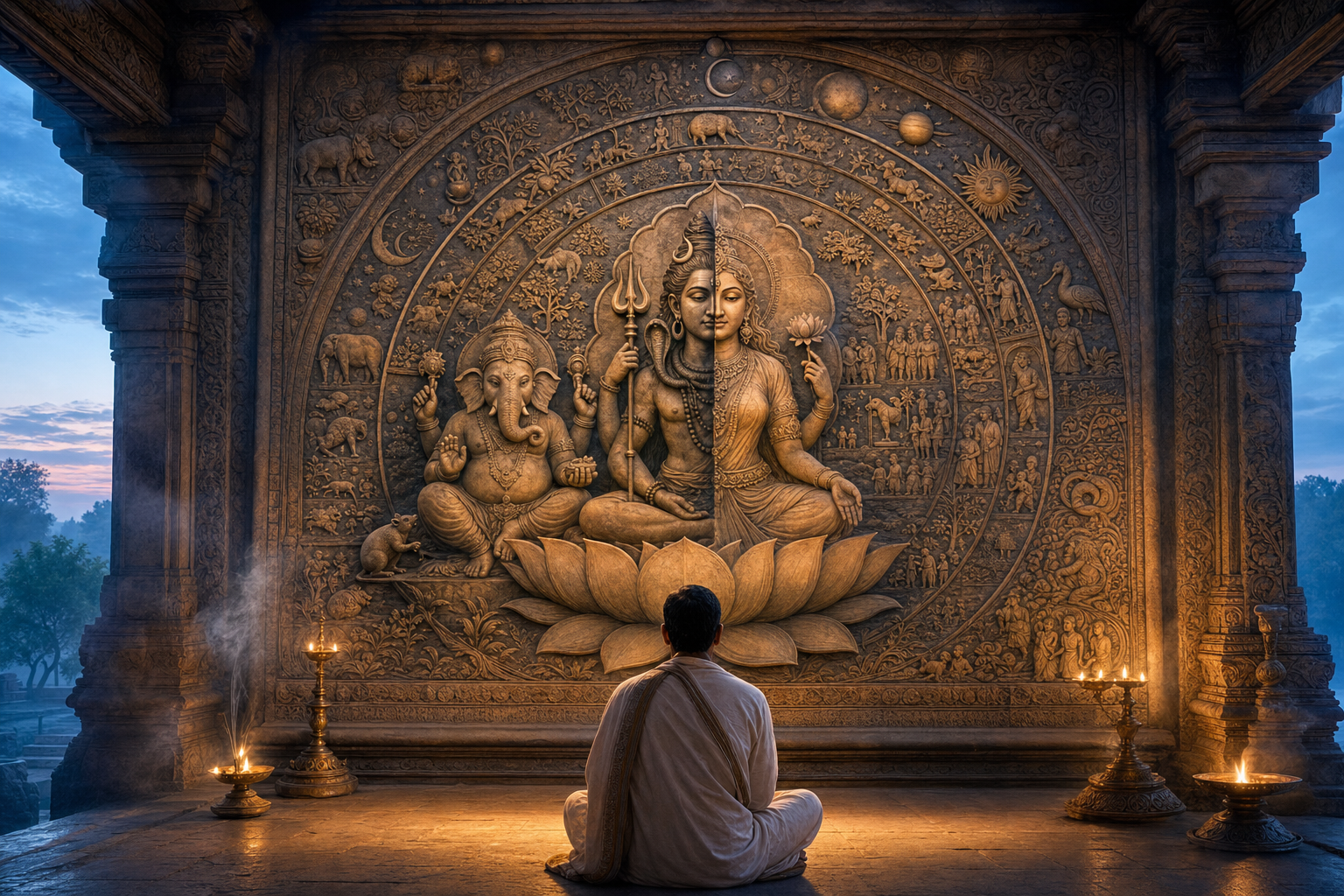
You are standing before a mūrti or reading a Purāṇic account, and a fair question arises: should you take this literally or symbolically? An elephant-headed deity rides with a mouse. A divine form is half Shiva and half Parvati. Sages emerge from Brahmā’s thought, breath, thumb, touch, and hand. What kind of truth is being communicated?
You do not have to choose between reverence and interpretation. Hindu sacred forms can sustain devotion, express a cosmic principle, and teach you how to live at the same time. The useful question is not whether an image or narrative is only symbolic. It is: what relationship does the symbol disclose, and what should you notice or do because of it?
A symbol is not a polite word for something unreal
Calling a deity symbolic can become a way of dismissing the deity: Ganesha is reduced to intellect, Saraswati to education, and Durga to confidence. That is not symbolic theology. It is compression. It strips a sacred form of personality, worship, narrative, and theological depth until only a modern psychological label remains.
The opposite error is to treat every feature as decorative or every narrative sequence as a report of ordinary physical events. That misses the precision with which Hindu iconography joins form, function, relationship, and spiritual discipline.
A more faithful reading allows several levels of meaning to remain active:
- Devotional: Who is being approached, praised, remembered, or served?
- Theological: What aspect of divine reality is this form making intelligible?
- Cosmic: What process of creation, preservation, transformation, law, time, or energy is being shown?
- Ethical: Which power must be cultivated, restrained, or directed toward dharma?
- Contemplative: What does the image help you observe within consciousness, breath, desire, action, and relationship?
These levels need not compete. The theological meaning prevents psychology from swallowing the deity; the ethical meaning prevents theology from remaining abstract; and devotion prevents interpretation from becoming an exercise in intellectual possession.
Consider Ardhanarishvara, the integrated form of Shiva and Parvati. You can contemplate still awareness and active energy, or spaciousness and creative manifestation, without declaring that Shiva and Parvati are nothing more than those concepts. The form holds difference within unity. It does not erase either member of the relationship.
The familiar comparison with yin and yang can help a newcomer recognize complementarity, but it should remain a comparison. It is not proof that two traditions teach an identical metaphysics. Use a cross-cultural parallel to open the door, then return to the names, relationships, practices, and theological setting of the Hindu form itself.
Read the whole sacred composition, not an isolated object
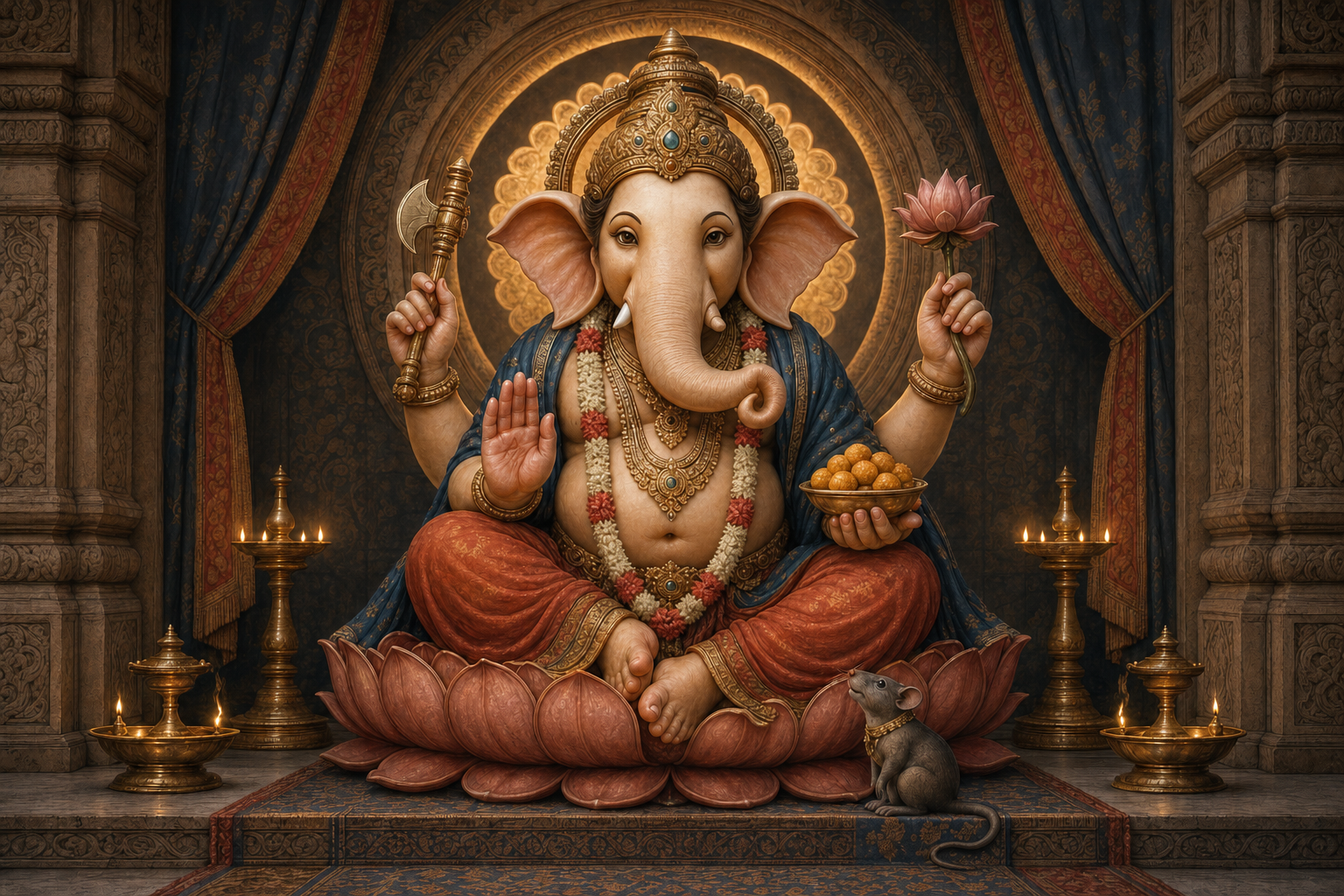
A mūrti is not a bag of symbols waiting to be decoded one by one. Its meaning often resides in relationships: the deity and the vahana, stillness and movement, a weapon and the hand that holds it, power and the purpose governing that power.
When you encounter a sacred image, begin with what is actually present. Ask:
- What is the deity doing rather than merely possessing?
- Which figure is active, still, elevated, seated, watching, or being guided?
- What relationship connects the deity to a consort, attendant, animal, or vehicle?
- Does the image place raw power under discipline, or bring still awareness into creative activity?
- Is this a regional or sectarian form whose local context must be respected before assigning a universal meaning?
This relational method is especially useful with deities and their vahanas. A vahana is not merely divine transportation. The pairing can show how consciousness bears, governs, refines, or employs a force of nature.
Ganesha and the mouse offer a clear example. The mouse can suggest quick, penetrating, restless movement: much like attention darting from one desire or distraction to the next. Ganesha’s composed presence shows that this energy need not be hated or destroyed. It can be directed by discernment. If you contemplate this pair before study or work, the practical question is precise: which distraction must be placed under intelligent direction before you begin?
Shiva and Nandi present another kind of relation. The bull’s strength is joined to patience, fidelity, and an unwavering orientation toward the divine. The lesson is not that force is impure. It is that force becomes trustworthy when it is steady and answerable to dharma. Before exercising authority, ask whether your strength is serving a rightful purpose or merely reacting to wounded ahankara.
Durga with the lion or tiger shows courage governed by protective compassion. Lakshmi with the owl joins prosperity to foresight, especially the ability to perceive dangers that remain hidden in favorable circumstances. Saraswati with the hamsa presents discernment as essential to learning. Kartikeya with the peacock turns brilliance and pride toward disciplined valor rather than display. In each case, the animal’s quality becomes intelligible through its relationship with the deity.
Do not turn these associations into a rigid dictionary. Lakshmi may appear with an owl in one setting and with elephants in another; forms of Devī may be accompanied by a lion or a tiger. Variation is a signal to examine region, narrative, and ritual context. It is not automatically a contradiction, and it does not authorize you to assign whatever meaning happens to feel attractive.
Ardhanarishvara requires the same care. The form can disclose the interdependence of consciousness and Shakti, but it should not be conscripted into a crude hierarchy of men over women, women over men, or one human personality type over another. Its composition points toward integrated reality: distinction without alienation and unity without sameness.
Creation narratives map the emergence of an ordered cosmos

Purāṇic creation accounts often become difficult when you expect them to answer only the modern question, “How was physical matter manufactured?” Their field of concern can be wider. A world is not complete merely because objects exist. Consciousness, life, agency, discernment, relation, sacrifice, and ethical order must also become possible.
Śrīmad-Bhāgavatam 3.12.23 gives a compact example through the emergence of sages from distinct aspects of Brahmā. Read symbolically, the bodily origins are not random anatomical details. Each origin invites you to connect a faculty with a form of sacred responsibility.
| Sage | Origin in the narrative | Symbolic theological reading | Question for practice |
|---|---|---|---|
| Nārada | Brahmā’s deliberation or highest intelligence | Devotional wisdom emerges from purified consideration rather than mental noise | Have you examined the intention behind the action you are about to take? |
| Vasiṣṭha | Breath | Wisdom requires the sustaining rhythm of life and presence | Is your mind steady enough to respond, or are you acting from agitation? |
| Dakṣa | Thumb | Skill, competence, and effective agency belong within cosmic order | What ability must you develop before accepting this duty? |
| Bhṛgu | Touch | Discernment arises in contact, relationship, and sensitivity | What can you learn by attending to the effect your conduct has on another being? |
| Kratu | Hand | Intention becomes sacred action through discipline and sacrifice | What concrete act will embody the value you claim to hold? |
These are interpretive readings, not exhaustive definitions of the sages or a claim that every Hindu lineage must gloss the verse identically. Their value lies in the coherence they reveal. Thought, breath, skill, contact, and action are presented as differentiated capacities within one creative order.
The sequence also gives you a way to audit your own conduct. Deliberation without vitality remains inert. Energy without discernment becomes erratic. Skill without ethical relation becomes manipulation. A declared value without the hand’s disciplined action remains a wish. Creation, read inwardly, is the continuing work of bringing these faculties into dharmic alignment.
When you meet another unusual birth or creation episode, do not begin by asking what every character secretly “stands for.” First identify the structure:
- From whom or from what does the being emerge?
- Which faculty, body part, element, sound, emotion, or action is involved?
- What role does the emerging being perform in the wider narrative?
- Why might that role belong with that origin?
- Does the sequence move from awareness toward manifestation, from disorder toward order, or from capacity toward duty?
That final relationship matters more than an isolated word association. A hand does not have one permanent meaning in every story. Its significance here becomes clearer because Kratu is connected with sacrificial and disciplined action.
Use a disciplined method, then test the result against dharma

A repeatable reading practice
You can use the following process with a temple image, calendar art, a Purāṇic passage, or a story heard in satsang:
- Observe before interpreting. Record the figures, objects, gestures, directions, vehicles, and actions actually present. Do not begin with what you assume the image must mean.
- Locate the relationship. Replace the weak formula “X equals Y” with a verb: awareness steadies energy; discernment directs restlessness; courage protects; wisdom governs prosperity; intention becomes action.
- Read outward and inward. Ask what cosmic principle is displayed and what corresponding tendency you can recognize in your own conduct. Keep both readings available.
- Preserve the deity’s integrity. Phrase the insight as something the form reveals, not as the total definition of the deity. Ganesha can teach mastery of distraction without being reduced to a productivity technique.
- Check the traditional setting. Look for the relevant narrative, regional form, sectarian theology, and ritual use before treating an association as universal.
- Choose one embodied response. Let the contemplation produce a specific discipline: remove a distraction, steady the breath before speaking, use resources generously, listen more carefully, or place strength in service of someone vulnerable.
A simple written template keeps the exercise honest:
- At the visible level, I observe…
- The central relationship is expressed by the verb…
- At the cosmic level, this can illuminate…
- In conduct, it asks me to…
- The traditional context I still need to verify is…
The final line is important. It marks the boundary between contemplation and unsupported certainty. Symbolic interpretation can deepen study, but intuition alone does not establish what a lineage, temple, or scripture teaches.
Mistakes that produce shallow readings
- Reduction: Saying a deity is “really just” a natural force, social category, or part of the brain. This treats one interpretive level as the whole truth.
- Arbitrary association: Assigning meaning from personal preference without attending to narrative function, traditional context, or the composition of the image.
- Moral inversion: Using divine power to sanctify pride, cruelty, domination, or impulsive anger. A sound reading should orient power toward responsibility, restraint, protection, seva, or ahimsa.
- Mechanical dictionaries: Assuming an animal, color, body part, or weapon must mean exactly the same thing in every form and region.
- Flattened Dharmic unity: Treating similar themes in Hinduism, Buddhism, Jainism, and Sikhism as proof that the traditions are interchangeable.
Dharmic comparison is strongest when it preserves distinctions. The Buddhist Middle Way, Jain anekāntavāda, and the Sikh integration of miri and piri can each illuminate balance, disciplined plurality, or the relation between spiritual and temporal responsibility. They are resonances, not alternate names for Shiva and Shakti. Unity becomes meaningful when it allows every tradition to speak in its own grammar.
The ethical test is equally important. A symbolic reading should make you more accountable, not more impressed with your cleverness. If your interpretation of Durga glorifies aggression without protection, of Lakshmi glorifies accumulation without stewardship, or of Shiva glorifies withdrawal without responsibility, return to the full composition. You have probably isolated one power from the divine relation that disciplines it.
Key takeaways for your next encounter with sacred imagery
- Symbolic meaning does not make a deity unreal; it articulates what the sacred form reveals.
- Keep devotional, theological, cosmic, ethical, and contemplative meanings in conversation rather than forcing one to replace the others.
- Interpret relationships before isolated objects: deity and vahana, awareness and energy, faculty and action.
- In creation narratives, examine origins and sequences as carefully as characters. They often connect capacities of consciousness with responsibilities in the cosmos.
- Use verbs rather than equations. Discernment directs restlessness is more faithful and useful than mouse equals desire.
- Regional and sectarian variation calls for context, not a universal symbol dictionary.
- A responsible interpretation should issue in dharmic conduct while preserving the mystery and integrity of the divine form.
At your next darśana or scriptural reading, choose one relationship rather than trying to decode everything. Observe it closely, name the action joining its parts, consider both its cosmic and ethical reach, and verify the context you do not yet know. Then carry one corresponding discipline into your day. Sacred symbolism becomes living theology when it refines attention and conduct without shrinking the deity to an idea.
References
- DharmaRenaissance Blog — Śrīmad-Bhāgavatam 3.12.23: Nārada’s Birth, Timeless Symbolism, and Dharmic Unity
- DharmaRenaissance Blog — Shiva–Parvati as Yin–Yang Archetypes: A Timeless Guide to Balance, Unity, and Grace
- DharmaRenaissance Blog — Hindu Gods and Their Vahanas: Timeless Symbolism, Deeper Meaning, and Dharma in Daily Life
